Apr 13, 2011

Benghazi hospitals struggle to treat war-wounded

An injured man waits to be operated on in a Benghazi hospital. He was shot by pro-Gaddafi forces while fighting on the frontline at the beginning of March
BENGHAZI, 13 April 2011 (IRIN) - Al Hawari hospital may be the most modern medical centre in the eastern Libyan city of Benghazi, but the large number of war wounded it has received in the last two months has stretched its limited resources.

"When the fighting began, most of the injured - both civilians and soldiers - were transferred here," said the hospital's senior medical officer Fabri El Jroshi. "We were missing a lot of important equipment to treat them, and we still are. We need material for fractures and fixtures and we badly need more nursing staff.

"Sometimes patients will find a doctor here, but no equipment for fixing a broken bone."

The 500-bed hospital has received 800-1,000 patients with war-related problems, El Jroshi told IRIN. "Providing physical therapy is also difficult. Again, we just don't have the equipment. Even before the conflict we had problems treating certain groups of patients, especially in the orthopaedic field."

Médecins Sans Frontières (MSF) emergency coordinator for Libya Simon Burroughs said: "All the doctors and medical staff that we've met in Benghazi, Brega and Ajdabya are incredibly skilled and dedicated. Although doctors are coping, many foreign nurses working in eastern Libya have now fled, leaving gaps in many health facilities. Medical students are doing their best to fill some of the gaps."

At one point, MSF left Benghazi after the security situation deteriorated. It is now back and has so far provided more than 30 tons of medical supplies to different hospitals, including surgical kits and equipment required for the treatment of gunshot wounds.

“On a more global level, we are struggling to get a clear picture of the needs as the security situation does not allow us to undertake even some basic assessments," Burroughs added. "When we tried to reach the town of Ras Lanuf - 300km west of Benghazi - we had to turn back twice because of fighting and insecurity.”

Transferred to Qatar

The most severely war-wounded patients have been transferred from Benghazi's hospitals to medical facilities in Qatar. Benghazi doctors are also having to deal with cases which were rare previously, like rape and paralysis.

Twenty-six-year-old Abdusalam* was admitted to the hospital last week, after being hit by a NATO strike that unintentionally targeted a group of rebel fighters heading for the frontline near Ajdabiya. He fractured his thigh and sustained bullet wounds to the lower chest. His mother and sister were not aware he was a rebel fighter, he said.

"My mother is sick and I didn't want to worry her. My father and brothers are proud of me though… We saw NATO planes flying above us and then suddenly, for no reason, they started to strike us… Before the revolution began, I was sitting behind a desk. I was an employee in an office. Once my body heals, I hope to go back to the frontline," he told IRIN.


Photo: Kate Thomas/IRIN
The mood in Benghazi remains defiant, despite little progress by the rebel fighters
"I would like to go to the frontline too, but I have a job. And treating the injured is just as important," El Jroshi said.

Shortage of nurses

Nursing resources are stretched. According to the International Organization for Migration, several hundred Filipino nurses have left eastern Libya since the unrest began.

Jeanette Calo is one of those who decided to stay. A Filipino nurse who left Manila for Benghazi a year ago, she said there was a shortage of nurses. Seventy of her colleagues at the Al Hawiya hospital have returned to the Philippines.

"I decided to stay because it is my job to be here to care for the patients, especially the rebel fighters injured on the frontline. I had no experience treating gunshot wounds previously, so I had to learn quickly."

For two weeks, at the worst point, the nurses slept at the hospital. "We worked 24-hour shifts, waiting for the injured to arrive," she told IRIN. "Things are better now but we are still lacking some equipment, and we have to work extra hard to make up for the loss of so many nurses."

Calo added that some of her Filipino colleagues were visiting Tripoli when the unrest began. Unable to return home to Benghazi, they were instead recruited by a Tripoli hospital that paid higher wages, she said.

One stethoscope

At the El Jalaa hospital on the other side of Benghazi, the situation is worse. Dr Nishal El Fayah said that although stocks of medicine are sufficient, there was a severe shortage of some medical supplies.

''On one of the wards, which has 38 beds, there is only one stethoscope and one blood pressure monitor…Recently we received a patient who had hepatitis. In order to ensure that the equipment was not contaminated, we decided not to monitor his vital signs.''
"On one of the wards, which has 38 beds, there is only one stethoscope and one blood pressure monitor," he said. "Recently we received a patient who had hepatitis. In order to ensure that the equipment was not contaminated, we decided not to monitor his vital signs."

Medical students, many of whom have been working unpaid at the hospital since the conflict began, have not been able to buy uniforms or appropriate footwear. "The shops are closed, so they have to go around in their old shoes," he said.

Occupying one bed was Younis Abdousalam Edbeshi who was shot by pro-Gaddafi forces while fighting at the beginning of March.

Another patient, Ed Beshi, who fractured his left thigh, was being treated for gunshot wounds, but could not be operated on due to a shortage of medical supplies.

"I was told to go home and return in a few weeks… The hospital didn't have the supplies to help me. I was hoping to be back on the frontline supporting the other rebels, but I'm still here, waiting for an operation… It is frustrating, but the hospitals here were just not ready for war casualties."

Misrata

Although Benghazi's hospitals lack supplies, aid workers say needs are greater in the city of Misrata, where doctors at the polyclinic there have recorded 257 deaths since 19 February, mostly civilians killed by snipers or gunfire. The polyclinic said 949 people had been treated for wounds.

According to Human Rights Watch, Misrata's main hospital had been under construction for the last two years, meaning that the seriously injured have been treated at the polyclinic instead.

"All over Libya, hospitals close for construction, often for several years," Fouad El Mabrouk, a doctor at Benghazi's El Jawaa hospital, said. "Under the Gaddafi regime, construction would begin and then the funds would dry up. Libya has many hospitals that could have been excellent centres for medical treatment, if only construction had been completed.”

Some of those injured at Misrata are being brought by ship to Benghazi.

"We never know who or what to expect," said paramedic Mohammed Nour. "So we have to be prepared for the worst. All we receive is a call saying that a vessel is about to dock at the port, and we get straight down there. Sometimes we have to deal with complicated injuries. Other times, fortunately, cases are much less serious."

*not a real name

kt/eo/cb
Enhanced by Zemanta

Winds of change in Sarawak?

Pehin Sri Haji Abdul Taib bin Mahmud, Chief Mi...Image via Wikipedia
Taib

April 13th, 2011 by Greg Lopez · 1 Comment

While the ruling Barisan Nasional (BN) coalition has dominated politics in Sarawak over the last four decades, significant changes have been taking place in the state that could weaken BN’s control. A key development in recent years is the ascendancy of nationally based parties such as the Democratic Action Party (DAP) and the Parti Keadilan Rakyat (PKR) within the opposition forces in Sarawak. Another significant change is the swing in Chinese support from the ruling party to the opposition. These developments together with the emergence of a Dayak intelligentsia sharply critical of the ruling elite will enable opposition forces to provide a credible challenge to the BN in the forthcoming Sarawak state assembly elections. This paper details how opposition forces will fare in the elections. It also discusses the issue of succession to Taib, who has been Chief Minister for thirty years, and outlines key developments in the ruling state coalition since the 1960s that led to the rise of Parti Pesaka Bumiputra (PBB) as the dominant party in the BN coalition.
- Extracted from Faisal S. Hazis, “Winds of change in Sarawak politics?”,   S. Rajaratnam School of International Studies, 24 March 2011.

1 response so far ↓

  • 1 Moses // Apr 13, 2011 at 4:32 pm
    Noting that Dr Faisal’s article was written in March, before the close of nominations, a key point that needs to be mentioned is the number of three-cornered fights there will be between BN, SNAP and PKR. PKR and SNAP’s inability to come to a satisfactory seat allocation arrangement and subsequent public bickering will hurt the opposition both by splitting the opposition vote (in close to 30 seats), and by giving the impression of a fractured opposition unready to assume government. That means little in the Chinese seats of course, where one would expect the DAP to have some success if the Sibu by-election is any guide. But that won’t be enough to win the opposition any more than about half a dozen seats more than it already holds.
    Winds of change? Only to the extent of the succession to Taib’s leadership…
    Quality comment or not? Thumb up 0 Thumb down 0
Enhanced by Zemanta

Timor-Leste security handover on track, says UN

Policing responsibility was handed over to the Timorese in March 2011
BANGKOK, 12 April 2011 (IRIN) - Timor-Leste is on course to take on full security responsibilities after national forces officially assumed policing at end-March, according to the UN.

The situation is now stable, Gyorgy Kakuk, a spokesman for the UN Integrated Mission in Timor-Leste (UNMIT), told IRIN. Presidential elections are expected to be held in May 2012, following which the UN is scheduled to depart.

"The UN and the government are working closely together to plan UNMIT's withdrawal from Timor-Leste at the end of 2012," Kakuk said.

The process is being led by a high-level committee, including President Jose Ramos-Horta, Prime Minister Kay Rala Xanana Gusmão and Special Representative of the UN Secretary-General, Ameerah Haq.

More than 1,400 uniformed personnel in the UN police have been working in Timor-Leste since the government requested help during the 2006 political crisis, when civil conflict broke out in the former Indonesian colony, displacing 155,000 people and destroying 3,000 homes, according to the UN.

Crime rates have fallen by 20 percent in the past year, Kakuk said. At present, 80 percent of all crimes against people are domestic violence-related, and the most pervasive petty crimes are those of opportunity, such as pick-pocketing and theft, which are attributed to high poverty levels, the Overseas Security Advisory Council of the US stated in a 2011 report

Where the money is

But while UNMIT remains confident in its gradual phase-out, others worry about the possible economic implications.

In a 2010 country report, the Organization for Economic Cooperation and Development (OECD) said after the departure of UN forces when Timor-Leste became a sovereign nation in 2002, there was "a sharp contraction in the local economy".

The UN pumps roughly US$20 million in annual salaries into Timor, according to a 2010 International Crisis Group (ICG) report

In addition, UN staff spending contributes to approximately 10 percent of the economy, reports the Asian Development Bank (ADB) in the 2011 Asian Development Outlook.

While the ADB says the phase-out will potentially exacerbate the poverty of the estimated 41 percent of Timorese who live on less than $1 per day, other sources say the half-island nation is well supported by oil money and the UN presence has had an inflationary impact on local wages and distorted local salaries.


Photo: UN Photo/Eskinder Debebe
UNMIT is expected to leave at the end of 2012
"Our petroleum wealth provides more than we need. The UN, if anything, has had a negative distorting influence on our economy and society. Its highly paid international staff pushes up the prices of everything from accommodation to everyday consumables," Jose Texeira, a member of parliament with the main opposition party Fretilin, told IRIN.

At the end of 2010, Timor-Leste's Petroleum Fund, set up in 2005, had $6.9 billion in offshore investments, a figure that is expected to exceed $14 billion by 2015, with an annual income of more than $2 billion, the ADB reported.

However, Jim Della-Giacoma, ICG's Southeast Asia project director, says the country's economy should not factor into the UN's withdrawal.

"The handover is long overdue, it should have happened a year ago. It is a positive step now putting the responsibility and ownership on Timorese to maintain their own security," Della-Giacoma said.

Upcoming elections

Confidence has grown in electoral bodies locally and internationally because of the lack of political violence since 2006, despite strong opposing groups in parliament.

"By the time 2012 comes around, we would have had two full parliamentary terms run from election to election, without a coup or irretrievable breakdown in democratic or constitutional rule," Teixeira said.

Timor's politics remains relatively peaceful, despite differences between the leading Alliance of the Parliamentary Majority, a four-party coalition, and opposing parties.

"They continue to channel these differences through established democratic institutions and processes," said Haq in a briefing to the UN Security Council on 22 February.

No social or political instability associated with the upcoming elections is expected, but more UN volunteers will be brought in "to support the electoral management bodies", Kakuk said.

"We believe that the institutional problems and political tensions that existed to create the 2006 crisis no longer exist," said Teixeira.

dm/nb/ds/mw
Enhanced by Zemanta

Apr 12, 2011

Japan rates nuclear crisis at highest severity level

Chernobyl Power PlantImage via Wikipedia
Chernobyl nuclear power plant
By Chico Harlan, Tuesday, April 12, 6:42 AM

TOKYO — Japanese authorities on Tuesday raised the severity rating of the nuclear crisis at the Fukushima Daiichi power plant to the highest level on an international scale, on a par with the 1986 Chernobyl disaster.

Officials from Japan’s nuclear agency reclassified the ongoing emergency from Level 5, an “accident with off-site risk,” to Level 7, a “major accident.” The reassessment comes at a time when the International Atomic Energy Agency says the plant is showing “early signs of recovery” but is still in critical condition.

At a news conference in Tokyo, Hidehiko Nishiyama, the chief of Japan’s Nuclear and Industrial Safety Agency, emphasized that radiation released from Fukushima amounted to one-tenth the total released from Chernobyl. But the plant continues to spew radiation, and at a separate news conference, an official from the Tokyo Electric Power Co. said that “our concern is that the amount of leakage could eventually reach that of Chernobyl or exceed it.”

The stark assessment reinforced the sense that this nuclear emergency ultimately will cause problems that exceed those first predicted by the government, which has downplayed long-term safety concerns and only Monday expanded its mandated 12-mile radius evacuation zone.

Still, the upgraded severity reading does not reflect a recent deterioration at the plant. Rather, it suggests Japan’s evolving understanding of the damage that occurred there one month ago — and the contamination that has been leaking ever since.

“We are taking this extremely seriously,” Tokyo Electric said in a statement signed by its president, Masataka Shimizu. “We deeply apologize for tremendous concerns and inconvenience we are causing the residents in the neighboring areas of the power plant as well as people of [Fukushima] prefecture, and further, to the people of” Japan.

A Level 7 accident, according to the International Nuclear and Radiological Event Scale (INES), is typified by a “major release of radioactive material with widespread health and environmental effects.” That measuring scale was established by the IAEA some 21 years ago, but its guidelines leave plenty of room for interpretations, nuclear experts say.

According to the Kyodo News agency, Japan’s Nuclear Safety Commission issued a recent report claiming that the Fukushima plant, at one unspecified point after the March 11 earthquake and tsunami, had been releasing 10,000 terabecquerels of radioactivity per hour. A release of tens of thousands of terabecquerels per hour corresponds with the leakage level that the IAEA recommends as a minimum benchmark for a Level 7 accident.

“This corresponds to a large fraction of the core inventory of a power reactor, typically involving a mixture of short- and long-lived radionuclides,” an IAEA document says. “With such a release, stochastic health effects over a wide area, perhaps involving more than one country, are expected.”

Most radiation readings around Fukushima have been decreasing for several weeks now, but the plant still faces numerous risks. Thousands of tons of contaminated water has flooded key buildings adjacent to the reactors. Nitrogen gas is being injected into one unit to prevent another explosion.

In the meantime, the plant faces the constant threat of aftershocks, and on Tuesday a 6.2-magnitude temblor caused a brief fire at a building near Daiichi’s No. 4 reactor. Tokyo Electric said the aftershock did not interrupt the critical injection process used to cool hot fuel rods -- but there had been a 50-minute interruption one day earlier, the result of a 6.6-magntiude quake with an epicenter just 42 miles from the plant.

“Right now, the situation of the nuclear reactors at the Fukushima plant has been stabilizing step by step,” Prime Minister Naoto Kan said in a televised address to the nation. “The amount of radiation leaks is on the decline. But we are not at the stage yet where we can let our guards down.”

Though the Fukushima crisis now stands alongside Chernobyl on the INES event rating, experts note several important distinctions. No deaths have yet resulted from radiation leaked at Fukushima. At Chernobyl, a single reactor exploded, and a massive cloud of cesium, plutonium and strontium spread across Belarus, Ukraine, Russia and Europe. At Fukushima, workers have struggled to stabilize seven reactors and spent fuel pools, but so far the radioactive releases have come as byproduct of emergency cooling efforts, with the venting of radioactive steam and the leaking of contaminated water.

Technically, Japan’s reassessed severity rating applies to only three of Fukushima’s six units — Nos. 1, 2 and 3, which have all sustained core damage. Each of those units, on March 18, had been initially given a Level 5 rating. At the same time last month Japan gave a Level 3 rating to unit 4; that remains unchanged. The IAEA cautioned that Japan could still change its ratings as more information becomes available.

The latest reevaluation underscores the difficulty of measuring the amount of contamination released and the danger it poses. Rather than creating a hard “no-go” circle around the plant, the government has instead singled out five particular towns between 12 and 19 miles from the plant for mandatory evacuation. Residents there should leave within a month, the government said.

Those who stay are at risk of receiving more than 20 millisieverts of radiation in a year — the government’s baseline for evacuations. Exposure at that level doesn’t cause immediate sickness, but it raises risk for cancer and other long-term health problems.

Japan’s various nuclear regulatory groups have come up with widely differing numbers regarding the total contamination released into the environment.

The Nuclear and Industrial Safety Agency, for instance, says that 6,000 terabecquerels of cesium-137 have been released. Japan’s Nuclear Safety Commission, meanwhile, quotes a number twice that. Much of that contamination, though, was released in the first week after an earthquake and tsunami knocked out Fukushima Daiichi’s primary and back-up power supplies, stopping the cooling of the reactors’ cores.

“Monitoring data available shows that, in my view, the government probably knew around March 16, 17 or 18 that it would reach Level 7,” said Hironobu Unesaki, a professor at the Kyoto University Research Reactor Institute. “I just don’t understand why it took them so long to raise the level to 7. They were completely slow. ... Their response has been extremely regrettable. The government is being very careful not to cause unnecessary panic, but they are being too cautious.”

Special correspondent Akiko Yamamoto contributed to this report.

harlanc@washpost.com
Enhanced by Zemanta

Gaddafi hunkers down under sanctions, rebel economy struggles

Muammar al-Gaddafi at the 12th AU summit, Febr...Image via WikipediaBy Simon Denyer, Monday, April 11, 7:01 PM

TRIPOLI, Libya — Forced on the defensive on the battlefield, Libya’s rebels are also struggling in the economic war of attrition with Moammar Gaddafi, despite the backing of the West.

Global efforts to isolate Gaddafi and cut off his economic lifeline have put significant pressure on his government. But President Obama and other NATO leaders may find that sanctions do not bring Gaddafi to his knees as quickly as they would hope, if at all.

The panic that gripped the Libyan economy at the height of the crisis has substantially abated, and the government has implemented a series of measures to cope with the sanctions and the loss of hundreds of thousands of foreign workers.

The economic situation appears more chaotic in the rebel-held east, with the collapse of much of the public sector and the shuttering of oil production.

“In the long run, sanctions will be quite devastating,” said Mustafa Fetouri, MBA program director at the Academy of Graduate Studies in Tripoli. “But we have had this situation before, and we have the experience to deal with it.”

Keeping the economy afloat amid tight international sanctions is costly, and Finance Minister Abdulhafid Zlitni said in an interview that the government’s money might run out “in a few months.”

Nevertheless, the British-educated economist was optimistic that this would buy Gaddafi’s government enough time — to probe for gaps in the international community’s resolve, to find a compromise that keeps Gaddafi in power or just to persuade old friends to help.

“Just go back to history,” Zlitni said. “When sanctions were imposed in the 1990s, Africans just broke them. They came over here with their planes and their presents.”

The current sanctions are considerably tougher than those imposed by the United Nations in 1992 and 1993 because of Libya’s alleged role in the bombing of a Pan Am airliner over Lockerbie, Scotland.

Nevertheless, cracks are appearing in the global coalition to isolate Gaddafi, after the African Union proposed a peace plan this week that called for a cease-fire and dialogue but would seem to leave Gaddafi firmly in power. Gaddafi backed the plan, but the rebels rejected it.

“In the international arena, we are seeing a lot of interventions to find an end to this, and this is what makes me optimistic this is going to end soon,” Zlitni said.

The bite of sanctions

In the meantime, sanctions are clearly having an effect in the areas under Gaddafi’s control, though his government appears to have found a way to manage.

In Tripoli, fuel is being rationed to a tank a week, while cash withdrawals from banks have been capped at the equivalent of $400 a month. Interest rates will be doubled this week to attract money, much of which is traditionally kept at home, back into the banking system.

The government has increased public-sector salaries by 50 percent to encourage Libyans back to work to fill the gaps left by the exodus of a substantial proportion of the workforce.

That exodus left fuel pumps unmanned and bakeries, normally run by Egyptians, shuttered. But Libyans are gradually stepping in. The huge lines of a week ago at gas stations have all but disappeared, and bread shortages have eased after young women were enlisted to help. On the black market, the Libyan dinar shot up to 3 against the dollar, from 1.3 before the crisis, before pulling back to less than 2.

Hospitals are functioning, but many factories and shops remain closed, construction work has stalled, and imported foods are beginning to disappear from the shelves. The price of cooking oil has risen more than fourfold, as has the cost of a packet of spaghetti.

But Libya has more than a decade of experience living with, and subverting, sanctions. And the harder they bite ordinary people, the easier it will be for Gaddafi to blame the West, as he is doing with some success, Fetouri said.

Growing concern in east

In the east, the fighting and the temporary partition of the country have all but destroyed the economy. Most of the country’s oil comes from the east, but Gaddafi’s forces have worked hard to disrupt production, which has halted. Rebels shipped out a tanker of crude last week, with Qatar acting as middleman, but just two tankers worth of oil remain in stock.

The vast majority of Libyans in the east work in the public sector and were paid out of Tripoli before the fighting began. Rebels have managed to keep salaries coming, but money is running out. Electricity is cut off for two hours a day, and unless oil production resumes, the diesel needed to power the generators will run out within two to three months, officials say.

Across the rebel stronghold of Benghazi, city engineers, doctors, lawyers and businessmen sit at home and wait for the violence to end. Lines for bread and gas are lengthening.

Gaddafi loyalists retain control of Ras Lanuf, home to the country’s largest refinery, and there is continued fighting over the oil town of Brega. Rebels still believe they have the stronger hand economically as long as they control the border with Egypt and receive international support.

But for now, securing the oil fields “is our biggest source of concern,” said Ali Tarhouni, finance minister in the Transitional National Council, the self-appointed rebel government.

In Tripoli, Zlitni is trying to make a virtue out of a necessity, arguing that western Libya will just have to live without oil.

“Oil is not always a good thing. It is a depleting asset; one day it will stop,” he said. “If people don’t realize this and pull up their socks, there is going to be a disaster.”

Oil revenue has made many Libyans lazy, he said. “If you have children, sometimes you have to smack them to make them behave themselves. You don’t like to do it, but you have to.”


denyers@washpost.com

Correspondent Leila Fadel contributed to this report from Benghazi.
Enhanced by Zemanta

Hundreds of Libyan Berbers flee Western Mountains and head to Tunisia


News Stories, 12 April 2011

© UNHCR/P.Moore
People at the Libya-Egypt border tell UNHCR staff of displacement in eastern Libya, such as these people in the desert outside the town of Ajdabiya.

GENEVA, April 12 (UNHCR) – The UN refugee agency reported Tuesday that more than 500 Libyans, mostly ethnic Berbers, have fled their homes in Libya's Western Mountains and sought shelter in the Dehiba area of south-east Tunisia over the past week.

"They have told us that mounting pressure on the cities of the Western Mountains by government forces, lack of basic medical supplies and shortages of food prompted their departure," UNHCR spokesman Andrej Mahecic told journalists in Geneva.

He noted that Dehiba was located about 200 kilometres south of Ras Adjir, the border crossing where tens of thousands of people fleeing Libya since the conflict erupted in mid-February have entered Tunisia.

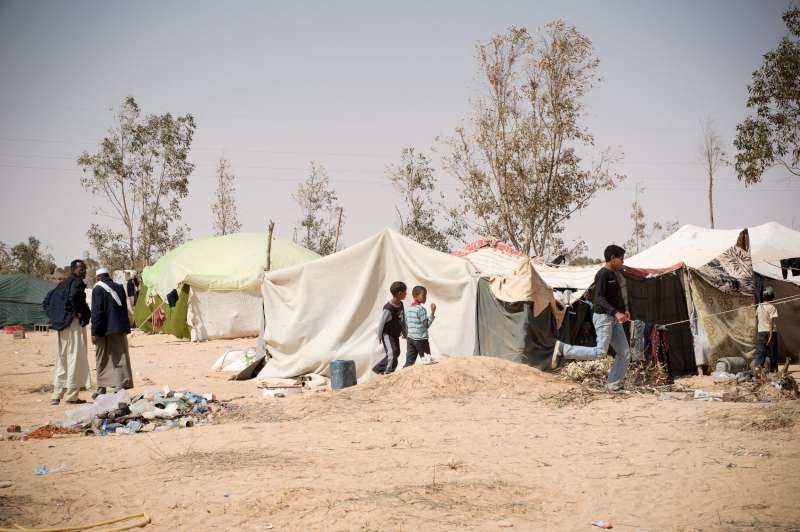
Mahecic said the new arrivals had very limited resources and "have significant humanitarian needs." The local authorities have allocated a sports field in Remada town, 45 kms inside Tunisia, where UNHCR has established a camp with 130 tents.

"Electricity and water have been connected and other services are being set up. UNHCR is working with a local partner Al Taáwon, and the Tunisian Red Crescent to rapidly provide support," the spokesman added.

The local community in Tunisia has offered considerable assistance, opening homes to hundreds of Libyan families. Youth hostels in Dehiba and the town of Tataouine further west are also being used to shelter families. A school near the camp in Remada has offered to take Libyan students.

Mahecic also said people crossing the Libyan-Egyptian border had given UNHCR field staff more details about displacement in eastern Libya between the towns of Ajdabiya and Tobruk, with thousands of families now in Benghazi and Tobruk. "While many are staying with local families, a small number are taking refuge in schools and empty buildings. People tell us they fear being trapped in Ajdabiya should government forces prevail," Mahecic said.

An estimated 1,200 displaced families are in Tobruk, where the Libyan Red Crescent is distributing aid supplied by UNHCR, mainly blankets and mattresses.

People also continue to flee Libya by sea to Italy and Malta. This morning, the Maltese armed forces came to the help of a boat carrying 116 people, including a dead woman, according to media reports. More than 1,100 people have arrived in Malta from Libya on five boats since March 26. In Italy, three boats carrying 1,008 people arrived on Lampedusa Island from Libya over the weekend, mainly Somalis and Nigerians. Since March 26, a total of 3,358 people have reached Italian territory from Libya.

Almost 500,000 people have fled Libya since mid-February, including some 200,000 to Egypt, 236,000 to Tunisia, more than 36,000 to Niger, about 14,000 to Algeria, 6,200 to Chad and 2,800 to Sudan.

Last Sunday, some 3,900 people crossed the Sallum border into Egypt, including 3,000 Libyans. "This is double the average number of Libyans that have crossed on a daily basis in the past few weeks," Mahecic noted, adding: "On the same day, 2,992 people crossed at Ras Adjir into Tunisia, including 2,173 Libyans." These numbers include some Libyans who are crossing for trade.
Enhanced by Zemanta

Apr 11, 2011

Migrants forced to fight for Gaddafi

'They said we must stay to fight when the Americans come,' a Ghanaian worker tells Al Jazeera from a refugee camp.
Last Modified: 09 Apr 2011 16:14
 
Many migrants from sub-Saharan Africa fled Libya when fighting began. Some say they were kidnapped and forced to fight alongside Muammar Gaddafi's forces [Anna Branthwaite/Al Jazeera]       

Among the reports of atrocities occurring in Libya are claims from African migrants that they were abducted and forced to fight with Gaddafi's forces.

Nearly all migrants from sub-Saharan Africa, who arrive at the desert refugee camp in Tunisia, have fled in fear of violent reprisals by Libyans who accuse them of being mercenaries. The extent to which Gaddafi's military has used foreign mercenaries, or press-ganged migrants into fighting, remains unclear.

A former Nigerian police officer, who had worked in Libya for eight years as a technician, alleges he was abducted in mid-March at a military checkpoint in Tripoli, along with other men from Ghana, Mali and Niger, before being taken to a military centre.
"There was up to 100 people in the courtyard and military trucks were arriving and leaving with more people. They started beating people, I saw them shoot one Ghanaian in front of me. The atmosphere was very intimidating," he explained. "They put us into a vehicle and we were driven into the desert. I saw an oil refinery, there was evidence of bomb strikes, burnt out vehicles and a strong smell. I think it was Ras Lanouf."
A Ghanaian worker claimed to have been abducted by Libyan military when they stormed his house in Sirte.
"They asked us why we were trying to leave the country and that we must stay to fight for when the Americans come," he explained. "We were taken to a police station and then to an underground hospital which they ordered us to clean."

Importing mercenaries

Reports of foreign mercenaries being shipped into Libya and shooting protesters emerged within the first weeks of the uprising.

"There's certainly evidence that Algeria sent pilots in before the no-fly zone and provided military transporters to move people, possibly mercenaries, maybe even equipment… but it is difficult to get them into the country," explains Jeremy Keenan, a professor specialising in the Maghreb who suggests that between 5,000 and 10,000 mercenaries may have entered Libya during this uprising, but that there is no concrete evidence.

"If you've got a million migrants milling around in Libya, mostly from sub-Saharan Africa, all paperless with no ID, I suspect he's using them, not Libyans, as human shields… the key thing is he (Gaddafi) has got them over a barrel, they can't leave," said Keenan. "I think the opposition people, when they bump into anyone fighting against them who is speaking another language and looks black, irrespective of how they got into Gaddafi's hands, they are using the word mercenary. There is a lot of confusion there."

Gaddafi has supported past Tuareg rebellions and allegedly backed candidates in recent elections in Niger, who may be beholden to support him.

Local African media have recently reported the recruitment and movement of young men into Libya, but others indicate that Tuaregs were recruited by the Libyan military several years beforehand. What is certain in recent weeks is that more people are leaving Libya than entering.

"Certainly Gaddafi uses mercenaries from abroad and from the foreign community in Libya. In Misurata, there are reports that the Africans are on the frontline, but the snipers are foreigners, mostly from Belarus, Eastern Europe," says Sliman Bouchuiguir, secretary-general of the Libyan League of Human Rights. "He has already used poor Africans as a political weapon against Europe saying he will let this African population go to Italy and Europe."

Gaddafi has used the specture of refugess flooding out of Libya into Europe as a reason why the West should allow him to remain in power [Anna Branthwaite/Al Jazeera]  

In an interview with French newspaper Le Journal du Dimanche, in February Gaddafi warned, "You will have the immigration of thousands of people who will invade Europe from Libya, and there will be nobody to stop them."

One million sub Saharan migrants, among them political refugees, are estimated to live in Libya, but there is virtually no documentation of the population. Many make the treacherous journey through the desert into Libya, either en route to Europe or to settle in oil rich Libya.

On entering Libya, thousands of migrants have been arrested and held in detention centres. Many of them are now escaping Libya and can speak openly about the appalling living conditions in the centres, torture resulting in scores of deaths, corruption, lack of legal and medical aid, all of which corroborates with earlier reports made by Amnesty International, Human Rights Watch and Global Detention Project.

Libya has never signed the 1951 Refugee Convention, and after allowing the UNHCR to provisionally re-open its office in Tripoli last year, the UNHCR has only ever been allowed to visit a few centres.
"There are 27 centres known to us. We can't even find out where the detention centres are, there is so little information. I would have little confidence that the treatment of detainees would be to EU standards," explains Michael Flynn, a researcher at the Global Detention Project based in Geneva.

Italy and other EU countries have made it policy to manage immigration from the source of its origins, and in recent years have collaborated with Gaddafi in stemming the flow of African migration – following the 2008 Friendship Pact, Italy has provided Libya with funding to build detention centres and surveillance equipment; the European Commission offered Libya up to 50 million Euros in aid last year to stop the flow of immigration.

"I don't know to what extent there were benchmarks built into these agreements between EU countries and Gaddafi, many of these were verbal agreements," explains Flynn. "There may have been some sort of reporting requirements on conditions, but I would have very little confidence that these requirements would have been met in Libya."

'I need to start again'

With the violence continuing in Libya, journalists and independent observers unable to access many parts of the country, the blight of Libyan and non-Libyans civilians remains largely unknown, but events inside Libya will have far reaching consequences beyond its borders.

As thousands of migrant workers return to their respective countries, Mediterranean and Western countries wrangle over their obligations to the displaced and refugees, neighbouring African states may face the migration of armed mercenaries crossing their desert borders, if, or when, they are no longer required in Libya.

Back in the desert camp in Tunisia, over 60,000 people have been evacuated by the UNHCR and the IOM to their respective countries, with on average of 2,000 flown out each day.

Others nationalities - Somalians, Eritreans, Sudanese, Iraqis and now Ivorians - with no safe country to be returned to, know they will be here for weeks if not months and attempt to make their desert camp as bearable as possible whilst awaiting to told where they will be resettled. Nearly all the families with young children belong to this group.

Waiting his turn to be told when he will be allocated a seat on a flight to Nigeria, the former police officer speaks of his future: "I left everything behind in Libya, all my clothes, savings, property and now I don’t even have one dinar with me. I need to start again. If I can go home I will start to look for a job."

He currently shares a tent with five other men, all facing the same predicaments. "But even though I should be relieved to be going home, I’m still very worried about the people who are trapped inside Libya, the ones who can't get out and have been left behind. I have a bad feeling about what will happen to them."

Anna Branthwaite worked at the Choucha transit camp in Tunisia, taking photographs and interviewing case studies as a freelancer for the Office of the United Nations High Commission for Refugees UNHCR.
Enhanced by Zemanta

Deadly Blast Hits Subway Station in Belarus

President of Belarus Alexander LukashenkoImage via Wikipedia
Aleksandr G. Lukashenko

MOSCOW — An explosion believed caused by a bomb ripped through a subway station next to the office of Belarus’s authoritarian president on Monday evening, killing at least 11 people, wounding more than 100 and worsening the already tense political situation there.

No one immediately claimed responsibility for the blast in Minsk, the Belarus capital, but witnesses described being hit by a wave of shrapnel that they said was contained in a bomb. Several victims had limbs torn off by the force of the explosion, paramedics said.

The president, Aleksandr G. Lukashenko, indicated in comments late Monday night that he believed that the explosion was terrorism. Prosecutors said their inquiry was focusing on a bomb.

Investigators and witnesses said the explosion occurred on a platform, just as passengers were leaving a train in the Oktyabrskaya station at the height of rush hour, about 6 p.m. The station is located in the center of Minsk, very close to major government offices, including Mr. Lukashenko’s, as well as his official residence.

While Muslim separatists from southern Russia have carried out deadly suicide bombings in the Moscow subway system, including one last year, they have never done so in Minsk. Belarus, a former Soviet republic with a population of 10 million, does not have a Muslim insurgency, and Mr. Lukashenko, who has tightly controlled the country since 1994, has portrayed himself as a stabilizing force.

But Belarus has faced political turmoil since Mr. Lukashenko’s reelection in December, which was denounced by his rivals as rigged. When opposition parties conducted a large protest on election night, the security services responded with a far-reaching crackdown, sending riot police to break it up violently and arresting hundreds of people.

Several presidential candidates were detained for weeks.

Dozens of opposition activists, including at least one presidential candidate, are still in custody and have been threatened with up to 15 years in prison for organizing the post-election rally. Mr. Lukashenko has accused the opposition of plotting a coup with aid from Western governments — charges European and American officials have called absurd.

The powerful security services, still called the K.G.B. in Belarus, a vestige of the Soviet era, had been on heightened alert before the explosion because of the political strains. Independent journalists and opposition figures had continued to be detained and interrogated, rights groups say.

The opposition to Mr. Lukashenko was largely peaceful before and after the election, but there have been unexplained bombings in recent years. In 2008, a bomb exploded in a park in Minsk, wounding dozens of people during a festival to celebrate independence day. The authorities never determined a motive.

In the city of Vitebsk, near the northeastern Russian border, two blasts in 2005 left about four dozen wounded.

On Monday night, Mr. Lukashenko visited the subway station and then convened a meeting of top advisers. Mr. Lukashenko made clear that he believed that the explosion was caused by a bomb, referring to the attackers as “ugly monsters.”

“I don’t exclude the possibility that this present was brought from the outside,” he said sarcastically, in remarks broadcast on state television. “But we also should look at ourselves.”

He then spoke directly to the leaders of the security services. “I want to tell you guys that this is a very serious challenge, and an adequate response is necessary,” he said. “I warned you that they would not give us a peaceful life. Who are they? I want you to answer this question without delay.”

Opposition politicians said they feared that Mr. Lukashenko would use the explosion to justify a new crackdown.

Anatoly V. Lebedko, who was arrested after the election protest in December and only just released, said in a telephone interview that after previous bombings, the security services rounded up opposition figures, though there was no evidence of their involvement.

“Because of this unfortunate explosion, human rights could possibly be limited,” Mr. Lebedko said. “At the very least, it will lead to further restrictions on the opposition and civil society. This can be expected.”

Witnesses reported that just after the explosion, smoke poured from the station’s exits as bodies were carried out on stretchers.

Aleksandr Vasiliyev, a local journalist on the scene, said by telephone from Minsk that witnesses told him that the explosion was caused by a bomb that had been packed with nuts, bolts and other shrapnel. The authorities would not immediately confirm such information.

The explosion occurred inside the station itself, not in a subway car, the witnesses told Mr. Vasiliyev.

Mr. Vasiliyev said that shortly after the blast, blood had pooled on the sidewalk outside the station where victims had been evacuated.

“Two dead bodies were brought out,” he said.

Anton Motolko, a photojournalist who lives near the station, ran to the scene after reading about the explosion on Twitter.

“I see blood, about 10 people, men and women, because at this time, it’s peak,” Mr. Motolko said in a telephone interview. “It’s the two biggest lines of our subway.”

Police cordoned off subway entrances. Crowds gathered around the main entrance, he said, as passengers emerged bloody and crying.

One of Russia’s main television stations, Channel One, broadcast interviews with witnesses who were in the station.

“We saw a bright light and everything started to shake,” one man said. “People were lying all over.” Another man said, “We were suffocating — there was so much smoke. We could barely see anything.”

A woman recalled that, “The glass crackled and everyone just fell. And then there was a deathly silence.”

Pavel Slobodyan said by telephone from Minsk that he arrived at the station about five minutes after the explosion. He said he saw about 20 people with wounds that seemed to be caused by shrapnel.

“Many people had wounds in their legs — not very large ones, but very many,” he said. One person, he said, was missing a hand. ..
J. David Goodman contributed reporting from New York.
Enhanced by Zemanta

Adoption increasingly crosses racial, ethnic lines


By Sharon Jayson, USA TODAY

CHICAGO – With 130,000 children adopted each year in the USA, researchers find growing numbers involve kids whose race is different from their parents'.


By Yoshikazu Tsuno, AFP/Getty Images

Angelina Jolie with four of her six children with Brad Pitt: Maddox, left, Zahara, Pax and Shiloh. Maddox is from Cambodia, Zahara from Ethiopia and Pax from Vietnam.
Enlarge


By Yoshikazu Tsuno, AFP/Getty Images

Angelina Jolie with four of her six children with Brad Pitt: Maddox, left, Zahara, Pax and Shiloh. Maddox is from Cambodia, Zahara from Ethiopia and Pax from Vietnam.

The latest data show that about 40% of adoptions in America involve such families. Among children from other countries adopted by American parents, 84% are trans-racial or trans-ethnic, says Adam Pertman, executive director of the Evan B. Donaldson Adoption Institute, a non-profit research, policy and education organization.

Pertman shared the statistics as part of a panel on multiracial identities at a weekend meeting here of the Council on Contemporary Families, a non- profit group of family researchers, mental health practitioners and clinicians.

"When you form a family with kids of a different race or ethnicity, you become a multiracial, multiethnic family," says Pertman, a father of two adopted teens.

The most common type of adoption in the USA is from foster care, which makes up 68% of adoptions, compared with 17% for infants adopted domestically and 15% from international adoption, Pertman says.

"The whole gamut of family issues is being influenced in a profound way by adoption," says Pertman, who lives in New York. "There are Chinese cultural festivals in synagogues and African-American kids with Irish last names at St. Patrick's Day parades."

Pertman is the author of the newly revised Adoption Nation: How the Adoption Revolution Is Transforming Our Families — and America. He says the revision was prompted by major developments in adoption since the first edition was published in 2000.

"An immense amount has changed in the last decade — intercountry adoption is plummeting, foster-care adoptions are soaring, a kid was 'returned' to Russia, the Haiti earthquake was an object lesson in how not to do adoptions, openness in infant adoptions really took hold, and on and on," say Pertman, whose work focuses on the overall adoptive family.

Gina Samuels, an associate professor in the School of Social Service Administration at the University of Chicago, has focused her research on identity development among trans-racial adoptees.

A multiracial adoptee who has worked in child welfare, Samuels has found the goal of being "colorblind," which white parents often espouse, may not be the best approach for them to take with their kids of other races.

"Colorblindness actually creates discordance," Samuels says, because parents set their children up to believe that race doesn't matter — until the children find that often race is an issue in the real world and they aren't prepared for it.

Her study of multiracial adoptees, "Being Raised by White People: Navigating Racial Difference Among Multiracial Adopted Adults," was published in 2009 in the Journal of Family and Marriage. She found that "colorblind" parenting might actually be more harmful than helpful to children.

"Adapting and understanding of equality doesn't require sameness, so for family members to be able to relate to one another, we don't have to be the same," says Samuels, who is part black; her adoptive mother was white. "We can be racially different and we can see the world and experience the world differently."
Enhanced by Zemanta

Lee Kuan Yew can preserve his legacy by stepping down

April 11th, 2011

As Singapore gears up for a General Election, believed to be just weeks away, many of the ruling PAP’s veteran campaigners have announced that they will be retiring from politics to make way for younger candidates – who will make up the core of Singapore’s “fourth generation leadership”. PAP Chairman and long-serving Cabinet Minister Lim Boon Heng is the latest to step down in the name of renewal, joining Senior Minister S Jayakumar, Speaker of Parliament Abdullah Tarmugi and former Transport Minister Yeo Cheow Tong, amongst others.

However, Minister Mentor Lee Kuan Yew – who is 88 years old – has made no such announcement. He is expected to run for yet another term in Tanjong Pagar, which he has held since 1955. When Lee was first elected to what was then known as the Legislative Assembly, Singapore was still a British colony, and Anthony Eden was the British Prime Minister. The UK has seen 12 Prime Ministers assume office since then.

It is well-known that Lee’s health is starting to become an issue. He had to undergo surgery for a heart condition in 2008, and was admitted to hospital again last year, making him unable to attend the funeral of PAP MP Balaji Sadasivan.

By his own admission, he no longer takes part in the day-to-day running of the country, and his role in the Cabinet has been reduced merely to ‘forecasting’ and ‘giving advice’.

The question is, why does a statesman of Lee’s stature – he was recently called one of Asia’s “legendary figures” by US President Barack Obama – need to remain in the Cabinet in order to do ‘forecasting’ and give advice?

Deng Xiaoping, who was a similarly revered figure in China prior to his death, stepped down from his posts as Chairman of the Chinese People’s Political Consultative Conference and Chairman of the CPC Central Advisory Commission in 1987.

That didn’t stop him from exercising considerable influence in Chinese politics, including playing a key role in ordering the Tiananmen Square crackdown in 1989. He continued to play the role of an advisor and ‘forecaster’ until his death in 1997, even though by then he was merely an ordinary civilian.

Considering that Lee Kuan Yew was Singapore’s first Prime Minister and the founder of the ruling PAP, it is inconceivable that he would not be able to provide guidance and ‘mentorship’ to the Prime Minister and the Cabinet without the need for an official title. Especially when the current Prime Minister is his son.

Lee Hsien Loong recently said that his father was ‘unique’, and he was right. There is only one Lee Kuan Yew, and people recognise that whether they like the man or not. Lee Kuan Yew does not need any official title in order to be Lee Kuan Yew.

The fact that Lee continues to occupy a position in the Cabinet and continues to draw an annual salary of over $3 million despite no longer being active in the day-to-day affairs of Government is ludicrous, and quite frankly, makes a mockery of the institution of Government and the office of Prime Minister.

No other Prime Minister in the world requires a ‘mentor’ to instruct him in the ways of government, especially when he has been Prime Minister for more than six years.

While Lee Kuan Yew is a respected name in international circles, the office of ‘Minister Mentor’ is a laughing stock. Lee could have cemented his legacy by relinquishing all of his official titles and enjoying his retirement, while at the same time providing advice to his son and his Ministers, who would undoubtedly be receptive and even deferential towards the elder statesman regardless.

Instead, he has attracted criticism because perceptions have been formed that Lee is desperate to cling on to power and unwilling to stand aside, even at 88 years of age. The longer he goes on, the greater the risk that he will damage his legacy and come to be remembered as the man who outstayed his welcome.

Lee Kuan Yew should just go back to being Lee Kuan Yew. He does not need any official titles to be Lee Kuan Yew. And there is no reason why he should jeopardise his position in the annals of greatness by insisting that he is anything or anyone but Lee Kuan Yew. .
Dr George Lim

The author is a Singaporean who has been based in Beijing for the past seven years. He is a lecturer at a reputable university there. He returns to Singapore at least three times a year and writes for The Satay Club.
Enhanced by Zemanta

Ivory Coast strongman arrested after French forces intervene

Ivorian President Laurent Gbagbo, 2007Image via Wikipedia
Laurent Gbagbo
By Colum Lynch and William Branigin, Monday, April 11, 10:53 AM

UNITED NATIONS — Ivory Coast strongman Laurent Gbagbo was arrested Monday by French-backed forces of president-elect Alassane Ouattara, raising hopes for an imminent end to the strife that has wracked the West African country since Gbagbo refused to acknowledge his defeat in a November presidential election.

Following an attack on Gbagbo’s residence in the capital, Abidjan, by French forces earlier Monday, troops loyal to Ouattara went in and seized Gbagbo, according to U.N., French and Ivorian officials.

Gbagbo “has been arrested,” said Youssoufou Bamba, the U.N. envoy of president-elect Ouattara. “He is alive” and will be “brought to justice,” he said in a telephone interview.

Initial reports indicated that French troops had captured Gbagbo and turned him over to Ouattara’s forces. But Bamba subsequently told reporters that the arrest operation had been carried out by forces loyal to Ouattara.

“I am clear about that,” he told reporters outside the U.N. Security Council. “That’s the Republican Forces of Cote d’Ivoire who have conducted the operation. Gbagbo is arrested. He is under our custody. . . . Right now, he is being brought to a safe location for the next course of action.”

Bamba said he was confident that as “the news will spread” of Gbagbo’s arrest, his forces “will stop fighting and they will lay down their weapons.” He added: “Those fighting are fighting for nothing, because this man is over, this era is over. We will address the serious problem of the humanitarian situation and the security situation . . . and restore public order.”

A spokesman for the U.N. mission in Ivory Coast said it has “confirmed that former president Laurent Gbagbo has surrendered to the forces of Alassane Ouattara and is currently in their custody.” The spokesman, Farhan Haq, said the U.N. mission was “providing protection and security in accordance with its mandate,” Reuters news agency reported.

For their part, Gbagbo’s supporters dismissed claims that the operation was carried out by Ouattara’s forces, noting that French and U.N. attack helicopters pounded the presidential palace and Gbagbo’s residence.

“It’s absolutely untrue,” said Zakaria Fellah, a Gbagbo loyalist and adviser, who claimed that French ground troops were deployed around the presidential residence. Fellah, who is in the United States, said he has been in constant telephone contact with Gbagbo loyalists in the vicinity of the fighting.

“The so-called regime of Ouattara’s forces were completely absent,” he said.

Any Ouattara loyalists who may have played any role in the arrest, he said, were merely “auxiliaries” of the U.N. and French troops. “This operation, the final assault, was carried out by the French troops,” he said.

Fellah said the manner in which Gbagbo was deposed will leave a legacy of deep resentment among his supporters, who will view this as another example of the former colonial power, France, using superior firepower to decide who will rule the country.

In London, British Foreign Minister William Hague urged Gbagbo’s captors to give him a fair trial.

“Mr. Gbagbo has acted against any democratic principles in the way he has behaved in recent months, and of course there have been many many breaches of any rule of law as well,” Hague told a news conference. “At the same time, we would say that he must be treated with respect, and any judicial process that follows should be a fair and properly organized judicial process.”

The arrest came after French armored vehicles closed in on the compound where Gbagbo had been holed up in a bunker while trying to remain in power despite Ouattara’s victory in the November election, the results of which were certified by the United Nations.

The column of more than two dozen armored vehicles advanced on the compound from a French base in Ivory Coast, a former French colony, a day after U.N. and French helicopters attacked Gbagbo’s forces, destroying its heavy weapons and damaging the presidential residence.

A U.N. Security Council resolution approved in March authorized the use of force in Ivory Coast. U.N. Secretary General Ban Ki-moon and French President Nicolas Sarkozy accused Gbagbo of using heavy weapons against civilians in his effort to cling to power.

Branigin reported from Washington.

lynchc@washpost.com

braniginw@washpost.com
Enhanced by Zemanta

Prosecution Makes Its Case in Indonesian Cleric's Terrorism Trial

Radical Islamic cleric Abu Bakar Bashir was arrested in August 2010 for allegedly helping set up and fund a new terror cell that was plotting high-profile assassinations and deadly attacks on foreigners, (File)
Abu Bakar Bashir
Photo: AP
Radical Islamic cleric Abu Bakar Bashir was arrested in August 2010 for allegedly helping set up and fund a new terror cell that was plotting high-profile assassinations and deadly attacks on foreigners, (File)
Prosecutors in Jakarta are expected to finish presenting their case this week in the trial of accused Indonesian terrorist Abu Bakar Bashir. The trial is seen by many as a test of Indonesia's judicial system to strongly deal with violent extremism.

The prosecution has filed seven charges against Abu Bakar Bashir under Indonesia’s Anti-Terror Law of 2002, including "inciting a terrorist act" and "trafficking in weapons and explosives for the purpose of conducting terrorism." If convicted, the radical Muslim cleric could face the death penalty.  He is also charged with supplying funds for terrorism, which carries a jail term of between three and 15 years.

The charges surround Bashir's alleged role in al-Qaida in Aceh, a terrorist group that was discovered operating a militant training camp in the northern Indonesian province on the island of Sumatra in 2009. According to Indonesian police, the group was planning attacks on foreign embassies and assassinations of Indonesian government officials, including President Susilo Bambang Yudhoyono.

Harkristuti Harkrisnowo is a criminal law professor at the University of Indonesia and is the director general of human rights at the Ministry of Law.

She says Bashir helped the government's case by defiantly admitting his support for violent Jihad, or holy war, to impose Sharia law in Indonesia.  She says the prosecution succeeded in showing Bashir's role inciting, funding and planning terrorist attacks.

"Bashir has confessed that Jihad is part of a deed of being an Islamic leader. He did confess that he generated money from different sources in order to fund this activity and I think several of the witness already provided testimony that they did support, they did give money for Jihad," she said.

Criminal lawyer Frans Winarta is a member of the National Law Commission of Indonesia and chairman of Peradi, the oldest lawyer association in the country.

He says the defense attorneys so far have not tried to directly to confront the evidence presented. Instead, he says, they have charged bias on the part of the judges and focused on procedural issues like allowing testimony from witnesses in other locations using a live televised video. Winarta says it was done for security reasons and has been used in other trials.

"It is unusual to do that but there is a precedent in the past that even in corruption cases you can do that, you see. But there is no regulation on that, unlike the law on terrorism. There was a provision that allows cross examination to let's say a distant cross examination, not in the court," Winarta explains.

The other line of defense, Winarta says, has been to claim that the Indonesian government has no jurisdiction in Aceh province, the area were al-Qaida in Aceh was operating. As part of a negotiated settlement to end a decades-long insurgency, Aceh province was granted a degree of autonomy in 2006 and has implemented a number of Sharia based laws. But these legal scholars say Aceh's autonomy does not apply in this case.

The defense will soon get the opportunity to make its case. The panel of three judges will then decide if they have heard enough to render a verdict.

Both legal experts say a conviction is likely, but Winarta does not expect Bashir to get the death penalty or even a life sentence. "The problem is, does the government have the courage to give a heavy sentence because if you look into other cases in the past. His sentence was, can you remember, two years or four years, right?" Winarta said.

In 2003 Bashir, a founder of the radical Jemaah Islamiyah movement, spent 20 months in prison for immigration violations. In 2005 he was sentenced to two-and-a-half years for his role in the 2002 Bali terrorist attacks. This sentence was eventually reduced and the conviction overturned by Indonesia's Supreme Court.

Harkrisnowo says the judges will take into account both the 72-year-old Bashir's age and the degree of his involvement in terrorist activities if he is found guilty. "I think this is also related to the charges that were brought against him, which is not under the terrorism itself but in aiding and abetting. And secondly I think that the age of Bashir that is 70 something might be one of the issues that will be considered by judges as well," Harkrisnowo stated.

While a short sentence may frustrate some of Indonesia's allies in the war on terror, a guilty verdict of any kind could draw violent responses from Bashir's supporters. But Harkrisnowo and Winarta say the judicial system must not allow political ramifications to influence the proceedings, so that the verdict will be seen as independent and legitimate by most Indonesians.
Enhanced by Zemanta

ICG - Thailand: The Calm Before Another Storm?

Abhisit Vejjiva, PM of ThailandImage via Wikipedia
Prime Minister Abhisit Vejjajiva
Full PDF report Media release

Asia Briefing N°121 11 Apr 2011

OVERVIEW

Nearly a year after the crackdown on anti-establishment demonstrations, Thailand is preparing for a general election. Despite government efforts to suppress the Red Shirt movement, support remains strong and the deep political divide has not gone away. Prime Minister Abhisit Vejjajiva’s roadmap for reconciliation has led almost nowhere. Although there have been amateurish bomb attacks carried out by angry Red Shirts since the crackdown, fears of an underground battle have not materialised. On the other side, the Yellow Shirts have stepped up their nationalist campaigns against the Democrat Party-led government that their earlier rallies had helped bring to power. They are now claiming elections are useless in “dirty” politics and urging Thais to refuse to vote for any of the political parties. Even if the elections are free, fair and peaceful, it will still be a challenge for all sides to accept the results. If another coalition is pushed together under pressure from the royalist establishment, it will be a rallying cry for renewed mass protests by the Red Shirts that could plunge Thailand into more violent confrontation.

The Red Shirt demonstrations in March-May 2010 sparked the most deadly clashes between protestors and the state in modern Thai history and killed 92 people. The use of force by the government may have weakened the Red Shirts but the movement has not been dismantled and is still supported by millions of people, particularly in the North and North East. Arresting their leaders as well as shutting down their media and channels of communication has only reinforced their sense of injustice. Some in the movement’s hardline fringe have chosen to retaliate with violence but the leadership has reaffirmed its commitment to peaceful political struggle. The next battle will be waged through ballot boxes and the Red Shirts will throw their weight behind their electoral wing, the Pheu Thai Party.

The protracted struggle between supporters of the elite establishment – the monarchy, the military and the judiciary – and those allied with ousted Prime Minister Thaksin Shinawatra began with the formation of the “yellow-shirted” People’s Alliance for Democracy (PAD) in 2006. The September 2006 coup removed Thaksin from power but prompted the emergence of a counter movement: the United Front for Democracy Against Dictatorship (UDD) or Red Shirts. The PAD’s campaigns to close down Bangkok airports in 2008 created deadlock that was resolved by a court ruling that removed Thaksin’s “proxy” party – People Power Party – from power. This led to the formation of the Democrat-led coalition government, backed by the military. Two years later, the ultra-nationalist Yellow Shirts have apparently split from their former allies and are protesting outside Government House against Abhisit’s alleged failure to defend “Thai territory” in the Preah Vihear border dispute with Cambodia. The PAD’s call for a “virtuous” leader to replace the prime minister has raised concerns that it is inviting the military to stage a coup.

Abhisit has stated he will dissolve parliament in the first week of May after expediting the enactment of legislation to revise key electoral rules. He is moving quickly towards the elections amid rumours of a coup. With the new rules and pre-poll largesse, the Democrat Party hopes to secure more seats and position itself to lead another coalition. Thaksin is still popular with much of the electorate and there is a strong possibility that his de facto Pheu Thai Party could emerge as the largest party. The formation of the government is likely to be contentious. The UDD has threatened to return to the streets if Pheu Thai wins a plurality but does not form the government. Obvious arm bending by the royalist establishment to this end is a recipe for renewed protests and violence. Should the opposite occur, and Pheu Thai has the numbers to lead a new government, the Yellow Shirts might regain momentum; they are unlikely to tolerate a “proxy” Thaksin government.

While elections will not resolve the political divide and the post-election scenarios look gloomy, Thailand nevertheless should proceed with the polls. A well-publicised electoral code of conduct and independent monitoring by local and international observers could help enhance their credibility and minimise violence during the campaign. If installed successfully, the new government with a fresh mandate will have greater credibility to lead any longer term effort to bring about genuine political reconciliation.

Bangkok/Brussels, 11 April 2011
Enhanced by Zemanta