Apr 28, 2012

Real-time voice interpretation startup Babelverse unveils public beta

Real-time voice interpretation startup Babelverse unveils public beta: babelverse founders 520x245 Real time voice interpretation startup Babelverse unveils public beta
Do you wish language barriers didn’t exist? Well, the young startup Babelverse hopes to make them disappear, thanks to its online community of remote interpreters. After a few months in private testing, it is now ready to launch its public beta version on stage during TNW Conference, where it is participating in TNW BizSpark Beta Startup Rally.
Interestingly, Babelverse itself is quite a melting pot. Its co-founders Josef Dunne, who is British, and Mayel de Borniol, who is French, met while living in Greece. This gave them a good glimpse of translation issues on a daily basis, but the story doesn’t stop here. After starting out during Startup Weekend Athens, the pair got the opportunity to head to Latin America and develop their product as part of Start-Up Chile‘s acceleration program (see our story ‘Start-Up Chile’s Entrustet Acquired‘).
When  looking at Babelverse, it is hard not to think of science-fiction – after all, real-time voice translation is the kind of technologies we see in alien movies. As a matter of fact, both of the startup’s founders are self-confessed fans of the Hitchhiker’s Guide to the Galaxy and its babel fish. However, Babelverse’s on-demand interpretation product is very much real, and you can check it for yourself:
babelverse homepage 520x382 Real time voice interpretation startup Babelverse unveils public beta
In practical terms, Babelverse caters to two types of users: human interpreters willing to monetize their language skills and individuals looking for affordable on-demand interpretation. As of today, multilingual speakers and professional interpreters can sign up to find translation gigs that fit their schedule. All they have to do is to fill in a detailed profile, including their languages, dialects and accents, as well as the topics of terminology they master.
babelverse interpreter profile 520x379 Real time voice interpretation startup Babelverse unveils public beta
As for users, they can request the interpretation in their native language of any video content on the web, such as TED Talk but also any YouTube or Vimeo video. If you are interested in trying this feature out, you can click on the “request interpretation” page on Babelverse’s new homepage or click on this link.
babelverse video request 520x391 Real time voice interpretation startup Babelverse unveils public beta
If you are following TNW Conference, you will also be able to test Babelverse’s services in real-time, as it is powering the interpretation of the event’s panels in Spanish and Portuguese. According to Babelverse’s founders, this is a first in the conference world. However, de Borniol insists that conferences and online videos are only a smidgen of Babelverse’s full potential:
“It’s very exciting to release this beta and see our interpreters start earning income on our platform right away, but this is also only a small preview into what Babelverse truly is. Language barriers affect people all over the world in so many different situations. Thus, the uses for Babelverse are endless.”
babelverse request interpretation 520x372 Real time voice interpretation startup Babelverse unveils public beta
Dunne and de Borniol aren’t the only ones to believe in Babelverse’s potential. Earlier this year, it won the third place in LeWeb’s startup competition and the second place in PulsoStartup10, which focuses on Latin America’s top startups.
While the startup has been bootstrapping so far, thanks to the $40k grant it received from the Chilean government, it is now getting ready to raise funds. After 8 months in South America, the team has now moved to London, where it hopes to make the most of Europe’s linguistic diversity.
Babelverse
TNW Conference on Babelverse
Follow all of our coverage of The Next Web Conference here.

Hackers take down official LinkedIn blog for ‘spreading lies about Syria’

Hackers take down official LinkedIn blog for ‘spreading lies about Syria’: syria 520x245 Hackers take down official LinkedIn blog for spreading lies about Syria
LinkedIn might be celebrating the launch of its new iOS and Android apps right now, but some of their staffers probably have others things to attend to.
Silicon Republic reports that for a while, the page displayed a Syrian flag, together with the commonly used image of Bashar Al Assad suited up in his army gear. Screen Shot 2012 04 26 at 2.06.56 PM Hackers take down official LinkedIn blog for spreading lies about SyriaIf you try to visit the LinkedIn blog right now, all you’re going to get is a message that it is currently unavailable.
The attack appears to have come courtesy of the Syrian Electronic Army,  a group of hackers based in the Middle Eastern country that is currently waging an online war against the government’s detractors.
In the past, Syrian hackers have gone after Middle Eastern news networks Al Arabiya and Al Jazeera, as well as their peers, Anonymous, taking down the social network AnonPlus.
Their most recent attack on Al Arabiya saw the Syrian Electronic Army hack into the news network’s social media accounts, spreading false information about an explosion in Qatar, as well as the sacking of the Qatari Prime Minster and Foreign Minister.
As far as the latest attack on LinkedIn is concerned, the reasons given for the attack were included in a message, in which they cirticized LinkedIn, accusing the site of spreading lies about Syria.
bashar Hackers take down official LinkedIn blog for spreading lies about Syria
A long statement about the current state of affairs in Syria was followed by a message directed at LinkedIn:
“We are a group of Syrian youth who wanted to show the truth and therefore we used this website which was used to spread lies about Syria. We are the Syrian Electronic Army and we come in peakoe (sic) for those who want peace for Syria.”
How LinkedIn itself has been spreading lies about Syria is something we’re not entirely sure of, but since users are able to post updates and share articles on the professional network, as on any other social network, it is possible that user-generated content led to the attack on the LinkedIn blog.
A Twitter account which appears to belong to a member of the Syrian Electronic Army, but who is tweeting from Utah, announced the attack:
#SEA #Syria #RealSyria @Linkedin Blog blog.linkedin.com Get Hacked By Syrian Electronic Army | @AnonyOps @teedoz @techwd
— Th3 Pr0 (@Th3Pr0_SEA) April 25, 2012
In an attempt to clamp down on the uprising, various measures have been taken in Syria, from blocking services like WhatsApp and Bambuser, while the Syrian Electronic Army targets services and networks who have spoken out against Bashar al-Assad’s regime, and have received high praise from the president, as a result.

Facebook launches its Support Dashboard to strengthen its community support

Facebook launches its Support Dashboard to strengthen its community support: 3769140926 a5808d56fb z 520x245 Facebook launches its Support Dashboard to strengthen its community support
User support hasn’t been a strong suit of Facebook for as long as I can remember. The word among many users that I know is that they feel like submitting suggestions or complaints to the company feels like a bit of a “black hole”.
The company announced some changes today to change that perception as well as strengthen its ties with the Facebook community. To that end, Facebook has launched what it calls a “Support Dashboard”, which will let users track all of the requests that they’ve submitted.
Now that the gigantic social network has over 900 million users, it must be able to keep them there, so this feature is aimed to do just that. Here’s what Facebook had to say about it on their safety blog:
At Facebook, we believe that safety is a shared responsibility. We encourage the more than 900 million people who use our service to report content to us that violates our Community Standards. These reports enable our team of review professionals to quickly and effectively remove abusive content from Facebook. However, we have consistently received feedback that once people report something to us, they did not know where it went or whether it was handled. Today, we are excited to announce initial testing of a feature that allows you to see what happens after you click “Report.”
Here’s what the dashboard looks like for users:
155490 367940996577078 125459124158601 935906 1658268390 n 520x216 Facebook launches its Support Dashboard to strengthen its community support
To make sure that the community feels safe and secure, the company will track all incoming requests and provide a new level of transparency for users to see the issue all the way through. This could be a simple feature request or a report of harassment or other safety related issues.
This is a massive shift for the company, as it promises to update the status on all submissions, giving users the ability to see why an action was taken, or why it wasn’t.
Terry Guo, Product Manager for Support Engineering and Site Integrity at Facebook added:
We are always looking for ways to make reporting easier and more transparent for the people who use Facebook. Through these vital reports, people help us effectively take down content that is against our policies. That is why we are excited to launch this feature that will enable people to track their reports and inform them when action is taken. The hope is that the Support Dashboard will provide greater clarity and accountability to our processes.
529212 367941629910348 125459124158601 935908 1959153211 n1 Facebook launches its Support Dashboard to strengthen its community support
582827 367941466577031 125459124158601 935907 1029329711 n 520x337 Facebook launches its Support Dashboard to strengthen its community support
Once you click the “report” button on a piece of content, you’ll be taken to this new dashboard, which the company is now in testing phases with.
When a status on a submitted issue has been changed, the user is alerted so that they can review it. I can’t overstate how much of an undertaking this is for any company, let alone one as large as Facebook. In what is mostly regarded as an engineering-heavy organization, bringing this level of communication and support to the table is a welcome addition.

Facebook adds names to Timeline Friend photos, makes it easier to find new friends

Facebook adds names to Timeline Friend photos, makes it easier to find new friends: 5886225374 c57c6c1966 z 520x245 Facebook adds names to Timeline Friend photos, makes it easier to find new friends
Facebook has made another minor change to users’ Timeline profiles, incorporating a new design for Friend listings that include both a person’s name and profile photo, making it easier for other users to make new connections via their existing connections.
The update appears to have rolled out over the past 24 hours, ensuring that when a user visits their friend’s Facebook profile, the Friends box immediately draws the their attention:
Screen Shot 2012 04 28 at 10.21.21 Facebook adds names to Timeline Friend photos, makes it easier to find new friends
Before, friends were listed but a user had to mouseover the person’s image to view their name on the resulting popup.
You could argue that Facebook’s new design has elements of Microsoft’s Windows Phone/Metro interface, a layout that is both simple but effective at encouraging users to click through to other people’s profiles and expand connections.
Facebook recently increased the size of Timeline profile images, just days after Google updated Google+ profiles to sport a larger photo. It appears that Facebook has been working to make the most of images on the social network, helping with the identification of its users and driving interaction between them.

Chinese Web giant Sina admits slow application of microblog rules, fears new government crackdown

Chinese Web giant Sina admits slow application of microblog rules, fears new government crackdown: sina logo1 520x245 Chinese Web giant Sina admits slow application of microblog rules, fears new government crackdown
Sina, the Chinese Internet giant behind popular Twitter-like service Sina Weibo, has admitted that it is yet to fully apply China’s ‘real name’ verification rules and fears the impact of a new government crackdown, according to a NASDAQ filing.
The Chinese government introduced the rules, aimed at cutting out anonymous postings by forcing microbloggers to verify their account with official ID, on March 16 but Sina has loosely applied it and many unverified China-based users remain active on the service.
The company says it needs more time to fully implement the regulations across its 300 million user base, which it recently said is 60 percent covered, but it remains unsure whether it will be punished for its slowness.
“Although we have made significant efforts to comply with the verification requirements, for reasons including existing user behavior, the nature of the microblogging product and the lack of clarity on specific implementation procedures, we have not been able to verify the identifies of all of the users who post content publicly on Weibo,” Sina says.
“We believe successful implementation of user identity verification needs to be done over a long period of time to ensure a positive user experience. However, we may not be able to control the timing of such action, and, if the Chinese government enforces compliance in the near term, such action may severely reduce Weibo user traffic,” the company says.
weibo screenshot 520x307 Chinese Web giant Sina admits slow application of microblog rules, fears new government crackdown
The Chinese government recently disabled Sina Weibo’s comment feature as punishment for the firm failing to adequately censor content on the service, after rumours of a coup spread across the microblogging site.
Following that incident, Sina fears that the rules “are not clear regarding the type and extent of punishment that will be imposed” for non-compliance, and future government action could see more moves which “deactivate certain features on Weibo”.
With nothing for certain, Sina even acknowledges that a clampdown could see the popular microblogging site closed down altogether.
“If in the future the PRC [People's Republic of China] government authorities decide to restrict the dissemination of information via microblogging services or online postings in general, Weibo could be impaired or even ordered to shut down,” it says.
Despite its admitted lack of speed, Sina says the new policy is hurting it by deterring new user sign-ups, although no specific figure is given. It has also pained “a significant portion” of existing users who saw the details they provided rejected by the Chinese government’s database, which likely prompted the introduction of a smoother verification via SMS process.
The filing discusses risks associated with the US-floated firm’s business — which includes a range of Internet media, mobile services and Weibo — and cites the possible entry of Western sites like Facebook and Twitter into China as potential threats.
“We expect that as Internet usage in Greater China increases and the Greater China market becomes more attractive to advertisers and for conducting fee-based services, large global competitors, such as Facebook, Twitter, LinkedIn, MySpace, Microsoft, Yahoo!, eBay, Google and AOL may increasingly focus their resources on the market.”
markjack 220x184 Chinese Web giant Sina admits slow application of microblog rules, fears new government crackdownFacebook is rumored to have held talks with Sina’s rival Baidu about teaming up, while its founder Mark Zuckerberg met Alibaba’s Jack Ma and among others in China. Sina anticipates that other firms may also seek local partners.
“Some of these global Internet companies may partner with domestic organizations to penetrate the PRC market,” it says.
Looking to the future, Sina is focused on monetising mobile traffic and further investing in the advertising sales business and product development line for Sina Weibo.
The firm posted disappointing financial results in the last quarter of 2011. CEO Charlies Chao admitted that he isn’t expecting to see profit from its Weibo microblogging service this year, although the firm’s overall ad revenues increased 26 percent year-on-year and further growth is likely.

Introducing Google Drive... yes, really

Introducing Google Drive... yes, really: Just like the Loch Ness Monster, you may have heard the rumors about Google Drive. It turns out, one of the two actually does exist.


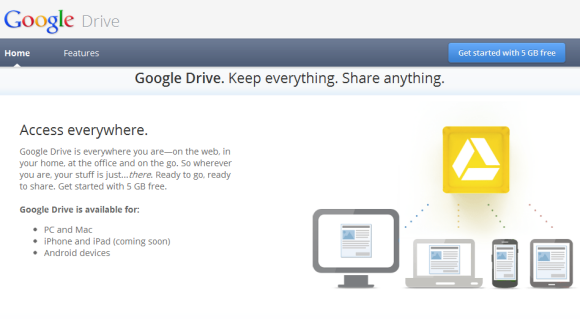
Today, we’re introducing Google Drive—a place where you can create, share, collaborate, and keep all of your stuff. Whether you’re working with a friend on a joint research project, planning a wedding with your fiancé or tracking a budget with roommates, you can do it in Drive. You can upload and access all of your files, including videos, photos, Google Docs, PDFs and beyond.


With Google Drive, you can:

  • Create and collaborate. Google Docs is built right into Google Drive, so you can work with others in real time on documents, spreadsheets and presentations. Once you choose to share content with others, you can add and reply to comments on anything (PDF, image, video file, etc.) and receive notifications when other people comment on shared items.
  • Store everything safely and access it anywhere (especially while on the go). All your stuff is just... there. You can access your stuff from anywhere—on the web, in your home, at the office, while running errands and from all of your devices. You can install Drive on your Mac or PC and can download the Drive app to your Android phone or tablet. We’re also working hard on a Drive app for your iOS devices. And regardless of platform, blind users can access Drive with a screen reader.
  • Search everything. Search by keyword and filter by file type, owner and more. Drive can even recognize text in scanned documents using Optical Character Recognition (OCR) technology. Let’s say you upload a scanned image of an old newspaper clipping. You can search for a word from the text of the actual article. We also use image recognition so that if you drag and drop photos from your Grand Canyon trip into Drive, you can later search for [grand canyon] and photos of its gorges should pop up. This technology is still in its early stages, and we expect it to get better over time.

You can get started with 5GB of storage for free—that’s enough to store the high-res photos of your trip to the Mt. Everest, scanned copies of your grandparents’ love letters or a career’s worth of business proposals, and still have space for the novel you’re working on. You can choose to upgrade to 25GB for $2.49/month, 100GB for $4.99/month or even 1TB for $49.99/month. When you upgrade to a paid account, your Gmail account storage will also expand to 25GB.


Drive is built to work seamlessly with your overall Google experience. You can attach photos from Drive to posts in Google+, and soon you’ll be able to attach stuff from Drive directly to emails in Gmail. Drive is also an open platform, so we’re working with many third-party developers so you can do things like send faxes, edit videos and create website mockups directly from Drive. To install these apps, visit the Chrome Web Store—and look out for even more useful apps in the future.


This is just the beginning for Google Drive; there’s a lot more to come.


Get started with Drive today at drive.google.com/start—and keep looking for Nessie...


Posted by Sundar Pichai, SVP, Chrome & Apps

Breaking down the language barrier—six years in

Breaking down the language barrier—six years in: The rise of the web has brought the world’s collective knowledge to the fingertips of more than two billion people. With just a short query you can access a webpage on a server thousands of miles away in a different country, or read a note from someone halfway around the world. But what happens if it’s in Hindi or Afrikaans or Icelandic, and you speak only English—or vice versa?

In 2001, Google started providing a service that could translate eight languages to and from English. It used what was then state-of-the-art commercial machine translation (MT), but the translation quality wasn’t very good, and it didn’t improve much in those first few years. In 2003, a few Google engineers decided to ramp up the translation quality and tackle more languages. That's when I got involved. I was working as a researcher on DARPA projects looking at a new approach to machine translation—learning from data—which held the promise of much better translation quality. I got a phone call from those Googlers who convinced me (I was skeptical!) that this data-driven approach might work at Google scale.


I joined Google, and we started to retool our translation system toward competing in the NIST Machine Translation Evaluation, a “bake-off” among research institutions and companies to build better machine translation. Google’s massive computing infrastructure and ability to crunch vast sets of web data gave us strong results. This was a major turning point: it underscored how effective the data-driven approach could be.


But at that time our system was too slow to run as a practical service—it took us 40 hours and 1,000 machines to translate 1,000 sentences. So we focused on speed, and a year later our system could translate a sentence in under a second, and with better quality. In early 2006, we rolled out our first languages: Chinese, then Arabic.


We announced our statistical MT approach on April 28, 2006, and in the six years since then we’ve focused primarily on core translation quality and language coverage. We can now translate among any of 64 different languages, including many with a small web presence, such as Bengali, Basque, Swahili, Yiddish, even Esperanto.


Today we have more than 200 million monthly active users on translate.google.com (and even more in other places where you can use Translate, such as Chrome, mobile apps, YouTube, etc.). People also seem eager to access Google Translate on the go (the language barrier is never more acute than when you’re traveling)—we’ve seen our mobile traffic more than quadruple year over year. And our users are truly global: more than 92 percent of our traffic comes from outside the United States.


In a given day we translate roughly as much text as you’d find in 1 million books. To put it another way: what all the professional human translators in the world produce in a year, our system translates in roughly a single day. By this estimate, most of the translation on the planet is now done by Google Translate. (We can’t speak for the galaxy; Douglas Adams’s “Babel fish” probably has us beat there.) Of course, for nuanced or mission-critical translations, nothing beats a human translator—and we believe that as machine translation encourages people to speak their own languages more and carry on more global conversations, translation experts will be more crucial than ever.


We imagine a future where anyone in the world can consume and share any information, no matter what language it’s in, and no matter where it pops up. We already provide translation for webpages on the fly as you browse in Chrome, text in mobile photos, YouTube video captions, and speech-to-speech “conversation mode” on smartphones. We want to knock down the language barrier wherever it trips people up, and we can’t wait to see what the next six years will bring.


Posted by Franz Och, Distinguished Research Scientist, Google Translate

Google Drive: Google Docs Meets Dropbox

Google Drive: Google Docs Meets Dropbox: Google Drive is finally here, but it's not a completely new service. It's not just a new name for Google Docs, it also brings a different vision: your files are always in sync. Google Drive offers 5 GB of free storage, up from 1 GB, and lets you download desktop and mobile apps that synchronize your files. For now, the apps are only available for Windows, Mac and Android, but Google will release an app for iPhone and iPad in the near future.


By default, the desktop app creates a new folder for Google Drive, downloads all the files uploaded to Google Docs and adds shortcuts for the files created using Google Docs apps. This way, the files download to your computer are available offline and can be opened using your favorite apps, while the files created using Google Docs can only open in a browser. If you use Chrome, you can also open some of the files offline. For some people, this will be confusing.


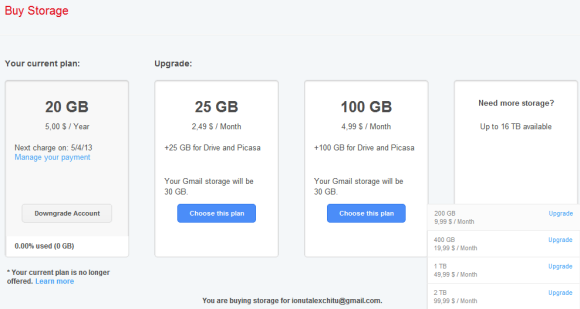
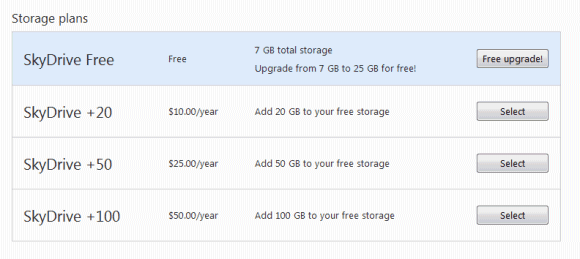
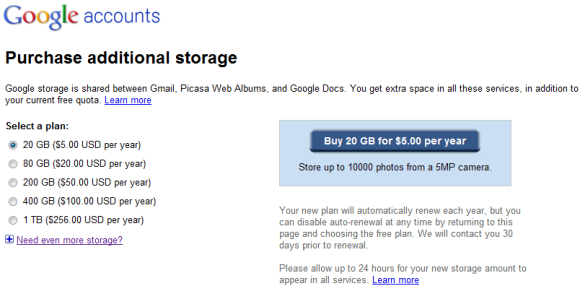
Another issue is that Google offers some new storage plans. The sad thing is that Google's new storage plans are a lot more expensive that the previous ones: now you need to pay $2.49/month (almost $30/year) for 25 GB, instead of $5/year for 20 GB. They're still cheaper than Dropbox's plans, but they're more expensive than Microsoft's plans. Microsoft downgraded the free quota from 25 GB to 7 GB, but existing users can still keep it.


Google DriveDropboxSkyDrive
Free storage5 GB2 GB (up to 18 GB)7 GB (existing users: 25 GB)
+20 GB$10
+25 GB$29.88
+50 GB$99$25
+100 GB$59.88$199$50


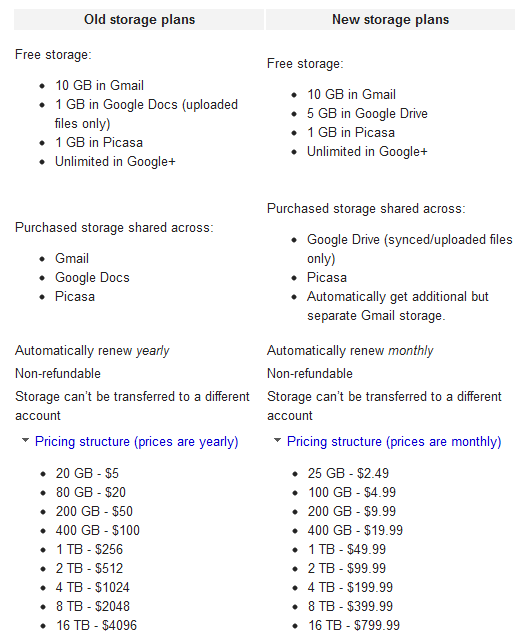
If you upgrade to one of the new plans, Google offers 30 GB of additional Gmail storage. For some reason, the shared storage is no longer available for Gmail and it's now limited to Google Drive and Picasa Web Albums.

Here are the old Google plans (if you already use one of them, you can keep it and you won't be upgraded to the new plans automatically):


and the new plans:


Gmail now offers 10 GB of free storage, while Google Drive only offers 5 GB. Instead of encouraging users to send attachments, the files could be stored in Google Drive.

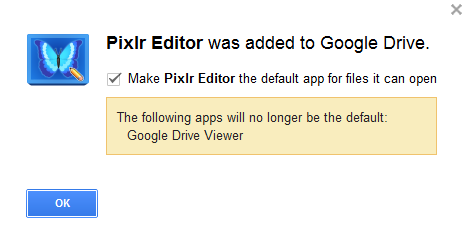
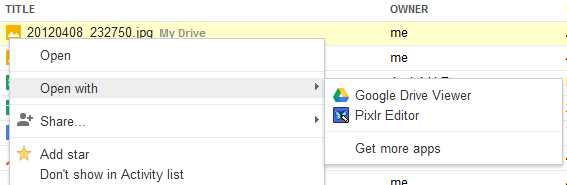
Google Drive integrates with third-party apps and one of them is already enabled by default: Pixlr, a photo editor. You can also install some Chrome apps that integrate with Google Drive. There's a new "open with" item that lets you pick one of the apps from the contextual menu.


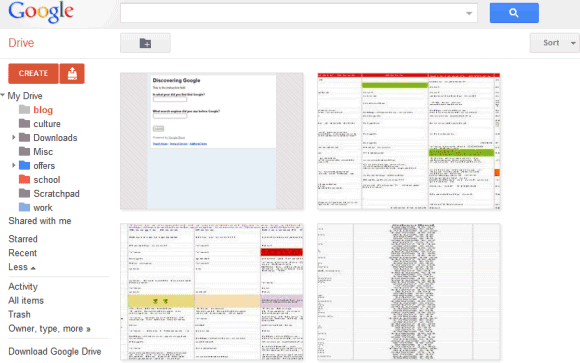
There are many other changes: a grid view, collections are now called folders, an activity view that shows "live updates of everything you and others have modified" and Google Apps support.


"Drive is built to work seamlessly with your overall Google experience. You can attach photos from Drive to posts in Google+, and soon you'll be able to attach stuff from Drive directly to emails in Gmail. Drive is also an open platform, so we're working with many third-party developers so you can do things like send faxes, edit videos and create website mockups directly from Drive," explains Google. Ironically, the Google blog post is written by Sundar Pichai, who killed the Google Docs project back in 2008. "I don't think we need GDrive anymore. Files are so 1990," he said at that time.


{ Thanks, Joel and Yavuz. }