Jun 6, 2012
Tunisia: Confronting Social and Economic Challenges
Tunisia: Confronting Social and Economic Challenges: Formidable social and economic challenges threaten to undermine – or even halt – progress in Tunisia, despite the country’s positive transition to democracy.


Tibetan Teachers Fired From Jobs
Tibetan Teachers Fired From Jobs:
Two educators and a school official have been removed from their posts following widespread language-rights protests earlier this year by Tibetan students in northwestern China, as Chinese authorities continue to clamp down on assertions of Tibetan cultural and national identity, according to a local resident.
Speaking to RFA on condition of anonymity, a Tibetan resident of the area identified the school official as Tsenden Gyal, 48, of the Tsekhog county education department in Qinghai province’s Malho (in Chinese, Huangnan) Tibetan Autonomous Prefecture
The teachers were identified as Pado, 42, head of the county’s Middle School No. 1; and Jigdo, 44, head of the county’s Middle School No. 2.
The date of their dismissal was not clear, but the firings are believed to be linked to demonstrations in March by Tibetan students in three Qinghai counties protesting a proposed change from Tibetan to Chinese as their primary language of instruction.
Calls for language rights
The first protest occurred on March 4, when around 700 students from the Rebkong County Middle School of Nationalities returned after a holiday break to find their textbooks for the new term written in Chinese, the London-based rights group Free Tibet said in a March 8 statement.
“They started ripping the books up and tried to march into the town to call for language rights,” but were stopped by their teachers from proceeding into town, the group said.
The protests were joined a week later by students from Tsekhog and Kangtsa counties who called for “equality” and “freedom for language,” other exile sources said, quoting local contacts in the region.
In Tsekhog, students also called for the removal of a local Chinese military barracks, one source said.
“The students marched to the county police station, the office of the local armed paramilitary police, and the county government center.”
Security forces quickly arrived at the scene, but no beatings or detentions of students were reported, the source said.
Tensions have heightened in Tibetan-populated provinces in China and in the Tibet Autonomous Region following a Chinese security clampdown and a wave of self-immolation protests challenging rule by Beijing.
Reported by Chakmo Tso for RFA’s Tibetan service. Translations by Karma Dorjee. Written in English by Richard Finney.
Two educators and a school official have been removed from their posts following widespread language-rights protests earlier this year by Tibetan students in northwestern China, as Chinese authorities continue to clamp down on assertions of Tibetan cultural and national identity, according to a local resident.
Speaking to RFA on condition of anonymity, a Tibetan resident of the area identified the school official as Tsenden Gyal, 48, of the Tsekhog county education department in Qinghai province’s Malho (in Chinese, Huangnan) Tibetan Autonomous Prefecture
The teachers were identified as Pado, 42, head of the county’s Middle School No. 1; and Jigdo, 44, head of the county’s Middle School No. 2.
The date of their dismissal was not clear, but the firings are believed to be linked to demonstrations in March by Tibetan students in three Qinghai counties protesting a proposed change from Tibetan to Chinese as their primary language of instruction.
Calls for language rights
The first protest occurred on March 4, when around 700 students from the Rebkong County Middle School of Nationalities returned after a holiday break to find their textbooks for the new term written in Chinese, the London-based rights group Free Tibet said in a March 8 statement.
“They started ripping the books up and tried to march into the town to call for language rights,” but were stopped by their teachers from proceeding into town, the group said.
The protests were joined a week later by students from Tsekhog and Kangtsa counties who called for “equality” and “freedom for language,” other exile sources said, quoting local contacts in the region.
In Tsekhog, students also called for the removal of a local Chinese military barracks, one source said.
“The students marched to the county police station, the office of the local armed paramilitary police, and the county government center.”
Security forces quickly arrived at the scene, but no beatings or detentions of students were reported, the source said.
Tensions have heightened in Tibetan-populated provinces in China and in the Tibet Autonomous Region following a Chinese security clampdown and a wave of self-immolation protests challenging rule by Beijing.
Reported by Chakmo Tso for RFA’s Tibetan service. Translations by Karma Dorjee. Written in English by Richard Finney.
Kerak Telor Recipe – A Traditional Betawi Recipe
Kerak Telor Recipe – A Traditional Betawi Recipe:
By: Rani Yunus
Indonesia has a rich culinary tradition where every region offers its own traditional food. The Betawi, as the natives of Jakarta are called, have many popular cuisines such as the Ketoprak, Gado-Gado, Kerak Telor, Soto Betawi, Nasi Uduk, Nasi Ulam, and many more. And I’m here to share with you one of the traditional Betawi delicacies: Kerak Telor—roughly translated as ‘Egg Crust.’

Kerak telor ready to eat, By: Rani Yunus
Simply put, Kerak Telor is an omelet made from Ketan Putih (glutinous rice) cooked with (preferably) duck or chicken egg, Ebi (dried salted shrimp), Serundeng (sweet grated coconut granules); there are 2 types of Serundeng (wet-Serundeng and dry-Serundeng), and some seasoning, like salt, spices, and pepper. In the streets of Jakarta, it costs around Rp13.000 for a chicken egg Kerak Telor, and Rp15.000.00 for a duck egg version.
It’s very simple to make Kerak Telor as you only need a small pan to cook (as Kerak Telor is always served as a single portion), and you don’t need oil to cook it. Here is the recipe to make Kerak Telor, which is very simple to make and has ingredients that are easy to obtain.

Mr. Teguh (50), who has been selling Kerak Telor at Monas in Jakarta for 30 years, By: Rani Yunus
Enjoy with rice or on its own!
By: Rani Yunus
Indonesia has a rich culinary tradition where every region offers its own traditional food. The Betawi, as the natives of Jakarta are called, have many popular cuisines such as the Ketoprak, Gado-Gado, Kerak Telor, Soto Betawi, Nasi Uduk, Nasi Ulam, and many more. And I’m here to share with you one of the traditional Betawi delicacies: Kerak Telor—roughly translated as ‘Egg Crust.’

Kerak telor ready to eat, By: Rani Yunus
Simply put, Kerak Telor is an omelet made from Ketan Putih (glutinous rice) cooked with (preferably) duck or chicken egg, Ebi (dried salted shrimp), Serundeng (sweet grated coconut granules); there are 2 types of Serundeng (wet-Serundeng and dry-Serundeng), and some seasoning, like salt, spices, and pepper. In the streets of Jakarta, it costs around Rp13.000 for a chicken egg Kerak Telor, and Rp15.000.00 for a duck egg version.
It’s very simple to make Kerak Telor as you only need a small pan to cook (as Kerak Telor is always served as a single portion), and you don’t need oil to cook it. Here is the recipe to make Kerak Telor, which is very simple to make and has ingredients that are easy to obtain.
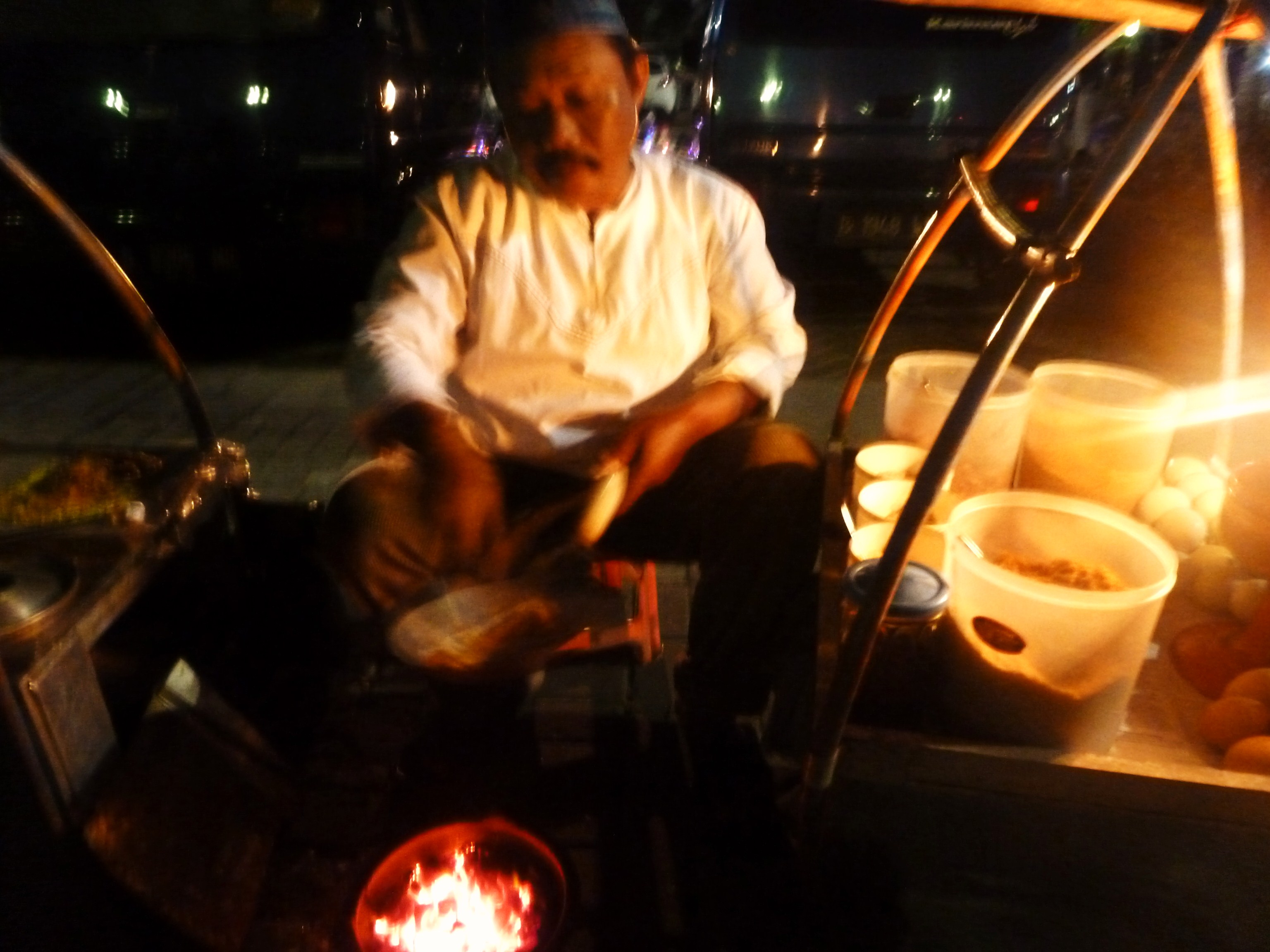
Mr. Teguh (50), who has been selling Kerak Telor at Monas in Jakarta for 30 years, By: Rani Yunus
Kerak Telor Recipe
Ingredients:- 100gr of white glutinous rice, wash until clean, soak it in water for 24 hours (over night) to make it soft.
- 1 tablespoon of wet Serundeng
- 1 teaspoon of dried shrimp powder
- 1 duck egg
- ½ teaspoon of salt and spices mixed together
- ½ teaspoon of pepper powder
- Dried Serundeng
- Fried onions
How To Make Kerak Telor
- Heat a frying pan until quite hot. Add 2 tablespoons of white glutinous rice that has been soaked with water and flattened out. Cook for about 1-2 minutes.
- Add 1 tablespoon of wet Serundeng & 1 teaspoon of dried shrimp powder.
- Add 1 duck egg onto the sticky rice and add some mixed seasoning (½ teaspoon of salt and spices and ½ teaspoon of pepper powder). Flatten and stir well. Cover and cook over low heat until slightly dry.
- After a couple of minutes, turn over the egg crust and transfer from the pan to a plate. Spread some dried Serundeng and fried onions on top as a finishing touch. Voila, Kerak Telor is ready to be served.
Enjoy with rice or on its own!
Malaysian Couple Breaks Maid’s Jaw
Malaysian Couple Breaks Maid’s Jaw:
A Cambodian maid is recuperating at a hospital in Malaysia after being severely beaten by her employers, highlighting the plight of women from some of the poorest countries in Southeast Asia who seek work abroad, only to find themselves held captive and abused with little recourse.
Chea Phalla, 28, is being treated in a hospital in the capital Kuala Lumpur after having her jaw broken and being tortured by the couple that hired her to clean their home, according to an official with the Cambodian Embassy in Malaysia who met with the victim.
Third secretary at the Cambodian Embassy Chhay Kosal told RFA that Chea Phalla’s employer, hairdresser Tan Mong Huwai, had tried to send her back to Cambodia so that he and his wife, Eng Lay San, could get away with their crime.
“When she arrived at the embassy, her condition was already critical. At first she could barely speak. Her boss slapped her in the face until her jaw was broken,” Chhay Kosal said.
“They wanted to finish by sending her back to Cambodia, but the company that recruited her [Cambodia Labor Supply] knew about the torture and stopped them,” he said, adding that the company was assisting the embassy in bringing the case to court.
“We will not accept this. We will file a lawsuit against her boss.”
Chhay Kosal said that Chea Phalla is recuperating after having rested in the hospital.
The couple that employed Chea Phalla, both 36 years old, has been charged with “causing grievous hurt” to the housemaid between August last year and May.
They allegedly beat Chea Phalla with an empty bottle, a pair of shoes, a weighing scale, an iron, an aluminum rod, a kitchen knife, a plastic chair, and a pail at various times during her employment, Malaysia’s The Star newspaper reported.
In addition to refusing her food and making her work long shifts without rest, the maid claimed that her employers forced her to eat and drink her own feces and urine.
The charge of “causing grievous hurt,” under Section 326 of Malaysia’s Penal Code, provides a maximum jail sentence of up to 20 years and a fine or whipping upon conviction.
History of abuse
Malaysia employs about two million foreign workers, mostly from less developed regional countries in jobs that local workers prefer not to take, including on construction sites and in plantations. Another two million are thought to work illegally in the country.
Thida Khus, executive director of Cambodian women’s rights group Silaka, said there are no accurate statistics of how many Cambodian women are currently working Malaysia.
“The companies often dispatch maids to work without monitoring their conditions,” he said.
“We don’t know how many women are working in Malaysia because they don’t maintain contact with embassy officials.”
Some estimates put the number of Cambodian women employed in Malaysian households at around 50,000.
A string of similar cases of abuse has led to strained ties between Malaysia and some of its Southeast Asian neighbors in recent years.
Cambodia imposed a freeze on sending domestic workers in October last year after activists exposed dozens of cases of sexual abuse, overwork, and exploitation among Cambodian maids in Malaysian homes.
Indonesia, which is the largest provider of domestic workers to Malaysia, had a similar ban in place since 2009, but lifted it recently after Malaysia pledged better protections for maids, including granting them one day off a week.
In May, the Cambodian Embassy in Malaysia assisted 10 Cambodians who had been ill-treated by their employers.
And in March, a Malaysian couple was charged with killing domestic worker Mey Sichan, 24, who was allegedly subjected to repeated physical abuse and starved.
Reported by Mao Sotheany for RFA’s Khmer service. Translated by Samean Yun. Written in English by Joshua Lipes.
A Cambodian maid is recuperating at a hospital in Malaysia after being severely beaten by her employers, highlighting the plight of women from some of the poorest countries in Southeast Asia who seek work abroad, only to find themselves held captive and abused with little recourse.
Chea Phalla, 28, is being treated in a hospital in the capital Kuala Lumpur after having her jaw broken and being tortured by the couple that hired her to clean their home, according to an official with the Cambodian Embassy in Malaysia who met with the victim.
Third secretary at the Cambodian Embassy Chhay Kosal told RFA that Chea Phalla’s employer, hairdresser Tan Mong Huwai, had tried to send her back to Cambodia so that he and his wife, Eng Lay San, could get away with their crime.
“When she arrived at the embassy, her condition was already critical. At first she could barely speak. Her boss slapped her in the face until her jaw was broken,” Chhay Kosal said.
“They wanted to finish by sending her back to Cambodia, but the company that recruited her [Cambodia Labor Supply] knew about the torture and stopped them,” he said, adding that the company was assisting the embassy in bringing the case to court.
“We will not accept this. We will file a lawsuit against her boss.”
Chhay Kosal said that Chea Phalla is recuperating after having rested in the hospital.
The couple that employed Chea Phalla, both 36 years old, has been charged with “causing grievous hurt” to the housemaid between August last year and May.
They allegedly beat Chea Phalla with an empty bottle, a pair of shoes, a weighing scale, an iron, an aluminum rod, a kitchen knife, a plastic chair, and a pail at various times during her employment, Malaysia’s The Star newspaper reported.
In addition to refusing her food and making her work long shifts without rest, the maid claimed that her employers forced her to eat and drink her own feces and urine.
The charge of “causing grievous hurt,” under Section 326 of Malaysia’s Penal Code, provides a maximum jail sentence of up to 20 years and a fine or whipping upon conviction.
History of abuse
Malaysia employs about two million foreign workers, mostly from less developed regional countries in jobs that local workers prefer not to take, including on construction sites and in plantations. Another two million are thought to work illegally in the country.
Thida Khus, executive director of Cambodian women’s rights group Silaka, said there are no accurate statistics of how many Cambodian women are currently working Malaysia.
“The companies often dispatch maids to work without monitoring their conditions,” he said.
“We don’t know how many women are working in Malaysia because they don’t maintain contact with embassy officials.”
Some estimates put the number of Cambodian women employed in Malaysian households at around 50,000.
A string of similar cases of abuse has led to strained ties between Malaysia and some of its Southeast Asian neighbors in recent years.
Cambodia imposed a freeze on sending domestic workers in October last year after activists exposed dozens of cases of sexual abuse, overwork, and exploitation among Cambodian maids in Malaysian homes.
Indonesia, which is the largest provider of domestic workers to Malaysia, had a similar ban in place since 2009, but lifted it recently after Malaysia pledged better protections for maids, including granting them one day off a week.
In May, the Cambodian Embassy in Malaysia assisted 10 Cambodians who had been ill-treated by their employers.
And in March, a Malaysian couple was charged with killing domestic worker Mey Sichan, 24, who was allegedly subjected to repeated physical abuse and starved.
Reported by Mao Sotheany for RFA’s Khmer service. Translated by Samean Yun. Written in English by Joshua Lipes.
Uyghur Detained Over Tweets
Uyghur Detained Over Tweets:
Chinese authorities have detained a Uyghur man for tweeting “false information” about a boy who family sources say died in police custody under suspicious circumstances in the ethnically troubled Xinjiang region.
Pamir Yasin, a resident of Urumqi, Xinjiang’s capital, was placed under 15 days’ administrative detention, the Xinjiang government news website Tianshannet.com reported, after he tweeted information on the May 20 death of a boy studying at an unsanctioned religious school in Korla.
Sources close to the family told RFA that 11-year-old Mirzahid Amanullah Shahyari died in the custody of Korla police, who told his mother the boy had committed suicide under their watch and forced her to bury the body immediately.
Official Chinese media reports, however, said that he died at a hospital after being beaten by fellow students at the illegal religious school.
The case has drawn strong condemnation from the Germany-based World Uyghur Congress (WUC) which called Mirzahid’s treatment “barbaric.”
The case was “riddled with many violations of fundamental international human rights law, as well as reminiscent of the persecution that Uyghurs face on a day-to-day basis,” it said.
Pamir Yasin had written on his Sina Weibo microblog eight days after Mirzahid’s death that the boy had died in police custody.
The authorities accused him of using “distorted information” derived from foreign websites as a basis for his claim, Tianshannet.com said over the weekend.
It said the information he had republished and discussed online was “connected to hostile outside forces that maliciously fabricate [and] distorted facts.”
WUC Spokesman Dilxat Raxit condemned the punishment meted out to Pamir Yasin, accusing the authorities of covering up the beating of the boy in detention and spreading “distorted information” of their own.
Pamir Yasin’s detention follows the jailing of several Uyghurs for online activities since July 2009 violence that rocked the Xinjiang capital of Urumqi. They were all sentenced on charges of “endangering state security.”
Pamir Yasin was a contributor to the Uighurbiz.net website, a site on Uyghur news and issues founded by Uyghur economist Ilham Tohti that recently re-opened after being shut down by the authorities.
According to posts on the website, Pamir Yasin had gotten the information about Mirzahid’s death from reports by RFA’s Uyghur service.
Information is strictly controlled in Xinjiang, where authorities shut down the Internet in the entire region for ten months following the July 2009 violence.
Pamir Yasin is being held under Article 47 of China’s Public Security Administration Punishment Law, which allows authorities to detain citizens without trial for up to 15 days for “inciting ethnic hatred or ethnic discrimination or publishing ethnically discriminatory or insulting content in printed materials or online.”
Death in custody
Sources close to Mirzahid’s family continue to question the circumstances under which he died.
They said Mirzahid, from Nurbagh township, Shayar county, in western Xinjiang’s Aksu prefecture, was first taken into custody along with his teacher and three other students in a late-night crackdown on their forbidden Islamic study group.
The next day, Korla police called his mother, Rizwangul, in Nurbagh and told her Mirzahid had killed himself by hitting his head against a wall while in their custody, the sources said.
When Mirzahid’s body was returned to her the next day, she found it had blood on one side of the head, bruises as if he had been beaten with a stick, and a line on his neck as if he had been choked, the sources said.
When she began washing the body to prepare it for burial, Shayar police came to her home and prevented others from visiting.
Police told her she must bury him immediately without speaking to others about his death.
She was told to inform those who inquired about him that he had gone to study at a technology school in Urumqi and fallen off of a building, the sources said.
On May 22, authorities forced her to bury him without reciting prayers from the Koran, they said.
The following day, police came to Nurbagh again and took Mirzahid’s uncle, his father's younger brother, into custody, saying he had passed on information to foreign media, the sources said.
Religious education
Mirzahid’s mother had sent him to study in the unsanctioned school in Korla because she did not want him to attend public school, the sources said.
Religious activity is strictly controlled in the Xinjiang region, home to nine million mostly Muslim Uyghurs, and children under 18 are forbidden from receiving a religious education or attending mosque.
Mirzahid, who would have turned 12 in August, had first been sent to another school in Hotan when he was seven years old, but the teacher sent him home again out of safety concerns, the source said.
Mirzahid’s father, Amanullah Shahyari, has been living in Mecca, Saudi Arabia, for the past 11 years.
From there, he had applied for the other members of the family to move to Turkey under a program for Uyghurs instituted following the July 5, 2009 ethnic violence in Urumqi.
Two months ago, the Turkish government granted Mirzahid, his mother, and older brother Miradil permission to live there.
But the three had not been able to leave China because authorities had taken their identity cards and would not allow them to get passports, sources said.
Reported by Mihray Abdilim and Mamatjan Juma for RFA’s Uyghur service. Translated by Mihray Abdilim and Dolkun Kamberi. Written in English by Rachel Vandenbrink.
Chinese authorities have detained a Uyghur man for tweeting “false information” about a boy who family sources say died in police custody under suspicious circumstances in the ethnically troubled Xinjiang region.
Pamir Yasin, a resident of Urumqi, Xinjiang’s capital, was placed under 15 days’ administrative detention, the Xinjiang government news website Tianshannet.com reported, after he tweeted information on the May 20 death of a boy studying at an unsanctioned religious school in Korla.
Sources close to the family told RFA that 11-year-old Mirzahid Amanullah Shahyari died in the custody of Korla police, who told his mother the boy had committed suicide under their watch and forced her to bury the body immediately.
Official Chinese media reports, however, said that he died at a hospital after being beaten by fellow students at the illegal religious school.
The case has drawn strong condemnation from the Germany-based World Uyghur Congress (WUC) which called Mirzahid’s treatment “barbaric.”
The case was “riddled with many violations of fundamental international human rights law, as well as reminiscent of the persecution that Uyghurs face on a day-to-day basis,” it said.
Pamir Yasin had written on his Sina Weibo microblog eight days after Mirzahid’s death that the boy had died in police custody.
The authorities accused him of using “distorted information” derived from foreign websites as a basis for his claim, Tianshannet.com said over the weekend.
It said the information he had republished and discussed online was “connected to hostile outside forces that maliciously fabricate [and] distorted facts.”
WUC Spokesman Dilxat Raxit condemned the punishment meted out to Pamir Yasin, accusing the authorities of covering up the beating of the boy in detention and spreading “distorted information” of their own.
Pamir Yasin’s detention follows the jailing of several Uyghurs for online activities since July 2009 violence that rocked the Xinjiang capital of Urumqi. They were all sentenced on charges of “endangering state security.”
Pamir Yasin was a contributor to the Uighurbiz.net website, a site on Uyghur news and issues founded by Uyghur economist Ilham Tohti that recently re-opened after being shut down by the authorities.
According to posts on the website, Pamir Yasin had gotten the information about Mirzahid’s death from reports by RFA’s Uyghur service.
Information is strictly controlled in Xinjiang, where authorities shut down the Internet in the entire region for ten months following the July 2009 violence.
Pamir Yasin is being held under Article 47 of China’s Public Security Administration Punishment Law, which allows authorities to detain citizens without trial for up to 15 days for “inciting ethnic hatred or ethnic discrimination or publishing ethnically discriminatory or insulting content in printed materials or online.”
Death in custody
Sources close to Mirzahid’s family continue to question the circumstances under which he died.
They said Mirzahid, from Nurbagh township, Shayar county, in western Xinjiang’s Aksu prefecture, was first taken into custody along with his teacher and three other students in a late-night crackdown on their forbidden Islamic study group.
The next day, Korla police called his mother, Rizwangul, in Nurbagh and told her Mirzahid had killed himself by hitting his head against a wall while in their custody, the sources said.
When Mirzahid’s body was returned to her the next day, she found it had blood on one side of the head, bruises as if he had been beaten with a stick, and a line on his neck as if he had been choked, the sources said.
When she began washing the body to prepare it for burial, Shayar police came to her home and prevented others from visiting.
Police told her she must bury him immediately without speaking to others about his death.
She was told to inform those who inquired about him that he had gone to study at a technology school in Urumqi and fallen off of a building, the sources said.
On May 22, authorities forced her to bury him without reciting prayers from the Koran, they said.
The following day, police came to Nurbagh again and took Mirzahid’s uncle, his father's younger brother, into custody, saying he had passed on information to foreign media, the sources said.
Religious education
Mirzahid’s mother had sent him to study in the unsanctioned school in Korla because she did not want him to attend public school, the sources said.
Religious activity is strictly controlled in the Xinjiang region, home to nine million mostly Muslim Uyghurs, and children under 18 are forbidden from receiving a religious education or attending mosque.
Mirzahid, who would have turned 12 in August, had first been sent to another school in Hotan when he was seven years old, but the teacher sent him home again out of safety concerns, the source said.
Mirzahid’s father, Amanullah Shahyari, has been living in Mecca, Saudi Arabia, for the past 11 years.
From there, he had applied for the other members of the family to move to Turkey under a program for Uyghurs instituted following the July 5, 2009 ethnic violence in Urumqi.
Two months ago, the Turkish government granted Mirzahid, his mother, and older brother Miradil permission to live there.
But the three had not been able to leave China because authorities had taken their identity cards and would not allow them to get passports, sources said.
Reported by Mihray Abdilim and Mamatjan Juma for RFA’s Uyghur service. Translated by Mihray Abdilim and Dolkun Kamberi. Written in English by Rachel Vandenbrink.
Beijing Air Pollution 'Plain to See'
Beijing Air Pollution 'Plain to See':
A Chinese environmental group has called on Beijing to implement policy changes to clean up the capital's air pollution instead of trying to prevent foreign diplomats from publishing its air monitoring results online.
Song Xinzhou, the founder of the environmental protection group Green Beijing, said the government should give official backing to initiatives by nongovernment organizations (NGOs) to help clean up the environment.
"Government departments could relax their policies so as to allow NGOs to receive official, legal backing for their activities," Song said.
"This support should include policy-level support for their existence and their activities, as well as investment," he said.
Speaking after Chinese deputy environmental protection minister Wu Xiaoqing told the U.S. Embassy in Beijing not to publish air pollution figures on its website, Song said most people who live in the Chinese capital don't need a set of figures to tell them that the air pollution is serious.
"This is something that everybody knows," he said. "We can all feel it, and we can all see its more visible aspects."
Wu demanded on Tuesday that foreign embassies stop issuing air pollution readings, saying this is against the law and diplomatic conventions, in pointed criticism of a closely watched U.S. embassy index.
Beijing has vowed to tighten its air-quality monitoring following widespread anger at discrepancies between government air quality readings and the visible smog that blankets China's major cities.
The Ministry of Environmental Protection only recently began to issue standards for the PM2.5 measurement of suspended particulates, the smallest specks of combusted particles contained in smoke, and the most damaging to human health.
China's air monitoring figures previously omitted measures of PM2.5 particles, leading many ordinary Chinese to club together and buy equipment to detect them, posting the results online.
The level of air pollution in Beijing varies depending on the wind, with the city's familiar blanket of smog boosted by industrial emissions, vehicle exhaust, dust from the Gobi desert, and aerosols. Last December, hundreds of planes were grounded and freeways shut down by poor visibility caused by smog.
Beijing residents have traditionally dismissed official air pollution readings—which usually admit only to "slight" air pollution—as propaganda.
U.S. Embassy readings
However, the U.S. embassy's Twitter feed, which posts hourly air quality readings from a monitoring point on its roof, is widely followed, as are similar feeds from U.S. consulates in Shanghai and Guangzhou.
Official readings and the U.S. embassy reading often show a large discrepancy, although both U.S. officials and Chinese experts have said that results obtained from a single monitoring station aren't authoritative.
Wu told reporters on Tuesday that such readings should stop, without naming the U.S. missions directly.
"According to the Vienna Convention on Diplomatic Relations ... foreign diplomats are required to respect and follow local laws and cannot interfere in internal affairs," Wu told a news conference.
"China's air quality monitoring and information release involve the public interest and are up to the government. Foreign consulates in China taking it on themselves to monitor air quality and release the information online not only goes against the spirit of the Vienna Convention ... it also contravenes relevant environmental protection rules."
Chinese Foreign Ministry spokesman Liu Weimin called on foreign diplomatic missions to respect China's laws and regulations and to stop issuing the readings, "especially over the Internet".
"If the foreign embassies want to collect this kind of information for their own staff and diplomats, I think it's up to them," Liu told reporters. "They can't release this information to the outside world."
Around 350,000 people in China die prematurely each year from exposure to outdoor air pollution, with a further 300,000 premature deaths caused by indoor air pollution, according to a 2007 study by the World Bank.
Reported by Tang Qiwei for RFA's Mandarin service and Ho Shan for the Cantonese service. Translated and written in English by Luisetta Mudie.
A Chinese environmental group has called on Beijing to implement policy changes to clean up the capital's air pollution instead of trying to prevent foreign diplomats from publishing its air monitoring results online.
Song Xinzhou, the founder of the environmental protection group Green Beijing, said the government should give official backing to initiatives by nongovernment organizations (NGOs) to help clean up the environment.
"Government departments could relax their policies so as to allow NGOs to receive official, legal backing for their activities," Song said.
"This support should include policy-level support for their existence and their activities, as well as investment," he said.
Speaking after Chinese deputy environmental protection minister Wu Xiaoqing told the U.S. Embassy in Beijing not to publish air pollution figures on its website, Song said most people who live in the Chinese capital don't need a set of figures to tell them that the air pollution is serious.
"This is something that everybody knows," he said. "We can all feel it, and we can all see its more visible aspects."
Wu demanded on Tuesday that foreign embassies stop issuing air pollution readings, saying this is against the law and diplomatic conventions, in pointed criticism of a closely watched U.S. embassy index.
Beijing has vowed to tighten its air-quality monitoring following widespread anger at discrepancies between government air quality readings and the visible smog that blankets China's major cities.
The Ministry of Environmental Protection only recently began to issue standards for the PM2.5 measurement of suspended particulates, the smallest specks of combusted particles contained in smoke, and the most damaging to human health.
China's air monitoring figures previously omitted measures of PM2.5 particles, leading many ordinary Chinese to club together and buy equipment to detect them, posting the results online.
The level of air pollution in Beijing varies depending on the wind, with the city's familiar blanket of smog boosted by industrial emissions, vehicle exhaust, dust from the Gobi desert, and aerosols. Last December, hundreds of planes were grounded and freeways shut down by poor visibility caused by smog.
Beijing residents have traditionally dismissed official air pollution readings—which usually admit only to "slight" air pollution—as propaganda.
U.S. Embassy readings
However, the U.S. embassy's Twitter feed, which posts hourly air quality readings from a monitoring point on its roof, is widely followed, as are similar feeds from U.S. consulates in Shanghai and Guangzhou.
Official readings and the U.S. embassy reading often show a large discrepancy, although both U.S. officials and Chinese experts have said that results obtained from a single monitoring station aren't authoritative.
Wu told reporters on Tuesday that such readings should stop, without naming the U.S. missions directly.
"According to the Vienna Convention on Diplomatic Relations ... foreign diplomats are required to respect and follow local laws and cannot interfere in internal affairs," Wu told a news conference.
"China's air quality monitoring and information release involve the public interest and are up to the government. Foreign consulates in China taking it on themselves to monitor air quality and release the information online not only goes against the spirit of the Vienna Convention ... it also contravenes relevant environmental protection rules."
Chinese Foreign Ministry spokesman Liu Weimin called on foreign diplomatic missions to respect China's laws and regulations and to stop issuing the readings, "especially over the Internet".
"If the foreign embassies want to collect this kind of information for their own staff and diplomats, I think it's up to them," Liu told reporters. "They can't release this information to the outside world."
Around 350,000 people in China die prematurely each year from exposure to outdoor air pollution, with a further 300,000 premature deaths caused by indoor air pollution, according to a 2007 study by the World Bank.
Reported by Tang Qiwei for RFA's Mandarin service and Ho Shan for the Cantonese service. Translated and written in English by Luisetta Mudie.
Cambodia to Deport Russian Pedophile
Cambodia to Deport Russian Pedophile:
Cambodian authorities are working with Moscow to deport a notorious Russian pedophile arrested this week with an underage girl just months after he was pardoned by King Norodom Sihamoni following his conviction of sexually abusing more than a dozen Cambodian girls.
“Alexander Trofimov is being detained temporarily under our authority. The Ministry of the Interior has decided to expel him,” Minister of the Interior Khieu Sopheak said, amid talks between Cambodian officials and the Russian Embassy.
Trofimov was arrested in 2007 in Cambodia's largest-ever pedophilia case. He was convicted of buying sex from 17 girls between the ages of six and 13 and sentenced to 17 years in prison, but later had his sentence reduced to eight years by an appeals court.
In December last year he was pardoned through a royal decree following a government request made to the king through Cambodia’s council of ministers and released from jail.
Since then, Khieu Sopheak said, the Russian national, also known as Stanislav Molodyakov, had been under police investigation and was arrested on Monday after he had been found to be living with a 12-year-old girl in Kandal province’s Ponhea Leu commune.
An order for his deportation had been issued in March, but authorities had been unable to arrest him until Monday.
The Cambodian government will add Trofimov to a blacklist which will ban him from entering the country in the future, Khieu Sopheak said.
Russian Embassy officials refused to comment about the extradition when contacted by RFA. The businessman is wanted by Interpol for raping six girls in Russia.
Deputy National Police Commissioner Sok Phal said a Russian Embassy representative had already met with Trofimov at his detention center at the Department of Immigration.
Cambodian officials are waiting for the embassy to issue an extradition document so that authorities can return him to his country, he said.
“We want to extradite him quickly, otherwise our authorities will be responsible for his food and security,” he said.
Seila Samleang, director of the anti-pedophile group Action Pour Les Enfants (APLE), welcomed the decision to expel Trofimov.
“This measure will ensure the security of our children in Cambodia,” he said.
“If he were allowed to stay in Cambodia, hundreds of victims might fall into his hands.”
 Investor relations
Before his arrest in October 2007, Trofimov was chairman of a Russian-led investment group developing a Cambodian tourist island.
He led Koh Pos Investment Company, which in 2006 received permission to build a U.S. $300 million resort on Koh Pos, known also as Snake Island, off Sihanoukville in southern Cambodia.
Trofimov was one of the higher profile cases in recent years in Cambodia's efforts to crack down on pedophiles, but despite being wanted in Russia in connection with child rape allegations, Cambodia's Court of Appeals rejected a request by the Russian government to extradite him.
He admitted to sexually abusing 16 of the girls and apologized to his victims and the Cambodian people during a hearing in 2010.
Anti-human trafficking groups had expressed dismay over his December release, saying it would set a bad example for criminals.
At the time, APLE’s Samleang Seila told RFA that even though freeing Trofimov was "legal," it would set a bad example in Cambodia, adding that it sent a “weak message … that serious offenders receive light punishment.”
Trofimov was one of more than 300 inmates held in prisons across Cambodia who was either released or had their sentences reduced after receiving a royal pardon.
Dozens of foreigners have been jailed for child sex crimes or deported to face trial in their home countries since Cambodia launched an anti-pedophilia push in 2003 in a bid to shake off its reputation as a haven for sex predators.
Reported by Sok Serey for RFA’s Khmer service. Translated by Samean Yun. Written in English by Joshua Lipes.
Cambodian authorities are working with Moscow to deport a notorious Russian pedophile arrested this week with an underage girl just months after he was pardoned by King Norodom Sihamoni following his conviction of sexually abusing more than a dozen Cambodian girls.
“Alexander Trofimov is being detained temporarily under our authority. The Ministry of the Interior has decided to expel him,” Minister of the Interior Khieu Sopheak said, amid talks between Cambodian officials and the Russian Embassy.
Trofimov was arrested in 2007 in Cambodia's largest-ever pedophilia case. He was convicted of buying sex from 17 girls between the ages of six and 13 and sentenced to 17 years in prison, but later had his sentence reduced to eight years by an appeals court.
In December last year he was pardoned through a royal decree following a government request made to the king through Cambodia’s council of ministers and released from jail.
Since then, Khieu Sopheak said, the Russian national, also known as Stanislav Molodyakov, had been under police investigation and was arrested on Monday after he had been found to be living with a 12-year-old girl in Kandal province’s Ponhea Leu commune.
An order for his deportation had been issued in March, but authorities had been unable to arrest him until Monday.
The Cambodian government will add Trofimov to a blacklist which will ban him from entering the country in the future, Khieu Sopheak said.
Russian Embassy officials refused to comment about the extradition when contacted by RFA. The businessman is wanted by Interpol for raping six girls in Russia.
Deputy National Police Commissioner Sok Phal said a Russian Embassy representative had already met with Trofimov at his detention center at the Department of Immigration.
Cambodian officials are waiting for the embassy to issue an extradition document so that authorities can return him to his country, he said.
“We want to extradite him quickly, otherwise our authorities will be responsible for his food and security,” he said.
Seila Samleang, director of the anti-pedophile group Action Pour Les Enfants (APLE), welcomed the decision to expel Trofimov.
“This measure will ensure the security of our children in Cambodia,” he said.
“If he were allowed to stay in Cambodia, hundreds of victims might fall into his hands.”
A bridge constructed by the Koh Pos Investment Company connects Sihanoukville with Koh Pos, March 23, 2012. Credit: RFA
Before his arrest in October 2007, Trofimov was chairman of a Russian-led investment group developing a Cambodian tourist island.
He led Koh Pos Investment Company, which in 2006 received permission to build a U.S. $300 million resort on Koh Pos, known also as Snake Island, off Sihanoukville in southern Cambodia.
Trofimov was one of the higher profile cases in recent years in Cambodia's efforts to crack down on pedophiles, but despite being wanted in Russia in connection with child rape allegations, Cambodia's Court of Appeals rejected a request by the Russian government to extradite him.
He admitted to sexually abusing 16 of the girls and apologized to his victims and the Cambodian people during a hearing in 2010.
Anti-human trafficking groups had expressed dismay over his December release, saying it would set a bad example for criminals.
At the time, APLE’s Samleang Seila told RFA that even though freeing Trofimov was "legal," it would set a bad example in Cambodia, adding that it sent a “weak message … that serious offenders receive light punishment.”
Trofimov was one of more than 300 inmates held in prisons across Cambodia who was either released or had their sentences reduced after receiving a royal pardon.
Dozens of foreigners have been jailed for child sex crimes or deported to face trial in their home countries since Cambodia launched an anti-pedophilia push in 2003 in a bid to shake off its reputation as a haven for sex predators.
Reported by Sok Serey for RFA’s Khmer service. Translated by Samean Yun. Written in English by Joshua Lipes.
No Place for Incarnation?
No Place for Incarnation?:

Dark Road by Ma Jian. Image courtesy of Tienchi Martin-Liao
The Chinese “one-child policy” has been implemented for three decades, and one proud official report estimates that 300 million newborns have been prevented since the policy was implemented.
How did that happen? Forced abortion and sterilization, economic penalties, demolition of homes, and detention of the husband or other family members. A woman with a second pregnancy is a criminal in China because the “family planning policy” has been written into the constitution. An officer of the Committee of the Family Planning has the duty and the right to uphold the law. As a result the blind lawyer Chen Guangcheng, who tried to protect victims of the law—pregnant women and their unborn babies— is treated as an enemy of the state. Weeks ago, after a legendary escape, Chen arrived in the U.S. and started his law studies at New York University. Would the discrepancy between Chinese and American law in terms of maternity and unborn lives be a great cultural shock for him?
Ma Jian, the London-based award-winning author of Beijing Coma (2008), has recently published his novel Yin Zhi Dao (Dark Road, Yunchen Publishing House, Taipei, 2012). Ma Jian spent years traveling around China to talk with women who want, but are not allowed, to give birth. As a father of four children, it is hard for him to write down the bloodcurdling stories of how millions of babies are killed in name of law and order in his home country.
The novel Dark Road is an absurd story about a couple, Kong Lao’er, a descendant of Confucius, and a common peasant woman who have to hide themselves in the most bizarre places in southern China—first in a boat, and later in a town’s dumpsite for electronics—in order to give birth to their second child. The woman is caught and forced to have an abortion by the authorities. Later she becomes pregnant again, yet at the due time, the baby, named Paradise, refuses to come out of the uterus. Five years pass, and when the family’s only daughter disappears mysteriously, baby Paradise arrives.
The book title, Yin Zhi Dao (Dark Road), also means vagina, or place of life and origin. Ma Jian applies magical realism to describe the perverse reality in China. Between the magical element and the reality, the readers experience the true human tragedy. Neither God nor nature determines human lives; instead it is the State and ignorant officers. “As long as you have a vagina in your trousers, no matter where you are, it will be checked. Men want your vagina, the authority controls your uterus. You cannot lock it up, they have the key. We females can’t escape our fate,” says one female character to another. The fear is immanent and well-founded, “Should one family have more than one child, the whole village will be sterilized.” This is the official slogan in reality, and it has been carried out with iron fist.
Eventually the protagonist of the novel, Kong, who symbolizes the good old Chinese traditions, has to go into exile in his home country. There is no place for the new baby’s incarnation, yet “Paradise” insists on its arrival into a world that its mother has called “hell.” What kind of future is awaiting the mother and her baby?
With colorful language and metaphors, the author shares a couple’s unbalanced fight against the cold-blooded policy that is made not to protect, but to destroy, lives.
The English version of Dark Road will be published in the U.S. by Penguin at the end of the year.
Ma Jian’s Dark Road: a new book on China’s one-child policy.
Dark Road by Ma Jian. Image courtesy of Tienchi Martin-Liao
The Chinese “one-child policy” has been implemented for three decades, and one proud official report estimates that 300 million newborns have been prevented since the policy was implemented.
- During the Cultural Revolution, people were sentenced to death or outright murdered because of one wrong sentence. In China today writers do not lose their lives over their poems or articles; however, they are jailed for years. My friend Liu Xiaobo for example will stay in prison till 2020; even winning the Nobel Peace Prize could not help him. In prison those lucky enough not to be sentenced to hard labor play “blind chess” to kill time AND TO TRAIN THE BRAIN NOT TO RUST. Freedom of expression is still a luxury in China. The firewall is everywhere, yet words can fly above it and so can our thoughts. My column, like the blind chess played by prisoners, is an exercise to keep our brains from rusting and the situation in China from indifference.
- Tienchi Martin-Liao is the president of the Independent Chinese PEN Center. Previously she worked at the Institute for Asian Affairs in Hamburg, Germany, and lectured at the Ruhr-University Bochum from 1985 to 1991. She became head of the Richard-Wilhelm Research Center for Translation in 1991 until she took a job in 2001 as director of the Laogai Research Foundation (LRF) to work on human rights issues. She was at LRF until 2009. Martin-Liao has served as deputy director of the affiliated China Information Center and was responsible for updating the Laogai Handbook and working on the Black Series, autobiographies of Chinese political prisoners and other human rights books. She was elected president of the Independent Chinese PEN Center in October 2009 and has daily contact with online journalists in China.


Ma Jian, the London-based award-winning author of Beijing Coma (2008), has recently published his novel Yin Zhi Dao (Dark Road, Yunchen Publishing House, Taipei, 2012). Ma Jian spent years traveling around China to talk with women who want, but are not allowed, to give birth. As a father of four children, it is hard for him to write down the bloodcurdling stories of how millions of babies are killed in name of law and order in his home country.
The novel Dark Road is an absurd story about a couple, Kong Lao’er, a descendant of Confucius, and a common peasant woman who have to hide themselves in the most bizarre places in southern China—first in a boat, and later in a town’s dumpsite for electronics—in order to give birth to their second child. The woman is caught and forced to have an abortion by the authorities. Later she becomes pregnant again, yet at the due time, the baby, named Paradise, refuses to come out of the uterus. Five years pass, and when the family’s only daughter disappears mysteriously, baby Paradise arrives.
The book title, Yin Zhi Dao (Dark Road), also means vagina, or place of life and origin. Ma Jian applies magical realism to describe the perverse reality in China. Between the magical element and the reality, the readers experience the true human tragedy. Neither God nor nature determines human lives; instead it is the State and ignorant officers. “As long as you have a vagina in your trousers, no matter where you are, it will be checked. Men want your vagina, the authority controls your uterus. You cannot lock it up, they have the key. We females can’t escape our fate,” says one female character to another. The fear is immanent and well-founded, “Should one family have more than one child, the whole village will be sterilized.” This is the official slogan in reality, and it has been carried out with iron fist.
Eventually the protagonist of the novel, Kong, who symbolizes the good old Chinese traditions, has to go into exile in his home country. There is no place for the new baby’s incarnation, yet “Paradise” insists on its arrival into a world that its mother has called “hell.” What kind of future is awaiting the mother and her baby?
With colorful language and metaphors, the author shares a couple’s unbalanced fight against the cold-blooded policy that is made not to protect, but to destroy, lives.
The English version of Dark Road will be published in the U.S. by Penguin at the end of the year.
Banned Books from Bahrain
Banned Books from Bahrain:
Bahrain has a long history of repressing free speech, which intensified after the pro–democracy protests in February 2011. Due to the 1976 Penal Code provisions, the Bahraini government is easily able to repress dissent and criticism. In March, the Press and Publications Directorate banned the following books from the Bahrain International Book Fair. Because of our commitment to freedom of expression, Sampsonia Way recommends these books to all those who speak Arabic.
Bahrain has a long history of repressing free speech, which intensified after the pro–democracy protests in February 2011. Due to the 1976 Penal Code provisions, the Bahraini government is easily able to repress dissent and criticism. In March, the Press and Publications Directorate banned the following books from the Bahrain International Book Fair. Because of our commitment to freedom of expression, Sampsonia Way recommends these books to all those who speak Arabic.
Political Organizations and Societies in Bahrain
http://www.sampsoniaway.org/wp-content/uploads/2012/05/Abdulhadi-Alkhawaja-e1338389343727.jpg
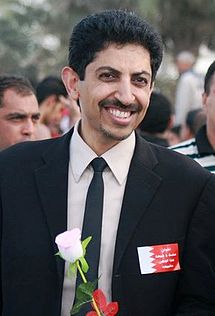
Co-authored by Abbas AlMurshid and Abdulhadi AlKhawaja (pictured), the book was published and distributed without incident in 2010. However the Press and Publications Directorate said “there were complaints by a local lobbyist group on the book’s cover.” Read the book
la
Bahrain in the Gulf Gazetteer
http://www.sampsoniaway.org/wp-content/uploads/2012/05/Bahrain-in-the-Gulf-Gazetteer-e1338389932613.gif
Written by Abbas Almurshid, the book focuses on historical and geographical material about Bahrain. The Press and Publications Directorate gave no reasons for banning the book. Purchase the book
la
Jazaweyat
http://www.sampsoniaway.org/wp-content/uploads/2012/05/Jazaweyat-Cover-e1338391523124.gif
Fahad Fatik's novel is among the books banned from the Bahrain International Book Fair. Purchase the book
la
Wahabbism
http://www.sampsoniaway.org/wp-content/uploads/2012/05/Wahabbism-Cover-e1338392084178.gif
Miqat Alrajehi’s study on Wahabbism, a conservative branch of Sunni Islam, is another book that was banned from the Bahrain International Book Fair. Purchase the book
la
The Personal Diaries of Charles Belgrave
http://www.sampsoniaway.org/wp-content/uploads/2012/05/Charles-Belgrave-Diaries-Cover-e1338392497278.jpg
Banned in Bahrain since 2010, this book features important historical information about the rulers of Bahrain from 1926-57 as notated by their British advisor, Charles Belgrave. Read the book
la
Unbridled Hatreds: Read in the Face of Ancient Hatreds
http://www.sampsoniaway.org/wp-content/uploads/2012/05/Unbridled-Hatred-Cover-e1338392865426.png
Dr. Nader Kadim’s book examines the human impulse of hatred and its prevalence in modern society, despite efforts to curb it through laws. Purchase the book
la
 la
la la
la la
la la
la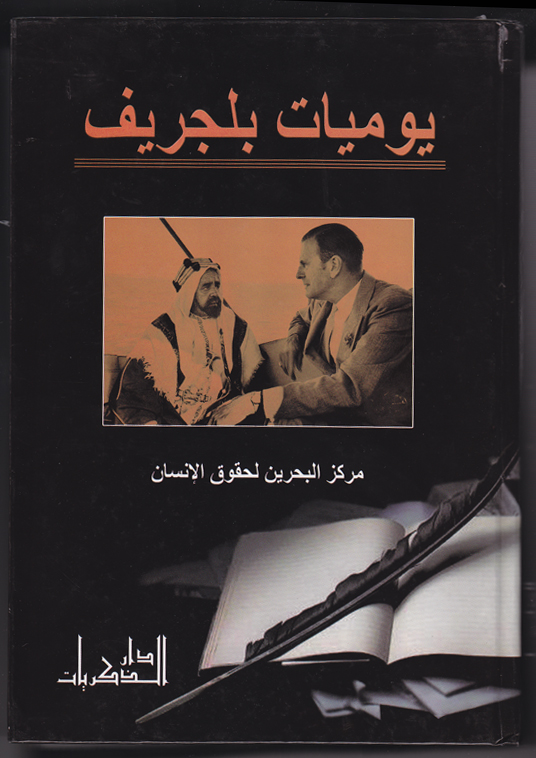 la
la la
laAmid Clashes, Talk of War Stirs in Azerbaijan
Amid Clashes, Talk of War Stirs in Azerbaijan: A growing number of people in Azerbaijan are calling for a solution to a dispute with Armenia over the Nagorno-Karabakh enclave, where eight soldiers have been killed this week, as Hillary Clinton visits to encourage a diplomatic solution.
China Sees Role in Afghanistan
China Sees Role in Afghanistan: To prevent wider regional disruptions, China, Russia and Central Asian nations need to do more to bring stability to Afghanistan, China's President Hu Jintao declared.
Blast Kills 20 Afghan Civilians
Blast Kills 20 Afghan Civilians: An Afghan official says an explosion has killed at least 20 civilians in Kandahar, the largest city in the country's south.
China Restricts Once-Public Data
China Restricts Once-Public Data: Beijing has curtailed access to information often used by investors and short sellers to evaluate Chinese companies.
Japan Faces Opposition to Plan to Restart Reactors
Japan Faces Opposition to Plan to Restart Reactors: As the Japanese government pushes to restart a pair of nuclear reactors, critics and some experts warn that safety measures may be taking a back seat to the desire to power a fragile Japanese economic recovery through the peak demand summer months.
Google Turns Tables on Government Monitors
Google Turns Tables on Government Monitors: Google rolled out a new warning for accounts it believes are the targets of "state-sponsored attackers," spurring discussion among a number of Chinese activists who said they received the alert.
Jun 5, 2012
US says drone killed al-Qaeda commander
US says drone killed al-Qaeda commander: Abu Yahya al-Libi, targeted in Pakistan's tribal region, described as group's second-in-command by US officials.
Laos prepares for regional connectivity : Lao Voices
Laos prepares for regional connectivity : Lao Voices: Laos will prepare for the construction of the high-speed rail project that will link China, the world's second largest economy, to Asean nations via Laos.
We need Airtime about as much as we need Facebook
We need Airtime about as much as we need Facebook: 
As you know, Sean Parker and Shawn Fanning launched their new startup, Airtime, today. The duo has been teasing its launch for some time now, and with it now available as a usable product, there are plenty of people weighing in on its nuances.
The question I’ve asked myself is: Do we really need Airtime? The answer is: About as much as we really need Facebook.
One of the most interesting quotes from today’s press event came from Facebook’s first President, Sean Parker:
Of course that means he sees Airtime as solving a problem. However, that problem is only major if you entirely rely on Facebook for your social interactions. As with Parker’s other favorite companies, Causes and Spotify, they require Facebook to operate. This comes as no surprise, since Parker has been involved with Facebook from nearly day one.
One could argue that Facebook solved a whole host of problems, but I’d contend that like any successful product, it created quite a few as well. Those problems can now be “solved” by companies like Airtime, which makes Facebook the holy grail of all platforms.
If a huge chunk of people decided that Facebook was no longer interesting or required in their daily lives, think of all of the companies that would cease to exist and operate. With so many entrepreneurs turning their focus on using Facebook’s social graph, we’re putting our eggs into one basket and that’s dangerous, no matter who owns the basket.
We’ve convinced ourselves that Facebook has solved so many problems for us, when in actually it hasn’t. It invented problems and successfully solved them. If I asked “What if Facebook didn’t exist starting tomorrow?” I’d get more than a few people saying that they’d no longer be able to keep up with their friends and family. Facebook decided to invent the notion of a digital way to “keep up with friends and family” that many have come to rely on. Before Facebook, I was able to do this just fine.
Now that Facebook has both invented and solved all of these social problems, companies like Airtime can come along and solve the problems that Facebook invented but haven’t gotten around to solving yet. The quote above from Parker calls out meeting new people, and that’s just one of them.
Meeting new people isn’t a new problem, or a problem at all really. We’ve been doing it for years and years. Before you take a deep dive into any technology, ask yourself if you really need it. If you don’t, then you probably shouldn’t bother. If you do, then prepare yourself to be tossed in the cycle of new problems coming up out of thin air. Before you know it, you’ll talk yourself into rationalizing these problems as something that’s real.
I love meeting new people and I love keeping up with my friends and family. Facebook is an amazing tool that lets me do just that. Where I cross the line is completely relying on something to justify how well my life is going. If Facebook were to cease existing tomorrow, I’d simply find another way to interact with people. It could be the phone, an email or a text message.

In my experience with Airtime thus far, I find that it hits on a few really cool features like introducing people based on interests. That’s not an easy thing to do “in real life” unless you hang out at “sports bars” or “bowling alleys”, where there is a built-in similar interest based on the theme of where you are at the time. The rate at which Airtime processes all of your meta data from Facebook is quite impressive.
What I find most useful about Airtime is that it’s actually a really nice standalone chat app for Facebook. If I don’t want to have the entire Facebook experience in my face, this is a great way to skip Skype and talk in text or video. This fact alone, tied with how well it connects strangers, makes it an easy Facebook acquisition target.
There’s no doubt that technology can be a wonderful thing, but do we actually “need” all of it? That’s for you to decide.


As you know, Sean Parker and Shawn Fanning launched their new startup, Airtime, today. The duo has been teasing its launch for some time now, and with it now available as a usable product, there are plenty of people weighing in on its nuances.
The question I’ve asked myself is: Do we really need Airtime? The answer is: About as much as we really need Facebook.
One of the most interesting quotes from today’s press event came from Facebook’s first President, Sean Parker:
Facebook isn’t helping you build new connections.
Of course that means he sees Airtime as solving a problem. However, that problem is only major if you entirely rely on Facebook for your social interactions. As with Parker’s other favorite companies, Causes and Spotify, they require Facebook to operate. This comes as no surprise, since Parker has been involved with Facebook from nearly day one.
One could argue that Facebook solved a whole host of problems, but I’d contend that like any successful product, it created quite a few as well. Those problems can now be “solved” by companies like Airtime, which makes Facebook the holy grail of all platforms.
If a huge chunk of people decided that Facebook was no longer interesting or required in their daily lives, think of all of the companies that would cease to exist and operate. With so many entrepreneurs turning their focus on using Facebook’s social graph, we’re putting our eggs into one basket and that’s dangerous, no matter who owns the basket.
We’ve convinced ourselves that Facebook has solved so many problems for us, when in actually it hasn’t. It invented problems and successfully solved them. If I asked “What if Facebook didn’t exist starting tomorrow?” I’d get more than a few people saying that they’d no longer be able to keep up with their friends and family. Facebook decided to invent the notion of a digital way to “keep up with friends and family” that many have come to rely on. Before Facebook, I was able to do this just fine.
Now that Facebook has both invented and solved all of these social problems, companies like Airtime can come along and solve the problems that Facebook invented but haven’t gotten around to solving yet. The quote above from Parker calls out meeting new people, and that’s just one of them.
Meeting new people isn’t a new problem, or a problem at all really. We’ve been doing it for years and years. Before you take a deep dive into any technology, ask yourself if you really need it. If you don’t, then you probably shouldn’t bother. If you do, then prepare yourself to be tossed in the cycle of new problems coming up out of thin air. Before you know it, you’ll talk yourself into rationalizing these problems as something that’s real.
I love meeting new people and I love keeping up with my friends and family. Facebook is an amazing tool that lets me do just that. Where I cross the line is completely relying on something to justify how well my life is going. If Facebook were to cease existing tomorrow, I’d simply find another way to interact with people. It could be the phone, an email or a text message.
In my experience with Airtime thus far, I find that it hits on a few really cool features like introducing people based on interests. That’s not an easy thing to do “in real life” unless you hang out at “sports bars” or “bowling alleys”, where there is a built-in similar interest based on the theme of where you are at the time. The rate at which Airtime processes all of your meta data from Facebook is quite impressive.
What I find most useful about Airtime is that it’s actually a really nice standalone chat app for Facebook. If I don’t want to have the entire Facebook experience in my face, this is a great way to skip Skype and talk in text or video. This fact alone, tied with how well it connects strangers, makes it an easy Facebook acquisition target.
There’s no doubt that technology can be a wonderful thing, but do we actually “need” all of it? That’s for you to decide.
Firefox Has a Redesigned Home Page and New Tab Experience That Make Browsing the Web Faster and Easier
Firefox Has a Redesigned Home Page and New Tab Experience That Make Browsing the Web Faster and Easier:
Firefox makes it faster and easier to get where you want to go on the Web with a redesigned Home Page and New Tab experience. The Home Page now includes icons at the bottom of the page to give you easy access to bookmarks, history, settings, add-ons, downloads and sync preferences with one-click shortcuts. When you open a new tab, you’ll see thumbnails of your most recently and frequently visited sites. You can customize the New Tab page by adding or removing thumbnails based on where you go most.

Click the screenshot to learn more!Firefox loads tabs on demand when restoring a browsing session to more quickly get you to Web pages. Firefox first loads the tab you are currently viewing, then loads background tabs when you click them. It’s an improvement that makes Firefox start faster and use less memory. This is just one of a series of performance improvements to Firefox responsiveness.
Firefox supports SPDY by default to make browsing more secure. SPDY is a protocol designed as a successor to HTTP that reduces the amount of time it takes for websites to load. You will notice faster page load times on sites that support SPDY networking, like Google and Twitter.
With this support, Firefox is available to an estimated 15 million native Khmer speakers around the world, in addition to the millions that already use Firefox in more than 85 languages worldwide.
For more information:
Firefox makes it faster and easier to get where you want to go on the Web with a redesigned Home Page and New Tab experience. The Home Page now includes icons at the bottom of the page to give you easy access to bookmarks, history, settings, add-ons, downloads and sync preferences with one-click shortcuts. When you open a new tab, you’ll see thumbnails of your most recently and frequently visited sites. You can customize the New Tab page by adding or removing thumbnails based on where you go most.
Click the screenshot to learn more!
Firefox supports SPDY by default to make browsing more secure. SPDY is a protocol designed as a successor to HTTP that reduces the amount of time it takes for websites to load. You will notice faster page load times on sites that support SPDY networking, like Google and Twitter.
With this support, Firefox is available to an estimated 15 million native Khmer speakers around the world, in addition to the millions that already use Firefox in more than 85 languages worldwide.
For more information:
TIMOR-LESTE: Women are also resistance heroes
TIMOR-LESTE: Women are also resistance heroes:
 | DILI, 5 June 2012 (IRIN) - When Indonesian forces invaded Timor-Leste in 1975, Maria De Fatima Kalcona hid in the jungle with resistance fighters, but after years on the move, and hobbled by a gunshot wound, she was eventually captured in 1979. |
China Plans to End Nomadic Life
China Plans to End Nomadic Life:
A U.S.-based rights group has hit out at plans by the Chinese government to force three ethnic minority groups to abandon the last traces of their nomadic lifestyles in the next three years.
"The Chinese Government continues to aggressively pursue and expand its national project for displacing nomadic herders off their traditional lands and resettling them in agricultural and urban areas," the Southern Mongolia Human Rights Information Center (SMHRIC) said in an e-mailed statement on Tuesday.
Citing a statement posted on the official website of China's central government, the group said it marked "a major and seemingly final step toward eliminating the remaining population of nomad herders and eradicating the thousands of years-old nomadic way of life in China."
SMHRIC, which campaigns for the rights of ethnic Mongols in China's Inner Mongolia region, said the resettlement policies would affect nomadic herders in the troubled northwestern region of Xinjiang, Inner Mongolia, and Tibet.
It said the statement confirmed Beijing's determination "to permanently end the nomadic way of life of these regions."
"The Party Central Committee and the State Council have especially emphasized the socio-economic development of pastoral areas, bringing a remarkable improvement to the herders’ living conditions and mode of production, causing the majority of herders to be resettled in static locations," the government announcement said.
It said China's 12th Five-Year Plan aims to resettle the remaining nomad population of 1.157 million people by 2015.
Broken commitments
SMHRIC said these policies violate China's obligations under the United Nations Declaration on the Rights of Indigenous Peoples (UNDRIP).
According to the Declaration, "indigenous peoples shall not be forcibly removed from their lands or territories."
Experts say that deep-seated cultural ties to the grasslands and traditional nomadic ways of life lay behind a wave of protests that swept across Inner Mongolia in May 2011.
Chinese authorities poured armed police and security forces into Inner Mongolia to contain protests sparked by the death of a herdsman from the Shiliin-Gol (in Chinese, Xilin Meng) region who was run over during clashes with mine company trucks.
Thousands of students were locked in campuses at major schools, colleges, and universities in the regional capital, Hohhot, following demonstrations by hundreds of ethnic minority Mongolians across the region.
Mongolian commentators said the protests reflect a deep and widespread anger over continuing exploitation of the region's grasslands, the heartland of Mongol culture
Environmental destruction
Environmentalists point to large-scale environmental destruction in Inner Mongolian regions where mining is taking place, as well as to more subtle ecological pressures in other areas.
Open-cast, or strip, mining is one of the most environmentally destructive forms of mining, destroying the surface ecosystem over a wide area and releasing pollutants into the air.
Ethnic Mongolians, who make up almost 20 percent of Inner Mongolia's 23 million population, complain of destruction and unfair development policies in the region, which is China's largest producer of coal. The overwhelming majority of the residents are Han Chinese.
Ninety percent of China's 400 million hectares (988 million acres) of grassland now show some degree of environmental degradation, according to official figures, and the government has pointed to over-grazing by nomads as a key contributing factor.
Last year, Beijing rolled out a slew of tax breaks and funding for enterprises in rural areas that implement environmentally friendly programs and technological innovations in the field.
But SMHRIC and other overseas campaigners have said that Chinese authorities and companies are continuing to exploit the grassland in spite of slogans like "grassland protection" and "economic growth."
Reported by Luisetta Mudie.
A U.S.-based rights group has hit out at plans by the Chinese government to force three ethnic minority groups to abandon the last traces of their nomadic lifestyles in the next three years.
"The Chinese Government continues to aggressively pursue and expand its national project for displacing nomadic herders off their traditional lands and resettling them in agricultural and urban areas," the Southern Mongolia Human Rights Information Center (SMHRIC) said in an e-mailed statement on Tuesday.
Citing a statement posted on the official website of China's central government, the group said it marked "a major and seemingly final step toward eliminating the remaining population of nomad herders and eradicating the thousands of years-old nomadic way of life in China."
SMHRIC, which campaigns for the rights of ethnic Mongols in China's Inner Mongolia region, said the resettlement policies would affect nomadic herders in the troubled northwestern region of Xinjiang, Inner Mongolia, and Tibet.
It said the statement confirmed Beijing's determination "to permanently end the nomadic way of life of these regions."
"The Party Central Committee and the State Council have especially emphasized the socio-economic development of pastoral areas, bringing a remarkable improvement to the herders’ living conditions and mode of production, causing the majority of herders to be resettled in static locations," the government announcement said.
It said China's 12th Five-Year Plan aims to resettle the remaining nomad population of 1.157 million people by 2015.
Broken commitments
SMHRIC said these policies violate China's obligations under the United Nations Declaration on the Rights of Indigenous Peoples (UNDRIP).
According to the Declaration, "indigenous peoples shall not be forcibly removed from their lands or territories."
Experts say that deep-seated cultural ties to the grasslands and traditional nomadic ways of life lay behind a wave of protests that swept across Inner Mongolia in May 2011.
Chinese authorities poured armed police and security forces into Inner Mongolia to contain protests sparked by the death of a herdsman from the Shiliin-Gol (in Chinese, Xilin Meng) region who was run over during clashes with mine company trucks.
Thousands of students were locked in campuses at major schools, colleges, and universities in the regional capital, Hohhot, following demonstrations by hundreds of ethnic minority Mongolians across the region.
Mongolian commentators said the protests reflect a deep and widespread anger over continuing exploitation of the region's grasslands, the heartland of Mongol culture
Environmental destruction
Environmentalists point to large-scale environmental destruction in Inner Mongolian regions where mining is taking place, as well as to more subtle ecological pressures in other areas.
Open-cast, or strip, mining is one of the most environmentally destructive forms of mining, destroying the surface ecosystem over a wide area and releasing pollutants into the air.
Ethnic Mongolians, who make up almost 20 percent of Inner Mongolia's 23 million population, complain of destruction and unfair development policies in the region, which is China's largest producer of coal. The overwhelming majority of the residents are Han Chinese.
Ninety percent of China's 400 million hectares (988 million acres) of grassland now show some degree of environmental degradation, according to official figures, and the government has pointed to over-grazing by nomads as a key contributing factor.
Last year, Beijing rolled out a slew of tax breaks and funding for enterprises in rural areas that implement environmentally friendly programs and technological innovations in the field.
But SMHRIC and other overseas campaigners have said that Chinese authorities and companies are continuing to exploit the grassland in spite of slogans like "grassland protection" and "economic growth."
Reported by Luisetta Mudie.
Security Tight in Beijing, Urumqi
Security Tight in Beijing, Urumqi:
Security remained tight in some parts of the Chinese capital on Tuesday, a day after the sensitive anniversary of the 1989 Tiananmen military crackdown, as authorities continued their clampdown on any attempt at public commemoration of those who died, local residents and security personnel said.
Meanwhile, authorities in the ethnically troubled northwestern region of Xinjiang began to implement tighter security measures ahead of the anniversary of deadly violence in July 2009, when ethnic tensions between Uyghurs and Han Chinese erupted into riots that left 200 people dead, according to the Chinese government’s tally.
Photos posted online in the early hours of Tuesday morning showed a number of attempts at Tiananmen memorial events, some solitary, others in small groups, wearing black and white clothing in mourning for those who died, and lighting candles.
An online rights website said petitioners from Shandong, Tianjin and Jilin provinces lit incense for the souls of the departed at an unknown location in Beijing, in spite of heightened security aimed at preventing such events.
Activists said police across China have detained a string of activists and petitioners and banned Internet posts relating to the politically sensitive anniversary, as well as forcing a number of prominent activists to go "on holiday" to locations outside their hometowns.
A Beijing-based petitioner surnamed Liu said a number of districts on the outskirts of Beijing were now under security lockdown.
"They have sealed off the villages the same way they did in Shoubaozhuang," Liu said, referring to a village that was previously walled off to outsiders in what officials called an experimental effort to curb crime.
"Every village in Daxing district has metal barricades at the entrance to the village...and there are large numbers of those people wearing red armbands."
"There are middle-aged [security volunteers] and some in their sixties and seventies, men and women alike," he said.
A security guard in Beijing's Tongzhou district said the authorities had stepped up patrols around the anniversary of the June 4 crackdown. "It's June 4, but nothing much has happened," the guard said. "We have patrols going around the residential complexes every day, and emergency patrols...today as well."
He said the number of people in each patrol varied. "It would depend on how many residents there are in the compounds," he said. "The main [security focus] is in the residential neighborhoods."
Petitioners in the capital with complaints against official wrongdoing back in their hometowns said police had detained some of their number on Friday.
"They went to the complaints office...in Beijing and they gave [them] their documentary evidence," said a petitioner from Zhejiang whose wife was taken away. "The police asked them what they were doing, and when they said they were in Beijing to file a complaint...they took them to Jiujingzhuang."
"Then, the representatives from Lishui in Beijing came to pick them up and take them back to be detained in Qingtian," the petitioner said.
Xinjiang
Meanwhile, in the Xinjiang region, authorities have revoked temporary residence permits to local people granting permission for people from remote rural areas to remain in the regional capital Urumqi, a government announcement said.
"From June 1, temporary residents permits will cease to be issued across the entire city," the government announced via the Xinjiangwang website.
Residents with a smart ID card containing their personal details on a chip would be allowed to remain in the city for up to 30 days, but would be forced to apply for a new temporary permit after that period, the government report said.
An Urumqi resident surnamed Zhang said authorities in the city were now gearing up for additional security ahead of the third anniversary of ethnic violence in early July.
"The community workers and security guards are already on the streets, and they have set up security tents in areas where there are large numbers of people," Zhang said. "[This will continue] until July 10 without a day's break."
"These are personnel charged with maintaining stability," he added. "All the shops have to take part in the Peaceful Businesses, Peaceful Families campaign."
"Over here, we have the Peaceful Communities, Peaceful Streets activities," Zhang said.
A police officer who answered the phone at the Nancaimen residential complex confirmed the measures.
"Yes, that's about right," he said, when asked to confirm the reports.
Official media say Beijing wants to turn Urumqi into an important exchange platform for leaders and businesses in China and its western and southern neighbors, including Russia, Kazakhstan, and Pakistan.
But some experts believe Beijing's rapid development of Xinjiang, which they say has created more opportunities for Han Chinese than for the local Uyghur population, is leading to additional ethnic tension in the region.
Reported by Qiao Long for RFA's Mandarin service. Translated and written in English by Luisetta Mudie.
Security remained tight in some parts of the Chinese capital on Tuesday, a day after the sensitive anniversary of the 1989 Tiananmen military crackdown, as authorities continued their clampdown on any attempt at public commemoration of those who died, local residents and security personnel said.
Meanwhile, authorities in the ethnically troubled northwestern region of Xinjiang began to implement tighter security measures ahead of the anniversary of deadly violence in July 2009, when ethnic tensions between Uyghurs and Han Chinese erupted into riots that left 200 people dead, according to the Chinese government’s tally.
Photos posted online in the early hours of Tuesday morning showed a number of attempts at Tiananmen memorial events, some solitary, others in small groups, wearing black and white clothing in mourning for those who died, and lighting candles.
An online rights website said petitioners from Shandong, Tianjin and Jilin provinces lit incense for the souls of the departed at an unknown location in Beijing, in spite of heightened security aimed at preventing such events.
Activists said police across China have detained a string of activists and petitioners and banned Internet posts relating to the politically sensitive anniversary, as well as forcing a number of prominent activists to go "on holiday" to locations outside their hometowns.
A Beijing-based petitioner surnamed Liu said a number of districts on the outskirts of Beijing were now under security lockdown.
"They have sealed off the villages the same way they did in Shoubaozhuang," Liu said, referring to a village that was previously walled off to outsiders in what officials called an experimental effort to curb crime.
"Every village in Daxing district has metal barricades at the entrance to the village...and there are large numbers of those people wearing red armbands."
"There are middle-aged [security volunteers] and some in their sixties and seventies, men and women alike," he said.
A security guard in Beijing's Tongzhou district said the authorities had stepped up patrols around the anniversary of the June 4 crackdown. "It's June 4, but nothing much has happened," the guard said. "We have patrols going around the residential complexes every day, and emergency patrols...today as well."
He said the number of people in each patrol varied. "It would depend on how many residents there are in the compounds," he said. "The main [security focus] is in the residential neighborhoods."
Petitioners in the capital with complaints against official wrongdoing back in their hometowns said police had detained some of their number on Friday.
"They went to the complaints office...in Beijing and they gave [them] their documentary evidence," said a petitioner from Zhejiang whose wife was taken away. "The police asked them what they were doing, and when they said they were in Beijing to file a complaint...they took them to Jiujingzhuang."
"Then, the representatives from Lishui in Beijing came to pick them up and take them back to be detained in Qingtian," the petitioner said.
Xinjiang
Meanwhile, in the Xinjiang region, authorities have revoked temporary residence permits to local people granting permission for people from remote rural areas to remain in the regional capital Urumqi, a government announcement said.
"From June 1, temporary residents permits will cease to be issued across the entire city," the government announced via the Xinjiangwang website.
Residents with a smart ID card containing their personal details on a chip would be allowed to remain in the city for up to 30 days, but would be forced to apply for a new temporary permit after that period, the government report said.
An Urumqi resident surnamed Zhang said authorities in the city were now gearing up for additional security ahead of the third anniversary of ethnic violence in early July.
"The community workers and security guards are already on the streets, and they have set up security tents in areas where there are large numbers of people," Zhang said. "[This will continue] until July 10 without a day's break."
"These are personnel charged with maintaining stability," he added. "All the shops have to take part in the Peaceful Businesses, Peaceful Families campaign."
"Over here, we have the Peaceful Communities, Peaceful Streets activities," Zhang said.
A police officer who answered the phone at the Nancaimen residential complex confirmed the measures.
"Yes, that's about right," he said, when asked to confirm the reports.
Official media say Beijing wants to turn Urumqi into an important exchange platform for leaders and businesses in China and its western and southern neighbors, including Russia, Kazakhstan, and Pakistan.
But some experts believe Beijing's rapid development of Xinjiang, which they say has created more opportunities for Han Chinese than for the local Uyghur population, is leading to additional ethnic tension in the region.
Reported by Qiao Long for RFA's Mandarin service. Translated and written in English by Luisetta Mudie.
Activists Highlight ‘Blood Sugar’ Dispute
Activists Highlight ‘Blood Sugar’ Dispute:
Cambodian land activists have appealed to local authorities to resolve a land dispute involving a sugar company they say encroached on farmland belonging to more than 1,000 villagers as they highlighted the country’s problem-ridden system of land concessions to mark World Environment Day on Tuesday.
More than 50 activists, from Am Laing commune in central Cambodia’s Kompong Speu province, said the Phnom Penh Sugar Company, owned by casino tycoon and ruling Cambodian People’s Party (CPP) senator Ly Yong Phat, had taken land farmed for years and offered those who cultivated it little compensation.
The land dispute has been dragging on for two years without any signs of an imminent resolution.
Speaking during a public debate organized by the Cambodian Center for Human Rights (CCHR), villager Ly Lao said the company, on taking his land, now plans to sue him and several others for “destroyed” company property following protests they held against the alleged land grab.
He said he has already been summoned by the court to testify in the lawsuit against at least 43 villagers on charges of destroying company property during their protests.
“I received a warrant accusing me of destroying the company’s property,” Ly Lao said.
“I have appealed to the lawmakers to help me,” he said.
The debate was attended by parliamentarians from the Sam Rainsy Party (SRP) and Human Rights Party (HRP), but no CPP officials showed up, the activists said.
More than 1,000 villagers say they have been affected by the land grab, having lost around 2,000 hectares (4,940 acres) since the government awarded the sugar company an 8,000 hectare (19,770 acre) concession in 2010.
A villager, who asked to remain anonymous, also charged that the company had illegally seized their land and forced them to move to higher ground, where they are unable to grow crops.
“Please make the company stop taking our land,” the villager said at the debate. “The villagers are eating rice and the company is eating sugar cane. Please give us a way to survive.”
Debate refused
CCHR coordinator Ouch Leng said Phnom Penh Sugar is not interested in resolving the dispute with the villagers and had refused to participate in the debate.
“The company has refused to resolve the case and the local authorities don’t have the power to talk with company representatives,” he said.
He said that villagers had been forced to accept low compensation for their land and that if they refused, the company would file a complaint with the court and the villagers would end up in prison.
Deputy provincial governor Pen Sambo told the debate that the authorities were working to resolve the land conflict “based on the law and the people’s interests.”
HRP lawmaker Ou Chanrith said land conflict in Cambodia is common because it is tied to concessions.
“Land concessions make the villagers the victims and only a few corrupt officials benefit from the deal,” he said.
SRP Member of Parliament Nuth Rumdoul, who attended the debate, said he would write to the Senate and government to demand adequate compensation for the villagers in a bid to resolve the dispute.
Opposition party members have warned European countries not to purchase sugar from the Phnom Penh Sugar Company, calling the product “blood sugar.”

Environment day
The debate over the concession came as more than 300 activists gathered in front of Cambodia’s National Assembly on Tuesday to mark World Environment Day, commemorating the life of recently murdered prominent environmentalist Chut Wutty, who was shot while investigating a logging concession in a protected forest.
The activists, who represented forest, land, and union concerns, honored Chut Wutty—gunned down in April in central Cambodia’s Prey Lang forest—by wearing shirts with his image and the slogan, “To destroy the forest is to destroy yourself.”
They also carried banners and sang songs calling on the public to lend its support in protecting the forest and the indigenous inhabitants who rely on it for their livelihood.
Prey Lang activist Phouk Hong, from northern Cambodia’s Preah Vihear province, said that without protecting the forest from logging by encroaching concessions, the people and wildlife of the country’s forests would be wiped out.
Prey Lang forests in central Cambodia hosts Southeast Asia's largest lowland evergreen forest but it remains unprotected.
“I like the forest and I will protect the forest, which means that I will protect the world,” Phouk Hong said, adding that the activist community would continue to fight against illegal logging despite Chut Wutty’s death.
Rights group Licadho’s senior investigator Am Sam Ath said the government should reexamine its land concession policy.
“I appeal to the government to take the necessary measures to effectively prevent illegal logging in Cambodia,” he said.
“The government must reconsider granting licenses for the sake of the environmental protection.”
After gathering in front of the National Assembly, the group of activists went on to pray at a shrine in front of the Royal Palace, hoping to convince government officials to protect the environment for the younger generation.
Reported by Sonorng Khe and So Chivi for RFA’s Khmer service. Translated by Samean Yun. Written in English by Joshua Lipes.
Cambodian land activists have appealed to local authorities to resolve a land dispute involving a sugar company they say encroached on farmland belonging to more than 1,000 villagers as they highlighted the country’s problem-ridden system of land concessions to mark World Environment Day on Tuesday.
More than 50 activists, from Am Laing commune in central Cambodia’s Kompong Speu province, said the Phnom Penh Sugar Company, owned by casino tycoon and ruling Cambodian People’s Party (CPP) senator Ly Yong Phat, had taken land farmed for years and offered those who cultivated it little compensation.
The land dispute has been dragging on for two years without any signs of an imminent resolution.
Speaking during a public debate organized by the Cambodian Center for Human Rights (CCHR), villager Ly Lao said the company, on taking his land, now plans to sue him and several others for “destroyed” company property following protests they held against the alleged land grab.
He said he has already been summoned by the court to testify in the lawsuit against at least 43 villagers on charges of destroying company property during their protests.
“I received a warrant accusing me of destroying the company’s property,” Ly Lao said.
“I have appealed to the lawmakers to help me,” he said.
The debate was attended by parliamentarians from the Sam Rainsy Party (SRP) and Human Rights Party (HRP), but no CPP officials showed up, the activists said.
More than 1,000 villagers say they have been affected by the land grab, having lost around 2,000 hectares (4,940 acres) since the government awarded the sugar company an 8,000 hectare (19,770 acre) concession in 2010.
A villager, who asked to remain anonymous, also charged that the company had illegally seized their land and forced them to move to higher ground, where they are unable to grow crops.
“Please make the company stop taking our land,” the villager said at the debate. “The villagers are eating rice and the company is eating sugar cane. Please give us a way to survive.”
Debate refused
CCHR coordinator Ouch Leng said Phnom Penh Sugar is not interested in resolving the dispute with the villagers and had refused to participate in the debate.
“The company has refused to resolve the case and the local authorities don’t have the power to talk with company representatives,” he said.
He said that villagers had been forced to accept low compensation for their land and that if they refused, the company would file a complaint with the court and the villagers would end up in prison.
Deputy provincial governor Pen Sambo told the debate that the authorities were working to resolve the land conflict “based on the law and the people’s interests.”
HRP lawmaker Ou Chanrith said land conflict in Cambodia is common because it is tied to concessions.
“Land concessions make the villagers the victims and only a few corrupt officials benefit from the deal,” he said.
SRP Member of Parliament Nuth Rumdoul, who attended the debate, said he would write to the Senate and government to demand adequate compensation for the villagers in a bid to resolve the dispute.
Opposition party members have warned European countries not to purchase sugar from the Phnom Penh Sugar Company, calling the product “blood sugar.”
A forest activist is wearing Chut Wutty’s mask to mark the World Environment Day in Phnom Penh, June 5, 2012. Credit: RFA
The debate over the concession came as more than 300 activists gathered in front of Cambodia’s National Assembly on Tuesday to mark World Environment Day, commemorating the life of recently murdered prominent environmentalist Chut Wutty, who was shot while investigating a logging concession in a protected forest.
The activists, who represented forest, land, and union concerns, honored Chut Wutty—gunned down in April in central Cambodia’s Prey Lang forest—by wearing shirts with his image and the slogan, “To destroy the forest is to destroy yourself.”
They also carried banners and sang songs calling on the public to lend its support in protecting the forest and the indigenous inhabitants who rely on it for their livelihood.
Prey Lang activist Phouk Hong, from northern Cambodia’s Preah Vihear province, said that without protecting the forest from logging by encroaching concessions, the people and wildlife of the country’s forests would be wiped out.
Prey Lang forests in central Cambodia hosts Southeast Asia's largest lowland evergreen forest but it remains unprotected.
“I like the forest and I will protect the forest, which means that I will protect the world,” Phouk Hong said, adding that the activist community would continue to fight against illegal logging despite Chut Wutty’s death.
Rights group Licadho’s senior investigator Am Sam Ath said the government should reexamine its land concession policy.
“I appeal to the government to take the necessary measures to effectively prevent illegal logging in Cambodia,” he said.
“The government must reconsider granting licenses for the sake of the environmental protection.”
After gathering in front of the National Assembly, the group of activists went on to pray at a shrine in front of the Royal Palace, hoping to convince government officials to protect the environment for the younger generation.
Reported by Sonorng Khe and So Chivi for RFA’s Khmer service. Translated by Samean Yun. Written in English by Joshua Lipes.
Jun 4, 2012
Men Still Dominate Op-Ed Pages, Study Finds
Men Still Dominate Op-Ed Pages, Study Finds: 
In 2012's fast and flexible media landscape, opinion writing is still overwhelmingly a man's game. Women authored 33 percent of the op-eds in new media publications and 20 percent of the op-eds in traditional media during a 12-week period last year, according to a study released Tuesday by the Op-Ed Project, an organization focused on increasing diversity in public forums.
While the survey calls those results a "major" improvement, Katherine Lanpher, an instructor with the organization, told TPM that "even with a gain, we are seeing that women aren't narrating the world, even though they're half of the world."
The good news, according to the organization's founder and CEO Katie Orenstein, is that compared to 2005 the Washington Post has 9 percent more female op-ed contributions, the New York Times has 5 percent more and the Los Angeles Times has 4 percent more. "This is a problem that is imminently solvable and even rapidly solvable," Orenstein told TPM.
Still, when it comes to the important policy questions of the day, Lanpher said, women "are not present." The issue, she said, is that women submit fewer opinion articles for publication than men. While some might scoff at the thought of distilling a complex policy issue into a 600-world column, Lanpher said the brevity "makes their work stronger because more people find out about it."
"There are women and minorities out there with tons of information ... you just have to get them to do it," she said.
In addition to more women submitting opinion columns, Orenstein said editors could be more proactive in seeking out female contributors.
The survey found that the women who write opinion pieces still tend to focus on so-called "pink" topics, such as gender, food, family and style. One of the figures that blew Lanpher away, she said, was that women only wrote 11 percent of the articles on the economy, according to the survey.
"Those numbers, I hope they wake people up," Lanpher said. "It's a disservice if you only hear from the same people all the time."
The survey evaluated more than 7,000 articles in 10 media outlets from September 15, 2011 to December 7, 2011. The "new media" outlets surveyed include The Huffington Post and Salon; the legacy outlets include The New York Times, The Washington Post and the Los Angeles Times; and the organization surveyed the college publications of Columbia, Harvard, Princeton and Yale. The college publications published the highest percentage of op-eds written by women at 38 percent.
Find the full study -- with graphs -- here.

In 2012's fast and flexible media landscape, opinion writing is still overwhelmingly a man's game. Women authored 33 percent of the op-eds in new media publications and 20 percent of the op-eds in traditional media during a 12-week period last year, according to a study released Tuesday by the Op-Ed Project, an organization focused on increasing diversity in public forums.
While the survey calls those results a "major" improvement, Katherine Lanpher, an instructor with the organization, told TPM that "even with a gain, we are seeing that women aren't narrating the world, even though they're half of the world."
The good news, according to the organization's founder and CEO Katie Orenstein, is that compared to 2005 the Washington Post has 9 percent more female op-ed contributions, the New York Times has 5 percent more and the Los Angeles Times has 4 percent more. "This is a problem that is imminently solvable and even rapidly solvable," Orenstein told TPM.
Still, when it comes to the important policy questions of the day, Lanpher said, women "are not present." The issue, she said, is that women submit fewer opinion articles for publication than men. While some might scoff at the thought of distilling a complex policy issue into a 600-world column, Lanpher said the brevity "makes their work stronger because more people find out about it."
"There are women and minorities out there with tons of information ... you just have to get them to do it," she said.
In addition to more women submitting opinion columns, Orenstein said editors could be more proactive in seeking out female contributors.
The survey found that the women who write opinion pieces still tend to focus on so-called "pink" topics, such as gender, food, family and style. One of the figures that blew Lanpher away, she said, was that women only wrote 11 percent of the articles on the economy, according to the survey.
"Those numbers, I hope they wake people up," Lanpher said. "It's a disservice if you only hear from the same people all the time."
The survey evaluated more than 7,000 articles in 10 media outlets from September 15, 2011 to December 7, 2011. The "new media" outlets surveyed include The Huffington Post and Salon; the legacy outlets include The New York Times, The Washington Post and the Los Angeles Times; and the organization surveyed the college publications of Columbia, Harvard, Princeton and Yale. The college publications published the highest percentage of op-eds written by women at 38 percent.
Find the full study -- with graphs -- here.
CNN Poll: Obama By 3, Powered By Enthusiasm
CNN Poll: Obama By 3, Powered By Enthusiasm: 
A new national poll from CNN shows President Obama with a 3 point lead over Republican nominee Mitt Romney, down from the 9 percent lead Obama held in the cable network's April polling at the end of the GOP primary process.
But what is sure to be a major factor in a close election -- voter enthusiasm -- tilts toward Obama in the CNN poll. "Although the race for the White House is essentially tied, Obama does have one big advantage: His supporters right now are far more enthusiastic about him," CNN wrote. "More than six in ten Obama voters say they strongly support the president, while only 47% of Romney voters feel that way about their candidate."
On the one hand, those numbers are up from CNN's April poll: a month and half ago, only 35 percent of Romney voters said they were voting for him, versus 63 percent who said they were voting against Obama. Romney's general favorability has also ticked up since he became the nominee and the party faithful have rallied around him, and he continues to do well with independent voters -- Romney takes 51 percent in the CNN poll, against Obama's 39. But Obama builds a lead by pulling more from his own party, and more self-described "moderate" voters.
As has been the case in 2012, CNN pointed to economic conditions as the overwhelming factor in the race:
The TPM Poll Average shows President Obama with a smal 2.1 percent lead in the race so far.
The CNN poll used 895 live telephone interviews with registered voters nationally conducted from May 29th to the 31st. The poll has a sampling error of 3.5 points.

A new national poll from CNN shows President Obama with a 3 point lead over Republican nominee Mitt Romney, down from the 9 percent lead Obama held in the cable network's April polling at the end of the GOP primary process.
But what is sure to be a major factor in a close election -- voter enthusiasm -- tilts toward Obama in the CNN poll. "Although the race for the White House is essentially tied, Obama does have one big advantage: His supporters right now are far more enthusiastic about him," CNN wrote. "More than six in ten Obama voters say they strongly support the president, while only 47% of Romney voters feel that way about their candidate."
On the one hand, those numbers are up from CNN's April poll: a month and half ago, only 35 percent of Romney voters said they were voting for him, versus 63 percent who said they were voting against Obama. Romney's general favorability has also ticked up since he became the nominee and the party faithful have rallied around him, and he continues to do well with independent voters -- Romney takes 51 percent in the CNN poll, against Obama's 39. But Obama builds a lead by pulling more from his own party, and more self-described "moderate" voters.
As has been the case in 2012, CNN pointed to economic conditions as the overwhelming factor in the race:
According to the survey, one in five questioned say neither candidate can fix the economy, with another one in five saying the economy will recover regardless of who wins in November. Among the rest, once again there is no clear advantage - 31% say economic conditions will improve only if Romney wins; 28% think things will get better only if Obama stays in office.
The poll was conducted Tuesday through Thursday, before the release of Friday's of the May unemployment numbers. According to the disappointing report from the Labor Department, the nation's unemployment level edged up to 8.2% last month, with only 69,000 jobs created in May.
The TPM Poll Average shows President Obama with a smal 2.1 percent lead in the race so far.
The CNN poll used 895 live telephone interviews with registered voters nationally conducted from May 29th to the 31st. The poll has a sampling error of 3.5 points.
Two Peas In a Pod: Romney's Transition Leader Is A Smart, Serious Ex-Governor
Two Peas In a Pod: Romney's Transition Leader Is A Smart, Serious Ex-Governor: 
By most accounts, Mike Leavitt, the former Utah governor and Bush administration official tapped by Mitt Romney to run his transition team if he is elected president is the kind of unflappable, low-profile smart guy politicians dream of surrounding themselves with. And though Leavitt is a cool head, his political past includes a few of the awkward gaffes that have sometimes veered Romney himself off course.
In Leavitt, Romney has tapped a kindred spirit: a smart, serious, ex-governor who has tripped himself up on occasion.
But gaffes have by no means been the hallmark of Leavitt's political career. In 2003, when President George W. Bush tapped Leavitt to take over the EPA after Christine Todd Whitman's tumultuous stint, the Washington Post reported he was chosen specifically for his ability to maintain calm waters.
"One senior Republican official called Leavitt a 'bureaucrat's bureaucrat,' who would keep the EPA out of the headlines," according to the Post. A year later, Bush again enlisted Leavitt to be a quiet, competent one-man cleanup crew after a string of bad headlines. Embarrassed by the fallout created by nomination NYPD Commissioner Bernard Kerik to head the Department Of Homeland Security, the president again turned to Leavitt, nominating him to lead the Department of Heath and Human Services amid public outcry that Bush's nominee-selection process was broken. Descriptions of Levitt at that time included "loyalist," "extraordinarily thoughtful" and, once again, quiet.
"He does not have an incendiary personality," former Montana Gov. Marc Racicot (R), Bush's 2004 campaign chair, told the Washington Post upon Leavitt's selection to lead HHS.
Leavitt's ability to be noncontroversial appears central to Romney's decision to place him in his inner circle. Levitt has been "a calming influence at critical times" to Romney, according to Politico. The Romneys trust him in part because he's "100 percent in it for Mitt, no secret agenda for himself," someone in the Romney camp told Politico.
Calm, cool and tempered also sum up Romney, who during the often chaotic Republican primary talked up his ability to keep things serious even when the politics around him veered toward silliness. But Romney, more than any errant staffers, often caused his campaign's most awkward moments, stumbling at precisely the wrong times.
Leavitt knows what this is like. During his 10-year gubernatorial tenure in Utah, Leavitt cruised to reelection and enjoyed wide public support. But he infamously stuck his foot in it when he took what appeared to be a soft line on polygamy. Navigating the issue of polygamy isn't necessary for most governors, but it is a political reality for Utah politicians, and Leavitt illustrated exactly how to get it wrong. In a July 1998 press conference, Leavitt said people who practice polygamy (outlawed by Utah's state Constitution) were "mostly good people." The line predictably drew national attention, even as he tried to staunch the backlash by backing off the statements. He publicly expressed frustration that the story had derailed his legislative priorities.
"After several minutes of questions on the polygamy subject, Leavitt shook his head a little and seemed irritated," the Deseret News reported. "'There are a number of important things going on in this state," he said, 'like freeways, education' and other items."
Romney expressed similar frustration when the media fixated on his own slip-ups and when his opponents' antics steered the primary campaign away from economic issues, where Romney is most comfortable.
Levitt's calm demeanor won't help with one campaign problem, though. Romney's camp has been forced to soothe fears among conservatives terrified that the moderate Leavitt's proximity to Romney signals the former Massachusetts governor won't dismantle Obama's health care law as he's promised. To those already worried that Romney's record as the only other politician to sign a health care reform package like Obama's into law makes him an unconvincing advocate for the national law's destruction, Leavitt's spot in the campaign has done little to soothe their fears.
Romney and Leavitt both know what it's like to be the smart guy in the room who nonetheless stumbles occasionally. Now it looks like the team of quiet men is going through one of the loud fights they both try to shy away from -- this time, together.


By most accounts, Mike Leavitt, the former Utah governor and Bush administration official tapped by Mitt Romney to run his transition team if he is elected president is the kind of unflappable, low-profile smart guy politicians dream of surrounding themselves with. And though Leavitt is a cool head, his political past includes a few of the awkward gaffes that have sometimes veered Romney himself off course.
In Leavitt, Romney has tapped a kindred spirit: a smart, serious, ex-governor who has tripped himself up on occasion.
But gaffes have by no means been the hallmark of Leavitt's political career. In 2003, when President George W. Bush tapped Leavitt to take over the EPA after Christine Todd Whitman's tumultuous stint, the Washington Post reported he was chosen specifically for his ability to maintain calm waters.
"One senior Republican official called Leavitt a 'bureaucrat's bureaucrat,' who would keep the EPA out of the headlines," according to the Post. A year later, Bush again enlisted Leavitt to be a quiet, competent one-man cleanup crew after a string of bad headlines. Embarrassed by the fallout created by nomination NYPD Commissioner Bernard Kerik to head the Department Of Homeland Security, the president again turned to Leavitt, nominating him to lead the Department of Heath and Human Services amid public outcry that Bush's nominee-selection process was broken. Descriptions of Levitt at that time included "loyalist," "extraordinarily thoughtful" and, once again, quiet.
"He does not have an incendiary personality," former Montana Gov. Marc Racicot (R), Bush's 2004 campaign chair, told the Washington Post upon Leavitt's selection to lead HHS.
Leavitt's ability to be noncontroversial appears central to Romney's decision to place him in his inner circle. Levitt has been "a calming influence at critical times" to Romney, according to Politico. The Romneys trust him in part because he's "100 percent in it for Mitt, no secret agenda for himself," someone in the Romney camp told Politico.
Calm, cool and tempered also sum up Romney, who during the often chaotic Republican primary talked up his ability to keep things serious even when the politics around him veered toward silliness. But Romney, more than any errant staffers, often caused his campaign's most awkward moments, stumbling at precisely the wrong times.
Leavitt knows what this is like. During his 10-year gubernatorial tenure in Utah, Leavitt cruised to reelection and enjoyed wide public support. But he infamously stuck his foot in it when he took what appeared to be a soft line on polygamy. Navigating the issue of polygamy isn't necessary for most governors, but it is a political reality for Utah politicians, and Leavitt illustrated exactly how to get it wrong. In a July 1998 press conference, Leavitt said people who practice polygamy (outlawed by Utah's state Constitution) were "mostly good people." The line predictably drew national attention, even as he tried to staunch the backlash by backing off the statements. He publicly expressed frustration that the story had derailed his legislative priorities.
"After several minutes of questions on the polygamy subject, Leavitt shook his head a little and seemed irritated," the Deseret News reported. "'There are a number of important things going on in this state," he said, 'like freeways, education' and other items."
Romney expressed similar frustration when the media fixated on his own slip-ups and when his opponents' antics steered the primary campaign away from economic issues, where Romney is most comfortable.
Levitt's calm demeanor won't help with one campaign problem, though. Romney's camp has been forced to soothe fears among conservatives terrified that the moderate Leavitt's proximity to Romney signals the former Massachusetts governor won't dismantle Obama's health care law as he's promised. To those already worried that Romney's record as the only other politician to sign a health care reform package like Obama's into law makes him an unconvincing advocate for the national law's destruction, Leavitt's spot in the campaign has done little to soothe their fears.
Romney and Leavitt both know what it's like to be the smart guy in the room who nonetheless stumbles occasionally. Now it looks like the team of quiet men is going through one of the loud fights they both try to shy away from -- this time, together.
Zuckerberg Falls Off Top 40 Richest People List
Zuckerberg Falls Off Top 40 Richest People List: Facebook’s Mark Zuckerberg has had a tumultuous month. Little more than a week after his company’s IPO made him one of the richest people on the planet, trading issues and a souring market have pulled some of that rug out from under him: the 28-year-old was recently kicked off Bloomberg’s Billionaires Index of the world’s [...]
Apps Aiming for Sharing Within Boundaries
Apps Aiming for Sharing Within Boundaries: In a natural evolution of social networking, more mobile apps are aiming for sharing within boundaries.
Cyberweapon Warning From Kaspersky, a Computer Security Expert
Cyberweapon Warning From Kaspersky, a Computer Security Expert: Eugene Kaspersky says his discovery of the Flame virus adds weight to his warnings of the grave dangers posed by governments that manufacture and release viruses on the Internet.
Walker Recall Battle May Hurt Obama
Walker Recall Battle May Hurt Obama: President Obama’s re-election campaign has always counted on Wisconsin for a victory, but Republicans there may be strengthened by their fight to defend Gov. Scott Walker against a recall effort.
Karzai Family Moves to Protect Its Privilege
Karzai Family Moves to Protect Its Privilege: As Hamid Karzai’s days as Afghanistan’s president draw to a close, his family members are trying to protect their status while secretly fighting among themselves over the fortune they have amassed.
More Protests Loom Since Egypt Election
More Protests Loom Since Egypt Election: Hoping to push Egypt’s military rulers to disqualify Ahmed Shafik from the presidential runoff vote, his electoral rivals are planning further demonstrations.
Netanyahu Vows Crackdown on African Asylum Seekers
Netanyahu Vows Crackdown on African Asylum Seekers: Prime Minister Benjamin Netanyahu has promised to step up efforts to deter, detain and deport illegal migrants to Israel, as tensions mounted over an influx of asylum seekers from Africa.
In Pennsylvania coal country, voters not thrilled with their choices
In Pennsylvania coal country, voters not thrilled with their choices:
This is coal country, even if there’s hardly any coal anymore. The elders can name the coal veins and describe their dimensions. People will still say, “I grew up in the patch.” That means they were raised in a cluster of company houses back in a hollow near the mouth of a mine. The kids would play king-of-the-hill on gobheaps of broken slate and mining waste.
Read full article >>

This is coal country, even if there’s hardly any coal anymore. The elders can name the coal veins and describe their dimensions. People will still say, “I grew up in the patch.” That means they were raised in a cluster of company houses back in a hollow near the mouth of a mine. The kids would play king-of-the-hill on gobheaps of broken slate and mining waste.
Read full article >>
Cyber search engine Shodan exposes industrial control systems to new risks
Cyber search engine Shodan exposes industrial control systems to new risks:
It began as a hobby for a teenage computer programmer named John Matherly, who wondered how much he could learn about devices linked to the Internet.
After tinkering with code for nearly a decade, Matherly eventually developed a way to map and capture the specifications of everything from desktop computers to network printers to Web servers.
Read full article >>
It began as a hobby for a teenage computer programmer named John Matherly, who wondered how much he could learn about devices linked to the Internet.
After tinkering with code for nearly a decade, Matherly eventually developed a way to map and capture the specifications of everything from desktop computers to network printers to Web servers.
Read full article >>
Think tanks getting new generation of leaders
Think tanks getting new generation of leaders:
Think tanks may be known as the ideas industry, but they are equally described as the government in exile, or the revolving door to government.
The latter designation has been more apt for think-tank scholars with political aspirations than for think-tank presidents, whose long tenures go unrivaled.
Read full article >>
Think tanks may be known as the ideas industry, but they are equally described as the government in exile, or the revolving door to government.
The latter designation has been more apt for think-tank scholars with political aspirations than for think-tank presidents, whose long tenures go unrivaled.
Read full article >>
U.S. strike said to target al-Qaeda’s No. 2
U.S. strike said to target al-Qaeda’s No. 2:
U.S. missiles killed more than a dozen people in northwestern Pakistan early Monday in a strike that apparently was aimed at al-Qaeda’s No. 2 leader, the charismatic and influential jihadist known as Abu Yahya al-Libi, U.S. and Pakistani officials said.
Read full article >>
U.S. missiles killed more than a dozen people in northwestern Pakistan early Monday in a strike that apparently was aimed at al-Qaeda’s No. 2 leader, the charismatic and influential jihadist known as Abu Yahya al-Libi, U.S. and Pakistani officials said.
Read full article >>
Investors Hear Call of Asian Telecoms
Investors Hear Call of Asian Telecoms: Asia's telecom companies, which offer healthy dividends and yields, are providing a safe haven for investors.
For Dollar Stores, the Dollars Are Adding Up
For Dollar Stores, the Dollars Are Adding Up: Discount retailers such as Dollar General proved resilient during the downturn. In the lukewarm recovery, they're flourishing.
Google Readies New Local-Ad Assault
Google Readies New Local-Ad Assault: Google is preparing to launch its largest-ever assault on the roughly $20 billion market for local business advertising.
Poll: Solve economic problems first
Poll: Solve economic problems first: Most people want the government to give more priority to solving economic problems than pushing for the passage of a reconciliation law, according to the results of an Abac Poll revealed on Sunday.
 |  |
Romney Edges Obama in Battle for Middle-Income Voters
Romney Edges Obama in Battle for Middle-Income Voters: Middle-income voters currently lean toward Mitt Romney, 49% to 45% -- and to the exact degree that upper-income voters also prefer Romney. Obama holds a much wider lead among low-income voters, largely due to his appeal to minorities.
Daily SG: 4 June 2012
Daily SG: 4 June 2012:
Educate Our Youth
- Random Thoughts of A Free Thinker: A Response To A 17 Year Old Cynic
- guanyinmiao’s musings: An Email Reply To Fifth Azure, Author Of “**** You, DPM Teo”
- SG Hard Truth: Pre-U Seminar Reflection : To the Blogger of fifthazure (who criticized DPM Teo Chee Hean) : Outright Rude, Mindless and 没家教
Hougang By-Elections
- Dr Derek da Cunha: “Opposition Central”: When Fact-based Analysis Comes Up Against Wishful Thinking
- New Asia Republic: Upgrading topic in elections – a time-limited weapon
- Yahoo: Summons filed to order PM Lee to court hearing on by-election
- My Singapore News: Vellama Marie Muthu versus the Attorney General
Internet Code of Conduct – See No Evil, Hear No Evil, Write No Evil
- Thoughts of a Cynical Investor: China’s Community Convention = Yaacob’s CoC
- Limpeh Is Foreign Talent: Q&A: Ethics, Privacy & Xiaxue
A Vote for Change
- The Idea Cauldron: a first world paliament
- five stars and a moon: Meet The People Session
Defending Our Lion City
- Senang Diri: Lest we forget: Singapore Armed Forces (SAF) should remember and honour its old warfighters and defence engineers
- Singapore Sojourn: Base-Less Rumours [Thanks Roger]
GIC, Temasek State Funds Investments
- The Balding Blog: Singapore, Inc.: Just When You Thought it Couldn’t Get Any Worse
Daily Disclosure
- Gintai: Filial Piety the best virtue; Lascivious the worst sin!
- New Nation: Generous donors teach Straits Times a lesson about unconditional giving
- Everything Also Complain: $1.99 set meals when 1 cent coins no longer exist
- Singapore Investor: Cost of living in the United Kingdom-Food [Thanks Adrian]
- The Kent Ridge Common: After Sungei Buloh: The Wrong Idea of what ‘Environment’ is
Strangers in a Strange Land
- Diary of A Singaporean Mind: Irresponsible framing of our integration woes….
- Blogging for Myself: Stories around a choked pipe
Internal Security Act
(Info: Internal Security Act (Singapore))
- Journalism.SG: Mightier Than The Pen: Remembering ISA Detentions Of Writers
- Where Bears Roam Free: Hypocrisy of the ‘Marxist Conspirators’ and their supporters
- Article 14: 25th Anniversary of the Marxist Conspiracy: remembering a legal footnote
- Kall Geez: The politics behind the Singapore anti-ISA movement
- Yawningbread: Hundreds turn up at rally against arbitrary detention
Uniquely Singapore
- I Wander: A Glimpse of the Subcontinent in Singapore’s Little India [Thanks Chua]
————————————————————————–
Singapore Daily highlight netizens’ opinions & interesting news about Singapore. Please share with us interesting blog articles or Facebook Notes.
————————————————————————–
Educate Our Youth
- Random Thoughts of A Free Thinker: A Response To A 17 Year Old Cynic
- guanyinmiao’s musings: An Email Reply To Fifth Azure, Author Of “**** You, DPM Teo”
- SG Hard Truth: Pre-U Seminar Reflection : To the Blogger of fifthazure (who criticized DPM Teo Chee Hean) : Outright Rude, Mindless and 没家教
Hougang By-Elections
- Dr Derek da Cunha: “Opposition Central”: When Fact-based Analysis Comes Up Against Wishful Thinking
- New Asia Republic: Upgrading topic in elections – a time-limited weapon
- Yahoo: Summons filed to order PM Lee to court hearing on by-election
- My Singapore News: Vellama Marie Muthu versus the Attorney General
Internet Code of Conduct – See No Evil, Hear No Evil, Write No Evil
- Thoughts of a Cynical Investor: China’s Community Convention = Yaacob’s CoC
- Limpeh Is Foreign Talent: Q&A: Ethics, Privacy & Xiaxue
A Vote for Change
- The Idea Cauldron: a first world paliament
- five stars and a moon: Meet The People Session
Defending Our Lion City
- Senang Diri: Lest we forget: Singapore Armed Forces (SAF) should remember and honour its old warfighters and defence engineers
- Singapore Sojourn: Base-Less Rumours [Thanks Roger]
GIC, Temasek State Funds Investments
- The Balding Blog: Singapore, Inc.: Just When You Thought it Couldn’t Get Any Worse
Daily Disclosure
- Gintai: Filial Piety the best virtue; Lascivious the worst sin!
- New Nation: Generous donors teach Straits Times a lesson about unconditional giving
- Everything Also Complain: $1.99 set meals when 1 cent coins no longer exist
- Singapore Investor: Cost of living in the United Kingdom-Food [Thanks Adrian]
- The Kent Ridge Common: After Sungei Buloh: The Wrong Idea of what ‘Environment’ is
Strangers in a Strange Land
- Diary of A Singaporean Mind: Irresponsible framing of our integration woes….
- Blogging for Myself: Stories around a choked pipe
Internal Security Act
(Info: Internal Security Act (Singapore))
- Journalism.SG: Mightier Than The Pen: Remembering ISA Detentions Of Writers
- Where Bears Roam Free: Hypocrisy of the ‘Marxist Conspirators’ and their supporters
- Article 14: 25th Anniversary of the Marxist Conspiracy: remembering a legal footnote
- Kall Geez: The politics behind the Singapore anti-ISA movement
- Yawningbread: Hundreds turn up at rally against arbitrary detention
Uniquely Singapore
- I Wander: A Glimpse of the Subcontinent in Singapore’s Little India [Thanks Chua]
————————————————————————–
Singapore Daily highlight netizens’ opinions & interesting news about Singapore. Please share with us interesting blog articles or Facebook Notes.
————————————————————————–
Rising Medical Costs a Big Worry for our Elderly Citizens
Rising Medical Costs a Big Worry for our Elderly Citizens: By Raymond Anthony Fernando - Workers Party Member of Parliament, Gerald Giam made a very valid point during the party’s election rally when he mentioned that Medishield had collected 130 million in premiums, but the payouts were so little. I fully agree with Mr Giam’s observation. I have been paying medishield premiums for both myself [...]
Government losing Chinese support, putting reforms at risk
Government losing Chinese support, putting reforms at risk: Reuters/The Malaysian Insider Jun 03, 2012 KUALA LUMPUR, June 3 — Ethnic Chinese voters, upset over policies that favour majority Malays, have become increasingly alienated from Malaysia’s ruling coalition, raising the risk of racial polarisation and a slowdown in the pace of reforms. Support for Prime Minister Najib Razak among Chinese voters plunged to 37 [...]

Mahathir is worried that the truth will be out about all the financial scandals during his 22-year premiership if Pakatan Rakyat forms national government in next polls
Mahathir is worried that the truth will be out about all the financial scandals during his 22-year premiership if Pakatan Rakyat forms national government in next polls: Former Prime Minister Tun Dr. Mahathir Mohamad has been more than his hyper-active self in the past fortnight, not only making preposterous statements about the political situation in the country but doing his utmost to fob off any possibility that the Prime Minister, Datuk Seri Najib Razak might stick to his earlier timetable to hold [...]
The Impact of Growth in International Schools
The Impact of Growth in International Schools: by M. Bakri Musa The government has gone beyond removing quotas, as with granting tax and other incentives, to encourage the growth of international schools. However, growth depends more on market forces, principally the demand which in turn is related to costs. Lower the cost and you expand the market. Reducing red tape, as with [...]
Subscribe to:
Posts (Atom)