Jun 13, 2012

Obama, his message and the 2012 battlefield are getting smaller

Obama, his message and the 2012 battlefield are getting smaller:
President Obama keeps blaming former president George W. Bush for our economic problems because he thinks enough people will believe this excuse. His latest attempt to distract voters is even more insulting. Trying to escape a referendum on himself, Obama now says the election is about who wants more firefighters, teachers and police at the local level. Yes, Mitt Romney is the enemy of those brave souls and Obama is their savior. Please. Does the race have to be this dishonest this early? Is Obama so exhausted that the best he can do is hide behind hometown heroes while he denies the failure of his economic plans and the harm caused by his growing deficits?
Read full article >>


Add to Facebook
Add to Twitter
Add to Reddit
Add to StumbleUpon


Verizon data plans expected to be followed by AT&T, others

Verizon data plans expected to be followed by AT&T, others:
Verizon’s new data plans announced on Tuesday are expected to be followed by others in the industry as wireless firms focus their attention on charges for Internet data, according to analysts.
Here is our story today on the new plan and the future of Internet service costs — which will in most cases be tiered and continue to rise as consumers use applications that consume more data.
Read full article >>


Coming of Age: Forgotten Faces of a Greying Asia

Coming of Age: Forgotten Faces of a Greying Asia:
June 9, 2012toJune 24, 2012
By: Diana van Oort

A friendly, wrinkly face greeted me, when I looked at the announcement of the exhibition. This was something I wanted to see. Looking at all these beautiful, old Asian faces in both black and white and color evoked different emotions.
Mr David Tay (2nd from left) sharing the story of the photograph with H.E. Ong Keng Yong (centre) and wife (2nd from right), accompanied by Mr Harry Woo (far left) and Prof Dr Christopher Boey (far right), SGM Publication Dept.
Add caption
Mr David Tay (2nd from left) sharing the story of the photograph with H.E. Ong Keng Yong (centre) and wife (2nd from right), accompanied by Mr Harry Woo (far left) and Prof Dr Christopher Boey (far right), SGM Publication Dept.

Sometimes you felt joy, hope, saw wisdom, other times sadness and a deep loneliness. Coming of age is an exploration of senescence, the state of being old.

Nothing can dim the light which shines from within. Maya Angelou (born 1928).”

David Tay Poey Cher, President of the Photographic Society of Singapore, and former CEO of Singapore Press Holdings Magazines, traveled two years through Asia to capture the different stages and aspects of ageing. He has a deep appreciation for common elderly people who are often forgotten and overlooked. ‘Because they evoke an emotion. Most people appreciate pretty images, but it is emotional images that move them’, David explains.
Friendly faces welcome you at the Coming of Age Photo exhibition, By David Tay Poey Cher

A guide told me the interesting stories behind the photographs. Following the tradition of street photography, David took his time, he talked to the people, listened to their stories and only then he made his photographs. He didn’t want to be just a passer-by. ‘By working closely with my subject, I aim to remove any barrier between us, and instead build rapport and trust. It is about the honesty of the moment, taken mainly in the streets or places where they live. I like what I see in daylight, hence no artificial lighting was used.’
One of the stunning portraits at the exhibition, By: David Tay Poey Cher

Sadly these stories were not added to the exhibit, since David wanted people to experience their own emotions and to make up their own stories. For me it would have given more depth to these personal and intimate photographs that touch and move you. You can feel the compassion and the respect he has for his subject.

Ageing is a topic that comes up more and more, since we as a people are getting older. And also more and more in combination with: who is going to pay for all the extra care old people need? How can old people lead meaningful lives? Other than in most Western countries, the majority of old people in Asian countries depend on family and friends for food, shelter and care. Not having a caring family or friends can have dire consequences. Not just materially, but also socially: the loss of self-worth and belonging can be devastating. Community work, wherein David is also active, tries to combat this negative trend in society.

Our society must make it right and possible for old people not to fear the young or to be deserted by them, for the test of a civilisation is the way it cares for its helpless members. Pearl S. Buck (1892 – 1973).”

Address: Soka Exhibition Hall, Ground Floor, Wisma Kebudayaan SGM,
243, Jalan Bukit Bintang,
55100 Kuala Lumpur
Tel: 03 2144 8686
E-mail: sgmpro@sgm.org.my
Website: www.sgm.org.my
Date: 9 – 24 June, 2012
Time: Open daily, 11.00 – 18.00
Price: Free

Egypt decree grants arrest powers to military

Egypt decree grants arrest powers to military: New decree allows army to arrest civilians for a number of crimes, raising concerns it replaces lapsed emergency law.

Global Opinion of Obama Slips

Global Opinion of Obama Slips: Global approval of President Barack Obama's policies has declined significantly since he first took office, while the overall ratings of the United States are mostly positive. There has been widespread opposition to the U.S. use of drone strikes and the global public now views China as the world's economic leader.

Bangladesh: Back to the Future

Bangladesh: Back to the Future: Bangladesh faces growing political violence in the lead-up to the 2013 elections unless the government takes a more conciliatory approach towards the opposition.

2011 and 2012: Over a Dozen Mexican Journalists Killed

2011 and 2012: Over a Dozen Mexican Journalists Killed:
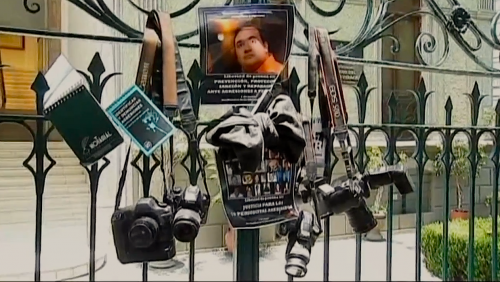
Impromptu Mexican Journalist Memorial
Journalists leave their notebooks and cameras in front of an administrative building to show solidarity with their fallen peers. Photo: HispanTV.
In one of the world’s most dangerous countries for journalists, the Mexican press has suffered the disappearance and murder of dozens of media personnel over the past decade. The ongoing conflict between the military and rival drug cartels is fraught with complication and corruption, resulting in rampant and unpunished violence against reporters.
The violence against the press has intensified to the extent that some outlets have ceased reporting on drug violence altogether. The Committee to Protect Journalists (CPJ) lists 11 reporters who have been killed in Mexico in 2011 and 2012, but at least three others are absent from their count. Below Sampsonia Way lists the journalists who have lost their lives in the line of duty over the last two years. This list does not contain the names of those who have been abducted and not found.
May 18th, 2012.

Marco Antonio Àvila Garcìa, crime reporter for Diario Sonora de la Tarde and El Regional de Ciudad Obregon, was found dead outside the city of Empalme, state of Sonora. He had been kidnapped the day before 70 miles away in Ciudad Obregon. His body was accompanied by a message from a cartel and showed signs of torture. Avila’s news director says he was an experienced reporter who worked on drug trafficking stories, but never mentioned suspects by name.
Gabriel Huge and Guillermo Luna
Gabriel Huge Còrdova, left, and Guillermo Luna Varela, right, were found dead near a canal in Boca del Rio. Photo: Notiver.
May 3rd, 2012.

Gabriel Huge Còrdova and Guillermo Luna Varela were killed in Boca del Rio (Veracruz state). Huge and Luna had both previously worked for Notiver as photographers: Huge had moved into freelance work and Luna was working with Veracruznews at the time. Their bodies were found dismembered in trash bags along with those of two other individuals: Estaban Rodriguez and Irasema Becerra. Rodriguez, a former camera operator for TV-Azteca and photographer for local newspaper AZ, had left journalism and been working as a welder. Becerra was Luna’s girlfriend and was employed by newspaper El Dictamen, though not as a journalist.
April 28th, 2012.

Regina Martìnez Pèrez, a well-known and respected investigative journalist for national magazine Proceso, had reported on political corruption and organized crime for over a decade. She was found beaten and strangled inside her own home. The intruders had removed her computer, television, and mobile phones.
January 6, 2012.

Ràul Règulo Garza Quirino, a journalist for La Ùltima Palabra, was gunned down in his car not far from his home. La Ùltima Palabra does not focus on crime and the next day gunmen returned to the scene and killed his neighbor, who owned the same model car. Garza’s death was believed to be a case of mistaken identity.
September 24, 2011.

Maria Elizabeth Macìas Castro was found beheaded in Nuevo Laredo. She had posted about cartel activities on a local awareness website, and a computer mouse and keyboard were left beside her body, along with a note alluding to her internet activism signed by a drug cartel. She allegedly was the editor for newspaper Primera Hora, but the publication would not confirm she held a position there.
September 1, 2011.

Ana Marìa Yarce Viveros and Rocio Gonzàlez Tràpaga were found naked, strangled, and shot in a Mexico City park. Yarce was the founder of investigative biweekly magazine Contralìnea. Gonzàlez was a freelance reporter, previously with Televisa. Authorities have ruled the case a “femicide” and assert their deaths were not related to their professions.
Humberto Millan Alive and Dead
Left: Millan, 53, before his death. Right: Millan's body as it was discovered. Photos: Al Instante and Borderland Beat.
August 24, 2011.

Humberto Millàn Salazar, writer for online news site A Discusion and host of a program on Radio Fòrmula was left in a field near Sinaloa with a gunshot wound to the head. Though Sinaloa is home to the Sinaloa cartel, colleagues allege his death likely had to do with his reporting on politics rather than drug trafficking.
July 26, 2011.

Yolanda Ordaz de la Cruz. A longtime police beat reporter for Notiver, Ordaz’s decapitated body was left in Veracruz outside the offices of another newspaper, Imagen. The state prosecutor received criticism for initially claiming that her killing was unrelated to her work and suggesting that she herself had links to organized crime. At the time of her killing she was believed to have been researching the death of Miguel Àngel Lòpez Velasco, who had been her boss.
Miguel Angel Lopez
Miguel Lòpez is one of several journalists killed in Veracruz in recent years. Photo: Notiver.
June 20, 2011.

Miguel Àngel Lòpez Velasco and his son Misael Lòpez Solana were killed when gunmen burst into their Veracruz home early in the morning. Miguel, 55, was a prominent columnist and former deputy editor of Notiver. Misael, 21, worked as a photographer for the same publication. Miguel’s wife (Misael’s mother) was also killed in the attack.
March 25, 2011.

Luis Emanuel Ruiz Carrillo, writer for La Prensa, was kidnapped and found shot in Monterrey along with two other individuals, including Josè Luis Cerda Melèndez. Cerda was a popular television host that Ruiz had traveled to do a story about for La Prensa. Graffiti near the location of the bodies indicated that the killings were related to a drug cartel, and Cerda was likely the intended target. An incidental victim, Ruiz was 21 years old.
March, 2011.

Noel Lòpez Olguìn, a columnist for La Verdad de Jàltipan, was kidnapped on March 8th and found on May 31st in Chinameca, buried in a clandestine grave. His column, “Con pluma de plomo” (With a Lead Pen) contained aggressive and specific coverage of drug crimes and political corruption. An arrested gang leader confessed to the killing and led authorities to his grave.

    Calls Grow For Death Probe

    Calls Grow For Death Probe:
    Thousands of people have signed an online petition, joining growing calls for a government probe into the death of veteran 1989 pro-democracy activist Li Wangyang after official claims that he killed himself while in police custody were disputed by activists and a Hong Kong official.

    The Google Docs-based petition titled "Urgent Appeal for a Credible Investigation into the Truth of Li Wangyang’s Death" had garnered eight thousand signatures in total by Tuesday, including signatures collected on the streets of Hong Kong,

    The petition, which was initiated by veteran journalist and blogger Wen Yunchao and a number of Hong Kong-based pro-democracy groups, is indicative of a growing mood of public outrage and suspicion surrounding Wang's death.

    A small group of activists in the southwestern city of Chengdu on staged a small protest of around a dozen people in Li's memory.

    "We think the explanation of suicide is pretty unbelievable," said Chengdu protester Li Yu. "If Li Wangyang can commit 'suicide' then this could happen to any one of us."

    Shanghai-based independent writer Li Huaping said he had written an open letter online, calling for a full probe into the circumstances surrounding Li's death.

    "The same day I published it, the Shanghai state security police asked me what I meant by it," Li Huaping said. "I said that we want ... to know the truth, because in the absence of the rule of law and the truth, there is no bottom line."

    "They gave me a warning, very good-naturedly, because this topic is still very sensitive from China's point of view, they said."

    Activists, politicians and even government officials in Hong Kong have responded to Li's death, with further demonstrations planned for July 1, the anniversary of the former British colony's 1997 return to Chinese rule.

    Official doubts

    Hong Kong's Food and Health Secretary York Chow said on Tuesday he doubted the nearly deaf and blind activist could hang himself, while Sin Chung-kai, vice-chairman of Hong Kong's Democratic Party, said the petition organizers hoped to raise at least 10,000 signatures ahead of July 1, when Hong Kong celebrates the 14th anniversary of its handover to Chinese rule.

    "When President Hu Jintao visits Hong Kong to celebrate the handover anniversary, we will hand it to him," Sin said. "The main thing we want from this campaign is a full investigation into the cause of Li Wangyang's death."

    "We hope that the central government will send officials to carry out a comprehensive probe, and report back on the cause of Li Wangyang's death to the general public."

    The petition was signed by "citizens who are deeply concerned with the state of human rights and the democratic development in China."

    It called for the probe to be monitored throughout by representatives of family and friends and the findings presented to the public.

    It also called on officials to allow Li’s friends to visit his home, send their condolences, and help with the funeral and other affairs, and for the authorities to "hold local police accountable for their criminal and civil responsibilities for Mr. Li’s death."

    The signature campaign follows a demonstration by thousands of people in Hong Kong who carried symbols of mourning for Li and who called for a full investigation into his death.

    Independent Chinese author Sun Liyong said the demonstration showed that Hong Kong people were "China's conscience."

    "This gives great support to those people who sacrifice their own freedom for the cause of freedom in China," Sun said. "We embrace these people who are far from the spotlight, who are quietly dedicated to the cause."

    "The reaction in Hong Kong was really great, with everyone coming out on Li Wangyang's behalf," he said.

    Circumstances questioned

    Li Wangyang, 62, died at a hospital in Shaoyang city in the custody of local police last week. When relatives arrived at the scene, his body was hanging by the neck from the ceiling near his hospital bed, but was removed by police soon afterwards.

    Relatives, friends, and rights groups have all called into question several details of both circumstance and timing which they say point to the possibility of foul play, including photographs distributed on the Chinese microblog service Sina Weibo, which showed Li’s feet touching the floor.

    Police took away Li’s corpse after his death was discovered and have kept it in an unknown location, Li's relatives said.

    Li's death came as Chinese authorities moved to crack down on dissidents and rights activists around the country, in a bid to prevent any public memorials on the 23rd anniversary of the June 4, 1989 bloodshed.

    Li, a former worker in a glass factory, was jailed for 13 years for "counterrevolution" after he took part in demonstrations inspired by the student-led protests in Beijing, and for a further 10 years for "incitement to overthrow state power" after he called for a reappraisal of the official verdict on the crackdown.

    He was blind in both eyes and had lost nearly all his hearing when he was finally released from prison in May 2011, his family said.

    Chinese activists began a campaign this week via Twitter to issue statements saying that they would never commit suicide, in an attempt to stymy any future attempts to do away with them.

    Beijing-based rights activist Hu Jia, who has served a three-and-a-half jail term for subversion, wrote, in comments translated by the Shanghaiist blog: "I guess I need to get the following document notarized at the lawyer's. It will say: 'I, Hu Jia, will not commit suicide at any time, because of anyone, in any situation, or for anything.'"

    Hu called on Chinese political prisoners, dissidents, activists and citizens who are illegally detained by national security on a regular basis to make their own copies of the statement, and have them notarized.

    "This country has no lack of people being 'suicided'," Hu wrote.

    Activists began to issue a series of tweets under the hashtag "I will not commit suicide", declaring that they would never commit suicide, and that any subsequent "accidents" that occurred should be treated with extreme suspicion.

    Reported by Wen Yuqing for RFA's Cantonese service, and by Lin Di for the Mandarin service. Translated and written in English by Luisetta Mudie.

    Jun 12, 2012

    World Bank, BDA and Partners Sign New Agreement to Promote Peace and Development in Mindanao

    World Bank, BDA and Partners Sign New Agreement to Promote Peace and Development in Mindanao

    Obama says he was too busy to campaign in Wisconsin recall election

    Obama says he was too busy to campaign in Wisconsin recall election:
    President Obama suggested Monday that he was too busy to campaign in Wisconsin ahead of the recall election that targeted Republican Gov. Scott Walker, whose victory last week has raised questions about whether there are broader implications for the president in the fall.
    Read full article >>


    Obama loses veneer of deniabilty with intelligence leaks

    Obama loses veneer of deniabilty with intelligence leaks:
    Pity the poor Obama administration leakers. They impart their much-cherished secrets to make their man look good and then, at the first chirp of criticism, are ordered to confess their (possible) crimes by the very same president they were seeking to please. In this, they are a bit like the male praying mantis. He does as asked, and then the female bites his head off.
    Read full article >>


    Asian Airlines Take a Gamble

    Asian Airlines Take a Gamble: Asia's premium airlines are creating discount airlines. But if history is a guide, Peach, Scoot and Smile could end up in the discount-airline graveyard alongside Song, Ted and Snowflake.

    Obama's White Base Shows Cracks Compared With 2008

    Obama's White Base Shows Cracks Compared With 2008: U.S. voters' support for Barack Obama is five points below what it was the month before the 2008 election, 46% vs. 51%. But some of his strongest white supporters, such as young adults and the lower-income, show even bigger declines.

    Indonesia lacks world-class executives, says search firm

    Indonesia lacks world-class executives, says search firm: Indonesia still lags behind its peers in Asia in producing t .....


    'Crisis looms if Yingluck won't act'

    'Crisis looms if Yingluck won't act': The country will plunge into a political crisis in the next seven days if Prime Minister Yingluck Shina-watra refuses to take responsibility and refuses to issue a royal decree to close the House sess .....

    Budding Filipino taipans urged to study in China

    Budding Filipino taipans urged to study in China: Many Filipino executives and entrepreneurs turn to Western universities for their masters in business administration. But a British professor from China’s largest business school, himself once part .....

    Entrenched prejudice

    Entrenched prejudice: Pakistan, India and Bangladesh share more than just a common history. All three countries are also battling entrenched discrimination for different reasons against certain sections of the population. .....


    The biggest little Buddha

    The biggest little Buddha: An enormous emerald, unearthed in Africa after perhaps two million years and reincarnated in Thailand as an image of the Lord Buddha, has been given the mission of promoting global peace and begun wha .....

    As writers migrate to the Internet, reviewers follow suit

    As writers migrate to the Internet, reviewers follow suit: Earning 1 million yuan (US$157,000) a year is a faraway dream for most Chinese book critics, as low pay tends to come with the career.But a new platform may make it possible. Cloudary Corp, which run .....

    Towards a new Arab cultural revolution

    Towards a new Arab cultural revolution: As the Arab Awakening veers sharply from being a project of reform and democracy towards a Gulf states-funded initiative to restore regional Sunni primacy, the strategy is becoming clear. Qatari and Saudi dollars will steer "stirrings" towards radical Salafism so their absolute monarchies can assert leadership of a new, wider Muslim polity. The cultural shift towards intolerance and hegemony is already causing uncertainty and desperation across the region. - Alastair Crooke (Jun 12, '12)

    Researchers find link between spying programs

    Researchers find link between spying programs: Experts say recently uncovered Flame shares software code with Stuxnet virus that targeted Iran's nuclear programme.

    Coroner finds dingo took Australian baby

    Coroner finds dingo took Australian baby: A 32-year legal mystery has came to an end in a case that split national opinion and attracted global headlines.

    Turkey to allow Kurdish lessons in schools

    Turkey to allow Kurdish lessons in schools: Reform aimed at easing tensions with Kurdish minority hailed as "a historic step" by Turkish prime minister Erdogan.

    Denialistan: Part Two

    Denialistan: Part Two:

    Should Pakistani writers hide their country’s problems from the world?

    Shahbaz Bhatti, murdered minority leader
    Shahbaz Bhatti, Minister for Minorities Affairs, was murdered for speaking out against blasphemy laws. Photo: Youtube user AlJazeeraEnglish


    In the first installment of Denialistan Shah called some of a book club’s members Denialistanis after they criticized her book Slum Child for its depiction of the discrimination Christians face in Pakistan.
    1. Pakistan is a country of contradictions – full of promise for growth, modernity and progress, yet shrouded by political, social and cultural issues that undermine its quest for identity and integrity. My bi-monthly column “Pakistan Unveiled” presents stories that showcase the Pakistani struggle for freedom of expression, an end to censorship, and a more open and balanced society.
    2. Bina Shah is a Karachi-based journalist and fiction writer and has taught writing at the university level. She is the author of four novels and two collections of short stories. She is a columnist for two major English-language newspapers in Pakistan, The Dawn and The Express Tribune, and she has contributed to international newspapers including The Independent, The Guardian, and The International Herald Tribune. She is an alumnus of the International Writers Workshop (IWP 2011).
    Some of the other members of the book club said that as a writer, I had the right to write whatever I wanted, and that the “truth” is a subjective concept anyway. Besides, what was wrong with pointing out the ills of our society? Isn’t that what a writer is supposed to do? “But it will give a negative image of Pakistan to the world,” came the response. Yet Slum Child had to be written, I said. It’s my job as a writer to speak honestly about what I see.
    Then a woman further down the table spoke out, saying she was a Christian and that everything I was talking about, she had experienced. She started talking about how many times she’d lost out on a job opportunity or been humiliated for her religious beliefs. She said that she had been called “shameless” and other epithets, and that she was told Christians had corrupted the “pure” religion, a belief common to many Muslims, and one which I had written about in Slum Child.
    She kept seeking out my eyes, and I felt the strongest bond of connection that I can remember feeling with another human being, let alone a complete stranger. It was as if she was telling me that she knew I understood. And I was telling her that I did. In writing the book, and speaking the way I had that evening, I had validated her experience of being discriminated against. I had shown her that her struggle had not gone unnoticed. That, to me, was “the truth.” Knowing that I had reached one person who needed to hear this message felt better than if I’d sold a million copies and appeared on Oprah’s Book Club.
    For many days after the event my mind kept going back to that Christian woman in the book club, who, when the evening ended and I was preparing to leave, took me aside and asked me how I had the courage to write and speak about such controversial subjects. She thanked me for coming that evening, and said that I had given her the courage to talk about her experiences. Previously she had bottled them up inside her, unable to write them down. “Every time I tried, my pen would just stop after a few paragraphs,” she said.
    I told her I was stupid, not brave. She was the brave one for living that life, not me just for writing about it.

    Forced Abortions in Hunan

    Forced Abortions in Hunan:
    Authorities in the central Chinese province of Hunan have forced a woman to abort the child she was carrying at seven months after she failed to pay a large fine for exceeding local birth quotas under the "one-child" policy, she and her relatives said Tuesday.
    Speaking from a local hospital in her home county of Zhenping, Feng Jianmei said she had been forced to have the procedure by local family planning bureau officials after she failed to pay a 40,000 yuan fine for an "excess birth" under China's draconian population control policies.
    Feng, speaking briefly from her hospital bed, said that she hadn't consented to the procedure.
    "I have just given an interview with a reporter. My head really hurts...No, it wasn't [with my consent.] It was forced. That's what happened."
    Feng's husband Deng Jiyuan said his wife was taken away on June 2 by officials from the local family planning bureau and given an injection at the Zhenping county hospital without her consent. Two days later, she lost the baby.
    A photograph taken at the time and later posted on the Tianwang rights website's discussion forum showed Feng lying in a hospital bed with her dead baby beside her.
    "They gave her the injection on June 2, and the child was stillborn at 3:00 a.m. on the morning of June 4," Deng said. "They gave the injection directly into the child's head."
    "She didn't agree to this...They grabbed her hand and forced her to sign," he said.
    Deng said he and Feng had agreed to pay a fine of 40,000 yuan levied by officials as a fine for the unapproved birth, but that they had forced her abortion anyway.
    He said the child would have been the couple's second.
    One-child policy
    An employee who answered the phone at the hospital where Feng was staying confirmed she was there.
    "I heard them talking about this woman this morning," the employee said. "Family planning is a basic national policy, which we implement, and provide services for afterwards. We have here such a thing as a special birth permit."
    The employee denied that forced abortion was a regular part of China's one-child population controls. "There is no coercion," the employee said. "There is ideological work, but we can't force [people]."
    "I don't know the details, but I don't think that we would do such a thing. She is probably just exaggerating things on the Internet. I am guessing that there is no truth in it."
    Asked if she saw a number of terminations, the worker replied, "No, because we are person-centered and we have to become more humane... Only the leaders can answer your questions."
    forced-abortion-cao-ruyi-400
    Cao Ruyi at the Women and Children's Baojian Hospital in Hunan province, June 8, 2012. Photo courtesy of Women's Rights in China.
    Changsha
    Meanwhile, Cao Ruyi, a resident of Hunan's provincial capital Changsha, said she had also been forced to abort her child after she received a notice to terminate her pregnancy and a demand for 10,000 yuan in fine money after she got pregnant without official approval.
    Changsha officials freely admitted that abortions could be carried out as late as six months in cases of unapproved pregnancies.
    "She should have gotten the permit first and had the baby afterwards," said an official who answered the phone at the Hongshan neighborhood committee in Cao's home district of Kaifu. Asked if she wouldn't be allowed to have a baby if the permit wasn't issued, the official said, "Those are the rules."
    "As for forcing, there's no use in her saying she doesn't want it. We try to talk her round, work with her, I guess."
    "Her pregnancy is an illegal one. If she really doesn't want [to abort] we will have to pursue it through legal channels."
    Asked if there had been a relaxation in family planning controls in recent years, the official replied, "Who says there's been a relaxation?"
    Asked about the abortion of a seven-month-old fetus, the official said: "If she agrees, then we would definitely go through with it."
    An employee who answered the phone at the Women and Children's Baojian Hospital in Changsha confirmed that the hospital carried out abortions on behalf of family planning officials.
    "Here, we need to see a permit from the family planning bureau," the employee said. "If the family planning department wants us to terminate it, we'll terminate it."
    The official said the limit for terminations was six months, adding, "But we'll proceed according to circumstances."
    Reported by Fang Yuan for RFA's Mandarin service and by Hai Nan for the Cantonese service. Translated and written in English by Luisetta Mudie.

    Groups Highlight Rights Concerns

    Groups Highlight Rights Concerns:
    Rights groups have highlighted deteriorating human rights, government intimidation of the opposition, and land grabs in Cambodia on the eve of a visit by Foreign Minister Hor Namhong to Washington for talks with his counterpart U.S. Secretary of State Hillary Clinton.

    The one-day visit will take place on Tuesday, during which Hor Namhong is expected to discuss with Clinton and other senior U.S. officials issues related to security in Asia, regional use of the Mekong River, and the Association of Southeast Asian Nations (ASEAN), which Cambodia is chairing this year.

    He will also request the U.S. to cancel Cambodia’s debt of around U.S. $440 million, including interest, which it incurred through agricultural aid during the Lon Nol era of the 1970s. Prime Minister Hun Sen has called the loan Cambodia’s “dirty debt.”

    In a petition addressed to Clinton, Cambodian Americans for Human Rights and Democracy and Khmer People’s Network for Cambodia wrote that human rights conditions in Cambodia have gone “from bad to worse” over the last two decades.

    “Initially, the victims of human rights violations had mostly been people who Prime Minister Hun Sen, his wife, and his associates considered potential opponents, competitors, detractors, environmentalists, unionists, and human rights defenders,” the statement read.

    “Now, they have widened their focus to include land owners, members of their families, and those who sympathize with their causes.”

    Rights petition

    The groups requested Clinton push the Cambodian government to reinstate parliamentary immunity to three opposition lawmakers from the Sam Rainsy Party (SRP), to allow the return of self-exiled party leader Sam Rainsy, and to reform the National Election Committee ahead of parliamentary polls slated for mid-2013.

    Sam Rainsy currently lives in exile in France and is facing a two-year jail sentence for uprooting markers at the border with Vietnam in 2009, if he returns. He has said that he plans to return for the elections to lead the opposition against the ruling Cambodian People’s Party (CPP).

    Hor Namhong said Sunday that the government is considering revoking Sam Rainsy’s passport, though an SRP spokesperson said that as a legal citizen of France, the opposition leader can travel on his French passport and his overseas plans should not be affected.

    The U.S.-rights groups also pointed to a longstanding dispute between tens of thousands of residents of capital Phnom Penh’s Boeung Kak Lake district who were evicted from their homes, or are in risk of losing them, and developers looking to turn the area into a luxury residential and shopping center.

    Last month, a Phnom Penh court ordered 15 women jailed for between one year and two and a half years for their part in protests which authorities said “encroached on private property” on the site. The rights groups called for their release in the petition to Clinton.

    The rights groups have also asked for U.S. assistance to “ensure the full independence of the judiciary branch of the government,” which opposition lawmakers have called a “political tool” of the CPP. The top officials of Cambodia’s Supreme Court are CPP members.

    The visit has brought criticism from Cambodian rights groups who say they will hold protests in front of the U.S. State Department on Tuesday during the meeting between the two diplomats.


    mu-sochua-rfa-400.jpg

    Mu Sochua prepares for an interview at RFA, June 8, 2012. Credit: RFA
    Aid suspension

    SRP lawmaker Mu Sochua, who is visiting the U.S., said she held talks with Clinton Monday in Boston, Massachusetts, at the inauguration of a two-week women’s leadership conference.

    She said in her talks, she asked Washington to suspend any military aid to Cambodia as the authorities in Phnom Penh had used the armed forces to evict people in land disputes.

    Mu Sochua also sought Clinton’s help to bring about the release of the 15 Boeung Kak women villagers being held at Prey Sar prison.

    “I requested her [Clinton] to suspend military aid to Cambodia,” she told RFA after the talks.

    “Madame Hillary Clinton has promised me that she would seek a solution to make sure women’s rights will be respected and put an end to violence.”

    Cambodian Americans for Human Rights and Democracy coordinator Saunora Prom said he believes pressure by the U.S. could help to influence Cambodia on the issues.

    “I am confident that the U.S. will resolve these issues because they are in the U.S. interest,” he said.

    Mekong initiative

    Speaking to reporters before he left Phnom Penh Sunday, Hor Namhong said that besides raising Cambodian issues with Clinton, he will also discuss issues linked to ASEAN and the Lower Mekong Initiative (LMI).

    The LMI was created following a 2009 meeting between Clinton and the foreign ministers of the Lower Mekong countries, Cambodia, Laos, Thailand, and Vietnam, in order to enhance cooperation in the areas of environment, health, education, and infrastructure development.

    Hor Namhong said Sunday that he expects Tuesday’s meeting with Clinton to yield improved relations between the two nations and their role in the Asian region.

    “The U.S. and Cambodia, we have many cooperation forums … we will also talk about regional issues,” he said.

    He said he hoped that the U.S. would consider cancelation of Cambodia’s debt, despite earlier talks where the two sides had failed to see eye-to-eye.

    “We have negotiated many times already, and we hope that we will do whatever we can for the two parties [U.S. and Cambodia] to reach an agreement,” he said.

    Clinton is due to visit Phnom Penh in mid-July to participate in the ASEAN Foreign Ministers Meeting.

    Reported by Samean Yun and Sok Serey for RFA’s Khmer service. Translated by Samean Yun. Written in English by Joshua Lipes.

    Jun 11, 2012

    Majority of Union Members Favor Obama; a Third Back Romney

    Majority of Union Members Favor Obama; a Third Back Romney: Fifty-seven percent of union workers who are registered to vote would support Barack Obama, while 35% would vote for Mitt Romney. Workers who are not union members tilt toward Romney over Obama, 48% to 44%.

    Congress Approval at 17% in June

    Congress Approval at 17% in June: Americans' approval of Congress is at 17% in June, similar to the 15% in May, and continuing the generally low levels seen since last June.
    Jeb Bush Takes Aim at Fellow Republicans: Mr. Bush said today’s Republican Party is out of step with the legacy of his father and Ronald Reagan.

    How the Khmer Rouge dehumanised their “enemies”

    How the Khmer Rouge dehumanised their “enemies”:

    Photo courtesy of Akshay Mahajan (Creative Commons licence)
    After a long period of relative silence, the most tragic period in Cambodia’s history has experienced a renaissance of interest. Spurred by the ongoing tribunal and a slew of excellent films including Enemies of the People, Lost Loves and Brother Number One, this attention demonstrates the continuing efforts made towards understanding the Khmer Rouge regime, as well as the difficulty of achieving reconciliation with such a traumatic past.
    Yet one aspect of Democratic Kampuchea remains neglected, and relates to the way the Khmer Rouge used language to facilitate their murderous policies. As well as using dehumanising language to denigrate ‘New People’ (neak thmei) as unworthy of human compassion, Khmer Rouge parlance constantly applied metaphors of health and the body to both individuals and society at large.
    Physical and moral purity were consistently emphasised by cadre who demanded behaviour bordering on pious religiosity, with Angkar the recipient of reverence. Inability to meet such high standards denoted disease and decay that were likely to infect others, with prophylaxis and excision the only method employed to stop the rot.
    Enemies were ‘worms’ (dangkow) who ‘gnawed the bowels from within’ (see roong ptai knong). They represented ‘no loss’ (meun khaat) when ‘weeded out,’ (daak jenh) whilst victims of enforced migration were ‘parasites’ (bunhyaou k’aek) who ‘brought nothing but bladders full of urine’ (yoak avey moak graowee bpee bpoah deuk) The sick were ‘victims of their own imagination,’ (chue sotd aarumn) unlike the party who remained ‘strong’ (kleyang) and ‘healthy’ (dungkoh).
    All this is, of course, nothing new. For the Soviets, the Cossacks were ‘malignances’ to be ‘removed’, Tutsi victims in Rwanda were labelled ‘cockroaches,’ whilst perhaps the most obvious victims of such an exclusionary discourse were the Jews in Nazi Germany, as famously documented by Victor Klemperer. This practice not only dehumanises victims, but it also legitimises violence by glorifying it and insinuating that it promotes ideals of purity and health in the broader socio-political body.
    This pseudo-medical discourse is essentially an aesthetic undertaking. It envisages an ideal society as culturally and often racially homogenous, and attempts to justify horrific tragedy as the price for harmonious utopia. In Cambodia, the Khmer Rouge demonstrated how an aesthetic vision can quickly degenerate into a society devoid of the traits of humanity. As a result, we should be particularly wary of regimes that employ such remedial, exclusionary rhetoric, because of the inherent dangers its implementation may portend.
    Fionn Travers-Smith is a history postgraduate at the School of Oriental and African Studies, London.

    Art for the people - Inside Indonesia

    Art for the people - Inside Indonesia - a quarterly magazine on Indonesia and its people, culture, politics, economy and environment

    Review: The ‘man question’ in Indonesian film and literature - Inside Indonesia

    Review: The ‘man question’ in Indonesian film and literature - Inside Indonesia - a quarterly magazine on Indonesia and its people, culture, politics, economy and environment

    Review: Men and masculinities - Inside Indonesia

    Review: Men and masculinities - Inside Indonesia - a quarterly magazine on Indonesia and its people, culture, politics, economy and environment

    Combating domestic violence - Inside Indonesia

    Combating domestic violence - Inside Indonesia - a quarterly magazine on Indonesia and its people, culture, politics, economy and environment

    The winds of change - Inside Indonesia

    The winds of change - Inside Indonesia - a quarterly magazine on Indonesia and its people, culture, politics, economy and environment

    What Would a Second Obama Term Bring? : The New Yorker

    What Would a Second Obama Term Bring? : The New Yorker

    The Miseducation of Mitt Romney

    The Miseducation of Mitt Romney: Diane Ravitch


    Mario Tama/Getty Images
    Republican candidate Mitt Romney participating in a 6th grade class at Universal Bluford Charter School, Philadelphia, Pennsylvania, May 24, 2012.


    On May 23, the Romney campaign released its education policy white paper titled “A Chance for Every Child: Mitt Romney’s Plan for Restoring the Promise of American Education.” If you liked the George W. Bush administration’s education reforms, you will love the Romney plan. If you think that turning the schools over to the private sector will solve their problems, then his plan will thrill you.

    The central themes of the Romney plan are a rehash of Republican education ideas from the past thirty years, namely, subsidizing parents who want to send their child to a private or religious school, encouraging the private sector to operate schools, putting commercial banks in charge of the federal student loan program, holding teachers and schools accountable for students’ test scores, and lowering entrance requirements for new teachers. These policies reflect the experience of his advisers, who include half a dozen senior officials from the Bush administration and several prominent conservative academics, among them former Secretary of Education Rod Paige and former Deputy Secretary of Education Bill Hansen, and school choice advocates John Chubb and Paul Peterson.

    Unlike George W. Bush, who had to negotiate with a Democratic Congress to pass No Child Left Behind, Romney feels no need to compromise on anything. He needs to prove to the Republican Party’s base—especially evangelicals—that he really is conservative. And this plan is “mission accomplished.”

    Romney offers full-throated support for using taxpayer money to pay for private-school vouchers, privately-managed charters, for-profit online schools, and almost every other alternative to public schools. Like Bob Dole in 1996, Romney showers his contempt on the teachers’ unions. He takes a strong stand against certification of teachers—the minimal state-level requirement that future teachers must pass either state or national tests to demonstrate their knowledge and/or skills–which he considers an unnecessary hurdle. He believes that class size does not matter (although he and his children went to elite private schools that have small classes). Romney claims that school choice is “the civil rights issue of our era,” a familiar theme among the current crop of education reformers, who now use it to advance their efforts to privatize public education.

    When it comes to universities, Romney excoriates Obama for the rising cost of higher education. He claims that more federal aid leads to higher tuition, so he offers no new federal funding to help students burdened with debt. His plan does not mention the fact that tuition has increased in public universities (which enroll three-quarters of all students) because states have reduced their investments in higher education and shifted the burden from taxpayers to students. Romney will encourage private sector involvement in higher education, by having commercial banks again serve as the intermediary for federal student loans, an approach Obama had eliminated 2010 as too costly. (Until 2010, banks received guaranteed subsidies from the federal government to make student loans, while the government assumed nearly all the risk. When the program was overhauled by the Obama Administration, billions of dollars in bank profits were redirected to support Pell Grants for needy students.) To cut costs, Romney encourages the proliferation of for-profit online universities.


    The Romney education plan says that no new money is needed because more spending on schools will not fix our problems. However, he proposes to dedicate more taxpayer money to the priorities that he favors, such as vouchers, charter schools, and online schools. He also wants more federal money to reward states for “eliminating or reforming teacher tenure and establishing systems that focus on effectiveness in advancing student achievement.” Translated, that means that Romney is willing to hand out money to states if they eliminate due process rights for teachers and if they pay more to teachers whose students get higher scores on standardized tests and get rid of teachers whose students do not.

    In making the case for vouchers—which provide government funding to pay the tuition at any private or religious school that parents choose—Romney exaggerates the evidence; indeed, some of his claims are simply false. He points to the D.C. voucher program, which began in 2004, the first program to use federal tax dollars to subsidize private-school tuition—as “a model for the nation.” He asserts that “After three months, students [in the D.C. voucher program] could already read at levels 19 months ahead of their public-school peers.”


    This is flatly wrong. A Congressionally-mandated evaluation of the D.C. program found that students with vouchers made no gains in either reading or math. As the report stated, “There is no conclusive evidence that the OSP [Opportunity Scholarship Program] affected student achievement.” Romney claims that 90 percent of voucher students graduated from high school, as compared to only 55 percent in the low performing public schools of D.C. But here he exaggerates. The federal evaluation of the program said that 82 percent of the students receiving vouchers graduated from high school as compared to 70 percent of the students who applied to the voucher program and were not accepted. This is a respectable gain, but nowhere near as large as the numbers Romney cited. Because students who enter a lottery tend to be more motivated than those who do not, reputable social scientists usually compare the outcomes of those who won the lottery and those who did not.

    Paradoxically, Romney’s campaign takes credit for the fact that Massachusetts leads the nation in reading and mathematics on the federal tests known as the National Assessment of Educational Progress. But Romney was not responsible for the state’s academic success, which owes to reforms that are entirely different from the ones he is now proposing for the country. Signed into law a full decade before Romney began his tenure as governor in 2003, the Massachusetts Education Reform Act involved a commitment by the state to double state funding of public education from $1.3 billion in 1993 to $2.6 billion by 2000; to provide a minimum foundation budget for every district to meet its needs; to develop strong curricula for subjects such as science, history, the arts, foreign languages, mathematics, and English; to implement a testing program based on the curriculum (because of costs, the state tested only reading and math); to expand professional development for teachers; and to test would-be teachers. In the late 1990s, again before Romney assumed office, the state added new funds for early childhood education.

    Romney’s plan, by contrast, is animated by a reverence for the private sector. While little is said about improving or spending more on public education, which is treated as a failed institution, a great deal of enthusiasm is lavished on the innovation and progress that is supposed to occur once parents can take their federal dollars to private institutions or enroll their child in a for-profit online school. Massachusetts attained success by raising standards for new teachers, not by lowering them. Nor did Massachusetts eliminate teacher tenure, that is, the right to a hearing for experienced teachers before they can be fired. Higher education, we are assured, will flourish when “innovation and skill attainment” matter more than “time in classroom.” Put in plain English, the last sentence is claiming that higher education will become more affordable when more students enroll in online universities, most of which are low-cost and for-profit. Of course, online universities are cheaper; they have no capital costs, no library, no facilities, and minimal staff. Some are under investigation for fraud because of their methods of recruiting students; they have fended off federal regulation by a heavy (and bipartisan) investment in lobbying.

    The Obama administration’s first response to Romney’s proposals was to scoff and say that Obama’s K-12 policies had the enthusiastic support of prominent conservative Republican governors, such as Chris Christie of New Jersey and Susana Martinez of New Mexico. Unfortunately, this is true. Apart from vouchers and the slap at teacher certification, Obama’s Race to the Top program for schools promotes virtually everything Romney proposes—charters, competition, accountability, evaluating teachers by student test scores. If anything, Secretary of Education Arne Duncan has been as outspoken on behalf of charters and test-based accountability as Mitt Romney. And, like Romney, Duncan has disdained the issue of reducing the number of students per teacher.

    Romney’s proposal for private-school vouchers is red-meat for the right wing base of the Republican party, especially evangelicals. Vouchers have been the third rail of education politics since Milton Friedman proposed them in 1955; they have been put before the voters in several state referenda and have been consistently rejected. As a general rule, the public does not want public money to support religious schools. And many religious schools are wary about accepting public money and the regulations that eventually are tied to it. But in the past few years, vouchers have been revived by state legislatures in Indiana, Wisconsin, and Louisiana without resorting to popular vote.

    The results are already troubling. In Louisiana, where Governor Bobby Jindal’s education reform legislation was enacted in mid-April, the new law declares that students in low-performing schools are eligible to take their share of state funding to any accredited private or religious school. About 400,000 students (more than half the students in the state) are eligible, but only some 5,000 places are available in the state’s private and parochial schools. When the state posted the list of participating schools, the one that registered to accept the largest number of voucher students was the New Living Word School, which offered to enroll 315 of them. But its current enrollment is 122, and it has no facilities or teachers for the new students, though it promises to erect a new building in time for the beginning of the school year this fall. Most of its instruction is delivered on DVDs.

    Another school, the Eternity Christian Academy, which currently has 14 students, has agreed to take in 135 voucher students. According to a recent Reuters article, students in this school

    sit in cubicles for much of the day and move at their own pace through Christian workbooks, such as a beginning science text that explains “what God made” on each of the six days of creation. They are not exposed to the theory of evolution.
    The pastor-turned-principal explained, “We try to stay away from all those things that might confuse our children.” Some of the other schools that have been approved to receive state-funded vouchers “use social studies texts warning that liberals threaten global prosperity; Bible-based math books that don’t cover modern concepts such as set theory; and biology texts built around refuting evolution.”

    The Reuters reporter described the Louisiana law as “the nation’s boldest experiment in privatizing public education, with the state preparing to shift tens of millions in tax dollars out of the public schools to pay private industry, businesses owners and church pastors to educate children.” Next year, all students in Louisiana will qualify for a voucher to take courses from private vendors or corporations offering courses or training. Expect a boom in new education businesses in Louisiana.

    What Governor Jindal is doing sounds like a template for the Romney plan. With no increase in funding, all the money for vouchers and private vendors and online charters will be deducted from the state’s public education budget. Governor Jindal and Mitt Romney should explain how American education will be improved if taxpayer dollars are used to send more students to sectarian schools and to take their courses from profit-making businesses and online schools.

    In the vision presented by Mitt Romney, public dollars would flow to schools that teach creationism. Anyone could teach, without passing any test of their knowledge and skills and without any professional preparation. Teachers could be fired for any reason, without any protection of their freedom to teach. In some states and regions, teachers will be fearful of teaching evolution or global warming or any controversial issues. Nor will they dare to teach books considered offensive to anyone in their community, like Huckleberry Finn.

    And candidate Romney should explain how privatizing the way we school our children will further his goal of “restoring the promise of American education.” “Restore” suggests a return to the past. When in American history did the for-profit sector run American schools? Which state ever permitted it until the advent in our own time of for-profit charter corporations and for-profit online corporations? Which founding fathers ever railed against public education? John Adams, that crusty conservative, said this:

    The whole people must take upon themselves the education of the whole people and be willing to bear the expenses of it. There should not be a district of one mile square, without a school in it, not founded by a charitable individual, but maintained at the public expense of the people themselves.
    Restoring the promise of American education should mean rejuvenating public schools, not destroying them.

    Former East Timor justice minister receives jail sentence | East ...

    Former East Timor justice minister receives jail sentence | East ...: ABC Radio Australia Updated 8 June 2012, 18:47 AEST - East Timor's District Court has sentenced the former Justice Minister, Lucia Lobato to five years jail for the misadministration of funds. Lobato was found not guilty of ...

    Jun 10, 2012

    Latino Growth Not Fully Felt at Voting Booth

    Latino Growth Not Fully Felt at Voting Booth »
    Latinos are not voting in numbers that fully reflect their potential strength, leaving Hispanic leaders frustrated and Democrats worried as they increase efforts to rally Latino support.

    As Focus Shifts to Rescuing Spanish Banks, Worries Grow Over Greece 

    As Focus Shifts to Rescuing Spanish Banks, Worries Grow Over Greece »
    Far harder to calculate than a Spanish banking rescue are the costs if, after Greek elections, the new government there reneges on the terms of the bailout Athens negotiated with its European lenders....

    Borrowing by Banks Plagues Europe Despite Aid for Spain 

    Borrowing by Banks Plagues Europe Despite Aid for Spain »
    The intervention in Spain will do little to address the problem that plagues European financial institutions: a longstanding addiction to outside loans that provides day-to-day financing.

    Political Reforms in Malaysia: Winds of Change or Hot Air? | East-West Center | »Justina Chen, Research and Policy Analyst at the Centre for Public Policy Studies (CPPS), Malaysia, explains that “The manner in which the 13th general election is conducted will set the stage for Mal...

    Political Reforms in Malaysia: Winds of Change or Hot Air? | East-West Center | »
    Justina Chen, Research and Policy Analyst at the Centre for Public Policy Studies (CPPS), Malaysia, explains that “The manner in which the 13th general election is conducted will set the stage for Mal...

    Old Alliance for the New Century: Reinvigorating the U.S.-Thailand Alliance

    Old Alliance for the New Century: Reinvigorating the U.S.-Thailand Alliance »
    Free through August 5, 2012. EXECUTIVE SUMMARY. This report examines U.S. and Thai perspectives on the U.S.-Thailand alliance with a view to reinvigorating the alliance and, in doing so, strengthening...

    Syrian Group Picks Kurdish Dissident as Leader

    Syrian Group Picks Kurdish Dissident as Leader: The main opposition group outside Syria chose a Kurdish dissident as its new leader, an attempt to forge a broader coalition against the regime of President Bashar al Assad.

    LinkedIn Breach Exposes Light Security Even at Data Companies

    LinkedIn Breach Exposes Light Security Even at Data Companies: Part of the problem may be that there are few consequences for companies with a lax attitude toward data. There are no legal penalties, and customers rarely defect.