Jul 25, 2012

Yingluck and Thaksin’s effective double game?

Yingluck and Thaksin’s effective double game?:
Pavin in WSJ:
Ms. Yingluck and Mr. Thaksin have so far executed an effective double game, with the former frequently bowing to the traditional elite while the latter maneuvers behind the scenes to consolidate power at the expense of establishment interests. The thrust to amend the constitution is part of Mr. Thaksin’s carrot-and-stick tactics, which are splitting the establishment camp.
The military has remained conspicuously silent about the government’s plan to pass reconciliation bills to grant amnesty for crimes committed during political upheavals. That would allow Mr. Thaksin to return to Thailand, reclaim assets confiscated by the courts and re-enter politics. Given that the military staged a coup in 2006 to remove him, its acquiescence now might seem surprising.
But the military would be one of the main beneficiaries of an amnesty, since it would be “off the hook” for any culpability in the deaths of almost 100 pro-Thaksin protesters in 2010. In May, state prosecutors said that they had compiled enough evidence to implicate the military in as many as 18 of 92 protest-related deaths. One military insider has said publicly that the top brass and all generals in line for promotion want the reconciliation bills to move ahead.
A few months back, Crispin in Asia Times with a piece entitled “Daring double game in Thailand”:
While Prime Minister Yingluck Shinawatra has taken a conciliatory tack to the country’s still unresolved seven-year-old political conflict, her self-exiled elder brother, former premier Thaksin Shinawatra, and his advisers have worked from behind the scenes to consolidate political power at the expense of rival royalist establishment interests.
Bureaucratic reshuffles, newly laid or threatened criminal charges and proposed constitutional changes have all enhanced the criminally convicted Thaksin’s negotiating leverage vis-a-vis royalist power centers, including in the military, judiciary and palace, to achieve a political amnesty that would restore his court-confiscated wealth and ultimately allow for his return to Thailand as a free man.
A new drive to achieve an amnesty through parliamentary means has met predictable resistance from the opposition Democrat party and anti-Thaksin People’s Alliance for Democracy (PAD) protest group, and raised the specter of new instability after over a year of relative political calm.
Recommendations submitted by a local think-tank to a parliamentary reconciliation subcommittee proposed an amnesty for offenses committed on both sides of the political divide and a reversal of decisions handed down against Thaksin by military coup maker-created bodies.
BP: When Crispin wrote that a few months ago, BP thinks you can say “yes” Yingluck and Thaksin were playing an effective double game. But now? Not sure that BP would agree with Pavin now. There was a possibility of following the KPI amnesty proposal by first holding public hearings. The Speaker conceded this should be done, but this concession only came  after the reconciliation bills had been introduced and postponed and we had protests. BP has been trying to figure out Thaksin’s rationale for introducing the reconciliation bills at that time To test the waters? Was the strong reaction unexpected? No. It is like turning on an oven element and touching it to see if it is hot. Yes, of course it is. The bills were introduced and then postponed, a week later. So what was achieved? Nothing. If this is part of some master plan then it must be a very long game before it will bear fruit as now there are no signs it has worked.
Pushing through the constitution amendments was always going to be hard because the establishment cares less about amnesty than the constitution amendments. Amnesty is mostly just a bargaining chip in dealing with Thaksin. As noted in the articles above (in Crispin’s article, you will need to click the link and scroll down), there are benefits for the military with a collective amnesty. Thaksin is unlikely to return anytime soon, or if he does fly into Thailand, it will be for very brief periods of time and he will likely keep a low profile, like he did in 2008. As Crispin notes, the possibility he could be killed, is a real possibility. You just need to see the precautions he took back in 2008 when he returned. Yes, there is a prestige thing for Thaksin, but do the establishment really suffer if there is an amnesty? No. They can also use it to extract concessions out of Thaksin.
The establishment really care about the constitutional amendments as this is the most effective way they have of controlling things. It would have been much more difficult to protest against constitutional amendments if the reconciliation bills had been properly put on the back burner. Before the introduction of the reconciliation bills, the PAD had planned to protest against the amendments, but abandoned those plans. The introduction of the reconciliation bills changed the dynamic, increased the political tensions, and made it easier for the court to intervene with their suggestion/advice.
A few months ago you could have said that Thaksin and Yingluck were playing an effective double game. Now, Yingluck is still playing her role and while her popularity has dropped slightly, it is still in the early 60s  and polls show a clear majority want her to serve out her term. There is no sign that there is a popular movement against Yingluck. For Thaksin though and his tactics, can it still be said he is playing an effective double game? Recently, no. He overplayed his hand and got burnt. What is his next play?

Singapore. The need for peaceful protest and why the Internet alone will not do.

Singapore. The need for peaceful protest and why the Internet alone will not do.:
Ladies and Gentlemen,

If there is one country in the world which is totally abuzz in the Internet with demands for the downfall of their government it has to be Singapore. Every which way you look, there are thousands and thousands of critics who want to see the back of the Singapore ruling family or what is also called the Lee Dynasty.

The demands for change should be obvious. You have Lee Kuan Yew and son and every other member of their family in cushy positions wallowing in corruption. Lee pays himself and each of them $3.7 million a year, 5 times that which Obama gets. The press is state controlled. The legal system is hijacked with government appointed judges who destroy government critics through the courts, the Malays and Indians are racially discriminated, and those at the top are preferentially treated in the courts.

True, with the population completely fed up with this dictatorial regime, with people across the island calling for regime change, change has not only started, it will eventually topple the regime. There is no doubt about that.

You see the unraveling of the regime even now. The brain drain is highest with almost everyone capable of leaving the island doing so. No matter how much the government tries to persuade the people to have more children, it has the lowest birth rate in the world and the highest rates of ageing.

To replace those leaving the island and dying of old age, the government is left with no choice but to bring in Chinese immigrants from mainland China who speak no English to replace them. Because of the low quality of these immigrants, the entire population is degraded and brought down to the level of these Mandarin speaking Chinese coolies.

There is no doubt that if the present trend continues, you will be left with a very inferior sort of population in the island leaving on the one hand educated opportunists who have no principles or self respect except the love of money and on the other hand ignorant dummies who have no idea that they don't have to live like slaves.

In this scenario, change takes time, but it will come. But remember also, no matter how much you sit at your computer writing bad things about the Lee ruling family, you are not going to see instant change. The Lee ruling family will linger on with their propaganda on the state controlled newspapers for some time at least.

If you want to see real change now, you are left with no choice. The message must be clear to you from across the Middle East. Egypt, Tunisia and now Syria will not have changed without the people getting up from the comfort of their computers and getting on the streets. Dictatorships like that of the Lees understand no other logic other than that of open resistance peacefully.

I concede these regimes unlike Singapore's were unimaginably brutal. You are talking about pulling out finger nails. But thank God, Lee does not resort to such brutality, not because he will not but because he understands that such reaction will lead to the island emptying out completely. He represses his people but the repression is a soft kind, such as throwing you out of your job, denying you privileges that other citizens receive and defaming your reputation through the state controlled media.

But my message to those Singaporeans who love their island home is this. If you don't want to see your island completely go to the dogs, which it is presently going, then you have to do what you think is right, protest.

If there is one thing the Lee family it terrified of, it is the lone peaceful protestor standing in Raffles Place surrounded by the high rise office blocks at noon on a working day when thousands and thousands of Singaporeans will be passing. The news of that protestor will spread across the tiny island within 5 minutes. Justice is on the side of this brave protestor, not on the side of the government. Remember the Constitution and the Universal Declaration of Human Rights across the world guarantees this human right of peaceful protest.

It is true that Lee will have this man arrested. But when he does so, across the world his action would be seen to be illegal, no matter what the illegal laws of Singapore were to say.

The moment one man protests, others will follow, and in a few hours if not a few days, the Lee ruling family will be forced to talk and listen to your demands. You will have a new Singapore almost instantly.

I am not asking for violence or bloodshed. Peaceful protests is a proud and noble form of resistance across the world. You are not a criminal for engaging in peaceful protests, instead you are the best citizen, noblest among the noble, with a civic sense of duty which will be respected and admired.

Remember in 2008 when a wrote a blog post in this blog criticizing Lee’s Judge Belinda Ang Saw Ean, and being arrested for it, I was acting in a noble cause and respected for what I did across the world, even if the Lee Ruling Family threw me in jail. Subsequently I was even disbarred from practicing law in Singapore but I remain today proudly on the Rolls of lawyers in California and the English Bar. Singapore might consider me a criminal but not so in the free world which looks at me instead as a noble citizen with the courage to stand up to principle. The Lee Ruling Family has not dared to demand that I be punished and disbarred in California or England for being in their opinion, in the Singaporean sense, a very bad criminal.

To those Singaporeans who wish to arrest the decline of the island to which it is heading through the denial of freedom, democracy and the rule of law by this dictatorial government, I say once again, that you must rise up in peaceful protest and do what is right for your island country.

Gopalan Nair
Attorney at Law
Singaporean by Birth
Fremont, California USA
Tel 510 657 6107 or 510 491 4375

National Day Rally to be held on August 26

National Day Rally to be held on August 26: SINGAPORE: Prime Minister Lee Hsien Loong said his National Day Rally will be held later than usual this year, on August 26, because the Sunday before that is Hari Raya Aidilfitri.

Defining Malaysia’s national identity

Defining Malaysia’s national identity:

Where are Malaysia's leaders?
Malaysian politicians have always been able to define what Malaysia’s challenges are and also know what should be done. The number of “plans and visions” that Malaysia has, attest to this.
The main problem is,  past and present set of political leaders, on both sides of the divide, in general have failed  to provide leadership at critical moments, and instead have sought to preserve power.
This is done through the appeal to their parties ideology. The ideology that underpins each of the main political parties is at odds with what needs to be done in Malaysia.
The United National Malays Organisation (UMNO) ideology is often termed as “Ketuanan Melayu” or Malay supremacy.
Malaysia’s Islamic party (PAS) has the welfare state as its current slogan, but it is essentially about Islamic supremacy (daulah Islamiyya)
Parti Keadilan Rakyat (PKR) is essentially a populist party for its base group, the Malays. It argues for “Ketuanan Rakyat” (supremacy of the people) but on several critical moments (when “Ketuanan Melayu” clashed head on with “Ketuanan Rakyat”), PKR has faltered. The selection of the Selangor state government economic corporation head and PKR leader, Anwar Ibrahim’s strong condemnation of homosexuality are cases in point.
There have of course been momentous occasions when PAS and PKR have stood up against UMNO’s Malay supremacy (such as the Allah issue) but these, while important can be interpreted as strategic rather than principled.
Dr. Helen Ting, from IKMAS (Institute of Malaysian and International Studies) captures the discussions around these ideologies in her paper, ” The Politics of National Identity in West Malaysia: Continued Mutation or Critical Transition
She concludes that:
Historic regime change became conceivable following recent political development. Nonetheless, prospects for radical revision of existing inter-religious dynamics remain dim because Islamic conservatism among Malay politicians transcends party-lines.
Articles by Thomas Pepinsky and Kikue  Hamayotsu in the Malaysia after regime change series, points to the same conclusion.
Does this mean, that Malaysia will perpetually find itself stuck with leaders that cannot lead Malaysia towards the reforms that Malaysia badly needs?

PNG leaders form joint government

PNG leaders form joint government: Papua New Guinea PM Peter O'Neill announces that he will be heading the next government with the support of former bitter rival Sir Michael Somare.

A Right and Significant Verdict on Bersih

A Right and Significant Verdict on Bersih: By Kee Thuan Chye Malaysian Digest 25 July 2012 THE High Court has declared that Bersih (Coalition for Clean and Fair Elections) is not unlawful. And rightly so. Although this comes as a blow to the Government, and especially the Home Minister, the Attorney-General (A-G) should not pursue an appeal. Doing so would hurt the [...]

Pakatan has mixed views on May 13 probe

Pakatan has mixed views on May 13 probe:
PETALING JAYA: Suaram adviser Kua Kia Soong’s call for a Truth and Reconciliation Commission to investigate the May 13 incident has drawn mixed reactions from Pakatan Rakyat leaders.
While PAS backs the call for a public inquiry, PKR and DAP say Malaysians must move on from one of the darkest episodes of Malaysian history.
PAS vice president Salahuddin Ayub said he was in support of Kua’s call, saying that a public inquiry would stop irresponsible quarters from raising the spectre of May 13 for selfish political agenda.
“The young generation needs to know what happened on that day,” said Salahuddin.
However, the PAS leader said it was more important for Barisan Nasional, particularly Umno, to stop playing the May 13 card in an attempt to scare voters into voting BN back to power.
PKR vice president Nurul Izzah Anwar said she was not keen on the formation of the commission saying it was time for Malaysians to let go of the 1969 tragedy.
“Members of my generation don’t recall anything of the incident,” she said.
She said it was more important for the government to draw up policies to promote national integration and back these up with concrete action.
She also expressed fear that some quarters might use the issue to further the agenda of racial politics.
DAP youth chief Anthony Loke said much due diligence would be required in the setting up of the proposed commission and the public must have confidence that it would serve its purpose well.
He agreed with Nurul Izzah that young Malaysians had moved forward from the 1969 tragedy.
On Monday, Kua had urged the government to set up the commission in order to bring justice to those who had lost their loved ones in the riots.
His call came after Deputy Prime Minister Muhyiddin Yassin urged the young generation to unite in order avoid a repeat of the May 13 incident.
Also read:

May 13: Umno’s election weapon

West Malaysian politics toying with Sabah

West Malaysian politics toying with Sabah:
KUALA LUMPUR: It’s finally arrived, the official announcement that Sabah Barisan Nasional MPs Lajim Ukin and Wilfred Bumburing have quit the coalition.

Lajim, who announced his withdrawal in front of 500 people at Kampung Bukit Kallam on July 18, said: “I will sacrifice my RM20,000 monthly pay and perks as a minister for my struggle to uphold Sabah’s rights and fight corruption and cronyism.”

Bumburing, meanwhile, said last night he had sent in his resignation letter to BN secretary-general Tengku Adnan Tengku Mansor and Sabah Chief Minister Musa Aman.

Both had earlier professed that they would remain “independent”, BN-friendly and likely to contest in the 13th general election.

But rumours are rife that Lajim may join PKR because de facto leader Anwar Ibrahim has allegedly promised him that if he helps PKR win most state seats and Pakatan Rakyat wins in Sabah, then Lajim will be chief minister. Lajim has been eyeing the post since 1994.

However, this is a rather sceptical scenario for Lajim is said to be Sabah “most famous” frog and will go only where the guarantees are water-tight. He (and Bumburing) were on that “infamous team” who were supposed to join Anwar in 2008 but did not.

With a looming 13th general election and speculations of it “happening anytime now”, Sabah is quite frankly a powder-keg with both Anwar and Prime Minister Najib Tun Razak pushing their political cart shopping for spineless MPs. Frankly, you get the impression that everyone’s sharing a room, if not a bed and the political lines merely illusory.

Both Lajim and Bumburing, meanwhile, are also holding separate “functions” on July 29, during which they will announce their pullouts from their respective parties – Bumburing from Upko and Lajim from Umno.

Interestingly enough, Anwar is also scheduled to be in Sabah next Sunday and tipped to attend Bumburing’s launch of a new political vehicle Sabah Reform Movement and Lajim’s Buka Puasa event.

What this will be is an irritation to Borneo Agenda campaigner Jefrey Kitingan, who has been trying to find a middle road with PKR vis-à-vis Pakatan in Sabah with the hope of achieving a consolidated opposition fight against BN.

But this isn’t likely to happen with Anwar having no interest in Sabah per se except to shop for MPs who are prepared to jump over to his side for money and position.

A source close to Jeffrey told FMT that Anwar wanted Jeffrey’s STAR to sort out and come to a compromise on the seats issues with Lajim and Bumburing.

“But Jeffrey flatly refused. He is not going to go with Anwar’s strategy.

“Jeffrey is crystal clear about STAR’s direction and will not compromise on his Borneo Agenda,” said the source.

Anifah close to Najib

Meanwhile, online blog, Malaysia Today, confirmed Kitingan’s angst.

The report by Raja Petra Kamarudin noted that Jeffrey is “quite upset” that Anwar is negotiating with BN leaders to switch camps “after the next general election”.

“This would mean the opposition would have to ‘give way’ to these people and allow them to win the election.

“The second would be: what if after they win they change their minds and decide not to jump after all because Barisan Nasional has counter-offered a higher price?

“They will only be jumping after the general election and after they have won their seats.

“[In the meantime], the opposition would have to help them win these seats, which is very risky.

“Hence [the reason why] Jeffrey is violently opposed to the idea and has told Anwar so in no uncertain terms,” wrote Raja Petra.

He also pointed out that Anwar is helbent on containing Jeffrey. And he is using Ansari Abdullah to do so.

Ansari is allegedly backed by Kimanis MP Anifah Aman, who is Chief Minister Musa Aman’s brother.

Anifah is also the federal level foreign minister and close to Najib.

Lajim factor

In this equation too we have Lajim, who Ansari and team see as a threat. It is known here that Anwar has also allegedly promised Lajim the PKR state chief seat and this is not sitting well with Ansari’s people.

This aside, Lajim is also no friend of the Amans. He is closely aligned to Umno vice-president Shafie Apdal, who’s also got Najib’s ear.

In fact, it was Lajim who, under the direction of Shafie, instigated protests and calls for Anifah to move out of Kimanis earlier this year and allow a Kimanis-born to contest in the constituency. But that fizzled out.

It’s common knowledge that Shafie dreams of becoming Sabah’s next chief minister and that Lajim who holds sway over westcoast Muslim in Sabah is an important ally for him.

Rumours of Lajim quitting Umno began last year and was as quickly “settled” when another speculation broke that Shafie, who is Rural Development Minister, had appeased Lajim with a RM150 million road project.

But apparently this wasn’t enough for Lajim who believes he has much to offer Sabah politics and wants to defend his Beaufort seat.

According to Sabah political blogger Selvaraja Somiah, with his latest announcement, Lajim will now train his guns on Musa and those closely aligned to the chief minister.

He said Lajim believes that Musa is poisoning Najib against him and is standing in the way of his candidacy.

“He believes Musa wants him out, so Lajim will do anything to enhance his political image, even if this means humiliating his senior colleagues in the party including Musa,” he said.

But he pointed out that the strategy may not work because the older Sabahans remember Lajim’s treachery from way back in 1987.

“In 1987, Lajim humiliated his then boss Joseph Pairin Kitingan during the swearing-in ceremony at the Istana because he was not appointed as deputy chief minister.

“He called him all kinds of names. Then in 1994, Lajim defected from Parti Bersatu Sabah which won the Sabah election.

“His action opened a floodgate of defections from PBS and saw the collapse of Pairin’s PBS government. He is doing it again,” said Selvaraja.

Lajim-Shafie’s strategy

Selvaraja said Lajim believes that if he continues with his “tantrums”, then Najib will sooner or later come to believe that Musa is no longer acceptable by the majority as chief minister.

In fact, word along Umno corridors in Kuala Lumpur is that some Sabah MPs have already conveyed their no confidence in Musa.

“Given this fractious relationship, any political development could serve as the trigger for a major upheaval.

“The moment Lajim withdraws support from Umno, others inside and outside the alliance will begin to exercise their leverage.

“They [Lajim and Shafie] are hoping to use this strategy to kill off Musa.

“They want Najib to intervene in Sabah’s affairs but that’s the last thing Najib would want to do. He knows what Musa has done,” he said.

It sounds like Lajim and Bumburing are hedging their bets and their followers are likely to do the same.

By Pushparani Thilaganathan FMT

Suara Sarawak: 'BN could lose more than half of Sabah seats'

Suara Sarawak: 'BN could lose more than half of Sabah seats': The BN stands to lose more than 60 percent of its parliamentary seats in Sabah in the next general election, said a Sabah-based political scientist. UiTM Sabah lecturer Arnold Puyok said that, based on his research, BN could ...

The beginning of the end of the Globe?

The beginning of the end of the Globe?:
Unspun was exceptionally skeptical of The Jakarta Globe when rumors began circulating of its imminent launch. At the heart of the skepticism were two questions:
Firstly, whether hard-nosed business like the Riyadis were prepared to keep pumping the huge amounts of investment into the paper before before can turn profitable (experts have speculated that this takes a minimum of five years)?
Secondly, would the Riyadis allow the type of hard hitting and/or incisive journalism that is required if you wanted to grow a viable newspaper?
Unspun’s skepticism then (this and other posts) led many journalists (who are usually the most defensive people when put under the spotlight) to brand Unspun a skeptic and cynic.
Fair comments and it looked for a time like they were right. Against Unspun’s initial predictions The Jakarta Globe actually began to look and read a lot better than its established rival, the grand old dame The Jakarta Post.
For a while there they had the Post on a run, even forcing the Post to redesign itself from a stodgy paper into a merely ugly paper (its new masthead has the looks only a mother could love).
Its stories also seemed more focussed and much better written. The Jakarta Globe also began to win awards, much more than The Jakarta Post, at least until two years ago.
Unspun was forced to eat humble pie, cancelled his subscription to the Post and signed up for The Globe. The Globe, it seemed, was settling into the right orbit.
Probably about three or four months ago, something began to get awry. The choice of news stories began to get wonky. The writing was still better than the Post but the quality was going down.
Then, a month or two ago the Globe sunk to a new low by changing its format from broadsheet to Berliner, a size slightly broader than the usual tabloid. The change in size is a fair move. (ironically, that format was what the original editors had recommended but wasn’t adopted for reasons unclear to Unspun). It saves paper and money and it is also more user friendly.
But along with the change also came a peculiar new sense. There was the front page story of a satellite launch by the Lippo Group (that owns the paper). It was news, but front page?
The front pages also seemed to adopt a magazine approach, splashing a large photo on the page with little teasers here and there. Unspun’s reaction is that if he wanted to read a magazine he would buy one, but he’d expect much more than a daily.
Then of course there is the famous Lady Gaga fiasco where the Jakarta Globe was not content to make a fool of itself editorial (see Did The Jakarta Globe’s editorial go gaga over Lady Gaga?); the next day it went one step further with an even more ludicrous defense of its editorial (see The Jakarta Globe mounts a defensive commentary on its editorial)
Readers may wonder why the Globe seems to be imploding when for a while it was going so well. Insiders claim that the backers were running out of money, hence the downsizing of the paper.
New people were also brought in to helm the paper and these new people didn’t care much about journalism or were patient enough to realize that good journalism can be viable, if you give it time and enough nurturing. They were in for the short term results and to stop the haemorrage.
So all the key people who started the paper and made it something to be reckoned with have been sidelined, ostensibly into other positions to increase the berita Satu offerings – but obviously so that they would no longer call the shots in Editorial at the Globe.
All this is a shame as some good competition would have kept the Jakarta Post on its toes and improved the state of journalism in this country. But there you have it. Given the choice between bread today and bread tomorrow and even the staunchest Christian might succumb to temptation.
Now Unspun has to eat humble pie again and cancel his subscription to the Globe and resubscribe to the Post. What other choice if there for the reader at home in the English language living in Indonesia?

Cross-Cultural Couples: Nicolas & Nina

Cross-Cultural Couples: Nicolas & Nina:
By: Chandra Drews & Emma Kwee


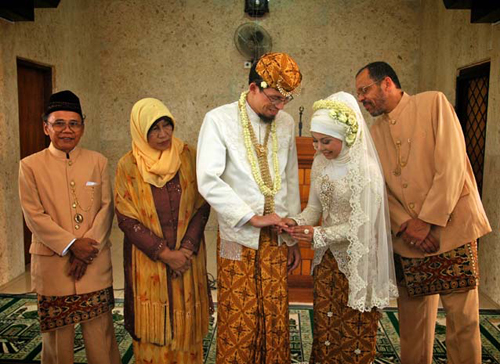
Nina & Nicolas' wedding

As far as Cross-Cultural-Couples go Nicolas and Nina tick every box.  Nicolas is a Parisian of Benin-French extraction and Muslim convert while Nina is a native of Bengkulu, South Sumatra. They ‘met’ 4 years ago on the World Wide Web and have recently tied the knot and have since been blessed with an adorable baby girl. This is their story.

If you want to be part of this series, all you have to do is e-mail info@latitudes.nu!

Please introduce yourselves, what are your names, where are you from and where do you live?
My name is Nina, I am 29 years old. I come from Jakarta, Indonesia but now live in Bengkulu, Indonesia. My name is Nicolas Keke Adjignon, I am also 29 years old. I come from Paris, France and live with my wife.

How did you meet and where?
Nina: We met on a pen pal site called interpals around 2008. Nicolas was looking for his Indonesian friend when suddenly he fell into my profile. We wrote each other for some time but nothing was special between us at that time. Afterwards we lost contact because Nicolas erased his account on interpals, until suddenly we met again on Facebook.

Nicolas : It’s not suddenly, she was actually looking for me :P


Travelling together

How did your relationship evolve?
Nina : On April 2010, I just broke up with my ex boyfriend when suddenly I thought of Nicolas to speak about it and somehow I felt very comfortable speaking to him. Few days after intensive chatting, we officially became couples on Yahoo Messenger, and already spoke about getting married because both of us were not looking for a simple relationship. I know, it was something crazy as we never even met each other before and we were thousands of miles apart, but my heart said “Ok, he’s going to be my future husband.” Nicolas decided to make a visit to Indonesia on August 2010 to meet me and my parents, and also to celebrate Ramadhan and Ied together. As we planned to get married soon, we also spoke about the details such as what we must prepare, where to live, etc.

My parents, family, and friends were quite shocked and surprised to know that I was going to marry to a foreigner I knew only from internet. They thought I was completely crazy. My parents of course were very shocked, especially my mother. But later I was very surprised to know that when Nicolas asked my parents’ permission to marry me, my father – who is quite strict and conservative- directly said okay without hesitating.

Knowing that my parents were okay, Nicolas decided not to take his plane back to France and stayed with me in Bengkulu while waiting for all the wedding preparations. On January 9, 2011, we got married in a mosque near my parents’ home in Depok, Indonesia. Our wedding was as perfect as what we wanted to. Simple but memorable. Nicolas decided to stay in Indonesia because I couldn’t leave my job for some time and as moslems, Nicolas thinks it’s much much better to stay in Indonesia than in France. Until now, Nicolas has never flown back to France and on March 22, 2012 our beautiful baby girl was born. We named her Aisya Odibula Keke Adjignon.


Aisya Odibula Keke Adjignon
Nicolas: Odibula means “don’t be afraid” in African, as my father in law is a mix of French and Benin, West Africa. So somehow my baby girl is a mix of Asian, European, and African.

What does it mean to your relationship to be of two different cultures?
Nina: Somehow I think these two different cultures have made my life even more colorful! Although there are times that I’m surprised by his habits and so on, but to be honest, it makes me happy because I learn something new. In my opinion, Nicolas made a quite rapid adaptation to Indonesian habits. For example, he now prefers to wear a sarong at home rather than jeans or trousers. Nicolas has almost no problems with Indonesian food, although he really cant stand chili and spicy foods. So I cook neutral Indonesian food and sometimes I do my best to cook an international menu as it is so difficult to find western food in Bengkulu.

Nicolas:Actually, it can sometimes bring misunderstandings but we both are conscious enough about this point to overcome this with no sweat, or almost anyway lol.  I must say that even if some habits here in Indonesia may sometimes puzzle me, I’m still amazed by their sharing and solidarity spirit. And also by their religious tolerance that, as surprising as it may sound, I don’t find so much in Paris!

Has it ever caused any problems or miscommunication?
Nina: In big matters, no. But daily life conversations are sometimes so funny because I use to say things short while Nicolas needs more precise sentences. And to me, his French accent makes his English sound weird while to him, my Indonesian accent makes my English sound weird to him (LOL).

Nicolas: Hahaha, yes and sometimes Nina’s accent make me misunderstand too. For exemple she says “beg” for “bag”. It took some time for me to adapt.


With both parents on our wedding

How did your surroundings react to your mixed relationship?
Nina: There are not many foreigners living in Bengkulu and so far I haven’t known any mixed couples who live here, so somehow I could say that Nicolas has become a “celebrity” in this city.  Everyone knows him and calls him “Mister”. One other funny thing is that almost everyone thought he is Arabic because his physical appearance is more similar to a Middle Eastern person than a European. So I often get the question “Is he Arabic?’. I guess many Indonesians have the stereotype of Europeans as someone with blonde hair and blue eyes.

Nicolas: Actually , I found the neighbourhood very friendly and helping. I don’t yet speak great Indonesian so sometimes it’s a bit hard to speak but all in all, everything went great. The only point that makes me sometimes grumble is that people here are much more “intrusive” in your life than in France. But well, I know that no harm is intended and that it’s just normal here so I keep patient with this and try to adapt.

What are the biggest challenges you had to overcome?
Nina: Nicolas stays in Indonesia with a kind of “Following Wife” visa which does not allow him to work here. So now, we change positions. I’m a working mother, while he’s a stay-at-home husband and father. As we don’t have any choice for now, we try our best to enjoy it to the fullest. But of course this condition invites so many questions and comments. First it was quite disturbing, but now I dont really care about what people say. It’s not easy sometimes, especially that now we have a baby. But it won’t last forever Insya Allah.

Nicolas: Definetely, WORK. And also now, our baby. Well, at least, we know that it’s temporary and that we must just be patient.

What are the best things that this relationship brings you?
Just like any other married couple, we feel complete. The best years of our lives.

What language do you speak with one another?
Nina: English is the main language we speak. But now we mix also with Indonesian and I start to learn French because I want to be able to speak French with my husband’s family. Now that we have a daughter, I speak to her most of the time in Indonesian, while my husband speaks Indonesian, French, and English to her.


Nicolas' sarung experience
Are religious differences an issue between you and your partner? How did you solve these?
Nina: No, never, because we both are moslem. Nicolas decided to become moslem around early 2009 by his own will, not because he wanted to marry me because at that time we were not in a relationship yet. When we first met on interpals, I remember he already told me that even though he was not officially into one religion, he already had interest in Islam.  And on January 2009, he told me that he already became moslem. I can say that he practices Islam much much better than me, that is why he doesn’t want to go back to France because he really enjoys practicing Islam in a country where the majority are moslems.

Nicolas: I would add furthermore that France is NOT a country for religious people, sadly. As soon as you’re practicing seriously, you somehow get harrassed at work etc or labelled extremist, whatever your belief is even if, being muslim is considered worse lol.

What are your future plans?
Nina: I’m planning to quit my job as soon as I could so that I could spend most of my time with my baby girl, and maybe mounting our own business. Hope that my husband soon be able to have working permit as the new regulation of immigration is applied.

Nicolas: Passing a grade for being french teacher, many side-projects regarding creative things (writing, video etc..) and spending the rest of my life with a wonderfully caring and understanding wife! And of course , do my best to raise my daughter the right way.

Do you have any tips for other mixed couples?
Nina: Enjoy every culture shock that may appear. Marriage is never really easy, even if you come from the same culture, but any difference that appears will truly colour your life.

Nicolas: Stick with what you see as a positive and leave the negative points in a trash can after speaking about it if it is necessary.

Tofu Makers in Indonesia May Halt Output as Soybean Prices Surge - Bloomberg

Tofu Makers in Indonesia May Halt Output as Soybean Prices Surge - Bloomberg:

ABC Online


Tofu Makers in Indonesia May Halt Output as Soybean Prices Surge
Bloomberg
The Confederation of Indonesian Tofu and Tempeh Makers Cooperatives demanded the government lift a 5 percent duty on soybean imports, imposed in January, to help ease local prices that have risen 33 percent in the past three weeks to about 8000 ...
Tofu strike in IndonesiaABC Online
Soaring soy sparks Indonesian tofu shutdownRadio Australia
Production of 'tahu', 'tempeh' in Indonesia threatenedChannel News Asia
Jakarta Post
all 8 news articles »

I’m a terrific child!

I’m a terrific child!:

A home schooling project in Kendari provides a new kind of early learning experience


Dirk Tomsa

tomsa1.jpg

The Kingdom Academy in Kendari
Dirk Tomsa
It’s 7.30 am in Kendari, the capital of Southeast Sulawesi. In the backstreets of this small town of just under 300,000 people, two boys aged two and six are getting ready for kindergarten and pre-school. It’s only a short walk to their classrooms once they have finished their breakfast and put on their uniforms. In fact, they don’t even have to leave the house. Both the kindergarten and pre-school are located inside their home and run by their mother, Mey Tanjung Niasari. Welcome to the Kingdom School. Kendari’s only school in a home.
Founded in 2009, the Kingdom School is a unique initiative in this part of Indonesia. It offers kindergarten and pre-schooling for children aged between two and six, but it is early learning with a difference. Children are allocated to groups and classes based not only on age, but also intellectual ability. The curriculum revolves primarily around character-building and increasing the children’s self-confidence. As a trained psychologist and motivational trainer, Mey is convinced that this approach facilitates early learning much better than conventional methods focused on memorising facts, words and numbers, which are still widely used in Indonesia. Defending her teaching philosophy, Mey criticises the lack of creativity, innovation and critical thinking in the country’s school system. ‘From Year 7 to

Read more...

The Muslim Brotherhood's post-uprising TV station - Columbia Journalism Review (blog)

The Muslim Brotherhood's post-uprising TV station - Columbia Journalism Review (blog):

The National


The Muslim Brotherhood's post-uprising TV station
Columbia Journalism Review (blog)
CAIRO, EGYPT — The Muslim Brotherhood's year-old television station, Misr25, broadcasts from a building in Egypt's Media Production City, a vast complex of buildings built under former president Hosni Mubarak in the desert west of Cairo, well beyond ...
The History and Ideology of the Muslim BrotherhoodRight Side News
Corruption: The Modern-Day Plague of EgyptFrontPage Magazine
From Arab Spring to the coming nuclear winterCanada Free Press
The National -CNN (blog) -msnbc.com
all 159 news articles »

Conversions to Islam enflame Gaza Christians' frustration and fears for ... - Washington Post

Conversions to Islam enflame Gaza Christians' frustration and fears for ... - Washington Post:

The Daily Star


Conversions to Islam enflame Gaza Christians' frustration and fears for ...
Washington Post
They are a dwindling minority among a mostly devout Muslim majority, mostly hemmed into the tiny sliver of land because of movement restrictions imposed by Israel and Egypt. And they say some Muslims are doubling their efforts to convert them, ...
Gaza Christians fear for future of tiny communityThe Associated Press
The Arab Spring: A Blessing for HamasThe Jewish Press

all 141 news articles »

Turkey stops cross-border trade with Syria

Turkey stops cross-border trade with Syria: Ankara seals border with Syria to commercial traffic, but keeps crossings open for Syrian refugees fleeing conflict.

NK unveils Kim Jong-un 'mystery' marriage

NK unveils Kim Jong-un 'mystery' marriage: State report ends weeks of speculation over unknown woman who had accompanied the 20-something leader at recent events.

FEATURE: Thai villagers to fight Lao Mekong dam in court - Reuters AlertNet

FEATURE: Thai villagers to fight Lao Mekong dam in court - Reuters AlertNet:

Reuters AlertNet


FEATURE: Thai villagers to fight Lao Mekong dam in court
Reuters AlertNet
As a result, they vehemently oppose plans for big hydropower projects that would involve building dams on the Mekong in Laos, largely aimed at selling electricity to Thailand. Village headman Phoomi Boonthom, 54, only fishes in his spare time now ...
'Drastic action' needed to halt traffickingBangkok Post

all 3 news articles »

Working for Renewal in Laos- Christian Reformed Church

Working for Renewal in Laos- Christian Reformed Church: In the upland area of Laos, ethnic minority groups earn their living through subsistence farming. The poverty rate is 43%. When CRWRC began working in Laotian communities, many villagers identified education as one of ...

Google Tests an Expanded Knowledge Graph Box

Google Tests an Expanded Knowledge Graph Box: Google tests a new feature of the knowledge sidebar: a link that invites you to "explore more". The Knowledge Graph section doesn't allow Google to show more than 5 related people, books, albums, movies, so the experiment displays more of them below the search box.

For example, when you search for a movie and click "explore more", Google shows more cast members. You can use the arrow icons to switch to a different category.


{ Thanks, Maarten. }

Use Your Real Name on YouTube

Use Your Real Name on YouTube: Now that YouTube uses Google Accounts and integrates with Google+, it's a lot easier for Google to bring more Google+ features to YouTube.

You can now use your full name on YouTube. Just go to YouTube's settings page, click "advanced" next to your email address and click "Begin using my full name on YouTube".


What will change after enabling this feature?

1. Your full name from your Google+ profile will replace your username on YouTube.

2. Your channel title and photo will change.

The YouTube username can still be used to log in and the channel URL will stay the same.

Google's goal is to use the same identity on YouTube, Google+ and other Google services so that it can provide an unified experience. For example, other people that know you will find your YouTube videos much easier if you're using your full name and your photo. YouTube's commmenting system can also improve if people use their real identity.

Obviously, not everyone will want to drop their username, especially if they like/need anonymity or their username is very popular. That's probably the reason why this feature is optional.

A Google spokesperson told LA Times that "YouTube will let people change their usernames back if they decide to start using their full name. (...) New users can still set their YouTube name however they want. The prompt comes up only for users who have a Google+ profile."

"You'll see this option when you upload or comment on YouTube (...). For partners, brands, and organizations, you won't see this just yet. In the coming months we'll be working on new options to give you even more control over your presence on YouTube," informs Google.

{ Thanks, Katty. }

South Sudanese supermodel Alek Wek's journey home

South Sudanese supermodel Alek Wek's journey home: The former refugee met with recent arrivals from Sudan and stressed her commitment to support programmes helping returnees settle back home.

Daily Number: 58% - Support for Capitalism Declines in Europe

Daily Number: 58% - Support for Capitalism Declines in Europe: Faith in capitalism has fallen in Europe, with 58% of the public saying that most people are better off in a free market economy.

SOUTH AFRICA: Court orders Cape Town to process asylum applications

SOUTH AFRICA: Court orders Cape Town to process asylum applications:
JOHANNESBURG, 25 July 2012 (IRIN) - Refugee rights organizations in Cape Town are breathing a sigh of relief following a high court judgement that will force the Department of Home Affairs to reverse a policy of not accepting new asylum-seeker applications at the region's only Refugee Reception Office (RRO).

Foreigners appreciate Khmer language

Foreigners appreciate Khmer language: Wednesday, 18 July 2012

Ngo Menghourng
Phnom Penh Post


Foreigners take Khmer-language lessons in Phnom Penh. Photograph: Phnom Penh Post


Sounds and pronunciation usually practiced by young Cambodian school
children are being mumbled by foreigners in Phnom Penh. “Kor, Khor, Koa,
Khoa…” More and more people from all over the world are taking Khmer
classes at the Institute of

CambodiaWatch-Australia: Defence teams press scholar

CambodiaWatch-Australia: Defence teams press scholar: Even co-accused Brother No 2 Nuon Chea had two questions of his own for the one-time US diplomat who has spent the better part of his academic career researching Cambodia and the Democratic Kampuchea period.

KHMER KAMPUCHEA KROM | 21 PPROVINCES: Worldwide ...

KHMER KAMPUCHEA KROM | 21 PPROVINCES: Worldwide ...: A Brief History of Kampuchea Krom ” was commissione... Khmer Krom Dialects. Khmer language is a Khmer-Mon linguistic group in South East Asia peninsula. It is presently spoken by Cambodia, upper land Khmers living in.

How well do you use social media?

How well do you use social media?:
It’s nice to be back home in Cambodia, though I miss the whole Seliger2012! This Wednesday (25th, I will be speaking for some good 5 minutes about being an online journalist and blogger for some 5 years at the Meta … Continue reading →
Related posts:
Social media impact on Cambodia
my favourite media or...


[[ This is a content summary only. Visit my website for full links, other content, and more! ]]

Bruce Lawson's personal site : Cambodia Rap: thoughts revisiting ...

Bruce Lawson's personal site : Cambodia Rap: thoughts revisiting ...: Cambodia Rap: thoughts revisiting Angkor Wat. Tuesday 24 July 2012. “Cambodia's great”, enthuses the twenty-something gap-year Italian woman in the air-conditioned internet cafe where they bake great croissants. “It's just that there are too ...

Gang rape in Cambodia an increasing trend

Gang rape in Cambodia an increasing trend: "At the end, she was in so much pain, I was afraid she had died,” a Cambodian sex buyer recounted.

Thai government reconsiders deportation

Thai government reconsiders deportation: 120725_04Thailand is rethinking a controversial plan to deport pregnant migrant workers from countries such as Cambodia and support them instead.

State and National Polls Tell Different Tales About State of Campaign

State and National Polls Tell Different Tales About State of Campaign: President Obama's average lead in our top 10 "tipping point" states is larger than his average lead in national polls.

July 24: The Incredibly Steady Presidential Race

July 24: The Incredibly Steady Presidential Race: We've now been running our presidential forecast model for almost two months, and each day, we have shown Barack Obama as a modest favorite to win re-election. At no point has projected margin of victory in the popular vote been smaller than 1.7 percentage points.

Baltimore puts out welcome mat for immigrants, hoping to stop population decline

Baltimore puts out welcome mat for immigrants, hoping to stop population decline:
The fate of Baltimore may rest with immigrants like Alexandra Gonzalez.
A native of Puebla, Mexico, Gonzalez feels more at home in Baltimore with every passing year. She attends city-run nutrition and exercise classes in Spanish and takes her two young children to a Spanish-language storytelling hour at her neighborhood library. She plans to earn a GED and become a teacher.
Read full article >>


Individual Fights for Control of the House

Individual Fights for Control of the House: With no partisan surge this year, the overall dynamic favors Republicans, who look poised to maintain their hold on the House.

Drone operations over Somalia pose danger to air traffic, U.N. report says

Drone operations over Somalia pose danger to air traffic, U.N. report says:
The skies over Somalia have become so congested with drones that the unmanned aircraft pose a danger to air traffic and potentially violate a long-standing arms embargo against the war-torn country, according to United Nations officials.
Read full article >>


Aquino Urges Expansion of Philippine Military - WSJ.com

Aquino Urges Expansion of Philippine Military - WSJ.com

Former Philippine President Arroyo Is Released on Bail in Fraud Case - WSJ.com

Former Philippine President Arroyo Is Released on Bail in Fraud Case - WSJ.com

IDP News Alert, 25 July 2012

IDP News Alert, 25 July 2012: Mali: Situation critical for 107,000 IDPs amidst renewed fighting
Syria: 1 million people displaced in Syria following beginning of Ramadan
China: over a 1.2 million internally displaced by disasters since end June
Japan:  Heavy rains and landslide risk prevent hundreds from returning home
Bangladesh: Floods and landslides displace over 600,000 people

North Korean Succession and the Risks of Instability

North Korean Succession and the Risks of Instability: Despite last week’s abrupt shuffle at the top of the military leadership, Kim Jŏng-ŭn appears to be firmly established as the new leader of North Korea, completing a faster and smoother power transition than many experts anticipated.

Struggle Can Weaken Pyongyang Regime

Struggle Can Weaken Pyongyang Regime:
Those who have heard of recent news about North Korea will be interested in the fact that Kim Jong Un received the title of Marshal of the Republic and that the Korean People's Army's Chief of General Staff Ri Young Ho was relieved of all his posts. I think these two developments are closely related.

Ironically, these changes in North Korea may not have anything to do with Kim Jong Un.

Kim Jong Un, who is young and has not had a chance to solidify his power base, may be a dictator with no power within the current political circles. It looks like against such a scenario, Kim’s circle began the struggle for power.

Kim Jong Un already had supporters when Kim Jong Il ruled North Korea. Kim Kyung Hee, Jang Sung Taek, and Ri Young Ho became his supporters as his father had wished.

Aside from the Kim family’s close high-profile officials such as Kim Kyung Hee and Jang Sung Taek, the supporters included representatives from the party and administration. They all have titles of military generals, but it is hard to consider them as soldiers.

On the other hand, Ri Young Ho, who devoted his whole life to the military, is considered one of the most typical military men.

It seems that the relations between the Workers’ Party and the People’s Army began deteriorating in March and April this year. Many new Party officials have no military experience even though they wore uniforms just like Choi Ryong Hae.

At the same time, high-ranking military officers who served in the military for their entire careers and the military as a whole began losing their powers.

Serious blow
Dismissing Ri Young Ho struck a serious blow to those whose backgrounds are in the People’s Army. The military lost its leader overnight. Of course, officially, Ri was removed because of his health, but no one believes it.

Ri was a relatively young leader compared to those in similar positions. In addition, there was no need to hold a meeting on a Sunday if Ri was going to be discharged only for health reasons.

Giving the title of Marshal to Kim Jong Un also requires a meeting of high-ranking party officials such as Jang Sung Taek. This also is to emphasize the superiority and importance of the party.

It remains to be seen what these conflicts between the military and the party will mean politically in North Korea.

We can just say an invisible power struggle is taking place in the inner circle of North Korea. Some view the military as conservatives and high-ranking officials in the Workers’ Party as progressives. This is possible, but it is hard to say with the available information.

However, the fights between the military and the party which are so obvious that even regular people notice could weaken the roots of the North Korean regime in the long run.

Andrei Lankov, a professor at Kookmin University in Seoul, is a Russian historian, North Korea expert, and regular RFA contributor.

New City in Troubled Waters

New City in Troubled Waters:
Beijing on Tuesday established a new administrative city in the South China Sea where it also plans to station a military garrison to defend its claims on the disputed waters, drawing protests from Vietnam and the Philippines.
The Chinese flag was raised and the national anthem played at a ceremony to mark the creation of the new 1,000-resident Sansha city on Woody Island, the largest of the Paracel Islands, which are claimed by Vietnam.
Sansha, the new prefecture-level municipality under Hainan province, will administer the Paracel archipelago as well as the nearby Spratly Islands and Macclesfield Bank, the official Xinhua news agency said.
The move strengthens Beijing’s foothold in the resource-rich South China Sea, portions of which are also claimed by Vietnam, the Philippines, Malaysia, Brunei, and Taiwan, and raises tensions in the region where experts have warned of the possibility of armed conflicts erupting.
Luo Baoyu, the Hainan secretary for the ruling Chinese Communist Party, said at the ceremony that Sansha, a settlement supplied with food and water by ship, will help China assert its control over the sea and promote its economic interests there.
"The provincial government will be devoted to turning the city into an important base to safeguard China's sovereignty and serve marine resource development," he said, Xinhua reported.
schinasea-305
China's territorial claim to the South China Sea includes two disputed island chains.
Objections
Sansha will also host troops as part of a new military garrison, according to China’s Central Military Command Friday, escalating territorial spats with Vietnam and the Philippines.
The garrison command will be responsible for managing the city's national defense, mobilizing military reserves, and carrying out military operations, China’s state media reported.
Vietnam’s Foreign Ministry spokesman Luong Thanh Nghi told Agence France-Presse on Tuesday that the plan for the garrison "violates international law, seriously violates Vietnam’s sovereignty... and is invalid.”
He said China must revoke its "wrongdoings" and urged "friendly and cooperative" relations in order to "maintain peace and stability" in the region.
Vietnam has faced off with China over Beijing’s detention of Vietnamese fishermen and its opening of oil and gas lots to international bidders in the disputed waters.
In the Philippines, the department of foreign affairs summoned China’s Ambassador to the Philippines Ma Keqing on Tuesday to protest against the garrison announcement.
Foreign Affairs Secretary Albert del Rosario said the Philippines had expressed “grave concern” and “strong protest” over China’s actions in the Paracels, the Manila Standard newspaper reported.
“We hope that China, as a responsible country, will exercise self-restraint on the conduct of activities that would complicate or escalate disputes and affect peace and stability in the region,” he said.
The Philippines became embroiled in a standoff with China at the Scarborough Shoal earlier this year, with both sides sending ships to the area after Manila accused Beijing of poaching in its exclusive economic zone.
On Monday, Philippine president Benigno Aquino said in an annual state of the nation address to parliament that the country would be upgrading its military capabilities in the South China Sea.
"If someone enters your yard and told you he owns it, would you allow that?" he said.
China’s actions have also drawn reactions from the U.S., where senior senator John McCain on Tuesday called the planned garrison in Sansha “unnecessarily provocative” and urged a multilateral solution to the overlapping claims in the waters.
‘New heights’
China’s expansion of Sansha comes as long-simmering tensions over the South China Sea disputes reached “new heights,” according to a new report by the International Crisis Group released Wednesday.
The think tank warned that tensions have grown particularly explosive since divisions over the territorial claims prompted the 10-member Association of Southeast Asian Nations (ASEAN) to postpone for the first time in 45 years its customary joint statement at the conclusion of its annual ministerial talks two weeks ago.
“As long as ASEAN fails to produce a cohesive South China Sea policy, a binding set of rules on the handling of disputed claims cannot be enforced,” said Paul Quinn-Judge, the International Crisis Group’s acting Asia director.
“Without a consensus on resolution mechanisms, tensions in the South China Sea can easily spill over into armed conflict,” he said.
Reported by Rachel Vandenbrink.

Jul 24, 2012

Khmer Krom NGO Status Revoked

Khmer Krom NGO Status Revoked:
The United Nations has revoked the special consultative status of a non-governmental organization representing the indigenous Khmer Krom group in Vietnam, drawing protests from human rights groups which accused the global body of buckling to pressure from Hanoi.

Member states of the United Nations Economic and Social Council (ECOSOC) on Monday voted 27-14, with 10 abstentions, to rescind a consensus decision in May approving the application by the Khmers Kampuchea-Krom Federation (KKF) for special consultative status with the Council.

Vietnam protested strongly against the May decision and proposed a resolution overturning the move along with El Salvador and fellow Association of Southeast Asian Nations (ASEAN) member states Burma, Indonesia, Laos, Malaysia, the Philippines, Singapore and Thailand.

The United States and the European Union meanwhile had expressed their opposition to the resolution revoking the special status of the KKF representing the Khmer Krom, an ethnic group that U.S.-based Human Rights Watch (HRW) says faces serious restrictions on freedom of expression, assembly, association, information, and movement in Vietnam.

The ECOSOC had “caved to Vietnamese pressure," a joint statement by the Observatory for the Protection of Human Rights Defenders (OPHRD) and the Vietnam Committee on Human Rights (VCHR) said.

The OPHRD is a joint program of the International Federation for Human Rights (FIDH) and the World Organization Against Torture (OMCT).

Ahead of the vote, the OPHRD, along with 12 international and regional human rights groups, urged ECOSOC member states to oppose the draft resolution and to “support the ability of civil society organizations to freely participate in the work of the United Nations.”

In the statement, the OPHRD pointed out that special consultative status is granted to NGOs that “have a special competence in, and are concerned specifically with, only a few of the fields of activity covered by the Council and its subsidiary bodies, and that are known within the fields for which they have or seek consultative status.”

Resolution condemned

In Tuesday’s joint statement, Vo Van Ai, president of the Paris-based VCHR, condemned those U.N. member states that had joined Vietnam in rescinding the decision.

“It is shameful that many U.N. member states caved in to Vietnam’s pressure and became an accomplice in stifling the rightful voices of human rights defenders,” he said.

“It sends a chilling signal to the people in Vietnam that the international community is not on their side in their quest for greater freedom.”

Souhayr Belhassen, president of the FIDH, said that Vietnam, which intends to run for a seat on the U.N. Human Rights Council, has repeatedly attacked independent human rights defenders at home and abroad, reflecting its “consistently dismal human rights record.”

“Before it is even elected to the Human Rights Council, Vietnam is already busy obstructing human rights groups from cooperating with the U.N. to promote human rights,” he said.

“This kind of intimidation must not be tolerated anywhere in the U.N. system.”

Gerald Staberock, secretary-general of the OMCT, called the resolution “an expression of fear to hear unpleasant truths and opinions.”

“The basis of any commitment to human rights defenders is the recognition of their very existence and their right to speak and to be heard, and the states have failed in this test—Vietnam in the first place,” he said.

Plans to reapply

Thach Ngoc Thach, the president of the KKF who led a delegation to join the ECOSOC, said his federation would reapply for membership in the next three years.

“The federation will continue to advocate to countries that didn’t vote or voted in absentia to support our bid for next time,” he said.

He added that Vietnamese allegations that the Khmer Krom are seeking independence from Vietnam were untrue.

“We cannot accept these allegations,” he said.

Thach Ngoc Thach said that even though the KKF was refused the right to act as an ECOSOC member, the federation remains recognized by the international community for its work on behalf of the Khmer Krom.

“This should not be considered a failure because we have received support from the U.S., France, and England. The countries that support Vietnam are Russia and China,” he said.

“The communist countries are supporting each other.”

Persecuted group

The Khmer Krom, many of whom have moved to Cambodia to escape persecution, are from southern Vietnam’s lower Mekong delta region, which Cambodians sometimes call "Kampuchea Krom," or "Lower Cambodia." As Khmers, they are ethnically similar to most Cambodians, and are considered outsiders in Vietnam.

The Vietnamese government has banned Khmer Krom human rights publications and tightly controls the Theravada Buddhism by the minority, who see the religion as a foundation of their distinct culture and ethnic identity.

In 2007, the Vietnamese government suppressed protests by over 200 ethnic Khmer Buddhist monks in Suc Trang who were calling for religious freedom and more Khmer-language education.

On the other side of the border, the Khmer Krom who leave Vietnam for Cambodia remain one of the country’s “most disenfranchised groups,” HRW has said.

Because they are often perceived as Vietnamese by Cambodians, many Khmer Krom in Cambodia face social and economic discrimination.

They also face hurdles in legalizing their status in the country, as despite promises to treat them as Cambodian citizens, authorities have failed to grant many Khmer Krom citizenship or residence rights, according to HRW.

Reported by Samean Yun for RFA’s Khmer service. Translated by Samean Yun. Written in English with additional reporting by Joshua Lipes.

Almost Everyone Doesn’t Trust the Internet

Almost Everyone Doesn’t Trust the Internet: We know you won’t believe us when we say this, but: 98% of people distrust the Internet. It’s true, according to a study conducted by market-research firm Harris Interactive: nearly all of us find a reason to discredit the information we read online. According to Mashable, the firm surveyed 1,900 Americans, yielding the overwhelming statistic [...]