Jul 29, 2012
Tempeh, tofu back on table after three-day strike ends
Tempeh, tofu back on table after three-day strike ends: After being absent from Jakartans’ dining tables due to a three-day strike, tempeh (soybean cake) and tofu will be back on the market starting on Saturday.Head of the city’s cooperatives and ...


Govt, police urged to end violence against farmers
Govt, police urged to end violence against farmers: The central government and the National Police have been called upon to help put an end to the conflict between PT Perkebunan Nusantara (PTPN) VII Cinta Manis in Ogan Ilir regency, South Sumatra, and ...
Learning for free
Learning for free: Force of change: Komunitas Salihara in Utan Kayu, East Jakarta, offers monthly discussions and lectures for free. (Courtesy of Komunitas Salihara/Witjak Widhi Cahya)At a time when money rules, ...
Preserving Toraja textiles
Preserving Toraja textiles: Various bags created from Torajan woven fabrics.Dinny Jusuf does not hail from South Sulawesi’s Toraja ethnic group but she is nevertheless driven to preserving the Toraja’s tenun woven cloth, ...
More comedy, soap operas during Ramadhan
More comedy, soap operas during Ramadhan: A scene from Dalam Mihrab Cinta (In the Pulpit of Love)While expecting some snacks and thirst-quenching beverages to break the fast, many Muslims usually gather with their families and friends or do ...
Islamic art masterpieces take center stage
Islamic art masterpieces take center stage: Koran. Probably from Indonesia, 18th or 19th Century. Ink and gold on paper in an Islamic binding. (Courtesy of the Asian Civilizations Museum)Two exhibitions present masterpieces of Islamic art ...
The Early Years
The Early Years:
By: Thomas Weber Carlsen
Thomas Weber Carlsen is a Danish architect who has been living in Cambodia with his Cambodian wife and their two children for over 10 years now. Apart from designing and building his own house, he has been working with humanitarian projects, worked as a tour leader and made video documentaries about the Khmer Rouge and indigenous people under the influence of globalization.
His first literary work Third World Man (Out of Denmark) is the personal account of his journey from Denmark to Cambodia and the various impacts it has had on his life. It is also a critical comment to the divided and unsustainable world we live in today. Thomas is now looking to have Third World Man (Out of Denmark) published in hard form and/or as an e-book. This article, “The Early Years”, is based on the third chapter of the book and is the second in a series of three articles by Thomas Weber Carlsen, all taken from chapters in the book, to be presented on Latitudes.nu in the near future.
Try to imagine being dumped outside of time in a place where nothing resembles anything you have ever experienced before; where the smells, the sounds, the lights and the feels are all different. To me the first meeting with Cambodia was like that: stepping into an entirely new dimension where everything suddenly switched from black and white into color. It felt like freedom.
When I first came here in the mid nineties the country had just opened up to the outside world after twenty years of war, isolation and ideological madness. Nothing as radical as the Pol Pot regime had ever been attempted in the history of mankind and the country was shattered to pieces. The Khmer Rouge literally wanted to erase history and time. Their new regime began with Year Zero in 1975 and only seemed to be moving backward from there. All the old formal institutions of society were broken down along with most of the known human relations including in many cases the family. Probably one third of the population was starved to death or executed as a result of failed and paranoid communist politics arbitrarily implemented by ignorant peasant revolutionaries in the course of less than four years. When the Vietnamese invaded Cambodia in 1979 they put the Khmer Rouge on the run but never fully controlled the country; they were at odds with the majority of the world too and kept the country sealed for another ten years.
Never has it been truer that one man’s hell can be another man’s redemption. For the people who had gone through this ordeal and survived, Cambodia was a living hell; to me it became a paradise.
I remember stepping out of the small plane at the old airport outside Phnom Penh and meeting the physical impact of an intense humid heat for the first time. I hadn’t been sweating for twenty five years and now it came pouring out. Instantly I had to adjust to a much slower pace, with every movement becoming a physical burden. It certainly affected my thinking too; I automatically switched to a “default” mode where most of my conscious thoughts were centered on getting from one place to another with the least possible effort, and finding something to drink. But that was a good thing as my mind had been running wild for a long time.
The first visual impression of Cambodia was one of … not just poverty, but rather dilapidation. The roads and the buildings were in a state of disrepair beyond imagining. Everything was makeshift: the vehicles, the shops and the restaurants – even the people seemed to be improvising their very existence from one minute to the other. But there was a sense of elementary joy too, a celebration of being alive and kicking, although I have never seen so many handicapped persons in various states of physical disarray. Cambodia was like that, total anarchy and very charming, and that was probably why I fell in love with it.
I remember Phnom Penh. There were no streetlights then and only small kerosene lamps in most of the houses at night. The city disappeared after seven pm and I would be navigating a strange and unfamiliar universe where new and exotic businesses sprang to life. It took several years before the first traffic lights were introduced and I thought then that the city had died – in retrospect I am pretty sure that this first impression was correct. Before the traffic lights came, everybody was weaving in and out between each other in the most incredible and elaborate pattern, a unique un-urban and very charming rhythm, a strange and unexpected order in a chaos like nothing else that I know of. It was mostly motos then, the small reliable Honda motorcycles which could go anywhere. The locals trusted them with their lives. There were thousands of them and hardly any cars. Potholes were everywhere, no street still had a smooth unbroken tarmac – many streets had no tarmac at all – and in the rainy season they were a real challenge to navigate. Some areas were notorious for being under half a meter of water for several months of the year and you would need a 4WD to get through. The locals would just wade across.
I remember the girls. There was a brothel on every street corner in Phnom Penh and sometimes next door too, a relic from the UNTAC period (1992-93), when twenty thousand UN soldiers from all over the world had been let loose here with monthly allowances bigger than what most local people could hope to earn in a decade.
I remember the people: smiling, curious, willing to reach out. Different, not better, but different from anyone I had ever seen. Not all of them were equally friendly. Some of them would stare at me sullenly, even hostile, as from a strange world I had no access to. Khmer Rouges? I never knew, by then many former KR had been reintegrated into the new society. Everybody had been uprooted and moved around for decades, many had changed their identity completely, nobody knew for certain who their new neighbor really was. But as a precaution everybody was very polite and soft spoken, always willing to compromise.
The best thing was the people. Nobody knew me there, nobody judged me, everybody was just curious and trying to understand the basics of this unpredictable life and taking whatever advantage of it they could in the process. I looked into their eyes and I saw souls, souls who had escaped a nightmare – just like me. We were brothers and sisters.
Of course all of these first impressions have long since faded and been replaced by others of a much more accurate and pragmatic nature. People here are not like that at all. They are selfish, stupid, revengeful and paranoid – just like me and you. But we are talking about first impressions here, and they can be a wonderfully healing thing.
The minefields of Cambodia – stranger and more exotic than anything I ever saw – were the real reason for my coming here. Nothing could be further from my first world existence until then, death lurking in the ground with every step you took. Or were they that different, really? I had grown up to become what is known in modern psychological terms as a “flying boy”, unable to reach the ground firmly below my own feet, afraid of the dangerous reality they might find there. I had long been living in my own dreamlike world out of touch with the surroundings, always fantasizing about somewhere else and someone else to be. A “flying boy” is a boy or young man who for one reason or another feels that the ground beneath him is poisonous, burning, not fit for walking on, and he seeks refuge in his own inner world far above the profane mentality of ordinary people.
I had come to Cambodia to finish my studies as an industrial designer; I wanted to do something different with my life, so I looked for a special challenge, some way of applying my new professional skills at the service of poor and needy people in the third world, and someone I knew had mentioned the landmine problem in Cambodia. That seemed like a fittingly heroic thing to do: develop a new technology for detecting and destroying landmines. I first came to Cambodia in early 1994 equipped with a video camera, a map and a very thin guidebook.
In the safe company of humanitarian mine clearance organizations who willingly let me study their practices in live mine fields, I went all the places where no one else dared to tread. Ancient temples still booby trapped, no man’s land between the remaining Khmer Rouge fighters and government forces, pristine jungles in their primeval splendor, well protected by the landmines and as yet unharmed by loggers. Quiet places, beautiful places, deadly places. I was in good hands among true professionals who knew the seriousness of their job; this was a man’s world in the best sense of the word and I enjoyed it immensely. The camaraderie between these foreign professionals, militarily trained and gentleman-like, and the local staff was a beautiful thing for me to observe.
There are rare times when everything comes together in an almost perfect way, when the moment and the place and the personal situation intertwine to become something more than the sum of the parts. I have had a few of those experiences along the way. One such occasion arose for me then. I was back in Denmark again, in my hometown Aarhus, and a friend of mine came by to welcome me home. When he learned that I was still working on a design solution to the landmine problem, he told me something interesting. A friend of his sister’s who was a diplomat at the Danish embassy in Bangkok had come home on vacation with his family and was visiting Aarhus. He was among other things in charge of government sponsored projects in Cambodia and my friend suggested that I contacted him. When this man heard about my idea for a low-tech landmine device, things suddenly started moving with a remarkable speed. The widespread use of landmines in many third world conflicts had by then become a very hot humanitarian and political issue, Princess Diana was a prominent advocate for the ban of landmines, and the campaign was gathering momentum by the day. I was encouraged by my friend’s sister’s diplomat friend to apply for a government grant to implement the MineBuster project in Cambodia.
After a few more months in limbo the answer came that I had been granted what amounted to an astronomical sum in my mind, and I set about to organize the project and my departure from Denmark at the earliest possible date.
This was my golden opportunity and I knew it. I had all the contacts in Cambodia in place from my earlier visits. Many different organizations came together on this project to support me in my endeavor; there was a distinct goodwill towards its objective as everybody had something to gain and nothing to lose. I found even the Cambodian government cooperative; they were a lot easier to approach in those days, eager to please their foreign donors and to get connected to the outside world.
I must have made all the mistakes in the book and possibly a few more. But this is how you learn, not from your successes but your failures. In the end the project failed – well, fell apart from lack of funding and external circumstances such as an armed clash between the two political factions in the government. Essentially the MineBuster was not the right answer to the landmine problem, but I spent one and a half year working in earnest to bring something good and useful into this world, and I certainly managed to improve my own personal situation a lot.
We were the good guys then, doing the right thing and being handsomely paid for it. For the first time in my life everything made perfect sense to me. I wrote exhilarated faxes back home, and my father must have sensed my excitement. He wrote me back that I seemed to be like a “fish in the water”. Faxes were in those days the only way of getting in contact with the outside world and a one page fax could take up to a whole day to get through. I didn’t miss the outside world one bit, I was happy to keep it at bay feeling really safe and protected here by the horrid image of Cambodia that kept everybody else out. Cambodia was my playground.
Those were the days of pioneers and marauders; there were more humanitarian aid workers in Cambodia than tourists, most ordinary people still being too afraid to enter this quaint little country with its more recent ominous image of death and destruction firmly attached to it. Some of the newcomers were saints, some just misfits who didn’t know what else to do with their lives. Crimes were being committed daily here on a massive scale by those with power inside the new regime taking outrageous advantages of their positions in order to establish themselves as the elite, ripping the country apart in their frenzy for material gain and personal security. Everywhere there was this rush for golden opportunities, but still there was a sense of innocence not completely lost. The bad guys had not yet won the field; everything was still up in the air.
Over the years, gradually but surely, I moved my life out of Denmark to Cambodia, realizing in the process how little life I had initially had. At a very early stage I made an investment in the plot of land where my house now stands. This piece of solid ground under my feet became a fixed point of reference, the guarantee for my continuing presence here, although I did not know in the beginning what to do with it. I was so desperate to finally break free of my Danish prison that this rectangle of untamed Cambodia became a token I left behind whenever I had to go, urging me on to find some other means to secure my return here. And it worked. I have always found the will and consequently the way to come back, surprising at times even myself at my own ingenuity and resourcefulness.
I had in effect become a freelancer, an entrepreneur, my own boss gathering experiences in a wide variety of fields and moving almost organically from one project to the next, adopting to the challenges along the way and growing in the process, something you would never be able to do if you wanted to have a family and settle down in a first world country. And I wanted to have a family.
By: Thomas Weber Carlsen
Thomas Weber Carlsen is a Danish architect who has been living in Cambodia with his Cambodian wife and their two children for over 10 years now. Apart from designing and building his own house, he has been working with humanitarian projects, worked as a tour leader and made video documentaries about the Khmer Rouge and indigenous people under the influence of globalization.
His first literary work Third World Man (Out of Denmark) is the personal account of his journey from Denmark to Cambodia and the various impacts it has had on his life. It is also a critical comment to the divided and unsustainable world we live in today. Thomas is now looking to have Third World Man (Out of Denmark) published in hard form and/or as an e-book. This article, “The Early Years”, is based on the third chapter of the book and is the second in a series of three articles by Thomas Weber Carlsen, all taken from chapters in the book, to be presented on Latitudes.nu in the near future.
Try to imagine being dumped outside of time in a place where nothing resembles anything you have ever experienced before; where the smells, the sounds, the lights and the feels are all different. To me the first meeting with Cambodia was like that: stepping into an entirely new dimension where everything suddenly switched from black and white into color. It felt like freedom.
When I first came here in the mid nineties the country had just opened up to the outside world after twenty years of war, isolation and ideological madness. Nothing as radical as the Pol Pot regime had ever been attempted in the history of mankind and the country was shattered to pieces. The Khmer Rouge literally wanted to erase history and time. Their new regime began with Year Zero in 1975 and only seemed to be moving backward from there. All the old formal institutions of society were broken down along with most of the known human relations including in many cases the family. Probably one third of the population was starved to death or executed as a result of failed and paranoid communist politics arbitrarily implemented by ignorant peasant revolutionaries in the course of less than four years. When the Vietnamese invaded Cambodia in 1979 they put the Khmer Rouge on the run but never fully controlled the country; they were at odds with the majority of the world too and kept the country sealed for another ten years.
Never has it been truer that one man’s hell can be another man’s redemption. For the people who had gone through this ordeal and survived, Cambodia was a living hell; to me it became a paradise.
I remember stepping out of the small plane at the old airport outside Phnom Penh and meeting the physical impact of an intense humid heat for the first time. I hadn’t been sweating for twenty five years and now it came pouring out. Instantly I had to adjust to a much slower pace, with every movement becoming a physical burden. It certainly affected my thinking too; I automatically switched to a “default” mode where most of my conscious thoughts were centered on getting from one place to another with the least possible effort, and finding something to drink. But that was a good thing as my mind had been running wild for a long time.
The first visual impression of Cambodia was one of … not just poverty, but rather dilapidation. The roads and the buildings were in a state of disrepair beyond imagining. Everything was makeshift: the vehicles, the shops and the restaurants – even the people seemed to be improvising their very existence from one minute to the other. But there was a sense of elementary joy too, a celebration of being alive and kicking, although I have never seen so many handicapped persons in various states of physical disarray. Cambodia was like that, total anarchy and very charming, and that was probably why I fell in love with it.
I remember Phnom Penh. There were no streetlights then and only small kerosene lamps in most of the houses at night. The city disappeared after seven pm and I would be navigating a strange and unfamiliar universe where new and exotic businesses sprang to life. It took several years before the first traffic lights were introduced and I thought then that the city had died – in retrospect I am pretty sure that this first impression was correct. Before the traffic lights came, everybody was weaving in and out between each other in the most incredible and elaborate pattern, a unique un-urban and very charming rhythm, a strange and unexpected order in a chaos like nothing else that I know of. It was mostly motos then, the small reliable Honda motorcycles which could go anywhere. The locals trusted them with their lives. There were thousands of them and hardly any cars. Potholes were everywhere, no street still had a smooth unbroken tarmac – many streets had no tarmac at all – and in the rainy season they were a real challenge to navigate. Some areas were notorious for being under half a meter of water for several months of the year and you would need a 4WD to get through. The locals would just wade across.
I remember the girls. There was a brothel on every street corner in Phnom Penh and sometimes next door too, a relic from the UNTAC period (1992-93), when twenty thousand UN soldiers from all over the world had been let loose here with monthly allowances bigger than what most local people could hope to earn in a decade.
I remember the people: smiling, curious, willing to reach out. Different, not better, but different from anyone I had ever seen. Not all of them were equally friendly. Some of them would stare at me sullenly, even hostile, as from a strange world I had no access to. Khmer Rouges? I never knew, by then many former KR had been reintegrated into the new society. Everybody had been uprooted and moved around for decades, many had changed their identity completely, nobody knew for certain who their new neighbor really was. But as a precaution everybody was very polite and soft spoken, always willing to compromise.
The best thing was the people. Nobody knew me there, nobody judged me, everybody was just curious and trying to understand the basics of this unpredictable life and taking whatever advantage of it they could in the process. I looked into their eyes and I saw souls, souls who had escaped a nightmare – just like me. We were brothers and sisters.
Of course all of these first impressions have long since faded and been replaced by others of a much more accurate and pragmatic nature. People here are not like that at all. They are selfish, stupid, revengeful and paranoid – just like me and you. But we are talking about first impressions here, and they can be a wonderfully healing thing.
The minefields of Cambodia – stranger and more exotic than anything I ever saw – were the real reason for my coming here. Nothing could be further from my first world existence until then, death lurking in the ground with every step you took. Or were they that different, really? I had grown up to become what is known in modern psychological terms as a “flying boy”, unable to reach the ground firmly below my own feet, afraid of the dangerous reality they might find there. I had long been living in my own dreamlike world out of touch with the surroundings, always fantasizing about somewhere else and someone else to be. A “flying boy” is a boy or young man who for one reason or another feels that the ground beneath him is poisonous, burning, not fit for walking on, and he seeks refuge in his own inner world far above the profane mentality of ordinary people.
I had come to Cambodia to finish my studies as an industrial designer; I wanted to do something different with my life, so I looked for a special challenge, some way of applying my new professional skills at the service of poor and needy people in the third world, and someone I knew had mentioned the landmine problem in Cambodia. That seemed like a fittingly heroic thing to do: develop a new technology for detecting and destroying landmines. I first came to Cambodia in early 1994 equipped with a video camera, a map and a very thin guidebook.
In the safe company of humanitarian mine clearance organizations who willingly let me study their practices in live mine fields, I went all the places where no one else dared to tread. Ancient temples still booby trapped, no man’s land between the remaining Khmer Rouge fighters and government forces, pristine jungles in their primeval splendor, well protected by the landmines and as yet unharmed by loggers. Quiet places, beautiful places, deadly places. I was in good hands among true professionals who knew the seriousness of their job; this was a man’s world in the best sense of the word and I enjoyed it immensely. The camaraderie between these foreign professionals, militarily trained and gentleman-like, and the local staff was a beautiful thing for me to observe.
There are rare times when everything comes together in an almost perfect way, when the moment and the place and the personal situation intertwine to become something more than the sum of the parts. I have had a few of those experiences along the way. One such occasion arose for me then. I was back in Denmark again, in my hometown Aarhus, and a friend of mine came by to welcome me home. When he learned that I was still working on a design solution to the landmine problem, he told me something interesting. A friend of his sister’s who was a diplomat at the Danish embassy in Bangkok had come home on vacation with his family and was visiting Aarhus. He was among other things in charge of government sponsored projects in Cambodia and my friend suggested that I contacted him. When this man heard about my idea for a low-tech landmine device, things suddenly started moving with a remarkable speed. The widespread use of landmines in many third world conflicts had by then become a very hot humanitarian and political issue, Princess Diana was a prominent advocate for the ban of landmines, and the campaign was gathering momentum by the day. I was encouraged by my friend’s sister’s diplomat friend to apply for a government grant to implement the MineBuster project in Cambodia.
After a few more months in limbo the answer came that I had been granted what amounted to an astronomical sum in my mind, and I set about to organize the project and my departure from Denmark at the earliest possible date.
This was my golden opportunity and I knew it. I had all the contacts in Cambodia in place from my earlier visits. Many different organizations came together on this project to support me in my endeavor; there was a distinct goodwill towards its objective as everybody had something to gain and nothing to lose. I found even the Cambodian government cooperative; they were a lot easier to approach in those days, eager to please their foreign donors and to get connected to the outside world.
I must have made all the mistakes in the book and possibly a few more. But this is how you learn, not from your successes but your failures. In the end the project failed – well, fell apart from lack of funding and external circumstances such as an armed clash between the two political factions in the government. Essentially the MineBuster was not the right answer to the landmine problem, but I spent one and a half year working in earnest to bring something good and useful into this world, and I certainly managed to improve my own personal situation a lot.
We were the good guys then, doing the right thing and being handsomely paid for it. For the first time in my life everything made perfect sense to me. I wrote exhilarated faxes back home, and my father must have sensed my excitement. He wrote me back that I seemed to be like a “fish in the water”. Faxes were in those days the only way of getting in contact with the outside world and a one page fax could take up to a whole day to get through. I didn’t miss the outside world one bit, I was happy to keep it at bay feeling really safe and protected here by the horrid image of Cambodia that kept everybody else out. Cambodia was my playground.
Those were the days of pioneers and marauders; there were more humanitarian aid workers in Cambodia than tourists, most ordinary people still being too afraid to enter this quaint little country with its more recent ominous image of death and destruction firmly attached to it. Some of the newcomers were saints, some just misfits who didn’t know what else to do with their lives. Crimes were being committed daily here on a massive scale by those with power inside the new regime taking outrageous advantages of their positions in order to establish themselves as the elite, ripping the country apart in their frenzy for material gain and personal security. Everywhere there was this rush for golden opportunities, but still there was a sense of innocence not completely lost. The bad guys had not yet won the field; everything was still up in the air.
Over the years, gradually but surely, I moved my life out of Denmark to Cambodia, realizing in the process how little life I had initially had. At a very early stage I made an investment in the plot of land where my house now stands. This piece of solid ground under my feet became a fixed point of reference, the guarantee for my continuing presence here, although I did not know in the beginning what to do with it. I was so desperate to finally break free of my Danish prison that this rectangle of untamed Cambodia became a token I left behind whenever I had to go, urging me on to find some other means to secure my return here. And it worked. I have always found the will and consequently the way to come back, surprising at times even myself at my own ingenuity and resourcefulness.
I had in effect become a freelancer, an entrepreneur, my own boss gathering experiences in a wide variety of fields and moving almost organically from one project to the next, adopting to the challenges along the way and growing in the process, something you would never be able to do if you wanted to have a family and settle down in a first world country. And I wanted to have a family.
‘You’re crazy. Don’t make up things!’
‘You’re crazy. Don’t make up things!’:
‘The shocking confession of Yupiter Fourtisimo about his deviant sexual behaviour is still fresh in the public memory. Now, another celebrity is thought to suffer too from such sexual deviance. This case is even more surprising because that celebrity is Evan Sanders, a handsome man with an athletic body, a macho man. And it comes despite his recent statement that he just found the girl of his dreams.’
This breathless statement opened a news item on the television infotainment program Hot Shot, broadcast by SCTV on 14 March 2008. It’s typical of the way in which homosexuality has become a regular topic to spice up these shows, breaking old taboos but in ways designed to titillate and scandalise the audience.
Evan Sanders is only one of many Indonesian artists who have featured on Indonesian infotainment programs as subjects of gossip about their alleged homosexuality. In the infotainment programs such gossip is turned into a spectacle. Is he gay? If not, why is he still single? Why are they so close? Are they lesbians? The hosts of such programs typically pose these questions in the special celebrity gossip segments of television infotainment programs. ‘Evidence’ is presented to spice up the story, from photographs to love letters.
Infotainment programs are very popular in Indonesia. There are dozens of shows
Read more...
Celebrity gossip shows denigrate homosexuality, but at least they talk about it
Bram Hendrawan
 |
Hot Shot peddles hot gossipwww.SCTV.co.id |
This breathless statement opened a news item on the television infotainment program Hot Shot, broadcast by SCTV on 14 March 2008. It’s typical of the way in which homosexuality has become a regular topic to spice up these shows, breaking old taboos but in ways designed to titillate and scandalise the audience.
Evan Sanders is only one of many Indonesian artists who have featured on Indonesian infotainment programs as subjects of gossip about their alleged homosexuality. In the infotainment programs such gossip is turned into a spectacle. Is he gay? If not, why is he still single? Why are they so close? Are they lesbians? The hosts of such programs typically pose these questions in the special celebrity gossip segments of television infotainment programs. ‘Evidence’ is presented to spice up the story, from photographs to love letters.
Infotainment programs are very popular in Indonesia. There are dozens of shows
Read more...
Stage 1 withdrawal from Preah Vihear
Stage 1 withdrawal from Preah Vihear:

Cambodian soldiers being withdrawn from the area near Preah Vihear temple
On 18 July 2012, I was at Preah Vihear temple and had an opportunity to see a grand ceremony to withdraw troops from the Preah Vihear disputed border area. The ceremony, organized by the Cambodian government, took place at the foot of the mountain on which the Preah Vihear temple is situated. The ceremony was presided over by Cambodian Deputy Prime Minister and Minister of National Defence, General Tea Banh, and attended by senior figures from the Council of Ministers, the parliament, and representatives from embassies in Cambodia. Cambodian armed forces commander-in-chief, General Pol Saroeun, and his deputy commanders and Commissioner-General of the Cambodian national police, General Neth Savoeun, were also present at the event.
In a so-called “stage one troop redeployment”, nearly 500 Cambodian soldiers were withdrawn from the area and replaced by more than 300 policemen and guards in a move that the government suggested complies with the International Court of Justice (ICJ) order on 18 July 2011 that both Cambodia and Thailand immediately withdraw troops from the Provisional Demilitarized Zone (PDZ).
On the other side of the border, Thai media reported that a number of Thai soldiers were also pulled back from the contested border area and replaced by border patrol police though the exact number was not declared. The troop redeployment from the PDZ was made after a meeting between Cambodian Prime Minister Hun Sen and Thai Prime Minister Yingluck Shinawatra on the sideline of US-ASEAN Business Forum in Siem Reap on Friday 13 July 2012.
The ceremony was also organized to mark the four-year anniversary (2008-2012) of the listing of Preah Vihear temple as a world heritage site and to celebrate Cambodia as a host country for UNESCO’s World Heritage Committee meeting next year.
At the ceremony, ASEAN and UNESCO flags were displayed along with the Cambodian flag. People from Preah Vihear province wore white T-shirts. On the front side of the shirts was the message ‘Heritage for Humanity’ and on the back side was ‘ICJ for peace and development’.
So what kind of image did the Cambodian government intend to project?
I think the government intended to convey three messages: it complies with the ICJ’s decision; it supports ASEAN community; and it is pro-peace. The government wanted to project its good image to both local and international communities.

ASEAN and UNESCO flags being displayed along with Cambodian flag at the ceremony
Looking from a political perspectives, the Cambodian government’s move to pull out troops from the contested border area could be seen as its preparation for the big events to take place in 2013, namely the national election, its hosting of the 37th UNESCO World Heritage Committee meeting, and the ICJ’s verdict over the disputed piece of land adjacent to the Preah Vihear temple.
In my opinion, the ruling Cambodian People’s Party (CPP) of Prime Minister Hun Sen does not see much political benefit in keeping the border issue with Thailand tense. There are other positive aspects that the party can easily capitalize on to win the general election next year. In addition to its traditionally strong election campaign messages of the CPP as the peace builder and peace keeper for Cambodia and the driver of the country’s development and economic growth, the ruling party has now, through its controlled media, projected the image of its leadership in the regional and international arena.
Cambodia is Chairman of ASEAN this year and has so far hosted important meetings in Phnom Penh. The ASEAN Summit, ASEAN Plus Three, and the East Asian Summit scheduled to take place in November this year will be attended by world leaders including US President Barack Obama.
Although Cambodia has been criticized for its failure to issue the joint communiqué at the conclusion of the ASEAN Foreign Ministers’ Meeting concerning the controversial and sensitive issue of the South China Sea dispute, this is an issue only among people in the media, diplomats, and political observers, while the large majority of ordinary Cambodians know only about Cambodia’s role as chair of ASEAN and its hosting of important meetings.
Prime Minister Hun Sen has also initiated the idea of recruiting more than one thousand young men and women to take voluntary missions to help demarcate land and fill land ownership forms for people in the provinces. The activities of this so-called Samdech Decho Hun Sen’s Voluntary Youth are extensively covered everyday by the state-controlled media. Land disputes are common and highly contentious in Cambodia. The initiative by the prime minister to launch this campaign will definitely help his party in its campaign for next year’s national election.
The images of Cambodia as ASEAN chair and the activities of Hun Sen’s voluntary youth are enough to guarantee the CPP’s victory in next year’s general election.
Nevertheless, the government has shaped public opinion of its dealing with troop withdrawal to portray it as a win-win strategy. When it deployed troops to the disputed border area, it was a victory for Cambodia because the soldiers could safeguard the country’s territorial sovereignty against Thailand’s aggression. Now that the the soldiers are being withdrawn, it is also Cambodia’s victory because the government’s goals have been achieved.
Cambodia’s request to the ICJ to interpret its 1962 judgment is now being reviewed by the international court and the verdict will be issued in late 2013. Also, Cambodia’s bid for hosting the UNESCO World Heritage Committee meeting in June 2013 has been approved.
The government has made frequent announcement on television about Cambodia’s hosting of the meeting next year, claiming that it proves that the international community has trust and confidence in Cambodia. The government suggested that the World Heritage Committee’s approval of Cambodia to host the meeting did not occur by accident. It came from the effort that the government delegates put in lobbying the members of the World Heritage Committee.
The image of troop withdrawal to reduce border tension fits very well with the larger pictures of Cambodia’s ASEAN chairmanship, the World Heritage Committee meeting, the general election, and the ICJ verdict.
The Preah Vihear dispute is arguably the most sensitive issue in the modern history of relations between Cambodia and Thailand, but genuine peace between the neighbors is possible if leaders and political groups in both countries have the political will to prevent domestic politics from hijacking the good neighborly tie. The stage one troop withdrawal by both countries is a positive sign toward healing the rift.
However, it is not enough.
Leaders in both countries need to make it clear to their respective people that they will strictly honour the ICJ judgement due to be released next year whatever the outcome will be. Cambodia’s Prime Minister Hun Sen already declared in his public address after Cambodia had submitted its request to the ICJ that his government would respect the court’s verdict.

Cambodian soldiers being withdrawn from the area near Preah Vihear temple
On 18 July 2012, I was at Preah Vihear temple and had an opportunity to see a grand ceremony to withdraw troops from the Preah Vihear disputed border area. The ceremony, organized by the Cambodian government, took place at the foot of the mountain on which the Preah Vihear temple is situated. The ceremony was presided over by Cambodian Deputy Prime Minister and Minister of National Defence, General Tea Banh, and attended by senior figures from the Council of Ministers, the parliament, and representatives from embassies in Cambodia. Cambodian armed forces commander-in-chief, General Pol Saroeun, and his deputy commanders and Commissioner-General of the Cambodian national police, General Neth Savoeun, were also present at the event.
In a so-called “stage one troop redeployment”, nearly 500 Cambodian soldiers were withdrawn from the area and replaced by more than 300 policemen and guards in a move that the government suggested complies with the International Court of Justice (ICJ) order on 18 July 2011 that both Cambodia and Thailand immediately withdraw troops from the Provisional Demilitarized Zone (PDZ).
On the other side of the border, Thai media reported that a number of Thai soldiers were also pulled back from the contested border area and replaced by border patrol police though the exact number was not declared. The troop redeployment from the PDZ was made after a meeting between Cambodian Prime Minister Hun Sen and Thai Prime Minister Yingluck Shinawatra on the sideline of US-ASEAN Business Forum in Siem Reap on Friday 13 July 2012.
The ceremony was also organized to mark the four-year anniversary (2008-2012) of the listing of Preah Vihear temple as a world heritage site and to celebrate Cambodia as a host country for UNESCO’s World Heritage Committee meeting next year.
At the ceremony, ASEAN and UNESCO flags were displayed along with the Cambodian flag. People from Preah Vihear province wore white T-shirts. On the front side of the shirts was the message ‘Heritage for Humanity’ and on the back side was ‘ICJ for peace and development’.
So what kind of image did the Cambodian government intend to project?
I think the government intended to convey three messages: it complies with the ICJ’s decision; it supports ASEAN community; and it is pro-peace. The government wanted to project its good image to both local and international communities.

ASEAN and UNESCO flags being displayed along with Cambodian flag at the ceremony
Looking from a political perspectives, the Cambodian government’s move to pull out troops from the contested border area could be seen as its preparation for the big events to take place in 2013, namely the national election, its hosting of the 37th UNESCO World Heritage Committee meeting, and the ICJ’s verdict over the disputed piece of land adjacent to the Preah Vihear temple.
In my opinion, the ruling Cambodian People’s Party (CPP) of Prime Minister Hun Sen does not see much political benefit in keeping the border issue with Thailand tense. There are other positive aspects that the party can easily capitalize on to win the general election next year. In addition to its traditionally strong election campaign messages of the CPP as the peace builder and peace keeper for Cambodia and the driver of the country’s development and economic growth, the ruling party has now, through its controlled media, projected the image of its leadership in the regional and international arena.
Cambodia is Chairman of ASEAN this year and has so far hosted important meetings in Phnom Penh. The ASEAN Summit, ASEAN Plus Three, and the East Asian Summit scheduled to take place in November this year will be attended by world leaders including US President Barack Obama.
Although Cambodia has been criticized for its failure to issue the joint communiqué at the conclusion of the ASEAN Foreign Ministers’ Meeting concerning the controversial and sensitive issue of the South China Sea dispute, this is an issue only among people in the media, diplomats, and political observers, while the large majority of ordinary Cambodians know only about Cambodia’s role as chair of ASEAN and its hosting of important meetings.
Prime Minister Hun Sen has also initiated the idea of recruiting more than one thousand young men and women to take voluntary missions to help demarcate land and fill land ownership forms for people in the provinces. The activities of this so-called Samdech Decho Hun Sen’s Voluntary Youth are extensively covered everyday by the state-controlled media. Land disputes are common and highly contentious in Cambodia. The initiative by the prime minister to launch this campaign will definitely help his party in its campaign for next year’s national election.
The images of Cambodia as ASEAN chair and the activities of Hun Sen’s voluntary youth are enough to guarantee the CPP’s victory in next year’s general election.
Nevertheless, the government has shaped public opinion of its dealing with troop withdrawal to portray it as a win-win strategy. When it deployed troops to the disputed border area, it was a victory for Cambodia because the soldiers could safeguard the country’s territorial sovereignty against Thailand’s aggression. Now that the the soldiers are being withdrawn, it is also Cambodia’s victory because the government’s goals have been achieved.
Cambodia’s request to the ICJ to interpret its 1962 judgment is now being reviewed by the international court and the verdict will be issued in late 2013. Also, Cambodia’s bid for hosting the UNESCO World Heritage Committee meeting in June 2013 has been approved.
The government has made frequent announcement on television about Cambodia’s hosting of the meeting next year, claiming that it proves that the international community has trust and confidence in Cambodia. The government suggested that the World Heritage Committee’s approval of Cambodia to host the meeting did not occur by accident. It came from the effort that the government delegates put in lobbying the members of the World Heritage Committee.
The image of troop withdrawal to reduce border tension fits very well with the larger pictures of Cambodia’s ASEAN chairmanship, the World Heritage Committee meeting, the general election, and the ICJ verdict.
The Preah Vihear dispute is arguably the most sensitive issue in the modern history of relations between Cambodia and Thailand, but genuine peace between the neighbors is possible if leaders and political groups in both countries have the political will to prevent domestic politics from hijacking the good neighborly tie. The stage one troop withdrawal by both countries is a positive sign toward healing the rift.
However, it is not enough.
Leaders in both countries need to make it clear to their respective people that they will strictly honour the ICJ judgement due to be released next year whatever the outcome will be. Cambodia’s Prime Minister Hun Sen already declared in his public address after Cambodia had submitted its request to the ICJ that his government would respect the court’s verdict.
Thailand’s Political Peasants
Thailand’s Political Peasants:

My book on Thailand’s Political Peasants is out now. Here is an extract from the Introduction (pp. 5-6):

My book on Thailand’s Political Peasants is out now. Here is an extract from the Introduction (pp. 5-6):
This book is an exploration of the underlying economic, political, and cultural processes that contributed to Thailand’s contemporary contests over power. It does not examine Thaksin’s political rise or the red-shirt movement directly. Instead, it investigates the rural transformations that have produced a major new player in the Thai political landscape: the middle-income peasant. I examine this middle-income peasantry from the perspective of Ban Tiam, a rural village in northern Thailand, located about one hour’s drive from the region’s major city, Chiang Mai. Of course it would be ludicrous to argue that life in a single village could fully explain the seismic movements that have shaken an entire country. But it is well to remember the old truism that anthropologists don’t study villages, they study in villages. At a time when the political motivations of the peasantry are poorly understood, detailed ethnographic engagement has the advantage of providing insights that fall below the radar of more totalizing forms of analysis. In simple terms my argument is this: in order to understand the politics of Thailand’s middle-income peasantry—including its strong electoral support for Thaksin’s populist policies, the political passions that brought the red shirts to Bangkok, and the electoral triumph of Yingluck Shinawatra—it is necessary to address how power is perceived in a context of rising living standards and a transformed relationship with the state. Rural politics in contemporary Thailand is not the old rebellious or resistant politics of the rural poor; rather, it is a new middle-income politics of peasants whose livelihoods are now relatively secure. Rural Thailand’s new “political society” is energized by a fundamental desire to be productively connected to sources of power. The power of the pro-Thaksin movement lies in a middle-income peasantry whose thoroughly modern political goal is to bind itself to the state, not to oppose it.Over the next few weeks I will feature some key extracts from the other chapters.
Al Jazeera speaks to Syria secret police
Al Jazeera speaks to Syria secret police: Rebels in Aleppo's al-Bab take members of regime's military intelligence captive after seizing headquarters.
Nigeria forces thousands from floating slum
Nigeria forces thousands from floating slum: Government defends its decision to forcibly evict the almost 200-year-old Makoko shantytown built on lagoon in Lagos.
Anti-nuclear rally surrounds Japan parliament
Anti-nuclear rally surrounds Japan parliament: Thousands of protesters form "human chain" to demand government ditch nuclear power after last year's Fukushima crisis.
Romney pledges support for Israel
Romney pledges support for Israel: Republican presidential candidate Mitt Romney says US has "a solemn duty" to block Iran's nuclear ambitions.
Senior Abu Sayyaf official 'captured'
Senior Abu Sayyaf official 'captured': Philippine police say Ahmadsali Badron is linked to kidnappings and helped "terrorists" travel in and out the country.
Too Few Doctors in Many U.S. Communities
Too Few Doctors in Many U.S. Communities: Even as the new health care law expands insurance coverage, another problem faces many areas of the country: a lack of physicians, particularly primary care ones.
The Aleppo Codex Mystery
The Aleppo Codex Mystery: The Aleppo Codex is one of the most precious artifacts of the Jewish people. Was it stolen from its rightful owners?
Protests Over China’s Curriculum Plans for Hong Kong
Protests Over China’s Curriculum Plans for Hong Kong: Hong Kong residents took to the streets a day after the city’s education minister warned that such demonstrations would not stop or delay the process.
Syrian Refugees Stung by Hostile Reception in Iraq
Syrian Refugees Stung by Hostile Reception in Iraq: Alone among Syria’s Muslim neighbors, Iraq is actively resisting receiving refugees from the conflict across the border, and is making those who do arrive anything but comfortable.
If Obama loses the election, here’s why
If Obama loses the election, here’s why:
With 100 days left in the presidential campaign, perhaps the two most vexing questions in American politics are: How could President Obama possibly lose? And, how could he possibly win?
Americans are scared, angry and struggling. They used to talk about job satisfaction; now they talk about just holding on to their jobs. No incumbent since FDR has ever won reelection with unemployment numbers remotely resembling today’s. What voters feel about their lives and dreams in the months leading up to an election tends to stick to the president when they enter the voting booth. And right now what’s sticking to Obama isn’t good.
Read full article >>


With 100 days left in the presidential campaign, perhaps the two most vexing questions in American politics are: How could President Obama possibly lose? And, how could he possibly win?
Americans are scared, angry and struggling. They used to talk about job satisfaction; now they talk about just holding on to their jobs. No incumbent since FDR has ever won reelection with unemployment numbers remotely resembling today’s. What voters feel about their lives and dreams in the months leading up to an election tends to stick to the president when they enter the voting booth. And right now what’s sticking to Obama isn’t good.
Read full article >>
White House cautions Syria rebels not to repeat mistakes of Iraq
White House cautions Syria rebels not to repeat mistakes of Iraq:
The Obama administration is warning Syrian opposition forces not to completely disband President Bashar al-Assad’s hated security and government apparatus if he is killed or forced from power, according to U.S. officials, who want them to avoid the chaos and power vacuum of Iraq in 2003.
Read full article >>
The Obama administration is warning Syrian opposition forces not to completely disband President Bashar al-Assad’s hated security and government apparatus if he is killed or forced from power, according to U.S. officials, who want them to avoid the chaos and power vacuum of Iraq in 2003.
Read full article >>
As presidential campaign heads into final 100 days, undecided voters still struggle
As presidential campaign heads into final 100 days, undecided voters still struggle:
TOLEDO, Ohio — There are 100 days left in what, at times, has seemed like an endless presidential election. And these are the bewildered sounds of the Undecided American, trying to decide.
“I know Obama says he has put people back to work, and I don’t dispute that,” Pam Nickel said at an outdoor shopping mall in Perrysburg, Ohio, on Tuesday. Underemployment is a big issue for her, though. “I don’t know that the last four years will sway me as much as what happens in the next few months,” she said.
Read full article >>
TOLEDO, Ohio — There are 100 days left in what, at times, has seemed like an endless presidential election. And these are the bewildered sounds of the Undecided American, trying to decide.
“I know Obama says he has put people back to work, and I don’t dispute that,” Pam Nickel said at an outdoor shopping mall in Perrysburg, Ohio, on Tuesday. Underemployment is a big issue for her, though. “I don’t know that the last four years will sway me as much as what happens in the next few months,” she said.
Read full article >>
Food-borne illnesses not diminishing, CDC finds
Food-borne illnesses not diminishing, CDC finds:
Little progress has been made in combating many types of food-borne illnesses in recent years, according to new federal data, an outcome that food safety advocates say underscores the need to put into place the landmark food-safety bill signed by President Obama more than a year ago.
Read full article >>
Little progress has been made in combating many types of food-borne illnesses in recent years, according to new federal data, an outcome that food safety advocates say underscores the need to put into place the landmark food-safety bill signed by President Obama more than a year ago.
Read full article >>
In Egypt, archaeologists re-open tombs to woo tourists
In Egypt, archaeologists re-open tombs to woo tourists:
GIZA, Egypt — More than 4,500 years since the paint was first applied, the reds, yellows and blues still stand out on the walls of the tomb of Queen Meresankh III.
A hunter throws a net to catch water birds, craftsmen make papyrus mats while a stream of people carry baskets filled with offerings for the afterlife.
Read full article >>
GIZA, Egypt — More than 4,500 years since the paint was first applied, the reds, yellows and blues still stand out on the walls of the tomb of Queen Meresankh III.
A hunter throws a net to catch water birds, craftsmen make papyrus mats while a stream of people carry baskets filled with offerings for the afterlife.
Read full article >>
China's Pollution Sensitivity Grows
China's Pollution Sensitivity Grows: The cancellation of a second Chinese industrial project in a month following fierce environmental protests demonstrates the government's growing sensitivity to China's pollution problems.
Thousands in Hong Kong Protest Patriotism Classes
Thousands in Hong Kong Protest Patriotism Classes: Tens of thousands took to Hong Kong streets Sunday to protest the coming introduction of Chinese patriotism classes they fear will lead to brainwashing, the latest sign of growing discomfort over Beijing's influence.
Freedom of Speech Roundup
Freedom of Speech Roundup:
In the weekly Freedom of Speech Roundup, Sampsonia Way presents some of the week’s top news on freedom of expression, journalists in danger, artists in exile, and banned literature.

Two young Egyptian men established the website Morsi Meter to gauge whether or not newly-elected president Mohamed Morsi is keeping his promises. Photo: Facebook.In this week’s Freedom of Speech Roundup, journalists around the world are confronted with both new tools and new obstacles. YouTube makes it easier to conceal witness identities while the American presidential campaigns make it harder to print a good quote. Journalists in Egypt establish a site to monitor their new leader’s progress, while Britain’s attempt to protect journalists from defamation suits receives a lukewarm response.
Elsewhere, Chinese authorities look to save face by censoring coverage of deadly flooding, while websites run by Pakistani religious minorities face stern censorship. And in Russia, eyebrows were raised with promises of a transparent trial for jailed punk band Pussy Riot and a live courtroom webcast to prove it.
Chinese artist Ai Weiwei continues his legal battles with authorities, and we direct you to the tales of ten famous literary exiles in history. Follow the links to read these and other free-speech stories from the week of July 27th.
Read here.
Read here.
Video: Karthik Subramanian of The Hindu takes you through a tutorial of YouTube’s new blur faces feature.
The New York TImes. The Chaoyang District Court has rejected Ai Weiwei’s argument that Chinese tax authorities had violated their own procedures when they raided his home studio last year under charges of tax evasion. He plans to continue the appeal. Read here.
AFP. A Russian court promised to show unprecedented transparency in the trial of anti-Putin punks Pussy Riot by broadcasting it on the Internet, but the defense sees the decision as “suspicious.” Read here.
In the weekly Freedom of Speech Roundup, Sampsonia Way presents some of the week’s top news on freedom of expression, journalists in danger, artists in exile, and banned literature.

Two young Egyptian men established the website Morsi Meter to gauge whether or not newly-elected president Mohamed Morsi is keeping his promises. Photo: Facebook.
Elsewhere, Chinese authorities look to save face by censoring coverage of deadly flooding, while websites run by Pakistani religious minorities face stern censorship. And in Russia, eyebrows were raised with promises of a transparent trial for jailed punk band Pussy Riot and a live courtroom webcast to prove it.
Chinese artist Ai Weiwei continues his legal battles with authorities, and we direct you to the tales of ten famous literary exiles in history. Follow the links to read these and other free-speech stories from the week of July 27th.
Arab Spring Journalism Advances with Morsi Meter
Poynter. A new site created by two young Egyptians tracks the new president’s completed campaign promises. The verdict on whether or not Morsi has completed his objectives will be crowd-sourced from visitors. Read here.China’s ‘Fault Lines’: Yu Jie on his new Biography of Liu Xiaobo
New York Review of Books. “A top public security official told me that if you write this you’ll be in big trouble. It’s the main reason I left China. I have a wife and ten-year-old child and couldn’t take the risk of hurting them.”Read here.
Latest Word on the Campaign Trail? I Take it Back
The New York Times. According to a recent expose, journalists covering the US presidential elections have to agree to quote approval from party headquarters before they can make an interview, or go to print. Read here.Half-Hearted Bid to Reform Libel Law
The New York Times. U.S. author Rachel Ehrenfeld was punished by an “archaic” British libel law for her book Funding Evil: How Terrorism is Financed—and How to Stop It. She appealed, and a new U.S. law was made to protect writers from “libel tourism.” There’s now a revised British libel law in parliament, but Ehrenfeld wonders if it does enough. Read here.Face Blurring Comes into Focus for Journalists
Committee to Protect Journalists. Youtube has added a new post-production tool: Blur Faces. The tool still needs some tweaking, but is a valuable, free resource for journalists in regions where witnesses are punished for talking to the media.Read here.
Video: Karthik Subramanian of The Hindu takes you through a tutorial of YouTube’s new blur faces feature.
China: Flood Coverage Censored, Ai Weiwei Loses Appeal
Bangkok Post. Beijing’s propaganda chief has ordered Chinese media to stick to good news about recent floods, after the death of at least 37 people sparked fierce criticism of the government. Read here.The New York TImes. The Chaoyang District Court has rejected Ai Weiwei’s argument that Chinese tax authorities had violated their own procedures when they raided his home studio last year under charges of tax evasion. He plans to continue the appeal. Read here.
Russia: Yaroslavl Court Bans Livejournal, Judiciary plans to broadcast ‘transparent’ Pussy Riot trial
Global Voices. In a preview of the Internet Blacklist, law enforcement ordered the shut-off of several websites, including the popular blogging platform Livejournal earlier this week. Read here.AFP. A Russian court promised to show unprecedented transparency in the trial of anti-Putin punks Pussy Riot by broadcasting it on the Internet, but the defense sees the decision as “suspicious.” Read here.
Pakistan’s Religious Minorities are Silenced Online
The New York Times. The Pakistani authorities are increasingly censoring websites run by religious minorities, while terrorist groups “enjoy a vast and unchecked web presence.” Read here.The Stories of 10 Famous Literary Exiles
Flavorwire. From Dante Alighieri to Victor Hugo to D.H. Lawrence, this list of writers who fled or were expelled from their home countries spans centuries. Read here.Obscenity Trials in Turkey Get Snuff’d
Melville House. In Turkey, the Ayrıntı Publishing House and the Sel Publishing House (which distributes the Turkish translation of former City of Asylum/Pittsburgh writer-in-residence Horacio Castellanos Moya’s She Devil in the Mirror) were on trial for obscenity, until the judge postponed the hearing until 2015. Read here.Concerned About Journalists’ Safety in Mali
All Africa. Article 19 has released a letter expressing concern over several instances of harassment, arrest, and phone tapping of journalists in Mali, and calls for an end to impunity in the country. Read here.Jul 28, 2012
Mali's interim president returns home
Mali's interim president returns home: Traore says he forgives those who assaulted him as he returned from Paris after recuperating from his wounds.
UN states fail to reach arms trade treaty
UN states fail to reach arms trade treaty: Negotiations to create landmark treaty to regulate global conventional arms trade valued at $60bn end without agreement.
India's PM promises help to riot victims
India's PM promises help to riot victims: Manmohan Singh visits district worst affected by clashes between ethnic Bodos and Muslim settlers in Assam state.
Kurd leader warns against budget cuts by Iraq
Kurd leader warns against budget cuts by Iraq: Massoud Barzani says any move to cut funding to the region in a dispute over oil sales would be a "declaration of war".
In Singapore, Vitriol Against Newcomers From Mainland China
In Singapore, Vitriol Against Newcomers From Mainland China: Tensions over immigration bedevil many nations, but what makes the clash here particularly striking is that most of Singapore’s population was already ethnic Chinese.
Spanish Unemployment Hits Record High
Spanish Unemployment Hits Record High: Spanish unemployment hit its highest level in the second quarter since the country's return to democracy in the mid-1970s, as firms shed more staff, driven by fears of prolonged recession and a crisis of confidence among consumers.
Ambassador Crocker Sees Fraught Foreign Landscape Ahead
Ambassador Crocker Sees Fraught Foreign Landscape Ahead: Ryan C. Crocker, a pre-eminent American diplomat, is deeply skeptical that Americans abroad can be anything other than strangers in a strange land.
News Analysis: Egypt’s Islamists Tread Lightly, but Skeptics Squirm
News Analysis: Egypt’s Islamists Tread Lightly, but Skeptics Squirm: President Mohamed Morsi has made no apologies for his Islamism, but he seems to be going out of his way to allay fears that the Muslim Brotherhood would radically change Egypt.
Syria has expanded chemical weapons supply with Iran’s help, documents show
Syria has expanded chemical weapons supply with Iran’s help, documents show:
Syria has expanded its chemical weapons arsenal in recent years with help from Iran and by using front organizations to buy sophisticated equipment it claimed was for civilian programs, according to documents and interviews.
Read full article >>
Syria has expanded its chemical weapons arsenal in recent years with help from Iran and by using front organizations to buy sophisticated equipment it claimed was for civilian programs, according to documents and interviews.
Read full article >>
In Damascus, losing faith in Assad
In Damascus, losing faith in Assad:
DAMASCUS — Even as forces loyal to Syrian President Bashar al-
Assad reassert control over much of Damascus, residents of the capital say they feel increasingly distant from the government they have long supported and are confident that it will eventually fall.
Read full article >>
DAMASCUS — Even as forces loyal to Syrian President Bashar al-
Assad reassert control over much of Damascus, residents of the capital say they feel increasingly distant from the government they have long supported and are confident that it will eventually fall.
Read full article >>
Malawi’s Joyce Banda ushers in a new kind of African leadership
Malawi’s Joyce Banda ushers in a new kind of African leadership:
BLANTYRE, Malawi — By the standards of most African leaders, President Joyce Banda is a renegade.
Since taking office less than four months ago, she has threatened to arrest Sudan’s President Omar al-Bashir, indicted for war crimes, if he tries to enter her country. She has suggested that Malawi repeal laws criminalizing homosexuality, at a time when many other African countries are moving to strengthen theirs. And in a part of the world where repression of journalists is widespread, she has ushered in media freedoms.
Read full article >>
BLANTYRE, Malawi — By the standards of most African leaders, President Joyce Banda is a renegade.
Since taking office less than four months ago, she has threatened to arrest Sudan’s President Omar al-Bashir, indicted for war crimes, if he tries to enter her country. She has suggested that Malawi repeal laws criminalizing homosexuality, at a time when many other African countries are moving to strengthen theirs. And in a part of the world where repression of journalists is widespread, she has ushered in media freedoms.
Read full article >>
Social-Media Stock Frenzy Fizzles
Social-Media Stock Frenzy Fizzles: Investors who six months ago clamored for shares of social-media firms have turned against them with a vengeance as concerns about the sector mount.
In Chinese Politics, a Fall---and a Rise
In Chinese Politics, a Fall---and a Rise: The fall of Bo Xilai, a party leader, appears to have given one of his longtime rivals, Guangdong party chief Wang Yang, an inside track for promotion to the Communist Party's top ruling body.
Saudi Students Flood In as U.S. Reopens Door
Saudi Students Flood In as U.S. Reopens Door: After the Sept. 11, 2001 terrorist attacks, tough restrictions kept most Arab students away from the U.S. This past school year, Saudi Arabia sent 66,000 students to U.S. universities, four times the number before the 2001 attacks.
Mobile Phones Proliferate in North Korea
Mobile Phones Proliferate in North Korea: North Korea's booming cellphone market now counts more than 1 million subscribers, providing citizens with an increasingly potent channel for delivering accounts from the reclusive country to the outside world.
Jul 27, 2012
ZIMBABWE: Typhoid and cholera return
ZIMBABWE: Typhoid and cholera return:
 | HARARE, 27 July 2012 (IRIN) - More than 100 people in the Zimbabwean capital Harare and Chitungwiza, a dormitory town 35km southeast of the city, have contracted typhoid this month, and the dilapidated water and sanitation systems are again being blamed for another round of water-borne diseases. |
IRAQ: Returnees from Syria - a “humanitarian crisis” in the making
IRAQ: Returnees from Syria - a “humanitarian crisis” in the making:
 | BAGHDAD, 27 July 2012 (IRIN) - Thousands of Iraqi refugees returning from Syria will face huge challenges reintegrating into a country with high rates of unemployment, dismal basic services and ongoing sectarian strife. |
MYANMAR: Opium farmers need alternative livelihood support
MYANMAR: Opium farmers need alternative livelihood support:
 | DAKAR, 27 July 2012 (IRIN) - Upwards of 90 percent of the opium poppies in Myanmar's northern region are grown in Shan State, even though farmers are aware that if they grow an illicit crop, it may be eradicated and they could lose everything Alternative livelihood support is needed if growers are to be weaned off this double-edged source of income. |
CNN Chief to Step Down
CNN Chief to Step Down: Jim Walton, the president of CNN Worldwide, will step down at the end of the year, the network said. CNN has been struggling to keep pace with Fox News and MSNBC in the ratings.
Jul 26, 2012
Lao, Cambodian parliaments renew cooperation roadmap
Lao, Cambodian parliaments renew cooperation roadmap:
Lao Voices
The National Assemblies (NA) of Laos and Cambodia will enhance bilateral cooperation in the future, aiming to strengthen the ability of the two legislative bodies to fulfill their growing roles. President of the Lao NA Pany Yathortou and her Cambodian counterpart Samdech Akka Moha Ponhea Chakrei Heng Samrin signed a memorandum of understanding (MOU) in Vientiane yesterday, setting out a roadmap for future cooperation between the two parliaments. Samdech Heng Samrin, his spouse and delegates arrived in Vientiane yesterday for a five-day official goodwill visit to Laos, at the invitation of Mrs Pany. The newly-signed MOU will renew the previous...
Lao, Cambodian parliaments renew cooperation roadmap

Lao Voices
The National Assemblies (NA) of Laos and Cambodia will enhance bilateral cooperation in the future, aiming to strengthen the ability of the two legislative bodies to fulfill their growing roles. President of the Lao NA Pany Yathortou and her Cambodian counterpart Samdech Akka Moha Ponhea Chakrei Heng Samrin signed a memorandum of understanding (MOU) in Vientiane yesterday, setting out a roadmap for future cooperation between the two parliaments. Samdech Heng Samrin, his spouse and delegates arrived in Vientiane yesterday for a five-day official goodwill visit to Laos, at the invitation of Mrs Pany. The newly-signed MOU will renew the previous...
Lao, Cambodian parliaments renew cooperation roadmap
Climate change to slow Vietnam's economic growth: report ...
Climate change to slow Vietnam's economic growth: report ...: Climate change is likely to slow Vietnam's economic growth and vulnerable sectors are liable to suffer huge losses, said a report released in Hanoi on July...
Turkey a hub for Syria revolution as illegal border crossing points abound
Turkey a hub for Syria revolution as illegal border crossing points abound:
Come nightfall, a bucolic farming village begins to buzz with unusual activity. Shadowy figures emerge from olive groves, clutching small suitcases. Cars crowd the winding rural road collecting and discharging passengers. Farmers step onto their porches, ready to offer a bed for the night to Syrians who have hiked across one of the countless illegal crossing points along Turkey’s 550-mile border with their country.
Read full article >>
Come nightfall, a bucolic farming village begins to buzz with unusual activity. Shadowy figures emerge from olive groves, clutching small suitcases. Cars crowd the winding rural road collecting and discharging passengers. Farmers step onto their porches, ready to offer a bed for the night to Syrians who have hiked across one of the countless illegal crossing points along Turkey’s 550-mile border with their country.
Read full article >>
Skype makes chats and user data more available to police
Skype makes chats and user data more available to police:
Skype, the online phone service long favored by political dissidents, criminals and others eager to communicate beyond the reach of governments, has expanded its cooperation with law enforcement authorities to make online chats and other user information available to police, said industry and government officials familiar with the changes.
Read full article >>
Skype, the online phone service long favored by political dissidents, criminals and others eager to communicate beyond the reach of governments, has expanded its cooperation with law enforcement authorities to make online chats and other user information available to police, said industry and government officials familiar with the changes.
Read full article >>
U.S. Business Owners Now Among Least Approving of Obama
U.S. Business Owners Now Among Least Approving of Obama: U.S. business owners grew less approving of President Obama's job performance in the second quarter of 2012 and now tie farmers and fishers for the lowest approval among occupational groups. Professional workers are the most approving.
FRETILIN Seeks Role in New Government in Timor-Leste - blog*spot
FRETILIN Seeks Role in New Government in Timor-Leste - blog*spot: East Timor Legal News 26 July 2012 Source: Jornal Independente By Agapito dos Santos DILI: FRETILIN is talking to CNRT about a role in the new regime and is keen to put forward its ideas on how to improve the ...
Memories of 'Petrus' killings resurface after three decades
Memories of 'Petrus' killings resurface after three decades: Sumardi, 44, a Karawang resident says the days when Karawang villagers repeatedly found bodies from the penembakan misterius (mysterious shootings), or Petrus, in the area of Citarum River, Karawang, .....
 |  |
Investors favour Indonesia over Asian rivals
Investors favour Indonesia over Asian rivals: Foreign direct investment, which is measured every three months, reached an all time high in the second quarter of this year as Indonesia becomes increasingly more attractive when compared to other em .....

| |
Cabinet revamp on
Cabinet revamp on: Manila, Philippines - A minor revamp is expected to take place in the official family of President Aquino effective August 1, after Secretary Julia Abad of the Presidential Management Staff (PMS) leaves the government, sources revealed yesterday.
Kit Siang: National Day logo, theme a laughing stock
Kit Siang: National Day logo, theme a laughing stock: 


The new national day logo and theme will make Malaysia ‘laughing stock' among its people and around when the Merdeka Day and Malaysia Day celebrations come, DAP parliamentary leader Lim Kit Siang says.
The much-criticised ‘Janji ditepati' (Promises fulfilled) theme of the celebrations and the accompanying logo, the Ipoh Timor MP said, have become the most divisive slogan in the nation's history.
 This was also a contradiction of Prime Minister Najib Abdul Razak's ‘signature policy slogan' of 1Malaysia.
"It is sad and shocking that this year's National Day is no longer conceived as a national celebration as it has been hijacked by Umno and BN.
"They are blatantly using their own slogan, which will divide rather than unite Malaysians, and yet nobody in the cabinet or government sees that this is just wrong and anti-national," Lim said.
This was also the latest and most potent example of Najib's 1Malaysia slogan being undermined and violated, "a living example of ‘Janji Ditepikan' ( Promises sidelined), instead of ‘Janji Detepati'."
The much-criticised ‘Janji ditepati' (Promises fulfilled) theme of the celebrations and the accompanying logo, the Ipoh Timor MP said, have become the most divisive slogan in the nation's history.
This was also a contradiction of Prime Minister Najib Abdul Razak's ‘signature policy slogan' of 1Malaysia."It is sad and shocking that this year's National Day is no longer conceived as a national celebration as it has been hijacked by Umno and BN.
"They are blatantly using their own slogan, which will divide rather than unite Malaysians, and yet nobody in the cabinet or government sees that this is just wrong and anti-national," Lim said.
This was also the latest and most potent example of Najib's 1Malaysia slogan being undermined and violated, "a living example of ‘Janji Ditepikan' ( Promises sidelined), instead of ‘Janji Detepati'."
'Summon emergency cabinet meeting'
Lim asked: "Is Najib so desperate about his electoral prospects and those of Umno and BN in the next general election that the 55th Merdeka Day and 49th Malaysia Day have to be hijacked to advance their interests by the elevation of their election campaign of ‘Janji Ditepati' as the official Malaysia Day theme?"
Najib, he advised, should quickly summon an emergency cabinet meeting to change the theme for the celebrations.
The prime minister last week launched a two-month-long ‘Fly the Jalur Gemilang' campaign as part of the run-up to the coming National Day and Malaysia Day celebrations, which have adopted the BN theme ‘Janji Ditepati'.
However, Pakatan Rakyat had criticised it as not inclusive, while former information minister Abdul Kadir Sheikh Fadzir has accused BN of hijacking the celebrations.
Responding to the criticism, current Information, Communications and Culture Minister Rais Yatim defended the move as normal practice in many other countries.
Lim asked: "Is Najib so desperate about his electoral prospects and those of Umno and BN in the next general election that the 55th Merdeka Day and 49th Malaysia Day have to be hijacked to advance their interests by the elevation of their election campaign of ‘Janji Ditepati' as the official Malaysia Day theme?"
Najib, he advised, should quickly summon an emergency cabinet meeting to change the theme for the celebrations.
The prime minister last week launched a two-month-long ‘Fly the Jalur Gemilang' campaign as part of the run-up to the coming National Day and Malaysia Day celebrations, which have adopted the BN theme ‘Janji Ditepati'.
However, Pakatan Rakyat had criticised it as not inclusive, while former information minister Abdul Kadir Sheikh Fadzir has accused BN of hijacking the celebrations.
Responding to the criticism, current Information, Communications and Culture Minister Rais Yatim defended the move as normal practice in many other countries.
When to Travel To Singapore
When to Travel To Singapore:
By: Cher Tan
The thrill to explore a new locale and to acquire a first-hand knowledge of the local culture is what makes travellers pack their bags and leave. Now considered to be a great tourist destination in the world, tourists from all corners of the world come to Singapore for a fun-filled vacation. Attracted by the bullish economy, business travellers from around the globe come to Singapore. The leisure travellers however come here to get a glimpse of the rich local culture and to imbibe the spirit of this city state. Beautiful throughout the year, when to visit Singapore therefore becomes just a matter of availability of time and budget.

Rain clouds over Singapore, By: Koshyk
Therefore, there is no “best time” to travel to Singapore, as heat and humidity combined with unpredictable rainfall throughout the year is what characterizes Singapore’s climate.

Chinese New Year by: Noorman Wijaksana
New Year’s Day kicks off with gala celebrations, and sees the city streets being decorated with colourful balloons, festoons, and lights. Celebrate with the locals as city streets turn into carnival venues. Another very important festival celebrated throughout Singapore is Chinese New Year, which occurs every year in the month of January. Other festivals like Good Friday, Hari Raya Haji, National Day, and Deepavali are ideal times to visit Singapore. Do take into account that hotels and flights to Singapore might be booked up in advance and/or higher rates apply.
By: Cher Tan
The thrill to explore a new locale and to acquire a first-hand knowledge of the local culture is what makes travellers pack their bags and leave. Now considered to be a great tourist destination in the world, tourists from all corners of the world come to Singapore for a fun-filled vacation. Attracted by the bullish economy, business travellers from around the globe come to Singapore. The leisure travellers however come here to get a glimpse of the rich local culture and to imbibe the spirit of this city state. Beautiful throughout the year, when to visit Singapore therefore becomes just a matter of availability of time and budget.
Rain clouds over Singapore, By: Koshyk
When to Travel to Singapore: Seasons & Weather
As Singapore is located a mere 1.5 degrees north of the Equator, the weather is usually sunny with no distinct seasons. Rain falls almost daily throughout the year, usually in sudden, heavy showers that rarely last longer than an hour. However, most rainfall occurs during the northeast monsoon (November to January), occasionally featuring lengthy spells of continuous rain. Temperatures average around 30°C in the daytime and 24°C at night in December and January, and around 32°C and 26°C for the rest of the year.Therefore, there is no “best time” to travel to Singapore, as heat and humidity combined with unpredictable rainfall throughout the year is what characterizes Singapore’s climate.
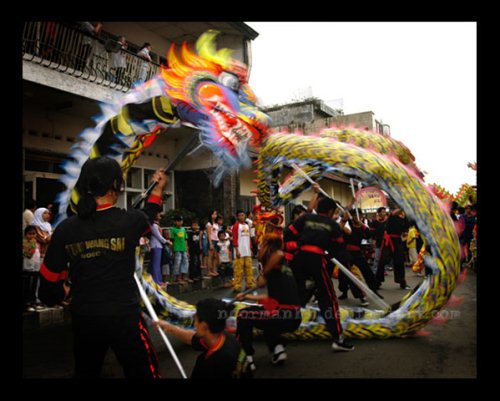
Chinese New Year by: Noorman Wijaksana
When to Travel to Singapore: Festivals & Celebrations
When to visit Singapore therefore does not rest much on the climate as it does on other factors like local festivals and sightseeing places. And, as the culture of Singapore is directly influenced by the multiculturalism that exists, it is therefore not at all surprising that festival times are the best times to visit Singapore.New Year’s Day kicks off with gala celebrations, and sees the city streets being decorated with colourful balloons, festoons, and lights. Celebrate with the locals as city streets turn into carnival venues. Another very important festival celebrated throughout Singapore is Chinese New Year, which occurs every year in the month of January. Other festivals like Good Friday, Hari Raya Haji, National Day, and Deepavali are ideal times to visit Singapore. Do take into account that hotels and flights to Singapore might be booked up in advance and/or higher rates apply.
Singapore Visa Regulations
Singapore Visa Regulations:
By: Cher Tan
The imposition of entry visas is part of Singapore’s Immigration and Checkpoint Authorities’ multi-pronged approach in ensuring that Singapore remains a safe and secure place for everyone. However, travel visa permits are not required by the citizens of several countries to visit Singapore as tourists. In this case, documents like passports, onward documents (onward/return tickets, entry permit, etc) to the next destination must be on the travellers. They should also have sufficient funds for their stay. For longer stay, permission of the immigration department is required.

Singapore Visa Stamps, By: Mroach
» United States of America, Australia, Belgium, Denmark, Germany, Finland, France, Norway, South Korea, Spain, Sweden, Italy, Iceland, Luxemburg, Japan, Republic of Ireland
» Countries that are members of the British Commonwealth (except India)
» Philippines (diplomatic, special or official passport holders)
» Liechtenstein, Monaco, Netherlands, San Marino, Switzerland, Thailand (diplomatic or service passport holders)
» India (diplomatic or official passport holders)
Singapore Visa Regulations for others
For citizens of countries not listed above who require a visa, they are required to have a passport valid for 6 months beyond the stay in Singapore. The visa is issued for the period of 1 month. It can be extended in Singapore to 3 months via the Immigration & Checkpoints Authority of Singapore. Visa approval can take anytime from 4 days to 4 weeks. Documents needed would entail a valid passport, 2 fully filled application forms, passport-size photos, proof of sufficient budget and journey details in Singapore.
By: Cher Tan
The imposition of entry visas is part of Singapore’s Immigration and Checkpoint Authorities’ multi-pronged approach in ensuring that Singapore remains a safe and secure place for everyone. However, travel visa permits are not required by the citizens of several countries to visit Singapore as tourists. In this case, documents like passports, onward documents (onward/return tickets, entry permit, etc) to the next destination must be on the travellers. They should also have sufficient funds for their stay. For longer stay, permission of the immigration department is required.
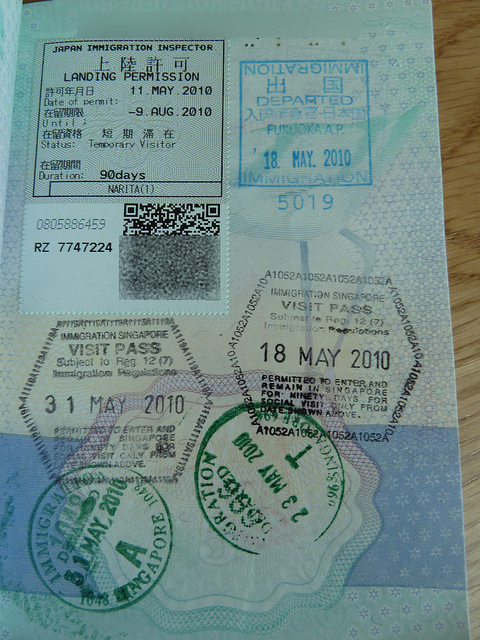
Singapore Visa Stamps, By: Mroach
Singapore Visa Regulations:
Citizens of the following nations do not need visas» United States of America, Australia, Belgium, Denmark, Germany, Finland, France, Norway, South Korea, Spain, Sweden, Italy, Iceland, Luxemburg, Japan, Republic of Ireland
» Countries that are members of the British Commonwealth (except India)
» Philippines (diplomatic, special or official passport holders)
» Liechtenstein, Monaco, Netherlands, San Marino, Switzerland, Thailand (diplomatic or service passport holders)
» India (diplomatic or official passport holders)
Singapore Visa Regulations for others
For citizens of countries not listed above who require a visa, they are required to have a passport valid for 6 months beyond the stay in Singapore. The visa is issued for the period of 1 month. It can be extended in Singapore to 3 months via the Immigration & Checkpoints Authority of Singapore. Visa approval can take anytime from 4 days to 4 weeks. Documents needed would entail a valid passport, 2 fully filled application forms, passport-size photos, proof of sufficient budget and journey details in Singapore.
Singapore Getting There and Away
Singapore Getting There and Away:
By: Cher Tan

Singapore Airlines, By: Simon ClancySingapore is one of Southeast Asia’s largest aviation hubs, so unless you’re coming from Peninsula Malaysia or Batam/Bintan in Indonesia, the easiest way to enter Singapore is by air. In addition to flag-carrier Singapore Airlines and its regional subsidiary Silkair, Singapore is also home to low-cost carriers AirAsia, Tiger Airways, Jetstar Airways and Scoot.

The Singapore Causeway, By: Jonathan Choe
A second crossing between Malaysia and Singapore, known as the Second Link, has been built between Tuas in western Singapore and Tanjung Kupang in the western part of Johor state. Much faster and less congested than the Causeway, it is used by some of the luxury bus services to Kuala Lumpur and is strongly recommended if you have your own car. Walking across is also not allowed, not that there would be any practical means to continue the journey from either end if you did.
By: Cher Tan
Getting to Singapore by Air
Singapore Airlines, By: Simon Clancy
Getting to Singapore by Land
If coming from/going to Peninsula Malaysia, Singapore is connected via two land crossings, one being the Causeway which is a very popular and thus terminally congested entry point connecting Woodlands in the north of Singapore directly into the heart of Johor Bahru. The Causeway can be crossed by bus, train, taxi or car, but it is no longer feasible to cross on foot after Malaysia shifted their customs and immigration complex 2 km inland.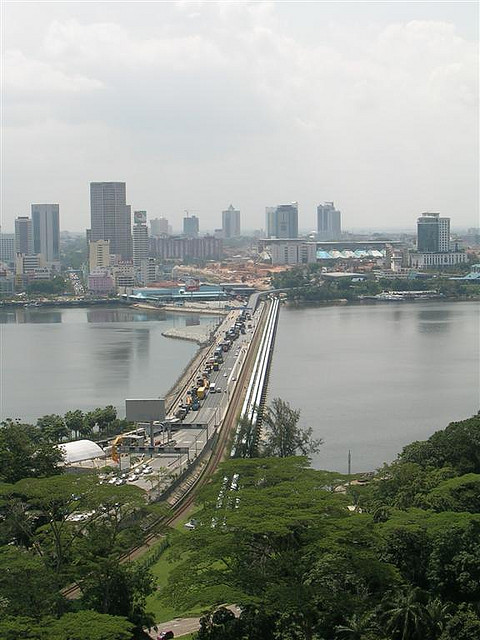
The Singapore Causeway, By: Jonathan Choe
A second crossing between Malaysia and Singapore, known as the Second Link, has been built between Tuas in western Singapore and Tanjung Kupang in the western part of Johor state. Much faster and less congested than the Causeway, it is used by some of the luxury bus services to Kuala Lumpur and is strongly recommended if you have your own car. Walking across is also not allowed, not that there would be any practical means to continue the journey from either end if you did.
Getting to Singapore by Water
As Singapore is an island city, it is also accessible by boat. Ferries link Singapore with neighbouring Indonesia province of Riau Islands, and the Malaysian state of Johor. Singapore has four ferry terminals which handle international ferries: HarbourFront (formerly World Trade Centre) near the southern part of the Central Business District, Tanah Merah Ferry Terminal on the East Coast, as well as Changi Ferry Terminal and Changi Point Ferry Terminal, at the eastern extremity of the island.Getting Around in Singapore
Getting Around in Singapore:
By: Cher Tan
Getting around in Singapore is easy: the public transportation system is extremely easy to use and taxis are reasonably priced when you can get one. Very few visitors rent cars. Gothere.sg does a pretty good job of figuring out the fastest route by MRT and bus and even estimating taxi fares between any two points.

Singapore MRT map, By: Edward

Singapore trishaw, By: Chang R
By: Cher Tan
Getting around in Singapore is easy: the public transportation system is extremely easy to use and taxis are reasonably priced when you can get one. Very few visitors rent cars. Gothere.sg does a pretty good job of figuring out the fastest route by MRT and bus and even estimating taxi fares between any two points.
Getting around in Singapore by rail
The MRT (Mass Rapid Transit) and LRT (Light Rail Transit) are trains that are the main trunk of Singapore’s transit system. They are a cheap and very reliable mode of transportation, and the network covers most points of interest for the visitor. All train lines use contactless RFID tickets (also known as EZ-Link cards). Single-trip tickets cost from $0.80 to $2 plus a $1 refundable deposit. All lines are seamlessly integrated, even if the lines are operated by different transport companies, so you do not need to buy a new ticket to transfer.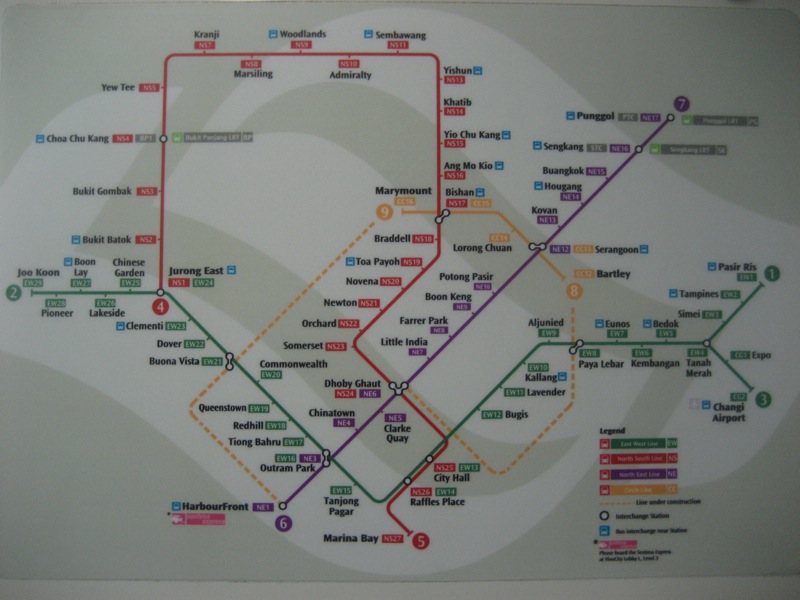
Singapore MRT map, By: Edward
Getting around in Singapore by bus
Buses connect various corners of Singapore, but are slower and harder to use than the MRT. Payment with EZ-Link card is thus the easiest method: tap your card against the reader at the front entrance of the bus when boarding, and a maximum fare is deducted from the card.
Singapore trishaw, By: Chang R
Getting around in Singapore by taxi
Taxicabs use meters and are reasonably priced and honest, however, a shortage of taxis in Singapore means that they are often unavailable for hours at a time. Taxis start from the flag-down fare of $3.00-$3.20.Getting around in Singapore by trishaw
Trishaws, three-wheeled bicycle taxis, haunt the area around the Singapore River and Chinatown. Geared purely for tourists, they should be avoided for serious travel as locals do not use them. There is little room for bargaining: short rides will cost $10-20 and an hour’s sightseeing charter about $50 per person.Getting around in Singapore on foot
Singapore is generally fairly pedestrian-friendly. Classic walks in Singapore include walking down the river from the Merlion through the Quays, trekking along the Southern Ridges Walk or just strolling around Chinatown, Little India, or Bugis.
Subscribe to:
Comments (Atom)