Nov 15, 2012

Indonesia & Performing arts: A Talk With Goenawan Mohamad

Indonesia & Performing arts: A Talk With Goenawan Mohamad:
By: Gerard Mosterd

Goenawan Mohamad is one of Indonesia’s most well-known intellectuals today. Looking younger than his actual age, he was born as Goenawan Susatyo on the 29th of July 1941 in Batang, a small town in the north coast of Java. He grew up in a political family: his father was a left-wing activist who was exiled to the remote Boven Digoel camp in West Papua — and, after his return to Java, was executed in 1947 by the Dutch troops sent by the colonial office in the Hague to retake Indonesia.
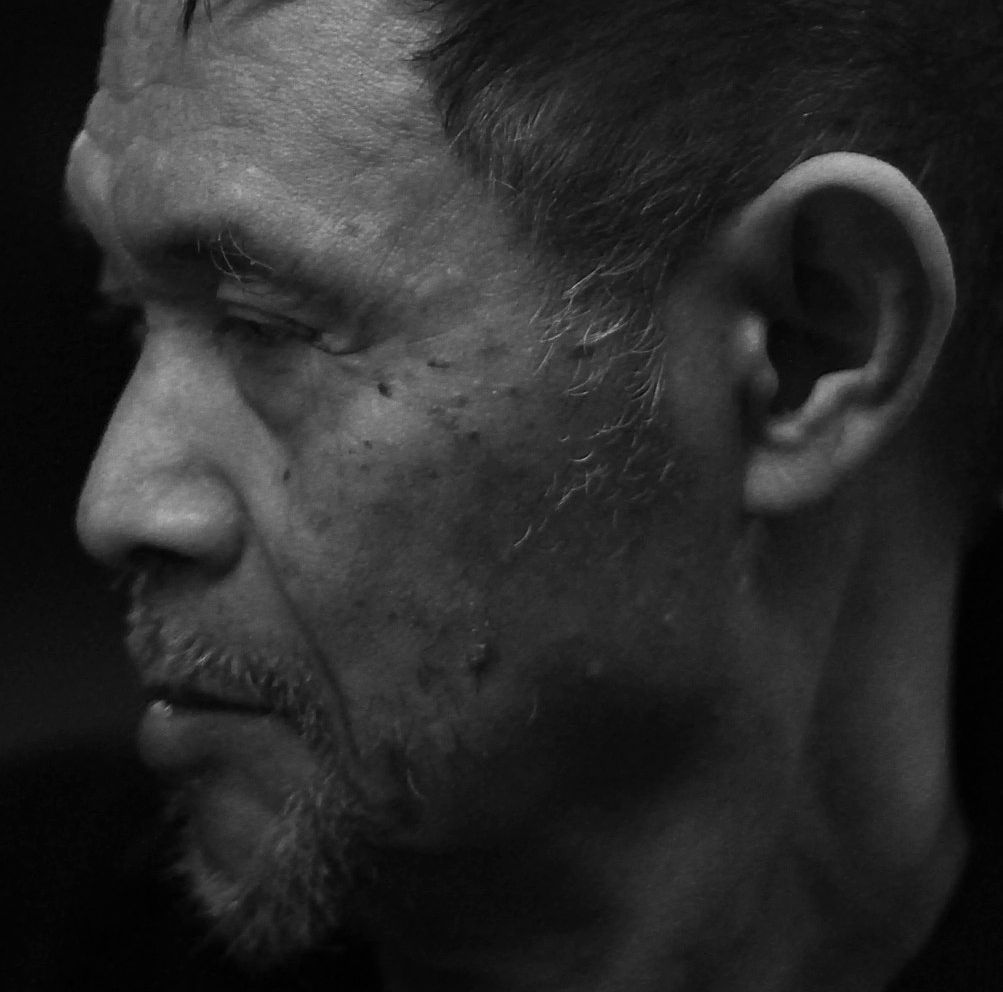
Goenawan Mohamad
Goenawan Mohamad, one of Indonesia’s most well-known public intellectuals

Goenawan studied psychology and philosophy at the University of Indonesia in the early sixties. He published poems and essays before turning 18. He gained a wider recognition after his essays and poetry were published by Sastra, a respected literary monthly published in Jakarta. Under Sukarno’s ‘Guided Democracy’, with its Third-World revolutionary ideology, Sastra was under attack for being “counter-revolutionary”. The campaign against Sastra writers was launched by leftwing writers like Pramoedya Ananta Toer who stood for “socialist realism”.

Fearing an imminent purge, writers and artists related to the magazine issued a manifesto, called “A manifesto on culture” (Manifes Kebudayaan) in 1963. It spoke for a creative life independent from the diktat of political powers; it stood against Stalinist “socialist realism.” Goenawan was one of the first signatories of the manifesto. After a huge political campaign led by supporters of the Indonesian Communist Party, Sukarno banned the manifesto.

Sastra ceased its publication. Its writers were not allowed to publish their works; Goenawan and others used pseudo-names to survive. “Not that we were against the revolution”, Goenawan told me of those years. “We were very much pro-Revolution. But we thought it was possible to be revolutionary without following the precept of ‘socialist realism’. People like Diego Rivera and Neruda were men of the left but were not Stalinist in their arts.” In 1965, just before the turbulent, violent days following the counter-coup by the Army — in which thousands of people were massacred and jailed, most of them accused of being communists — Goenawan left for Europe. He was 24 and accepted as a student at the College d’Europe in Brugges, Belgium.

Not long after he returned to Indonesia, he joined Kami, a student newspaper in Jakarta that spearheaded student movement against Sukarno and his “Guided Democracy”. The newspaper was also highly critical of the military regime under Suharto — and was later banned. Under the Suharto regime, Goenawan and his friends started Tempo newsmagazine in 1971. In its pages Goenawan’s short essays, published under the rubric of Catatan Pinggir (“marginalia”), have been a weekly staple with a large number of loyal readers. This year, Tempo’s publishing wing produced nine big volumes of Catatan Pinggir. In 1994, Tempo was banned.

Goenawan decided to join a growing pro-democracy movement and set up an underground network of information. Three of the members of the network were jailed, one was kidnapped. Until the end of the regime, Goenawan was never caught and detained; probably he was so highly visible internationally that the regime had to be careful not to make him another Amnesty International’s “prisoner of conscience” like Pramoedya Ananta Toer.
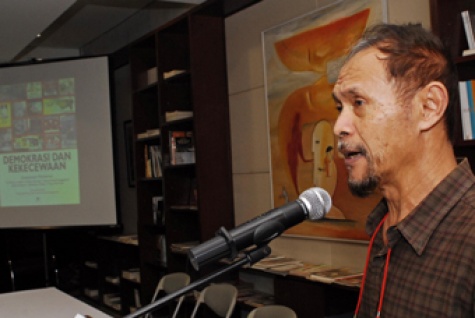
Goenawan Mohamad with in the background one of his books 'Democracy and disappointment'

In 1998, Suharto fell from power following a huge student demonstration. During his underground years, Goenawan transformed an unused space belonging to Tempo (which was out of business) into a hub of different activities (theatrical and dance performances, art exhibitions) mostly as a cover. This was the genesis of the Utan Kayu Community (Utan Kayu is the name of the street where it is located), a small art centre known for many innovative works performed in a room with a limited audience. The theatre had no seats; people just sat on the floor to watch plays and dances. After the fall of Suharto, with the help of Jawa Pos, a Surabaya-based newspaper,

Goenawan built another centre, to accommodate the growing need for space for performing arts at Salihara Road, one hour-drive from Utan Kayu. It was on 8 August 2008 that Komunitas Salihara was launched as the new contemporary arts centre. It is located near Pasar Minggu (Sunday Market) and the National University in the South of Jakarta. It was good timing as the “Big Durian”, an Asian metropolis of around 17 million people, had been lacking a decent house for the arts for quite some time. When Komunitas Salihara was created, the Jakarta “National” Theatre (Gedung Kesenian) built in the colonial time was going through a crisis due to an unfavourable change in policy and management.

Until then Gedung Kesenian used to be the main place for the performing arts in Jakarta along with the theatres at Taman Ismail Marzuki, the small Utan Kayu centre, and the European cultural centres like Erasmushuis, Goethe Institut, Istituto Italiano and Centre Culturel Francais. Salihara offers monthly lectures and discussions for free. With a 240-seats black box stage and a gallery-cum-concert space, it has an attractive, on-going program of national and international fine art expositions, dance and musical performances. Though this venue may not be too easily reached by road transport due to Jakarta’s notorious traffic jams and its remotene location from the city centre, it can be reached relatively quickly by train. Get off at Pasar Minggu station and walk or take a motor cycle or taxi from there, which takes you to Jalan Salihara in just a few minutes. Salihara houses an Indonesian-style restaurant (kedai) and a small souvernir shop. It serves as an excellent meeting point as wel.
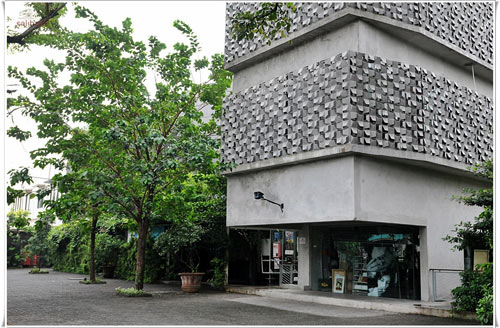
Komunitas Salihara is truly a unique place in Jakarta

Gerard Mosterd: Komunitas Salihara has existed since 2008. How did you get to the idea to set up the Salihara Community? Goenawan: In the beginning I was working for Tempo as an editor. I started it to promote quality journalism but this also enabled me to make a living. As you know for a poet it is not easy to survive. Poetry doesn’t pay. Working as an editor caused kind of a problem — meaning I didn’t have much time to write poetry. But at the end I managed to find a balance.

One good thing about Tempo is that half of its shares are controlled by the employees and the other half belongs to a Jakarta foundation that funds sports (mostly badminton) training centres. So basically we were free to use parts of the profit for the purpose of art. We sponsored and funded productions. This did not last, though. When Tempo was closed down by Suharto, the publishing company practically went bankrupt. Luckily, we did have a group of offices that, after the banning of the magazine, we could use for underground activities. We created a gallery. We would have meetings in the gallery, and the police and the military would think we were doing an exhibition or a seminar on arts. We called this Komunitas Utan Kayu. In 2007, I received an interest-free loan — practically it was a grant — from Jawa Pos, a Surabaya-based newspaper owned by Tempo (and by me together with some former Tempo people). Following the suggestion of my friends at the Utan Kayu Community, I used the money to purchase a cheap piece of land in the southern part of Jakarta; it was a parking lot for garbage collection trucks. We transformed it into an arts venue, designed by three prominent architects who did it pro bono. We called it Komunitas Salihara — “Salihara” (a Sundanese word for lantana) being the name of the road where it is situated.

Gerard Mosterd: How do you find the money to run this arts community? Goenawan Mohamad: Parts of it come from my personal earnings as a share holder of Java Pos; other parts from the Java Post and other donors. In the past, we refused to receive government’s fund, but recently our relationship with the Ministry of Education and Culture has improved considerably — and the ministry has a large budget to spend. For our 2012 festival, we got additional funding from the government. It has yet to be seen whether this will be a regular policy.

Gerard Mosterd: You are regarded as an icon, representing a long part of the history of Indonesia, stretching from the independence, the Sukarno era, through the New Order into the present “democratic” time. Goenawan Mohamad:

An icon is dead stuff. I prefer to stay alive.”

And maybe political activity is embarrassingly limited; I always see political activism as an cumbersome necessity — a “sad duty”, as one prominent theologian puts it. The problem is that it is a Sisyphus-like story. In each part of Indonesian modern history there has always been a totalitarian temptation. Living here means you have to deal with this recurrent non-freedom. In the past we had colonialism, then “the guided democracy”, then “the military-based New Order” and later on, after Reformasi in 1998 — after our democratic ideals were institutionalised — we have had religious fanatics threatening to get rid of our traditional tolerance and expressions of difference. It is very exhausting but if we don’t continue fighting, the intellectual and artistic resources of this country will disappear.”

Goenawan Mohamad also updated the text for the extraordinary performance L'Histoire du Soldat

Gerard Mosterd: Do you expect support from outside of Indonesia? Goenawan Mohamad: In the past, during the resistance against Suharto, we had a good network with friends in East Timor, pro-democratic elements in Burma, the Philippines, Thailand and Malaysia. But this was mostly political in nature. On the cultural front, it was, and still is not, very easy. The aftermath of Reagan-Thatcher “market fundamentalism” was a new type of right wing myopia. The Ford Foundation, used to be a generous supporter for the arts has since been transformed into a business-oriented donor agency. Of all nations the Dutch, with its Prince Claus Funds and HIVOS, have been the only progressive institutions in their outlook in promoting cultural activities as part of the social. But I’m afraid – and I am not alone in this — even in the Netherlands “culture” is the first casualty in this time of the Right. I always think Right wing ideas begin with a parsimonious paranoia. You know that in your country some well established institutions such as KITLV were under the threat of being dismantled. The Tropentheater in Amsterdam will close down in a few months.
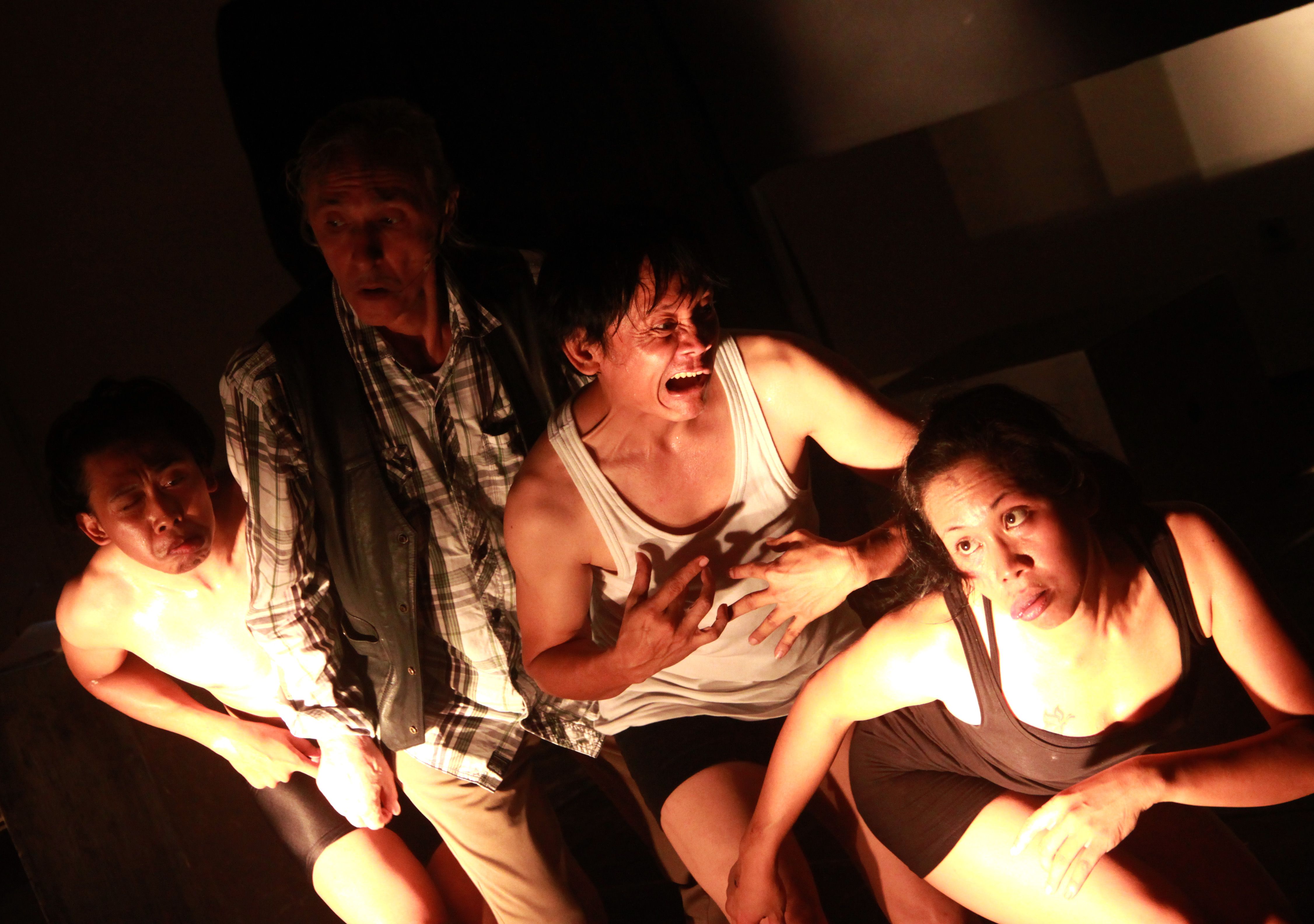
A scene from L'Histoire du Soldat

Gerard Mosterd: But Indonesia is not in the same position, isn’t it? Goenawan Mohamad: “In Indonesia conservatism of all kinds, particularly Muslim, is on the rise. The brighter side is of course the consistent growth of the economy, despite the European and American crisis. Yes, the middle class seems to be flourishing, consumers have a strong confidence in their future. But this may have adverse effects as well. First, the income disparity is growing menacingly. It is almost as bad as in China. Second, there is a craze for material culture — and given the fact that business and political elites of Indonesia are culturally illiterate, the funds allocated for true creativity become increasingly marginal.

But let me give you a more optimistic view. All this may end up with Indonesia having a new generation who demands more quality in the artistic and intellectual production. I think it is the role of Komunitas Salihara to prepare the way. Especially we insist on having first class performances that the young can afford to see. As you know we don’t make any money by selling tickets. The prices are reasonable and quite low. 50.000 IDR for ordinary people and 25.000 IDR for students.

Gerard Mosterd: You have been following artistic currents in Indonesia.What is your idea about the Indonesian performing arts, past, present and future? Goenawan Mohamad: I think the golden age of the Indonesian performing arts was during the seventies. That was when the arts centre Taman Ismail Marzuki was fully supported by the city under the governorship of Ali Sadikin, who started it.. Sadikin gave the Jakarta arts community good funding and freedom which is unusual. So we had beautiful, homegrown performances and good artists from abroad were brought in as well — including Marcel Marceau and Pina Bausch. It was Rendra’s best time performing Hamlet and Oedipus. It was the time that Sardono Kusumo created his best works. Then Sadikin stepped down and Suharto placed one of his men in that position. He cut all the money substantially and started to control Taman Ismael Marzuki. A long time of decline was setting in. The arts cannot exist and grow without money. Gedung Kesenian used to be a cinema at that time. Even in Yogya things were not as good for a long time during the eighties.”

Gerard Mosterd: Has there been an improvement since? Goenawan Mohamad: “Almost invisible. We no longer have reliable theatre and dance companies. The quality of contemporary dances is erratic. So is that of the theatre. The good thing is that from time to time, you find surprising talents, It strengthens my belief that creativity, like a flowing current, has always get a way to keep on flowing. ***

Extremely high infant mortality Result of Discrimination

Extremely high infant mortality Result of Discrimination:
Press Release – SDSP
Extremely high infant mortality in West Papua result of discrimination Amsterdam, 12 November 2012 – New research on the position of the native population of West Papua reveals that systematic discrimination of Papuans in Indonesian society has …

Press statement
Extremely high infant mortality in West Papua result of discrimination


Amsterdam, 12 November 2012 – New research on the position of the native population of West Papua reveals that systematic discrimination of Papuans in Indonesian society has resulted in extremely high child mortality. The differences between Papuans and non-Papuans on the Indonesian island are devastating; whereas the rural Papuans have an infant mortality rate of 18,4% non-Papuans have a rate of 3,6%. These statistics indicate a society where Papuans are structurally disadvantaged and discriminated against. As a result of years of Indonesian transmigration politics 50% of the population of West Papua consists of non-Papuans. Interviews held with both population groups confirm that discrimination is deeply rooted into society. Decades of the harrowing Indonesian regime has reduced Papuans to being second-class citizens in their own land.
“The way they treat us, it feels like we don’t even have a government.” Papuan woman, 30 years old

“When my grandson fell ill we took him to the hospital in the city, but they kept asking questions and weren’t helping us. He was very sick. When we finally got some help it was too late.” Papuan woman, 48 years old
“ We can only watch from a distance. We don’t belong, we are the others in our own land.” Papuan man, 32 years

Invisible victims The research report ‘Invisible Victims: The effects of structural violence on Infant and Child mortality in Papua Barat, Indonesia in the context of Human Rights’ demonstrates that the Indonesian government is in violation of the Rights of the Child and the Maastricht Guidelines. Observations show that medical care in the cities is better equipped than the remote inland populated almost entirely by Papuans. The Indonesian government has not taken sufficient steps to improve the dire situation, which has led to the appalling infant mortality rate of 18,4% among rural Papuans. Health centers are often vacant or even abandoned; there is not enough medical personnel or equipment and there is an insufficient, unvaried stock of medicine that is often past the expiration date. This despite the fact that Indonesia has ratified the Rights of the Child on September 5, 1990 which obligates the state to uphold the special rights accorded to children. Additionally the situation is in violation with the Maastricht Guidelines, a document which is used within international law as a guideline for prevention of the violation of the Economic, Social and Cultural Rights that enumerates the judicially required minimum standard of healthcare. The Indonesian state has ratified the Covenant on Economic, Social and Cultural Rights in 2006 and is thus obligated to adhere to these guidelines. Nevertheless despite the legal obligations both treaties have been violated in the province West Papua. Papuans are a vulnerable group and within the current system created by the Indonesian government as a result of the transmigration policy they have no chance of a decent future.
“The discrimination of Papuans in their own land has affected me deeply. The lack of opportunities for a brighter future for the native population of West Papua is heart wrenching, especially compared to the non-Papuans who have a better life. The fact is; Papuans are badly discriminated against and there is little concern for their predicament in the media. Hopefully this research will contribute to generating more attention for West Papua resulting in action being taken by politicians and Human Rights organizations to give these forgotten people a proper chance for a future’ Stella Peters, Master student Conflict Studies & Human Rights
About the research:

The research report ‘Invisible Victims: The effects of structural violence on Infant and Child mortality in Papua Barat, Indonesia in the context of Human Rights’ has been conducted for the master Conflict Studies & Human Rights at Utrecht University. The thesis was written by Stella Peters in collaboration with the NGO Stichting Duurzame Samenleving Papua Barat (SDSP). To explore discrimination in West Papua three groups were investigated; the Papuans in rural areas, the Papuans in urban areas and non-Papuans. More information at: www.sdsp.nl.


Stichting Duurzame Samenleving Papua Barat http://www.sdsp.nl/
ENDS
Content Sourced from scoop.co.nz

Original url

UN To Stay Engaged In Timor-Leste After Peacekeeping Mission

UN To Stay Engaged In Timor-Leste After Peacekeeping Mission:
Press Release – UN News
New York, Nov 12 2012 5:10PM The United Nations and the broader international community will remain engaged in Timor-Leste beyond December, when the world body’s peacekeeping mission withdraws from the country, a top UN official told the Security Council today.UN To Stay Engaged In Timor-Leste After Peacekeeping Mission Ends, Says Senior Official
New York, Nov 12 2012 5:10PM The United Nations and the broader international community will remain engaged in Timor-Leste beyond December, when the world body’s peacekeeping mission withdraws from the country, a top UN official told the Security Council today.
“Timor-Leste still faces many challenges. However, a peacekeeping mission is no longer best placed to support efforts to meet those challenges,” said the Acting Special Representative of the Secretary-General and head of the UN Integrated Mission in Timor-Leste (UNMIT), Finn Reske-Nielsen.
“The time has come for Timor-Leste’s interaction with the international community to be guided through different structures and modalities,” he added in his briefing to the 15-member body.
Mr. Reske-Nielsen reported that UNMIT is on track to withdraw by 31 December and that the phased drawdown of the mission has been moving apace.
Earlier this year, the Council extended the mandate of UNMIT – which it first established in 2006 in the wake of a major political, humanitarian and security crisis that erupted that year – for a final period, so the Mission could assist the country with several key tasks this year.
This has been an eventful year for the small nation that the UN shepherded to independence in 2002: it celebrated the 10th anniversary of its independence, elected a new president and held parliamentary elections, which were largely peaceful and held in an orderly manner.
A ceremony was held on 31 October to mark the certification of the full reconstitution of the national police, known by the acronym PNTL – acknowledging that the force was fully capable of conducting all police functions throughout the country – a key benchmark ahead of the Mission’s departure.
“The reconstitution of the police service of Timor-Leste is a milestone that marks the great advances of the PNTL and civilian oversight authorities since 2006,” the envoy told the Council. “This is not to say that the PNTL is a perfect police service. Significant capacity challenges remain, and have been identified jointly by the Government and UNMIT.”
He noted that building an effective and responsible police service is an ongoing effort that stretches over many, many years. “As in other areas, Timor-Leste is now at a stage when these long-term efforts can be better served by other forms of international cooperation,” he stated, adding that UN agencies will continue to provide some support to the PNTL post-2012.
At the same time, Mr. Reske-Nielsen urged Member States to continue their strong engagement with the PNTL, including through the ‘Friends of PNTL’ – an important venue to mobilise and coordinate external support. “With the planned departure of UNMIT, their engagement will become even more important,” he stressed.
In terms of UNMIT’s drawdown, the Special Representative said that one of the Mission’s regional offices has already closed, with two to close this month and the last one in early December. In addition, the repatriation of UNMIT police accelerated after the certification ceremony of 31 October, with only a residual presence to remain by the end of November.
The only notable area where UNMIT’s work will not be completed by the end of its mandate concerns the investigations into cases relating to crimes against humanity and other serious crimes committed between 1 January and 25 October 1999.
Under the supervision of the Office of the Prosecutor-General, the UNMIT Serious Crimes Investigation Team has completed 319 of 396 investigations. It is projected that an additional 16 investigations will be concluded by 31 December, leaving 61 investigations outstanding.
“Delivering effective support to Timor-Leste’s development and institution building priorities will require the continued commitment and financial contributions of the international community,” noted Mr. Reske-Nielsen.
Also today, the Council heard a briefing by Ambassador Baso Sangqu of South Africa, who headed the Council’s 3-6 November mission to Timor-Leste. He stressed the South-East Asian country would continue to have the support of the world body once UNMIT departs. Nov 12 2012 5:10PM ________________ For more details go to UN News Centre at http://www.un.org/news
Follow us on Facebook (http://www.facebook.com/UN.News.Centre) and Twitter (http://twitter.com/UN_News_Centre)
ENDS
Content Sourced from scoop.co.nz

Original url

PNG investigator claims Australia ‘Cayman Islands’ of Pacific money-laundering

PNG investigator claims Australia ‘Cayman Islands’ of Pacific money-laundering:
PNG walk against corruption
Papua New Guineans “walk against corruption” in a demonstration in Port Moresby earlier this year. Image: PNG Ports Corporation
Papua New Guinea’s new government has given the Task Force Sweep team the freedom to investigate, prosecute and charge anyone they believe to have benefitted from corruption and its proceeds. The plan is to “clean up” laundered money sent to Australia, says an Asia-Pacific Journalism special report.
Pacific Scoop:

Report – By Cassandra Mason
Addressing a Sydney crowd during a recent visit, the head of Papua New Guinea’s new anti-corruption unit Task Force Sweep likened Australia to the “Cayman Islands” for its role in turning a blind eye to investments of PNG government corruption money on Australian shores.
Sam Koim’s presentation at the Australian Transaction Reports and Analysis Centre major reporters meeting “Money laundering in Australia of the proceeds of corruption in PNG” called on Australian authorities to up their game in combating money laundering and cross-border corruption.
He laid out investment figures he said could not possibly have derived from legitimate funds, raising the question “Is the banking industry in Australia doing business with ‘dirty’ money?”
Figures obtained by Gorethy Kenneth for the PNG  Post-Courier in May this year showed that six known PNG politicians have combined property investment in Cairns of A$11.5 million, and according to Asian Development Bank economist Aaron Batten, PNG’s overall investment in Australia has reached A$1.2 billion.
Kenneth also referred to reports earlier in the year that the latest Registrar of Titles figures showed PNG residents were the largest overall investors in the far Australian north. He warned that Cairns would soon be “another PNG city”.
Koim’s presentation used these figures to urge Australian authorities and financial institutions to stop neglecting the obvious source of this money.
“They have bought property and other assets, put money in bank accounts and gambled heavily in your casinos and have never been troubled by having their ill-gotten gains taken off them.
‘Bad guys win’

“Unless the money can be prevented from leaving our country or prevented from entering Australia, the bad guys win and the rest of Papua New Guinea suffers.
“And PNG is suffering.”
Papua New Guinean investigative journalist and researcher Alexander Rheeney says while what has been happening in Australia has been “public knowledge for a long time”, Koim’s declaration signified a turning point.
“Papua New Guineans know that a lot of their politicians, big businessmen and the elite have investments down in Australia – that has been public information for a while.
“What is new is that an entity connected to the PNG government has actually come out and said ‘this is the value of this investment that’s been made in Australian real estate and we reckon a lot of this is actually corruption money.’”
Because of the way the new government has been operating, Rheeney says Prime Minister Peter O’Neill has given Koim and his team the freedom to investigate, prosecute and charge anyone they believe to have benefitted from corruption and its proceeds.
He believes it was on the basis of this freedom that Koim made his statement in Sydney, one that has stirred up a lot of interest in social media, invoking wide criticism of Australia for “harbouring the proceeds”.
Tighter law

Since the change in legislation in 2005 which brought in the Proceeds of Crime Act, banks have become much stricter around the amounts of funds you can invest in accounts both locally and offshore.
This act effectively gave PNG an “opportunity” to successfully prosecute corruption cases, says Rheeney.
“So long as they can prove that Papua New Guineans have moved funds to Australia – if they can successfully prove in court that those funds were obtained through corruption, they could use the Proceeds of Crimes Act to ask Australia to do something about it and get those funds sent back.”
Yet Rheeney points out that while the crux of Koim’s speech is Australia’s failure to return any of these proceeds, the PNG government has not yet used the legislation to try to recoup any of the money either.
“It has put the government in a bad light.
“PNG actually has to fix up its backyard first before it can start pointing fingers at Australia.”
And fixing PNG’s backyard is a mammoth task. Since its independence in 1975, state powers and functions have been decentralised in a bid to address issues of service delivery and diversity.
As Dr Ray Anere wrote last year in his article “Papua New Guinea in 2011: Politics Confused, but Democracy Stable”, this decentralisation process has led to fragmentation, legislative loopholes and systematic corruption.
Embezzled funds

It is estimated that one billion kina (about A$471 million) of public funds are embezzled through corruption each year. At the same time, 37 percent of the population lives below the poverty line, with only seven per cent with access to electricity.
For a country MP Dame Carol Kidu once described as “blessed with too many natural resources”, PNG has failed to benefit from its abundance of copper, forestry, oil and gold. Corruption in forest laws and land deals has deprives the Papua New Guinean people of millions of dollars every year.
Where the population should be enjoying the benefits of their resource wealth, the proceeds don’t get translated into development and services that reach them.
The loss of aid money to corruption has also been an ongoing struggle for PNG – to the extent where development agency AusAID called for funding to PNG’s National AIDS Council Secretariat to be suspended earlier this year.
The rationale for this was, as reported by ABC, that “development projects have been exposed as effective tools for money laundering and it is estimated that half of development money is lost through corruption.”
Weak governance

The year 2004 saw the establishment of the National Anti-Corruption Alliance but weak governance and a lack of human resources and capacity have prevented the success of its anti-corruption strategies.
Following years of inquiries and few prosecutions, the PNG government announced the appointment of anti-corruption unit Task Force Sweep in August last year.
Since then, the team, headed by Koim, has made dozens of arrests of current and former government ministers, MPs and businessmen and produced a report calling corruption “institutionalised”, reported Global Information Network in June this year.
According to Dr Anere, the operation has so far recovered 20-50 million kina ($9-24 million) of public funds. Koim says it is corrupt officials like these that have turned PNG’s constitutional democracy into a “mobocracy”.
Yet others believe that while Task Force Sweep is on the right track with its mandate, the restrictions it faces as acting within a government still suffering from corruption will limit its success.
Journalist and former Transparency International PNG employee Henry Yamo says it will take the current government a long time to achieve change while people from the former government are still in positions of power.
“These people are not going to change their practice in accordance with the new government.
“If we need to really get to the bottom of really ending corruption then we need to look at more drastic measures than putting in place a Task Force.”
‘Band aid’ approach

Yamo says Task Force Sweep is “more of a band aid approach” than what PNG needs long-term.
“Task Force are doing what they’re supposed to under the powers they have been vested with, but the team can’t act alone – other agencies have to come in and do their part.
“They can do the investigations, get people and lock them up but if the police are not cooperating with them… investigations can be in vain.”
The perception that agencies like Task Force Sweep are rendered impotent by the lack of cooperation across networks and the lack of capacity to properly equip them is something widely discussed in the Pacific.
In his 2009 article “Cleaning up the Pacific: anti-corruption initiatives”, Dr Manuhuia Barcham wrote of the pressing need to ensure “vertical and horizontal integration” within and across agencies involved in anti-corruption work.
He urged that a prerequisite for the fight against corruption must be “an environment of mutually reinforcing accountability. The one “key impediment” to this integration, he wrote, was a general lack of capacity.
Capacity stretched

“The problem is that many current anti-corruption frameworks are often created without any real sense of the resources required to implement them, thus complicating the affordability of government and stretching the already low capacity of many developing country states.”
Yamo says this integration must be seen as cooperation and a common focus between the police, the courts and the Task Force.
“All these agencies need to work together towards common goal.
“All must be equally committed.”
He says if the government is truly dedicated to eradicating corruption, they will take it further than just a “witch hunt”.
“You can’t stub out corruption just by hunting out the people that are involved.
“You also need to empower society and people in the community.”
Corruption silence

Yamo attributes a silence on corruption to a culture of fear, born out of decades of powerlessness.
“Most of these people are witnesses to corruption and they can’t always speak out.
“They are afraid of the repercussions.”
If the government is serious about fighting corruption, it needs to empower people by passing legislation that protects freedom of speech, he says.
“PNG is a socially networked kind of society where people depend on each other.
“People will talk about it if they feel protected by law. Right now, nobody’s protected so they are really vulnerable.
“You can be killed and it’s done in a way that makes it difficult to know who has committed the crime.”
Australian responsibility

But the reach of this responsibility is not limited to within PNG. It is also the responsibility of countries like Australia not to facilitate corruption through lack of regulation.
Yamo agrees with Koim’s statement that Australia has anti-money laundering obligations, saying it is very reasonable to request that Australian banks conduct due diligence on their customers.
This due diligence is made up of questions that Koim describes as a “means test”. The test requires banks to ask for tax returns, bank statements, income declarations, salary slips and other means of telling where the money has come from and whether it has been obtained by legitimate means.
Koim warned in his presentation that financial institutions would need to show proof of these processes if the AFP “come knocking”.
He acknowledged that the responsibilities “may seem onerous” but added that the stakes were high.
Yamo says he thinks the means test is made up of “very reasonable requests” for Australian financial institutions to implement.
“That is one way Australia can help prevent corruption from happening in PNG because Australia is fuelling it by allowing it to happen, allowing money to cross countries and come in.
Checks, balances

“[Right now] they’re not keeping checks and balances to see where the source of the finance is and how the people have money – are they public servants and politicians or are they just ordinary citizens?”
Knowing that they have nowhere else to invest their money, Yamo says it is more likely corrupt officials will try to invest it inside their country, making it easier for investigators to catch them.
He thinks there are other things Australia could be doing to help, pointing out that Australia’s history of pouring aid and development money into PNG while failing to prevent it being laundered back through its own country is illogical.
“The first step should be Australia looking at such things and [ensuring] that money should stay inside and contribute to the development of the country.
“And then maybe we won’t need Australia’s aid money.”
Yamo says following Koim’s speech, the media would have picked up on the accusations and defended their institutions’ policies. Yet since that story came out, Yamo says he hasn’t seen anything crop up in Australia’s defence, causing him to believe that Australia might never have been enforcing policies to stop this.
And so the question falls back on PNG’s “backyard”. Should PNG be working on improving its own anti-corruption legislation and enforcement before it accuses Australia?
Yamo says it lacks the political will.
“There is no political will to tackle this from the leaders. If there was political will to get rid of this, things would happen. Investments are done by politicians so if they go ahead and tackle this, it’s going to affect them so they just don’t want to do it because it comes back to them.”
Cassandra Mason is a Postgraduate Diploma in Communication Studies student journalist on the Asia-Pacific Journalism course at AUT University.

Malaysia’s commodified Islam

Malaysia’s commodified Islam:

At the World Halal Week held annually in Kuala Lumpur, you can purchase halal bone china, an exemplar of luxury and piety rolled into one. Malaysia is the leader in halal certification and a major promoter of the global halal industry. With markets saturated with a mind-boggling array of sharia-compliant goods that cater to a more discerning Muslim middle class, Islam can be seen as having entered more deeply into the lives of Malaysian Muslims in more commodified ways than ever before. The line between the sacred and the consumable profane have blurred, and true to the dictum that Islam is ‘a way of life’,  anything which supports the notion of good Muslim personhood can now be made halal. The explosion of consumer goods imbued with spiritual meaning is a new phenomenon spurred on by the broadening middle classes disenchanted with meaningless consumerism. Now consumer goods can have real intrinsic, spiritual meaning. But how did everything beyond consumables (and indeed items beyond meat) become halal.
Commodification of culture started as a phenomenon that emerged from the early capitalist period of Fordist mass production which then intensified during late capitalism. Flexible and geographically mobile post-Fordist market approaches shifted from mass production to a more fragmented, niche market to suit every possible types of lifestyle. The ‘religious’ lifestyle or public piety characterised by halal crockery, toothpaste, make-up, and even beer can be regarded an outcome of post-Fordist modes of production. Marx’s concept of ‘commodity fetish’ may be the most relevant point of entry into understanding the commodification of objects and practices that were previously not considered commercial.
In Marx’s analysis, commodity fetish requires the concealment of the origins and processes involved in the production of a consumer product from the consumer in order to maintain the ‘religious fog’ that justifies the mystery of its self-evident value. Religious symbols and meaning as commodity fetish may behave in the same manner, in that the deeper engagement of the purpose and context of a particular symbol are sidestepped and usurped by other distracting elements that vie for the attention of the consumer. The self-evident value of a religious commodity is intrinsically located within itself rather than the processes that lead to its points of ‘origin’.
The abstraction of all other factors involved in the production of a commodity has profound consequences on not just our relationship with literal consumer products but also with symbols, religious or otherwise. The post-Fordist condition demands the proliferation of diversity and thrives on the specialisation of products (and labour). Driven by the perpetuated need for ‘new’ and ‘ever more novel-seeming goods’, styles and signifiers are extracted from their previous associations and fused together to produce new products in what Jameson calls ‘pastiche’ for new consumers in new contexts. The ease with which such meaning and symbols are removed from their original contexts may point to their increasingly depthless, untethered, and frictionless qualities.
Investigations into religious commodification have challenged theories of secularisation in modern society demonstrating that far from a wholesale decline in public belief in God and church membership, modern and rational societies, in particular those in Asia and the United States, continue to embrace religion and imbue public life with notions of religious essence. The rise of religious commodification has been argued to go hand in hand with the emergence of ‘Islamic modernity’, a political and cultural sensibility whereby modernity is embraced alongside a commitment to Islam as part of the project of modernity in its own terms as much as its approximations to western notions of modernity.
The concept of ‘Islamic modernity’ have a Lyotardian suspicion against the grand narrative of western modernity in favour of a more hybrid and reflexive modernity inflected with faith-based sensibilities where non-western contexts experience the rise of advanced economies and public cultures. The Islamic modern can be located in the popular consumption of Islamic media and Islamic forms of consumerism that at times exist, not without friction, alongside orthodox Islamic beliefs and practices.
When does a symbol cease becoming sacred and becomes simply a commodity bereft of its spiritual meaning? Can they become both? Halal products now have become more than just a spiritual choice but made to be synonymous with quality. However, there is considerable debate among practitioners and scholars about the effects of commodified forms of Islam. Some have praised the increased presence of Islam in the marketplace as it encourages the incorporation of Islamic values into the everyday practices of Muslims. Others have been less celebratory, arguing that the commercialisation of Islam appeals to superficial expressions of piety. Where does one draw the line for halal products? Does the choice to not utilise halal products make one less a conscientious Muslim?
The circulation of Islamic symbols outside the formalist domains and authority of the state and religious institutions and into the market and the media coheres with the emergence of Muslim publics. Facilitated by increasing access to new modes of communication, the creation of the Muslim public sphere challenges the authority of conventional religious institutions and fosters the building of a civil society and the ‘global ummah (community)’. The so-called Islamic revivalism across Muslim societies of the world coupled with increased communication and economic opportunities have boosted the production of things ‘Islamic’ which occurs alongside the increasing adoption of a public pious image amongst the consumer middle-class.
With all things considered, it is not an understatement to say that Islam is big business. But in Malaysia, where the conflation of ethnic and Islamic identity is a political and socioeconomic issue, consumer habits aligned with aspirational piety form just another disciplinary mode to reinforce the boundary markers of such an identity. To purchase halal products may just be another way of asserting one’s Malay identity. In the mounting challenges to Malay privilege and positive discrimination, Islamic consumerism may be a way to reinstate a sense of meaning and belonging.  Perhaps unexpectedly, Malaysia’s mall culture and ethnic/religious anxiety over the loss of institutional privilege were destined to become kindred spirits.
Alicia Izharuddin is a final year PhD candidate at the Centre for Gender Studies at the School of Oriental and African Studies where she specialises in religious cinema in Indonesia.

Cambodia, Thailand and the ASEAN Way

Cambodia, Thailand and the ASEAN Way:

Despite the signing of the ASEAN Charter in 2008, the recent border conflict between Thailand and Cambodia has shown that the organisation places the onus of avoiding armed conflict on the disputants themselves. Following Michael Leifer’s account of the ‘ASEAN paradox’ (1983), this dispute has further demonstrated that ASEAN is an association rather than an alliance. Leifer argued that security matters are addressed bilaterally rather than regionally, and national interest prevails over regional unity. Even after both countries withdrew troops in June 2012, it is worth looking back at what the conflict meant for the body.
The ASEAN way, which includes the ‘non-intervention’ principle and consensus-based decision-making, has weakened any possibility of intervention and has constrained any aspirations of regional powers such as Singapore and Indonesia to resolve the border conflict. Less pressure from neighbouring ASEAN countries on the Thai and Cambodian governments has added to the dispute. But these are merely the everyday frictions of diplomacy, rather than something that could threaten the stability of the region.
Other factors that weakened the prospect of ASEAN intervention were that Indonesia had its own agenda of self-interest, which was to boost its own international reputation, along with Secretary General Surin Pitsuwan’s general reluctance to be involved in a conflict involving its members. Moreover, the external factors led ASEAN to depend on the UN Security Council to resolve the conflict as the organisation is unable to impose hard measures on its own member states, such as sanctions.
The latest developments suggest that the border conflict shifted towards peace, but looking ahead, a change in the Thai government might resume the conflict. Therefore, the end result of the conflict remains precarious. If the mediation continues to be successful and peace is sustained, then ASEAN may be able to exercise a degree of influence over other regional territorial disputes, such as in the South China Sea.
Still, in the long term, while the principle of non-intervention has been violated several times, the principle of consensus-based decision making will continue to drive the paradox. The idea of regional unity will remain rhetoric at best, while the divide between member countries enlarges.
ASEAN should rather model itself as a political security organisation based on a UN formula, bestowing members the power to either abstain or veto conflict resolution efforts. The ASEAN Charter has not yet transformed the group into a rules-based organisation, and therefore there needs to be a significant reinvention of policy.
The border conflict is indeed, in some form, a battle for national pride which can be offset by an ASEAN-based regional unity. Still, historical animosity between both countries has existed since the pre-colonial era, and both governments took advantage of engrained nationalism to win support. Thus, the efforts of ASEAN were diplomatic rhetoric with no clear effect, a show of weakness cloaked by rhetoric of “non-interference.”
Sources:
Barry Buzan, Ole Waever, and Jaap de Wilde. 1998. Security: A New Framework for Analysis. Boulder: LynneRiennerPublishers.
Michael Leifer. 1983. “ASEAN and the problem of common response” International Journal Vol. 38 (2)
Dinita Setyawati, an Indonesian political analyst, resides in Jakarta. She researches governance, economic development, environmental politics and labour migration.

Once a Muslim, always a Muslim

Once a Muslim, always a Muslim:

Dr. Marzuki Mohamed, ANU alumnus, and advisor to the Deputy Prime Minister of Malaysia recently argued that Malaysia is NOT a secular state.
The timing of Dr. Marzuki’s assertions of course fits a larger strategy undertaken by the ruling party: to use religion as a wedge between Muslims and non-Muslims in general, but also between the parties in the opposition coalition, especially the Islamist PAS, and the social democrats, DAP. Islam is also of course used to ensure compliance, and to stifle dissent.
Having next to nothing to rely on: suffering from massive deficits on the leadership and policy front, and with an increasingly debilitating track record in the economic, social and political front, this is indeed a sound strategy as there are sufficient number of Malaysians, and especially Malaysian Muslims to fall for this – that UMNO is the protector and the guarantor of the sanctity of Islam. To  paraphrase and slightly modify Samuel Johnson, “religion is indeed the last refuge of a scoundrel.”
Another ANU alumnus, Dr. Kikue Hamayotsu, give credence to the argument that Islam is used simply as a means to ensure the continuation of this corrupt regime. In her article, she argues that:
It is commonly assumed that greater enforcement of Syariah [Islamic law] is the result of growing Islamism in civil society and/or the state. This article investigates the most burning political issue relating to the state enforcement of Syariah in contemporary Malaysia, that of apostasy. The author argues that it is the electoral imperative of the secular Muslim ruling elites, especially prime ministers, to cultivate broader support to achieve political survival, not only among their traditional power base in the rural Muslim constituencies, as is conventionally argued, but equally importantly among the urban non-Muslim (especially Chinese) constituencies, which has also conditioned the state enforcement of Syariah. The author’s findings from Malaysia and observations on Indonesia further suggest that electoral competitiveness – rather than authoritarianism or theocracy – conditions state enforcement of Syariah, contrary to expectations.
In an earlier posting on New Mandala, Dr. Ahmad Farouk Musa had argued that Islam would flourish best only under a secular state.
It never ceases to amaze me, that there are still sufficient number of Muslims who actually believe that they can, and should be legislated to heaven!

Review of Buddhist Fury

Review of Buddhist Fury:

Michael K. Jerryson, Buddhist Fury: Religion and Violence in Southern Thailand
New York: Oxford University Press, 2011.  Pp. 262; maps, tables, photographs, appendix, bibliography, index.
Reviewed by Tim Rackett.
Buddhist Fury explores the relationship between religion and violence in the far South of Thailand, where Buddhist monks are a marginalized local minority. Michael Jerryson focuses on the Buddhist and monk “side” of the Thai state’s conflict with Malay Muslims and thus explores a previously unexamined dimension of that conflict.  His book is also a welcome corrective to the received wisdom in Thailand, which demonizes Islam as a violent religion causing conflict in the country’s far South. Building on the work of Mark Jürgensmeyer, Stanley Tambiah, Duncan McCargo and Brian Victoria, Jerryson debunks the myth of Buddhism as a moderate, moral spiritual force operating “above” the political and outside the state.
Whilst Buddhism is not violent in and of itself, as a lived tradition it can lend itself to dark and deadly uses. There are Buddhist dimensions to the Thai state’s violent struggle to control the country’s far South. To make sense of insurgent violence and the response to it, we have to understand the intricate interdependencies and interconnections among “race”, rule and religion in Thailand. To that end, Buddhist Fury examines “the role of Thai Buddhist monks in a religio-political conflict” (p. 5): the impact of violence on Buddhist monks and the ways in which, as actors in their own right, those monks have an effect on the ongoing violence. Its author asks whether the practices and habits of Buddhist monks in a violent environment exacerbate or ameliorate violence.
The performance of monasticism entails being a dhammic vessel, blessing people and amulets, purifying, offering merit on alms rounds, conducting rituals, living an ascetic lifestyle. Each of these roles and forms of agency is interrupted through and changed by violence. Being a Thai monk is not the same in all parts of the country. How to be a monk is prescribed by socio-political parameters and fantasy. Buddhist Fury demonstrates the ways in which religious identifications “interact with concepts of race, ethnicity and nationalism” (p. 185). Thus, whilst the cause of violence in Southern Thailand has ecological, economic, drug and political dimensions, for Jerryson, the “most pervasive, persistent and systematic problem is based on identity-formation” (p.183). Thai religious nationalism sets out the norm: to be Thai is to be Buddhist. This norm combines race and religion in a form of rule. Any solution to the conflict, argues Jerryson, requires making a space in Thainess for Malay-Muslim identity.  It demands an inclusive “reworking of Thailand’s concept of racial formations”, which act to “displace minority identities by measuring their ethnic and religious identities against the norm of Thai Buddhism” (p.183).
Buddhist Fury is divided into five interrelated chapters, each examining Buddhist dimensions of violence in southern Thailand.
Chapter I provides historical context for the southern conflict. It addresses how and why a “master narrative” of Thai historical truth predominates in accounts of the region, justifying Thai Buddhist rule by excluding and delegitimizing Malay-Muslim claims to autonomy and ethno-religious identity. The political role and representations of southern Thai Buddhist monks in relation to the conflict are explored in Chapter II, “Representation”. How did Thai Buddhist monks come to be “walking embodiments of Thai nationalism”? (p. 50). What exactly do monks signify? Thai monks’ roles mean that they are agents of both state and sangha, representing the sacred and the profane, as living symbols of the dhamma and representatives of Thainess, of the Thai polity. It is monks’ political agency that explains their being targeted by insurgents. As representatives of the Thai state, monks are, unintentionally, a catalyst for escalating religious violence and identity politics. Jerryson argues that the conditions for evoking Buddhist violence are a space of conflict; politicized Buddhist images, roles and representations; and any defacing assault upon the sacred status and incarnation of those latter.
Chapter III, “Practice”, focuses on the ways in which being a Thai Buddhist is learnt and performed in a specific way in the southern Thai conflict zone. Using the personal narratives of southern monks, Jerryson shows how the role of Buddhist monk has been politicized as a response to violence and, furthermore, how it incites Thai religious nationalism. Monks incarnate and signify the legitimacy of the Thai state in a “convergence of Thai sacrality and governance” (p. 81). The theme of being a Buddhist and what this role entails is pursued in Chapter IV, “Militarization”. Mobilizing religion transforms security forces into “moral guardians, sacred avengers of the nation, not mere State servants, whose sacred duty is to uphold and protect the integrity of Thai Buddhism” (p. 75). The consequences of the defense of monks and local communities against insurgent attacks, as that defense is undertaken by Buddhist soldiers and police, are the militarization of Buddhist identities and spaces. Temples become fortresses and military camps.  We have seen the advent of a seemingly enigmatic figure of the military monk, the “thahan phra”.
Jerryson’s most astute and perspicacious insights and interpretations—in Chapter V, “Identity”—concern the under-investigated notions of “race” in Thai identity, the phenomenon of state racism in Thailand and the relationship of those notions and that phenomenon to religion and violence. Jerryson shows that race and ethnicity are mobilized and combined with religion. Being Thai is a state-produced racialized identity, with its source in Siam’s response to Western colonization and Buddhist and Hindu religious traditions. Thai identity politics doubly excludes Malay Muslims from Thainess: for their other religion and for their racialized status as “khaek”.
The comparative and historical narrative in Buddhist Fury helps render the religious violence in southern Thailand intelligible as a norm and not an enigmatic exception. Buddhism, in thrall to Thai state nationalism, functions as a fundamental marker of ethnicity and imagined “race” to the end of domination and rule. In Jerryson’s analysis the political issue at stake in the far South of Thailand seems to be Malay Muslims’ desire “for autonomy based on ethno-religious identification” (p. 8) and the Thai state’s denial of their voice and of space for their socio-political aspirations and interests. This political drama is, however, reconceptualized through nationalist fantasy as an anti-Thai clash threatening to destroy Thai civilization and unleash anarchy. Buddhism is used to manage the “state of emergency” in the South.
Buddhist Fury concludes by suggesting ways in which ethno-religious conflict can be ameliorated by a different use of Buddhism. Rather than as an instrument of rule to handle a religious security threat, and thus as fuel for Buddhist nationalism and strife, it could be deployed in conflict resolution, fostering inter-faith communal bonds.
Jerryson’s iconoclastic analysis draws on interviews with thirty abbots, with monks and with soldiers.  It is based on participant observation of different southern Thai Buddhist communities.  It does not centre on Buddhist doctrine and texts but rather on “local situational performances” (pp. 17, 83) of being a Buddhist. Buddhism as a “lived tradition”, outside Western idealized “Platonic” representations, is diverse, fluid and contradictory. Buddhist truth and traditions are not universal and eternal but are rather enmeshed with particular interests and power relations.
How, then, is the non-violent image of Buddhism maintained? Such an image is achieved, argues Jerryson, because its practitioners and its analysts create a fantasy version of Buddhism: “fictitious people and practice—virtual religious models, morally airbrushed to enhance the message” (p. 185). The problem with this mythic Buddhism is that its dark side is ignored: extreme phenomena such as monks with guns, “soldier-monks”, militarized temples, Buddhist militia. In Thailand, religious nationalism legitimates violence, offensive and defensive, against the enemies of “nation, religion and king”. Monks as spiritual exemplars are credited with the power to purify and order hearts and minds and social relations, as Christine Gray has argued.
This sacred role is not discrete from politics and power. Under Thai state purview, monks have had a political role as emissaries, as agents for building a new national identity and fostering unity.  Indeed, the advent of political monks was first set out in the work of Tambiah and Somboon. The Thai state is sacralized as an imaginary repository of pure dhammic practice, which monks politically defend on the front lines with their sacred bodies, as agents of the sangha and state. Anyone who wishes to change the socio-political order, to create division and disharmony, becomes an enemy of the state. In the 1970s Thai communists were enemy Number One; today, it is “separatist” Malay Muslims and “republican” Red Shirts.
To understand the uses of Buddhism we must not view it as abstracted from social relations, a philosophically or spiritually pure form of knowledge, but rather as an historical practice of truth and a technique of power shaping people’s socio-political identities and mundane reality. Its sacred “ultimate truth” as performed is neither other-worldly nor discrete from oppressive forces which justify and legitimate violence.
Buddhist Fury marks a significant advance in understandings of Thai racialized identity and the Buddhist spiritual dimensions of ultra-nationalism and racism. Why are ethnic Malays, categorized as “khaek”, excluded from Thainess but Sikhs included? It seems that Chinese can become Thai overnight but not “farang”, in spite of their alluring lighter skins, idealization and privileged status in Thai society. Jerryson’s bold hypothesis is that the primary cause of violent conflict in Thailand’s far South is racial inequality; state-led exclusionary policies together with conditions of poverty give rise to separatist strife. Malay Muslims are neither ethnically Thai, nor religiously Buddhist (p. 144). There is thus a need to examine the relationship among religion, historical Siamese and Thai notions of race and contemporary racism in the South.
The category of “khaek” subsumes multiple ethnicities—South Asians, Malays, Arabs—aggregated by the shared attribute of having dark skin, which is read by Buddhists as a sign of impurity and inner badness. It is not ethnicity that causes racism, exclusion and inequality in Thai society but, rather, the ways in which race and religion are combined in identity formation. Religion, central to Malay Muslims’ identity, excludes them from Thainess. Malay ethnic identity has become fused with Islam. But it has not always been so; history reveals the existence of Malay Buddhists.
Thai racism identifies Malay Muslims as “khaek” not by using a Western biological notion of race, but rather one based on skin colour, a sign of spiritual purity. Chinese are included within Thainess on the grounds of shared customs and Buddhist beliefs, socio-economic roles and status. Thai Buddhism is the normative measure of identity and civility, which others lack. It becomes a racial identity. “Khaek” is a racialized identity including a religious marker, a negative classifier of “people of another religion”. Jerryson points out, following Charles Keyes, that “khaek” are associated with the Buddhist evil figure of Mara, demons and their human followers, imagined as dark-bearded figures representing Malays and South Asians. The Thai social order embodies racialized distinctions and statuses, and to this degree it has traces of the Hindu caste system as re-worked in Thai Buddhism and politics.
Jerryson’s analysis reveals the weakness of David Streckfuss’s path-breaking account of the Siamese “creative adaption” of Western racial categories to resist colonization by forging a new notion of identity combining nation and race and citizenship into “chat”. However, pace Streckfuss, this does not entail a Western physio-anthropological category of race. Streckfuss fails to note the religious dimension in the new concept of chat: being a Thai Buddhist, a racialized religious identification. Having a dark or light skin is not just a sign of a poor socio-economic status, or an aesthetic issue. It is an indigenous Buddhist classifier of moral and spiritual purity. Buddhism is not, in the end, an exception to religious traditions that assign people to superior and inferior racial groups.
The Brahmin and Buddhist origins of “chat”, in Sanskrit “jati”, signify rank, caste, family, race and lineage; membership of a “divine race”; becoming or being born a Buddhist. Caste, purity and pollution, the sacred and mundane, are all entailed in the term’s meanings: a spiritual and socio-economic status and the racial formation of superior pure and impure inferior castes. One sign of membership is of course light skin color. “Jati” was taken up in the nationalist ideology of Rama VI to render Buddhism a signifier of being civilized, the member of a superior race, not among the savage others within Siam, on the international imperial stage. Siam needed savages and inferior beings for its appearance of being civilized; ethnic and religious minorities took on this role. Siamese Buddhism became part and parcel of Siamese racial identity through the exclusion of Malay  Muslims as “foreign and semi-barbarians” as Chao Phraya Yommarat expressed it, but the inclusion of ethnic Lao, Khmer, Vietnamese and Chinese as they were closer, as Buddhists, to the Siamese race.
Violence stems from racial inequalities rooted in religious and ethnic identifications. Jerryson shows how in a zone of conflict identities become racialized into incarnations of goodness and badness as effects of the trauma of violence. Faith becomes fate when identification is fixed to an essential racialized and primordial religiosity. Buddhism is used to construct the otherness of those who question and oppose Thainess. Regimes of religious and racial truth identify who and what people are, worthy of living or dying. The master narrative of Thai history and the myth of national unity confirm Schmitt’s notion of the political entailing/deciding of existential friend-enemy relations by positing a permanent Thai self which needs a bad or enemy other in order to be itself. Enemies “within” are both created and desired.
Buddhist Fury also suggests that the legitimacy of “network monarchy” and the inviolability of the kingdom’s sacred “geo-body” might not be the primary issue in the southern conflict. Malay Muslims are not attacking the monarchy, but rather the racist and religious form of “colonial” rule and domination emanating from Bangkok. Malay Muslims are asserting their counter-truth, their history and identity, which have been silenced and subjugated. What is occurring is not a sovereign struggle over land but a conflict over ethno-religious identity and forms of life. Malay Muslims are attempting to “de-colonize” hearts and minds of religiously enforced Thainess.
Furthermore, Jerryson’s analysis suggests that Buddhism is not a Thai coping strategy for handling anxiety and uncertainty—about succession, Malay-Muslim autonomy in the South, the future of Thai society.  Rather, it actually generates fear and insecurity to feed religious nationalist fantasy. Thus Buddhist religion is used to maintain a state of exception that manifests itself as permanent crises and “holy war” against impure others. Buddhist-inspired violence in the far South of today’s Thailand is, rather than an abhorrent exception to the rule of peaceful and sacred uses of the religion, just a modern version of an Asian Buddhist tradition of defensive war and warrior monks.
Tim Rackett is an associate professor on the faculty of HELP University, Kuala Lumpur.  He has spent more than a decade and a half in Thailand researching Thai Buddhism, religious nationalism and forms of truth and rule.
References
Gray, C. Thailand: The Soteriological State in the 1970s. Doctoral dissertation, University of Chicago, 1986.
Jürgensmeyer, M.  Terror in the Mind of God.  Berkeley and Los Angeles: University of California Press, third edition, 2003.
Jerryson, M., and M. Jürgensmeyer, editors.  Buddhist Warfare.  New York: Oxford University Press, 2010.
McCargo, D.  Mapping National Anxieties. Copenhagen: NIAS Press, 2012.
Somboon Suksamran.  Buddhism and Political Legitimacy. Bangkok: Chulalongkorn University Research Dissemination Project, 1993.
Streckfuss, D. “The Mixed Colonial Legacy in Siam: Origins of Thai Racialist Thought 1890-1910.”  In L. J. Sears, ed., Autonomous Histories, Particular Truths: Essays in Honor of John R. W. Smail.  Madison: University of Wisconsin Center for South East Asian Studies, 1993.
Tambiah, S. J.  World Conqueror and World Renouncer: A Study of Buddhism and Polity in Thailand against a Historical Background. Cambridge: Cambridge University Press, 1976.
Tambiah, S. J.  Buddhism Betrayed? Politics and Violence in Sri Lanka. Chicago: University of Chicago Press, 1992.
Victoria, B.  Zen at War. New York: Weatherhilt, 1998.
Zizek, S. The Puppet and the Dwarf: The Perverse Core of Christianity. Cambridge, Mass.: MIT Press, 2003.

Cambodia’s death squads

Cambodia’s death squads:

Human Rights Watch released a sizzling report today that details the Hun Sen regime’s three-decade history of extrajudicial killings, and shows that the culprits have been rewarded with high-ranking government positions. The document starts out with “A-Team” death squads in the 1980s and the signing of the 1991 Paris Peace Agreement, and concludes with the shooting of environmental activist Chut Wutty last April:
According to accounts by Veal Bey residents, local businesspeople, and various human rights and other nongovernmental investigators who provided information to Human Rights Watch in Koh Kong and Pursat provinces, and in Phnom Penh, Wutty was shot after he was confronted by a team of three Timber Green security personnel and gendarme officers armed with AK-47 assault rifles who were summoned by subordinates at Veal Bey from the above mentioned gendarme and company check-point. These security forces, described as acting primarily under the authority of an armed, masked, and drunk Timber Green employee in military uniform from the checkpoint, insisted that Wutty and the journalists turn over all the photographs they had taken, which they did. Wutty tried to leave, taking the two journalists with him, but was prevented from doing so after he was told that his group first had to meet a senior gendarme officer at their headquarters in Koh Kong. While in the driver’s seat of his car, Wutty was shot amidst a verbal altercation with the security forces, during which a junior gendarme In Rattana, was also fatally shot.
(For background, one journalist who was traveling with Wutty later recounted the experience.)
It doesn’t take much to figure out that a gang of thugs is running the Cambodian People’s Party.  Still, the government seems to hope this is chatter that will pass (Phnom Penh Post):
But Information Minister Khieu Kanharith said on the sidelines of a meeting this morning that Human Rights Watch was just trying to make noise ahead of ASEAN, and called it standard practice for rights groups and protestors during international meets.
But this isn’t your typical, titular ASEAN meeting. Barack Obama will be the first US president to attend the summit in Phnom Penh next Monday and Tuesday, and HRW is raising the issue just as international eyes are, in a rarity, on Cambodia.

Turkey urges recognition of Syrian opposition

Turkey urges recognition of Syrian opposition: Country sees new coalition as legitimate representative of people, while rebels make advances.

KENYA: Rice farmers lose harvest to floods

KENYA: Rice farmers lose harvest to floods:
KISUMU, 15 November 2012 (IRIN) - Flash floods have washed away the rice harvest of some 2,000 farmers in western Kenya, flooding some of their homes and sending latrine effluent into water courses, according to officials and residents.

Briefing: Ethiopia’s Muslim protests

Briefing: Ethiopia’s Muslim protests:
ADDIS ABABA, 15 November 2012 (IRIN) - Tensions have been simmering over several months between Muslims and the government, with thousands holding demonstrations in protest at the government's alleged interference in religious affairs; the government has blamed the protests on a small group of extremists.

SIERRA LEONE: Ethnicity trumps policy in upcoming polls

SIERRA LEONE: Ethnicity trumps policy in upcoming polls:
FREETOWN, 15 November 2012 (IRIN) - Supporters of the opposition Sierra Leone People's Party (SLPP) will today take to the streets of the capital Freetown for the last time before presidential, parliamentary and local elections on 17th November.

HRW Report - Rights Out of Reach | Human Rights Watch

Rights Out of Reach | Human Rights Watch

HRW Report - Morocco: Abuse of Child Domestic Workers | Human Rights Watch

Morocco: Abuse of Child Domestic Workers | Human Rights Watch

HRW Report - Cambodia: Hun Sen Promoting, Rewarding Killers | Human Rights Watch

Cambodia: Hun Sen Promoting, Rewarding Killers | Human Rights Watch

New Gmail Search Operators

New Gmail Search Operators: Gmail added a lot of new search operators. Now you can finally filter messages by size, find old messages and mail that has no label.


Here are the new operators:

- size: lets you "search for messages larger than the specified size in bytes". For example, search for [size:512000] to find messages larger than 500 KB (1 KB = 1024 bytes). It's important to note that MIME encoding adds 33% overhead, so you may find a message that only includes a 400 KB attachment when you search for [size:512000].

- larger:, smaller: are similar to size:, but they allow abbreviations like K, M for KB, MB. Some examples: [smaller:1M] (messages smaller than 1MB), [larger:500K] (messages larger than 500KB). You can also use larger_than: and smaller_than:.

- older_than, newer_than are great for restricting Gmail results to recent or old messages. They allow to find messages older than 2 years (older_than:2y), older than 5 months (older_than:5m), but also messages sent within the past month (newer_than:1m) or the past 3 days (newer_than:3d).

- has:userlabels, has:nouserlabels are useful for finding messages that have or lack user-defined labels. Obviously, this excludes system labels like spam, chat, inbox, allmail and smart labels. You'll probably see a lot of conversations that have user-defined labels when you search for [has:nouserlabels] and that's because "Gmail applies labels to individual messages. In this case, another message in the same conversation thread has had a label applied to it."

- + (plus sign) added before a word excludes messages that match related words. For example, when you search for [start], Gmail also shows messages that include the word "starting". Change your query to [+start] and you'll only find messages that match the search term exactly. Another example: [+engineers] doesn't return search results that include "engineer". This operator used to be available in Google search, but it's now used for Google+ results and you need to use quotes for exact matches.

- rfc822msgid: is a more advanced operator that lets you find a message by the message-id header.

Now Gmail users who hit the storage limit can finally find the messages that have large attachments and delete them. They can search for [larger:5M], [larger:10M] or [larger:10M older_than:2y] and quickly delete the messages that are no longer useful.

{ via Gmail Blog }

Gmail Finds Similar Words and Spelling Mistakes

Gmail Finds Similar Words and Spelling Mistakes: Gmail has constantly improved its search feature in the past few months. After adding spell checking, suggestions, searching inside attachments, Gmail now matches similar words that have the same root. You can find a message even if you don't remember the exact words and that's pretty helpful.

Now you can search for [cat] and find messages that include the word [cats], search for [start] and find messages that only include [starting], search for [usable] and match [usability], search for [colour] and match [color], [coloured], [colours], [multicolor] and more.


Gmail also finds spelling mistakes like "clours" instead of "colours".


Gmail's search feature is less sophisticated than Google Search, so Gmail won't find synonyms and acronyms. You won't find messages that include "New York" when you search for [NY] or messages that include "tv" when you search for [television], at least not yet.

To prevent Gmail from finding related matches, use the + operator. For example, search for [+usable] and Gmail will no longer return messages that only include "usability".

Search for emails by size and more in Gmail

Search for emails by size and more in Gmail: Posted by Christian Kurmann, Software Engineer


We're always looking for ways to make it faster and easier for you to find your messages using search in Gmail. So starting today, you can now search emails by size, more flexible date options, exact match and more.


This means, for example, to find emails larger than 5MB, you can search for size:5m or larger:5m or to find emails sent over a year ago, older_than:1y.

These changes go hand in hand with other recent enhancements to search such as the improved autocomplete predictions and a field trial for instant results from Gmail, Google Drive and more as you type.

Gay Vote Seen as Crucial in Obama’s Victory - NYTimes.com

Gay Vote Seen as Crucial in Obama’s Victory - NYTimes.com

Sandy May Cost Insurers Up to $25 Billion

Sandy May Cost Insurers Up to $25 Billion: Sandy may cost the insurance industry up to $25 billion, according to a new estimate that provides the largest potential price tag for the storm so far.

China's Aid to Cambodia Helps Cement Ties - WSJ.com

China's Aid to Cambodia Helps Cement Ties - WSJ.com

Air Force trainers had improper relationships with dozens of students, report finds - The Washington Post

Air Force trainers had improper relationships with dozens of students, report finds - The Washington Post

The new boom: Shale gas fueling an American industrial revival - The Washington Post

The new boom: Shale gas fueling an American industrial revival - The Washington Post

In post-Gaddafi Tripoli: The Bee Gees, burgers and militia gun battles - The Washington Post

In post-Gaddafi Tripoli: The Bee Gees, burgers and militia gun battles - The Washington Post

BP agrees to criminal plea, $4 billion settlement in Gulf oil spill case - The Washington Post

BP agrees to criminal plea, $4 billion settlement in Gulf oil spill case - The Washington Post

Obama visits New York, takes aerial tour, to inspect Sandy damage - The Washington Post

Obama visits New York, takes aerial tour, to inspect Sandy damage - The Washington Post

Republicans to Mitt Romney: Exit stage left

Republicans to Mitt Romney: Exit stage left

Landlocked Laos's big plans - Asian Correspondent

Landlocked Laos's big plans - Asian Correspondent:

Asian Correspondent


Landlocked Laos's big plans
Asian Correspondent
Can one of the world's poorest nations join Burma on the march to development? asks Asia Sentinel's Simon Rougheen. Although Laos is soon to join the World Trade Organization, it remains very much Southeast Asia's forgotten country, a landlocked ...

and more »

Public Call For Dung to Resign

Public Call For Dung to Resign:
Vietnamese Prime Minister Nguyen Tan Dung faced an unprecedented call for his resignation on the floor of parliament Wednesday as a lawmaker challenged him to take greater responsibility for mistakes in handling the troubled economy of the one-party communist state.
In a daring challenge to the prime minister that was aired on TV, Duong Trung Quoc, one of few representatives in the National Assembly not affiliated with the ruling Vietnamese Communist Party, said the people demanded more than an apology for the government’s failings.
Quoc suggested that by quitting, Dung could help the country move toward a “culture of resignation” that holds politicians more accountable to the people.
“Are you willing to start the government’s progress towards a culture of resignation, in order to break away step by step from the apologies?” Quoc asked the prime minister, who had escaped punishment at a party meeting last month over a string of scandals involving state-run firms that have tainted the country's leadership.
Qouc’s statement was believed to the first public call for Dung’s resignation by a member of the National Assembly.
Dung responded that he was serving as prime minister according to the wishes of the party and the assembly, implying he would not resign.
“Under the direct leadership and management of the Party, during the last 51 years [that I’ve been a member of the Vietnamese Communist Party] I have never asked for any positions. On the other hand, I have never denied any service that the party assigned to me,” he said.
Dung’s second five-year term was approved by the communist-controlled parliament in July 2011.
“The party has decided to volunteer me for the post of prime minister and to continue with the task of prime minister that was assigned by the Central Committee and the assembly voted for,” he said.
“I’m willing to accept and willing to fulfill earnestly any decision of the party, the Central Committee, and the Assembly.”
Admitting mistakes
In a National Assembly session last month, Dung admitted that he had failed to effectively lead the country’s economy out of turmoil amid a spate of corporate scandals and inefficient management of major state-run firms.
He said he had made “mistakes” in his leadership that blackened the country’s reputation, vowing to work harder to amend official shortcomings.
He specifically pointed to the failure to address scandals such as the near-collapse of state-owned shipbuilder Vinashin in 2010 under a debt of about U.S. $4.5 billion and for sparking investor concerns over the management of the country’s other government-run firms.
Following public outcry over the shipbuilder, the government had admitted that Dung had played a role in allowing the mismanagement of state-owned firms including Vinashin, but said the "shortcomings and mistakes" were not serious enough to warrant disciplinary action.
Reactions
The back-and-forth between Dung and Quoc provoked enthusiastic response among those who saw it on TV or online in Vietnam, where political debate is restricted.
Mai Thai Linh, former vice president of the Da Lat City People Committee in southeastern Vietnam, said he thought the prime minister’s response that he served in accordance with the party’s wishes was a reflection of how much the Vietnamese Communist Party dominates the country’s politics.
“All such positions [like that of prime minister] have been decided by the party’s congress. That’s why the people have no impact on the leadership machinery and that machinery has no accountability to the people,” he told RFA’s Vietnamese service.
“It’s the basic problem of the communist regime. The decision of who takes what positions can no way be made by the people.”
“The National Assembly only does one thing: formalize what has been set up by the party,” he said.
Another commentator, Professor Tuong Lai, former Head of Vietnam Institute of Sociology Science, said that because the prime minister serves the party, any movement toward greater accountability in Vietnam’s political system would require a revamp of the entire system.
“The prime minister would stay wherever the party put him and would quit if the party told him to quit,” he said.
“[So] I think the issue is not to the replacement of the prime minister, the head of the assembly, or head of state, but the replacement of the whole system, the whole regime.”
Reported by RFA’s Vietnamese service. Translated by Viet Long. Written in English by Rachel Vandenbrink.

Send Web pages to your Kindle with new Firefox add-on | PCWorld

Send Web pages to your Kindle with new Firefox add-on | PCWorld

Nov 14, 2012

Dalai Lama wants probe into self-immolations

Dalai Lama wants probe into self-immolations: Spiritual leader demands China investigate a spate of self-immolations in Tibet during visit to Tokyo.

African Union backs Mali troops plan

African Union backs Mali troops plan: Deal endorses ECOWAS plan to send 3,300 troops to northern area of embattled Sahel country.

Many killed in string of Iraq bomb blasts

Many killed in string of Iraq bomb blasts: A series of coordinated car bombs and a roadside explosions kill dozens across the country.

Toyota recalls faulty cars worldwide

Toyota recalls faulty cars worldwide: Water pump problem and steering shaft defect that may result in faulty steering has caused company to recall cars.

Obituary: Ahmad Jabari

Obituary: Ahmad Jabari: The chief of Hamas's military branch, assassinated in the Gaza Strip, was initially a Fatah activist.

Israel PM 'prepared to expand' Gaza operation

Israel PM 'prepared to expand' Gaza operation: Air strikes continue as Netanyahu says Israel sent a "clear message" to Hamas through the killing of its military chief.

Controversial Russia treason law takes effect

Controversial Russia treason law takes effect: Critics say new legislation is so vague the government can now brand any inconvenient figure a traitor.

Violent protests continue in Jordan

Violent protests continue in Jordan: Demonstrators clash with police and chant slogans against the king as anger grows over fuel price hikes.

Congolese refugee children attend catch-up classes in Rwanda

Congolese refugee children attend catch-up classes in Rwanda: To date, almost 2,800 refugee children at Rwanda's Kigeme camp have registered for the orientation classes and more are expected to join.