Dec 13, 2012
Police break up anti-China rallies in Vietnam
Police break up anti-China rallies in Vietnam: Vietnamese police detain at least 20 activists as hundreds protest China's claim over oil and gas-rich South China Sea.


US blacklists Syrian rebel group al-Nusra
US blacklists Syrian rebel group al-Nusra: Washington designates group as a terrorist organisation, saying it is trying to hijack rebellion on behalf of al-Qaeda.
AU condemns Mali PM 'forced' resignation
AU condemns Mali PM 'forced' resignation: Bloc says country's military must accept civilian authority, while welcoming swift appointment of new premier.
Facebook helps FBI foil $850m-cybercrime ring
Facebook helps FBI foil $850m-cybercrime ring: US federal investigators arrest 10 people from seven countries, after co-operation from social network site.
Outrage over Argentina sex slavery acquittals
Outrage over Argentina sex slavery acquittals: Angry protesters hold demonstrations across country after Tucuman court acquits 13 accused of trafficking women.
Bangladesh opposition protests turn violent
Bangladesh opposition protests turn violent: Opposition protesters, fearing election rigging, demand restoration of caretaker government before polls.
Former Thai PM charged with murder
Former Thai PM charged with murder: Abhisit Vejjajiva, PM during violent protests in 2010, charged with murder over case of a civilian killed by army.
UN inspectors in Iran for nuclear talks
UN inspectors in Iran for nuclear talks: Seven-member IAEA delegation in Tehran for one-day visit to discuss country's disputed nuclear programme.
European court backs CIA rendition victim
European court backs CIA rendition victim: European Court of Human Rights rules that German citizen was an innocent victim of extraordinary rendition by US agents.
S Africa's Zuma to face leadership challenge
S Africa's Zuma to face leadership challenge: Kgalema Motlanthe, the president's deputy, to run against Jacob Zuma for leadership of ruling African National Congress.
Chavez suffers 'complications' from surgery
Chavez suffers 'complications' from surgery: Venezuelan president suffered "bleeding" that needed "corrective measures" during cancer surgery in Cuba, minister says.
Spain seizes $36.5m worth of Mubarak assets
Spain seizes $36.5m worth of Mubarak assets: Millions of assets of ex-Egyptian president and associates located, including Marbella beach properties and luxury cars.
Pakistan army denies 'abuses' in tribal areas
Pakistan army denies 'abuses' in tribal areas: Military says report by human rights group detailing widespread abuses amid conflict with Taliban is "a pack of lies".
Susan Rice withdraws name to replace Clinton
Susan Rice withdraws name to replace Clinton: US ambassador to UN withdraws name for consideration as US secretary of state, citing "lengthy and disruptive" process.
PM Won’t Meet Rights Expert
PM Won’t Meet Rights Expert: 
Prime Minister Hun Sen on Thursday refused to meet with a United Nations expert currently on a fact-finding mission to Cambodia, saying he has no time to listen to “the recommendations of a foreigner” on the situation of human rights in the country.
Hun Sen said he would not meet with U.N. Special Rapporteur on Human Rights in Cambodia Surya Subedi, who arrived Sunday for an eight-day investigative visit, adding that according to the constitution he is only answerable to the nation’s national assembly, or parliament, and his constituency.
“I’m not responsible to [answer to] anyone,” the prime minister said, speaking at a graduation ceremony at the University of Cambodia in the capital Phnom Penh. “In short, I don’t have time for any recommendations.”
“I heard he wants to meet me but I don’t have time for that,” he said.
Hun Sen said he “the integrity of the country to uphold.”
“You can criticize me, but I am working for my country,” he said.
“Should I [spend my time] implementing a foreigner’s recommendations or implementing the law?” he asked.
Hun Sen said that he had been unaware of a request by Subedi to meet with him. The Cambodia Daily reported that the Special Rapporteur had sent a letter to the prime minister asking for a meeting some three weeks ago.
Hun Sen said that Cambodia was willing to listen to the recommendations of others, but that they should not act as an authority in the country.
Since his appointment in March 2009, Subedi has made eight visits to Cambodia and has presented five reports to the United Nations Human Rights Council, which renewed his mandate for a further two years in March 2011.
He had hoped to meet with government officials, including Hun Sen, and King Norodom Sihamoni, in addition to representatives from Cambodia’s nongovernmental organizations, the country’s donor community, and the United Nations country team.
Hun Sen reportedly said that the King would not receive Subedi either because he is busy mourning the loss of his father, former King Norodom Sihanouk, who died of a heart attack in October.
At the end of his eight-day mission, the Special Rapporteur will release a press statement highlighting the issues raised during his meetings and summarizing his initial conclusions.
Call for dialogue
Subedi responded to Hun Sen’s statement by stressing the “importance of dialogue” with all stakeholders, and “particularly with the Royal government.”
“I interact with various actors in Cambodian society, including civil society and development partners, and we disagree on certain things. But we continue our dialogue to find a common ground and that is what I wish to do with the government too,” Subedi said in a statement to RFA’s Khmer Service on Thursday.
“I have no intention of—and it is not a matter of—imposing anything on the government of this country,” he said.
“All I am trying to do as part of my job on behalf of the U.N. is to advise the government what its obligations are under international law and suggest a way forward in my capacity as an independent expert of the U.N.”
Hun Sen said he “fully respects” Cambodia’s sovereignty and that of the government.
“I am heartened to hear that the Prime Minister will continue to listen to my recommendations, which I feel are in the best interests of the country.”
Recent findings
Subedi has been critical of Cambodia’s progress on human rights during this visit, saying on Wednesday that the country’s judicial system is still “chronically underfunded” and laws on its management are almost 20 years overdue, according to the Cambodia Daily.
A year ago, on his sixth mission to Cambodia, Subedi had said reform in the country’s courts was moving at a “frustratingly slow” pace. On Wednesday, he said laws on the establishment of judges, organization of the judiciary and reform of the Supreme Court Magistracy—all of which he had called for—have yet to materialize.
On Tuesday, the Special Rapporteur vowed to appeal to the government on the behalf of victims of land disputes in the country.
But Subedi has recently been given the cold shoulder by Cambodian officials who rejected a report he released in August which called for electoral reforms and accused authorities of rights violations over economic land concessions.
At the time, Om Yin Tieng, head of the government’s Human Rights Committee, said Subedi was siding with the country’s political opposition and civil society.
In another report, Subedi also warned that Cambodia could plunge into violence if it does not reform the current electoral system to allow for fair and free elections.
Subedi will present his next report to the U.N.’s Human Rights Council at its September 2013 session.
Reported by Sok Ry Sum for RFA’s Khmer Service. Translated by Samean Yun. Written in English by Joshua Lipes.
Prime Minister Hun Sen on Thursday refused to meet with a United Nations expert currently on a fact-finding mission to Cambodia, saying he has no time to listen to “the recommendations of a foreigner” on the situation of human rights in the country.
Hun Sen said he would not meet with U.N. Special Rapporteur on Human Rights in Cambodia Surya Subedi, who arrived Sunday for an eight-day investigative visit, adding that according to the constitution he is only answerable to the nation’s national assembly, or parliament, and his constituency.
“I’m not responsible to [answer to] anyone,” the prime minister said, speaking at a graduation ceremony at the University of Cambodia in the capital Phnom Penh. “In short, I don’t have time for any recommendations.”
“I heard he wants to meet me but I don’t have time for that,” he said.
Hun Sen said he “the integrity of the country to uphold.”
“You can criticize me, but I am working for my country,” he said.
“Should I [spend my time] implementing a foreigner’s recommendations or implementing the law?” he asked.
Hun Sen said that he had been unaware of a request by Subedi to meet with him. The Cambodia Daily reported that the Special Rapporteur had sent a letter to the prime minister asking for a meeting some three weeks ago.
Hun Sen said that Cambodia was willing to listen to the recommendations of others, but that they should not act as an authority in the country.
Since his appointment in March 2009, Subedi has made eight visits to Cambodia and has presented five reports to the United Nations Human Rights Council, which renewed his mandate for a further two years in March 2011.
He had hoped to meet with government officials, including Hun Sen, and King Norodom Sihamoni, in addition to representatives from Cambodia’s nongovernmental organizations, the country’s donor community, and the United Nations country team.
Hun Sen reportedly said that the King would not receive Subedi either because he is busy mourning the loss of his father, former King Norodom Sihanouk, who died of a heart attack in October.
At the end of his eight-day mission, the Special Rapporteur will release a press statement highlighting the issues raised during his meetings and summarizing his initial conclusions.
Call for dialogue
Subedi responded to Hun Sen’s statement by stressing the “importance of dialogue” with all stakeholders, and “particularly with the Royal government.”
“I interact with various actors in Cambodian society, including civil society and development partners, and we disagree on certain things. But we continue our dialogue to find a common ground and that is what I wish to do with the government too,” Subedi said in a statement to RFA’s Khmer Service on Thursday.
“I have no intention of—and it is not a matter of—imposing anything on the government of this country,” he said.
“All I am trying to do as part of my job on behalf of the U.N. is to advise the government what its obligations are under international law and suggest a way forward in my capacity as an independent expert of the U.N.”
Hun Sen said he “fully respects” Cambodia’s sovereignty and that of the government.
“I am heartened to hear that the Prime Minister will continue to listen to my recommendations, which I feel are in the best interests of the country.”
Recent findings
Subedi has been critical of Cambodia’s progress on human rights during this visit, saying on Wednesday that the country’s judicial system is still “chronically underfunded” and laws on its management are almost 20 years overdue, according to the Cambodia Daily.
A year ago, on his sixth mission to Cambodia, Subedi had said reform in the country’s courts was moving at a “frustratingly slow” pace. On Wednesday, he said laws on the establishment of judges, organization of the judiciary and reform of the Supreme Court Magistracy—all of which he had called for—have yet to materialize.
On Tuesday, the Special Rapporteur vowed to appeal to the government on the behalf of victims of land disputes in the country.
But Subedi has recently been given the cold shoulder by Cambodian officials who rejected a report he released in August which called for electoral reforms and accused authorities of rights violations over economic land concessions.
At the time, Om Yin Tieng, head of the government’s Human Rights Committee, said Subedi was siding with the country’s political opposition and civil society.
In another report, Subedi also warned that Cambodia could plunge into violence if it does not reform the current electoral system to allow for fair and free elections.
Subedi will present his next report to the U.N.’s Human Rights Council at its September 2013 session.
Reported by Sok Ry Sum for RFA’s Khmer Service. Translated by Samean Yun. Written in English by Joshua Lipes.
Dec 12, 2012
Google Zeitgeist 2012
Google Zeitgeist 2012: Google's Zeitgeist page for 2012 has a lot of lists of popular searches from different categories and from different countries, so it's easy to find the people, the events, the games, the movies, songs and gadgets that defined the year 2012. It's important to keep in mind that most lists only include the queries with "the highest amount of traffic over a sustained period in 2012 as compared to 2011", so you won't find boring queries like [games] and [music], which are popular every year.
The "movers and shakers" of the year are:
1. Whitney Houston
2. Gangnam style
3. Hurricane Sandy
4. iPad 3
5. Diablo 3
6. Kate Middleton
7. Olympics 2012
8. Amanda Todd
9. Michael Clarke Duncan
10. BBB12 (Big Brother Brasil).
If you look back at the 2011 Zeitgeist list, you'll notice that "Gangnam style" replaces Rebecca Black, iPad 3 replaces both the iPhone 5 and the iPad 2, Diablo 3 replaces Battlefield 3.
The list of popular gadgets includes 6 tablets (iPad 3, iPad Mini, Nexus 7, iPad 4, Microsoft Surface and Kindle Fire), 3 phones (Galaxy S2, Galaxy Note 2, Nokia Lumia 920) and Sony's PlayStation. With so many interesting tablets released this year, it's hard to choose which one to buy.
Sometimes, Google's lists don't make a lot of sense, so you should take them with a grain of salt. Compare these 2 lists for US tech trends (for example, Note 2 is both more popular and less popular than iPhone 5):

Download the entire Zeitgeist collection [PDF] and don't miss the cool Easter Egg that shows a "Gangnam style" Android animation: mouse over the colorful bar at the bottom of the Zeitgeist page and click the robot.

{ Thanks, Arpit. }


The "movers and shakers" of the year are:
1. Whitney Houston
2. Gangnam style
3. Hurricane Sandy
4. iPad 3
5. Diablo 3
6. Kate Middleton
7. Olympics 2012
8. Amanda Todd
9. Michael Clarke Duncan
10. BBB12 (Big Brother Brasil).
If you look back at the 2011 Zeitgeist list, you'll notice that "Gangnam style" replaces Rebecca Black, iPad 3 replaces both the iPhone 5 and the iPad 2, Diablo 3 replaces Battlefield 3.
The list of popular gadgets includes 6 tablets (iPad 3, iPad Mini, Nexus 7, iPad 4, Microsoft Surface and Kindle Fire), 3 phones (Galaxy S2, Galaxy Note 2, Nokia Lumia 920) and Sony's PlayStation. With so many interesting tablets released this year, it's hard to choose which one to buy.
Sometimes, Google's lists don't make a lot of sense, so you should take them with a grain of salt. Compare these 2 lists for US tech trends (for example, Note 2 is both more popular and less popular than iPhone 5):
Download the entire Zeitgeist collection [PDF] and don't miss the cool Easter Egg that shows a "Gangnam style" Android animation: mouse over the colorful bar at the bottom of the Zeitgeist page and click the robot.
{ Thanks, Arpit. }
Dec 11, 2012
Logging Reporter Arrested
Logging Reporter Arrested: 
Authorities in eastern Cambodia’s Kratie province have arrested a local reporter who had exposed illegal timber smuggling in the area, according to police and an anti-logging activist.
Taing Try, a reporter affiliated with the Khmer Democratic Journalists’ Association, was taken into custody on Friday, police in Kratie’s Snoul district told RFA on Sunday.
Police refused to discuss the charges against him, saying only that local villagers had reported Taing Try for illegal activities to the district prosecutor.
But Ing Savoeun, a representative from the local Anti-logging and Wildlife Protection group, said he believes Taing Try is being held in connection with timber-smuggling activities that the journalist himself had reported to local authorities.
“I see this scenario as very unjust,” he told RFA’s Khmer Service.
He said that Taing Try had uncovered illegal smuggling involving a well-connected businessman who had conducted crimes in Snoul’s Ksem township without fear of local authorities.
“Taing Try had seen the illegal transportation [of timber],” he said.
“The owner of the vehicle was Eourn … He has been doing this business for two to three years and has never paid anyone a single riel because of how powerful his backers are.”
Reporters from the Meattophum (Homeland) newspaper who know Taing Try also said they believe he was arrested because he had witnessed illegal timber smuggling and reported it to the authorities, but they did not elaborate.
Taing Try had contributed articles to the paper.
Arrest
Ing Savoeun said that on Friday, after Taing Try had reported information on timber smuggling in the Ksem township’s Sompoch village to district authorities, police came to the area and arrested the journalist along with others suspected of involvement in illegal timber smuggling.
The police, who were accompanied by the head of the local forestry department and the head of Ksem township, brought them to the local district police station, he said.
Authorities soon released the other detainees after impounding a car that belonged to one of them, but kept Taing Try in custody, he said.
District police said Taing Try was transferred to the provincial court on Saturday.
District Prosecutor Chat Soraksmeay, who issued the warrant for Taing Try’s arrest, could not be reached for comment.
Illegal logging
Taing Try’s arrest follows a pair of murders this year tied to exposing illegal logging in Cambodia’s forests, where deforestation and mining in recent years have taken a heavy toll on the environment.
In April, environmental activist Chut Wutty, who had organized communities to protect forests, was gunned down while investigating illegal logging operations in Koh Kong province.
Court proceedings on his case, the highest-profile death of a Cambodian activist in years, ended in October after judges dropped an investigation into the murder on the grounds that the suspected killer was already dead.
In September, an investigative journalist who had exposed illegal logging and forest crimes involving the local elite was found dead in his car in Rattanakiri province.
In his most recent article before his death, Hang Serei Oudom, a reporter for the local Virakchum Khmer Daily, had accused the son of a district military police chief of smuggling logs and extorting money from people who were legally transporting wood.
Reported by Vichey Ananndh for RFA’s Khmer Service. Translated by Samean Yun and Poly Sam. Written in English by Rachel Vandenbrink.
Authorities in eastern Cambodia’s Kratie province have arrested a local reporter who had exposed illegal timber smuggling in the area, according to police and an anti-logging activist.
Taing Try, a reporter affiliated with the Khmer Democratic Journalists’ Association, was taken into custody on Friday, police in Kratie’s Snoul district told RFA on Sunday.
Police refused to discuss the charges against him, saying only that local villagers had reported Taing Try for illegal activities to the district prosecutor.
But Ing Savoeun, a representative from the local Anti-logging and Wildlife Protection group, said he believes Taing Try is being held in connection with timber-smuggling activities that the journalist himself had reported to local authorities.
“I see this scenario as very unjust,” he told RFA’s Khmer Service.
He said that Taing Try had uncovered illegal smuggling involving a well-connected businessman who had conducted crimes in Snoul’s Ksem township without fear of local authorities.
“Taing Try had seen the illegal transportation [of timber],” he said.
“The owner of the vehicle was Eourn … He has been doing this business for two to three years and has never paid anyone a single riel because of how powerful his backers are.”
Reporters from the Meattophum (Homeland) newspaper who know Taing Try also said they believe he was arrested because he had witnessed illegal timber smuggling and reported it to the authorities, but they did not elaborate.
Taing Try had contributed articles to the paper.
Arrest
Ing Savoeun said that on Friday, after Taing Try had reported information on timber smuggling in the Ksem township’s Sompoch village to district authorities, police came to the area and arrested the journalist along with others suspected of involvement in illegal timber smuggling.
The police, who were accompanied by the head of the local forestry department and the head of Ksem township, brought them to the local district police station, he said.
Authorities soon released the other detainees after impounding a car that belonged to one of them, but kept Taing Try in custody, he said.
District police said Taing Try was transferred to the provincial court on Saturday.
District Prosecutor Chat Soraksmeay, who issued the warrant for Taing Try’s arrest, could not be reached for comment.
Illegal logging
Taing Try’s arrest follows a pair of murders this year tied to exposing illegal logging in Cambodia’s forests, where deforestation and mining in recent years have taken a heavy toll on the environment.
In April, environmental activist Chut Wutty, who had organized communities to protect forests, was gunned down while investigating illegal logging operations in Koh Kong province.
Court proceedings on his case, the highest-profile death of a Cambodian activist in years, ended in October after judges dropped an investigation into the murder on the grounds that the suspected killer was already dead.
In September, an investigative journalist who had exposed illegal logging and forest crimes involving the local elite was found dead in his car in Rattanakiri province.
In his most recent article before his death, Hang Serei Oudom, a reporter for the local Virakchum Khmer Daily, had accused the son of a district military police chief of smuggling logs and extorting money from people who were legally transporting wood.
Reported by Vichey Ananndh for RFA’s Khmer Service. Translated by Samean Yun and Poly Sam. Written in English by Rachel Vandenbrink.
On Self-Censorship
On Self-Censorship:

A censored page from Pakistan's International Herald Tribune. Photo: Courtesy of the author.One morning, as I was reading the International Herald Tribune, I turned the page to the World News section (the Pakistani edition squeezes several sections together, so “America” and “Middle East” appear on the same page). Upon opening the section I was confronted with a huge white space that took up three-fourths of the page. This had to be a story that the editors deemed too offensive or controversial for Pakistani readership, but it was still astonishing to see such stark evidence of self-censorship in a time when Pakistan’s media is declared relatively free.
So I went online, to the New York Times‘ Global Voices page (the International Herald Tribune is “The Global Edition of The New York Times”), to see if I could identify the offending story. The Middle East page offered no clues. Was it the story on protests in Saudi Arabia, one of Pakistan’s long-time allies? People in Pakistan are very religious, and the political arm of Saudi Arabia, Wahabiism, has staunch supporters in the country. Publishing a story about unrest in Saudi Arabia could have repercussions amongst Wahabis here. No other story looked like a possibility. Of course, sometimes the editors don’t publish stories that are heavily pro-Israel, but typically they just leave those out. I moved elsewhere to find the answer to the puzzle.
Clicking on the “America” section revealed more stories that might have been the reason for that ghostly blankness in the newspaper. On that page a story on gay conversion therapy and related lawsuits was the most likely culprit. The discussion on gay rights simply doesn’t exist in Pakistan: Homosexuals are expected to live in utter secrecy in a Pakistani version of “don’t ask, don’t tell.” Any attempt to bring the issue out into the open is met with furious protest, as the American Embassy learned, to their chagrin, when they held an LGBT-themed event in Islamabad last year. They haven’t yet lived down the backlash from that wonderful idea (and I use the word “wonderful” with a heavy dose of irony; for a superpower conducting an illegal drone war in our territory to decide to host a gay pride event in the capital had to involve a massive failure to understand sentiments on the ground).
But let me be clear: Writers are always dealing with issues of censorship; no matter what country they live and work in. Certain topics are taboo in every culture, from Holocaust denial in Europe and 9/11 conspiracy theories in the United States, to gay rights in Pakistan and political issues in China. But while governments vary in their responses to these issues— in some places with sophistication (invoking technicalities which contravene freedom of speech rights) and in others with crudeness (taking a black pen to scantily-clad women in magazines)—society has instilled self-censorship in all its members. For example, Herta Muller recently said Mo Yan’s Nobel Prize was a “catastrophe” because he toes the Communist Party line; the implicit accusation being that Mo Yan censors himself in order to remain in the ruling party’s good books. But perhaps Mo Yan truly believes in what the Communist Party espouses, and in that case, it’s not self-censorship, but self-expression, just not the kind that Herta Muller wants to hear.
In the end, one of the International Herald Tribune‘s local editors told me the answer to the puzzle: The blank page had contained an interview with Nakoula Basseley, the man behind the film Innocence of Muslims. The headline? “From the Man Who Insulted Mohammed, No Regrets.” It immediately became clear why the editors had pulled the story: Scores of people died and millions of dollars worth of property was damaged in Pakistan during violent protests against the film. Even though the interview is not sympathetic to Nakoula at all, the editors determined that the story was too controversial to carry. When done in the name of public safety, self-censorship is the hardest pill to swallow, but sometimes the most necessary medicine tastes bitterest.
Searching for clues to a mysterious blank page in the newspaper.
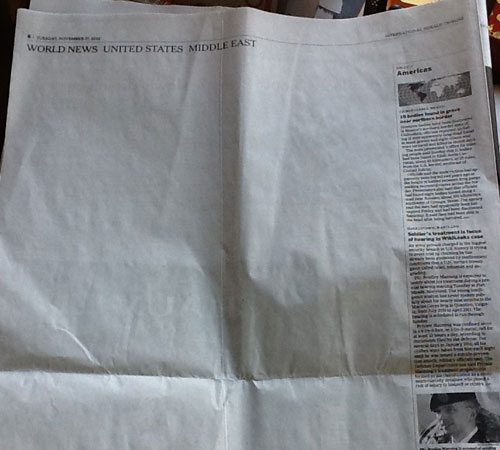
A censored page from Pakistan's International Herald Tribune. Photo: Courtesy of the author.
- Pakistan is a country of contradictions – full of promise for growth, modernity and progress, yet shrouded by political, social and cultural issues that undermine its quest for identity and integrity. My bi-monthly column “Pakistan Unveiled” presents stories that showcase the Pakistani struggle for freedom of expression, an end to censorship, and a more open and balanced society.
- Bina Shah is a Karachi-based journalist and fiction writer and has taught writing at the university level. She is the author of four novels and two collections of short stories. She is a columnist for two major English-language newspapers in Pakistan, The Dawn and The Express Tribune, and she has contributed to international newspapers including The Independent, The Guardian, and The International Herald Tribune. She is an alumnus of the International Writers Workshop (IWP 2011).


Clicking on the “America” section revealed more stories that might have been the reason for that ghostly blankness in the newspaper. On that page a story on gay conversion therapy and related lawsuits was the most likely culprit. The discussion on gay rights simply doesn’t exist in Pakistan: Homosexuals are expected to live in utter secrecy in a Pakistani version of “don’t ask, don’t tell.” Any attempt to bring the issue out into the open is met with furious protest, as the American Embassy learned, to their chagrin, when they held an LGBT-themed event in Islamabad last year. They haven’t yet lived down the backlash from that wonderful idea (and I use the word “wonderful” with a heavy dose of irony; for a superpower conducting an illegal drone war in our territory to decide to host a gay pride event in the capital had to involve a massive failure to understand sentiments on the ground).
But let me be clear: Writers are always dealing with issues of censorship; no matter what country they live and work in. Certain topics are taboo in every culture, from Holocaust denial in Europe and 9/11 conspiracy theories in the United States, to gay rights in Pakistan and political issues in China. But while governments vary in their responses to these issues— in some places with sophistication (invoking technicalities which contravene freedom of speech rights) and in others with crudeness (taking a black pen to scantily-clad women in magazines)—society has instilled self-censorship in all its members. For example, Herta Muller recently said Mo Yan’s Nobel Prize was a “catastrophe” because he toes the Communist Party line; the implicit accusation being that Mo Yan censors himself in order to remain in the ruling party’s good books. But perhaps Mo Yan truly believes in what the Communist Party espouses, and in that case, it’s not self-censorship, but self-expression, just not the kind that Herta Muller wants to hear.
In the end, one of the International Herald Tribune‘s local editors told me the answer to the puzzle: The blank page had contained an interview with Nakoula Basseley, the man behind the film Innocence of Muslims. The headline? “From the Man Who Insulted Mohammed, No Regrets.” It immediately became clear why the editors had pulled the story: Scores of people died and millions of dollars worth of property was damaged in Pakistan during violent protests against the film. Even though the interview is not sympathetic to Nakoula at all, the editors determined that the story was too controversial to carry. When done in the name of public safety, self-censorship is the hardest pill to swallow, but sometimes the most necessary medicine tastes bitterest.
Dec 10, 2012
Twitter says everyone will get the new profile pages look as of December 12th
Twitter says everyone will get the new profile pages look as of December 12th: 
Twitter has announced via its official blog that the new profile setup which includes an avatar and a header photo will be rolled out to everyone on December 12th. Previously only a subset of users had access to the new look.
The new profile look features a user’s Twitter avatar sitting on top of a wide header image. Thew new design has made headway into turning your Twitter profile into a ‘home page’ of sorts that displays media you’ve shared, tweets you’ve made and more. Those changes make it feel less like a stream of text and more like a place to collect everything you share.

The new header photo image capability is explained by this clever video Twitter released back in November:
The new profiles were announced by Twitter on the Today Show, an interesting venue for what was arguably an incremental design change. But the shift makes sense, as the pre-profile image design already feels very ‘dry’ and data-base-ey to me when I look at it. If Twitter wants to sell itself as a media service for people, it needs to make it feel much less nerdy.
Image Credit: RODRIGO BUENDIA/Getty Images


Twitter has announced via its official blog that the new profile setup which includes an avatar and a header photo will be rolled out to everyone on December 12th. Previously only a subset of users had access to the new look.
The new profile look features a user’s Twitter avatar sitting on top of a wide header image. Thew new design has made headway into turning your Twitter profile into a ‘home page’ of sorts that displays media you’ve shared, tweets you’ve made and more. Those changes make it feel less like a stream of text and more like a place to collect everything you share.

The new header photo image capability is explained by this clever video Twitter released back in November:
The new profiles were announced by Twitter on the Today Show, an interesting venue for what was arguably an incremental design change. But the shift makes sense, as the pre-profile image design already feels very ‘dry’ and data-base-ey to me when I look at it. If Twitter wants to sell itself as a media service for people, it needs to make it feel much less nerdy.
Image Credit: RODRIGO BUENDIA/Getty Images
Hacker group GhostShell claims attack on FBI, Interpol, NASA, and Pentagon, theft of 1.6M accounts
Hacker group GhostShell claims attack on FBI, Interpol, NASA, and Pentagon, theft of 1.6M accounts: 
The hacktivist group GhostShell on Monday announced its biggest attack yet: #ProjectWhiteFox, which targets the ESA, the FBI, the Federal Reserve, Interpol, NASA, and the Pentagon, as well as many companies that partner with these organizations. The team says it has released 1.6 million accounts and records from fields such as aerospace, nanotechnology, banking, law, education, government, military, the department of defense, airlines, and more.
In a Pastebin file, GhostShell features a list of 37 organizations and companies, including The European Space Agency, NASA’s Engineers: Center for Advanced Engineering, and a Defense Contractor for the Pentagon. GhostShell sets itself apart from other hacktivist groups by targeting more than just one company or organization, and then releasing the results of its attack all at once. This set of hacks is spread out across 456 links, many of which simply contain raw dump files uploaded to GitHub and mirrored on paste sites Slexy.org and PasteSite.com.
The uploaded files contain what appears to be user data that looks to have been obtained from the servers of the various firms (likely via SQL injection). The entries include IP addresses, names, logins, email addresses, passwords, phone numbers, and even home addresses. Email accounts include the big three (Gmail, Hotmail, and Yahoo), as well as many .gov accounts. There are also various documents and material related to partnerships between companies and government bodies, as well as sensitive information for the aforementioned industries.

Furthermore, the group says it has sent an email to the ICS-CERT Security Operations Center, Homeland Security Information Network (HSIN), Lessons Learned and Information Sharing (LLIS), the FBI’s Washington Division and Seattle location, Flashpoint Intel Partners, Raytheon, and NASA. In it, theysay to have detailed “another 150 vulnerable servers from the Pentagon, NASA, DHS, Federal Reserve, Intelligence firms, L-3 CyberSecurity, JAXA, etc.”
GhostShell made a name for itself by breaching 100 top university servers and releasing 120,000 student records in October. In November, the group stepped up its game by declaring war on Russia and allegedly leaking 2.5 million accounts and records. Now we’re in December, and once again it has upped the ante.
The hacktivist group says this is their last project for the year and calls it “an early Christmas present.”
Image credit: Stephen Davies


The hacktivist group GhostShell on Monday announced its biggest attack yet: #ProjectWhiteFox, which targets the ESA, the FBI, the Federal Reserve, Interpol, NASA, and the Pentagon, as well as many companies that partner with these organizations. The team says it has released 1.6 million accounts and records from fields such as aerospace, nanotechnology, banking, law, education, government, military, the department of defense, airlines, and more.
In a Pastebin file, GhostShell features a list of 37 organizations and companies, including The European Space Agency, NASA’s Engineers: Center for Advanced Engineering, and a Defense Contractor for the Pentagon. GhostShell sets itself apart from other hacktivist groups by targeting more than just one company or organization, and then releasing the results of its attack all at once. This set of hacks is spread out across 456 links, many of which simply contain raw dump files uploaded to GitHub and mirrored on paste sites Slexy.org and PasteSite.com.
The uploaded files contain what appears to be user data that looks to have been obtained from the servers of the various firms (likely via SQL injection). The entries include IP addresses, names, logins, email addresses, passwords, phone numbers, and even home addresses. Email accounts include the big three (Gmail, Hotmail, and Yahoo), as well as many .gov accounts. There are also various documents and material related to partnerships between companies and government bodies, as well as sensitive information for the aforementioned industries.

Furthermore, the group says it has sent an email to the ICS-CERT Security Operations Center, Homeland Security Information Network (HSIN), Lessons Learned and Information Sharing (LLIS), the FBI’s Washington Division and Seattle location, Flashpoint Intel Partners, Raytheon, and NASA. In it, theysay to have detailed “another 150 vulnerable servers from the Pentagon, NASA, DHS, Federal Reserve, Intelligence firms, L-3 CyberSecurity, JAXA, etc.”
GhostShell made a name for itself by breaching 100 top university servers and releasing 120,000 student records in October. In November, the group stepped up its game by declaring war on Russia and allegedly leaking 2.5 million accounts and records. Now we’re in December, and once again it has upped the ante.
The hacktivist group says this is their last project for the year and calls it “an early Christmas present.”
Image credit: Stephen Davies
Facebook absolves its democratic structure as voting falls far short of key threshold
Facebook absolves its democratic structure as voting falls far short of key threshold: 
Facebook is shutting down its voting site in less than 20 minutes that allowed users to vote on proposed policy and site governance changes it was recommending. Currently there are over 665,000 votes cast, but they fall far short from the 30% threshold needed in order to make the changes binding. Because the vote failed to garner the required number of active voters to participate, the opinion given will be merely taken as “advisory”.
At stake are updates to the network’s Data Use Policy and the Statement of Rights and Responsibilities. Perhaps the most important part of this change is, if passed, user data could be provided to Facebook’s partners, specifically Instagram, in order to create a cohesive network similar to Google. Consumer groups have already come out opposed to this change and this update could ultimately wind up with a court deciding.
Per Facebook’s policy, all active users are encouraged to vote and had from December 3 until today at noon to cast their ballot. If more than 30% of active users participate, then the results will be binding. However, since it appears that it won’t even get that far, the company will take the feedback under advisement and can proceed with their plans to make changes to the policy, or maybe even update it to assuage any fears users may have.
Currently, there are over 586,000 votes in favor of keeping the existing policy in place with over 79,000 voting for the new updates. As Buzzfeed notes, the number of users that voted in this instance roughly matches what it was the last time Facebook ran through this exercise.

Photo credit: PORNCHAI KITTIWONGSAKUL/AFP/Getty Images


Facebook is shutting down its voting site in less than 20 minutes that allowed users to vote on proposed policy and site governance changes it was recommending. Currently there are over 665,000 votes cast, but they fall far short from the 30% threshold needed in order to make the changes binding. Because the vote failed to garner the required number of active voters to participate, the opinion given will be merely taken as “advisory”.
At stake are updates to the network’s Data Use Policy and the Statement of Rights and Responsibilities. Perhaps the most important part of this change is, if passed, user data could be provided to Facebook’s partners, specifically Instagram, in order to create a cohesive network similar to Google. Consumer groups have already come out opposed to this change and this update could ultimately wind up with a court deciding.
Per Facebook’s policy, all active users are encouraged to vote and had from December 3 until today at noon to cast their ballot. If more than 30% of active users participate, then the results will be binding. However, since it appears that it won’t even get that far, the company will take the feedback under advisement and can proceed with their plans to make changes to the policy, or maybe even update it to assuage any fears users may have.
Currently, there are over 586,000 votes in favor of keeping the existing policy in place with over 79,000 voting for the new updates. As Buzzfeed notes, the number of users that voted in this instance roughly matches what it was the last time Facebook ran through this exercise.

Photo credit: PORNCHAI KITTIWONGSAKUL/AFP/Getty Images
Subscribe to:
Comments (Atom)