Jun 7, 2012

Search recent Google Scholar additions, sorted by date

Search recent additions, sorted by date:
Over the years, we’ve added several Scholar features to help researchers keep up with recent publications --  customized ranking for recent articles, email alerts and following author profiles. As the next step in this endeavor, today we are making it possible for you to search just the recent additions to the index. The search results are presented in date order, most recently added articles appearing first. To help you decide how far back you would like to scan, each search result indicates how long ago the article was added to the index.

To search recent additions, enter a search query as you normally do, and then click on “Recent additions” in the sidebar of the results page.


You can choose to search over just the abstracts (the common case) or entire articles. Our experience indicates that for search results presented in date order, searching over abstracts often allows you to find the key recent articles quickly.


Posted by: Anurag Acharya, Distinguished Engineer

Daily Number: 38% - More Americans Say They Are Political Independents

Daily Number: 38% - More Americans Say They Are Political Independents: The ranks of political independents continue to grow and now stand at 38% of the public.

CAMBODIA: Malaria gains fragile

CAMBODIA: Malaria gains fragile:
PHNOM PENH, 7 June 2012 (IRIN) - Two years after some US$22 million in donor funds were pumped into malaria control along the Cambodia-Thailand border to fight off suspected resistance to treatment, health workers say the battle is not over.

Philippines: Obama Should Press Aquino to Tackle Abuses

Philippines: Obama Should Press Aquino to Tackle Abuses:
US President Barack Obama should press Philippine President Benigno Aquino III to bring to justice security forces implicated in serious human rights abuses. 
(Washington, DC, June 7, 2012) – US President Barack Obama should press Philippine President Benigno Aquino III to bring to justice security forces implicated in serious human rights abuses, Human Rights Watch said today. Obama will be the host for a visit by the Philippine president in Washington, DC, beginning on June 8, 2012.


read more

Dozen Children Injured in Police Raid

Dozen Children Injured in Police Raid:
Twelve children suffered burns when police on Wednesday stormed an "illegal" Islamic school in China's troubled Xinjiang Uygur Autonomous Region in an incident that an exile rights group said highlighted religious discrimination.

According to state media, police moved to rescue a group of children from "illegal preachers" in southern Xinjiang's Hotan (in Chinese, Hetian) city but that 12 among them were burned when the suspects fired explosives in their bid to fend off the police raid.

Fifty-four children were rescued and three suspects were seized during the operation in which three police officers were also wounded, state news agency Xinhua quoted a police spokesman as saying.

Xinjiang's Tianshan news portal said the 12 children were hospitalized with burns from a blaze triggered by the explosives.

RFA's Uyghur service contacted the emergency room of the Hotan district people's hospital at which some of the children were admitted but its staff refused to provide key details.

One medical staff said "all the children are fine" but on further questioning clarified that only "some of them" were at the hospital while others were at different hospitals.

The World Uyghur Congress, a Germany-based Uyghur exile group, accused the "armed" police of using tear gas in the raid on what it said was an Islamic school teaching children the Koran.

"What happened in Hotan is that armed Chinese personnel raided a Koran-teaching school where there were Uyghur youths," spokesman Dilxat Raxit told RFA's Mandarin service.

"Armed Chinese personnel used tear gas on the Uyghur youths.  This is what led to clashes that resulted in injuries on both sides." he said. "The Chinese authorities try to eradicate people's religious beliefs. "
Raxit also said that police had arrested 47 people, including 11 women, in a crackdown following the raid, accusing them of owning illegal publications and disturbing social stability.
Controls on religion
Xinjiang is home to the mainly Muslim Turkic-speaking Uyghurs, who say they have long suffered ethnic discrimination, oppressive religious controls, and continued poverty and joblessness despite China's ambitious plans to develop its vast northwestern frontier.

Hotan particularly has been the scene of numerous violent incidents in recent years.

No extraordinary security measures had been taken in the city following the incident, said one Han businesswoman, identified as Wang and living in Hotan.

She was unaware of the raid at the religious school.

Asked whether there were additional police personnel on the streets, she said, "No more than usual."
"There are a lot of police on the streets every day."

Religious activity is strictly controlled in the Xinjiang region, where children under 18 are forbidden from receiving a religious education or attending mosque.

Last month, an 11-year-old Uyghur boy studying at an unsanctioned religious school in Korla city died in police custody under suspicious circumstances, family sources said.

The sources said that Korla police told Mirzahid Amanullah Shahyari’s mother that he had committed suicide under their watch and forced her to bury the body immediately.

Official Chinese media reports, however, said that he died at a hospital after being beaten by fellow students at the illegal religious school.

The case also drew strong condemnation from the World Uyghur Congress, which called the boy's treatment “barbaric.”

Mirzahid had first been sent to another school in Hotan when he was seven years old, but the teacher sent him home out of safety concerns, the sources said.

Reported by Jilil Musha of RFA's Uyghur service and Gao Shan of Mandarin service. Translated by Jennifer Chou and Jilil Musha. Written in English by Parameswaran Ponnudurai.

Call to End Biased ‘Songbun’ System

Call to End Biased ‘Songbun’ System:
North Korea maintains a class system of rewarding citizens that is based on allegiance to the country’s hardline regime and is used to determine the allocation of food, according to a new study that has prompted calls for international pressure to end the discrimination.

The “songbun” system identifies three main classes of North Korean society—core, wavering, and hostile—and uses these labels to selectively dole out privilege and opportunity, the Washington-based Committee for Human Rights in North Korea (HRNK) said in a report released Wednesday.

This includes the distribution of food aid, the report said, indicating that the system could have been a key factor in the survival or death of North Koreans during a famine in the mid-1990s that resulted in as many as 3.5 million deaths.

“We have some evidence that the songbun system determined ration levels in the public distribution system which fed the country from the founding of the North Korean state until the deterioration of the system during the famine and its ultimate collapse,” HRNK said.

“In the context of the famine, songbun may have determined who lived and who died, who ate well and who starved, and whose children suffered permanent physical (through stunting) and intellec¬tual damage (prolonged acute malnutri¬tion lowers IQ levels) from acute severe malnutrition.”

Correlation with nutrition

While the songbun system is not officially a North Korean policy, class stratification has been referred to a number of times since the country was “liberated” by communist forces six decades ago.

In 1958, founding father of North Korea Kim Il Sung delivered a speech in which he reported that the “core,” or devoted, class represented 25 percent of the population, while the percentage of the population considered “wavering” and “hostile” to the regime represented 55 percent and 20 percent, respectively.

Those numbers largely correspond with findings from a 1998 nationwide survey conducted by the World Food Program, UNICEF, Save the Children, and the European Union on the nutritional condition of North Korean children.

Taken about one year after what was widely considered to be the worst period of the famine, the study showed that 32 percent of children exhibited no evidence of malnutrition, while 62 percent suffered from moderate malnutrition, and 16 percent suffered from severe acute malnutrition, with an error rate of 5 percent.

“While the survey had its limitations because of restrictions placed on the effort by the North Korean state, it is noteworthy that the size of the three social classes is about the same as the size of the nutritional categories,” the report said.

“If the regime was feeding people through the public distribution system (PDS) based on their songbun classification, it would be reflect¬ed in the nutritional data; and the data does show considerable coincidence.”

Andrew Natsios, a scholar at Georgetown University in Washington who formerly served as the administrator of the U.S. Agency for International Development (USAID), called the PDS a “tool of control” based on the songbun system.

He said that the PDS, which has in the past been used by international donors to distribute food to the North Korean public, determines rations based on the importance of a citizen’s job to the survival of the state.

“My advice would be that no food [aid] should go through the PDS, period. We need to find different ways of distributing food,” he said.

“This report needs to inform all food distributions henceforth … and if the North Koreans won’t agree to it, then we just don’t distribute the food.”

‘Marked for life’

The report, titled “Marked for Life,” was compiled from interviews with 75 North Korean defectors, the most recent in 2011.

The study’s author, Robert Collins, of the U.S. Department of Defense, also cited a 1993 manual written by the North Korean Ministry of Public Security that informs officials on how to investigate a citizen’s sociopolitical background.

A person’s classification is assigned at birth, according to how one’s family members have been viewed by the regime since the nation’s founding in 1948, and the government maintains a file on every citizen from the age of 17.

While a person’s file is updated every two years, an upgrade in status is rare, the study said. North Koreans can easily be downgraded based on political or criminal offenses and their families are generally considered guilty by association.

Songbun’s three classes are further subdivided into 51 classes of loyalty to the Kim family.

The system has its origins in the social restructuring enforced by the country’s founders, who sought to elevate peasants at the expense of landlords.

During the 1950-53 Korean War, those who fought against the Japanese colonialists and the U.S. received “core” status, while those who collaborated with the enemy or whose family members left North Korea were branded “hostile.”

Granting privilege

In addition to determining how to allow access to food, the study said, classification through songbun also has a bearing on a person’s education, employment, health care, and even whom one can marry.

Only around one-quarter of North Korea’s 24 million inhabitants are considered part of the core class and dominate the country’s military and ruling Worker’s Party. They are granted the right to live in the relatively prosperous capital Pyongyang, and are given access to the best education and jobs.

Those in the hostile class live mostly in remote parts of the country’s impoverished northeastern provinces and work hard labor on farms and in mines. They are the class that has suffered the most from failed state policies and during the famine of the 1990s.

And while the emergence of informal markets since the late 1990s has challenged state control, it is clear that songbun still exists and perpetuates discrimination amongst the lowest ranks of North Korean society, the report said.

It called on members of the international community to put pressure on the North Korean regime to abandon songbun, but acknowledged that the country’s current leader, Kim Jong Un, is unlikely to change the policy.

“The songbun policy is a prime enabler of regime security and a decisive provider of critical labor inputs, and thus its reform may endanger the regime’s survival,” it said.

Reported by Joshua Lipes.

Nine Uyghurs Jailed Over Religious Activities

Nine Uyghurs Jailed Over Religious Activities:
Authorities in China’s restive northwestern Xinjiang region have jailed nine ethnic Uyghurs for “inciting separatism” and “disturbing social order” over their participation in “illegal” religious activities, according to an exile rights group Wednesday.

The sentences of between six and 15 years were handed down May 31 by three county-level courts in Kashgar prefecture, the exile World Uyghur Congress (WUC) said.

It condemned the jailings, calling them an attack on religious freedom of the Uyghurs, who form a distinct, Turkic-speaking minority in Xinjiang and claim to have long suffered ethnic discrimination, oppressive religious controls, and continued poverty and joblessness.

"The court verdicts were reached without any fundamental legal procedures and were a result of the political needs of China," WUC spokesman Dilxat Raxit said.

"China is using heavy sentences to persecute and completely deprive the rights of legal defense and appeal of the defendants,” he said, according to Agence France-Presse.

Heaviest sentence

In the heaviest of the sentences, the Shule County Intermediate People’s Court sentenced Sidik Kurban to 15 years in jail and five years’ deprivation of political rights on charges of “inciting ethnic separatism” following what it said was his involvement in illegal religious activities.

He had overseen  the operation of illegal, home-based religious schools throughout Xinjiang over the past decade that provided instruction for 86 students, including young children, the WUC cited a local newspaper as saying.

The same Shule county, Kargilik (Yecheng) county, and Kashgar city courts also sentenced seven others to seven years jail for "disturbing social order,"  saying they had engaged in underground religious activity.

A ninth person was given 10 years in jail by the Kashgar city court for illegal business activities and was also slapped with a fine.

Xinjiang has been gripped for years by persistent ethnic tensions between the Muslim Uyghurs and the rapidly growing Han Chinese migrant population, leading to riots in the regional capital Urumqi on July 5, 2009 which left 200 dead and 1,700 injured, according to state media.

Reported by Hai Lan for RFA’s Cantonese service. Written in English by Rachel Vandenbrink.

Anger Over China's Syria Stance

Anger Over China's Syria Stance:
Chinese netizens reacted angrily to official media commentary on Chinese and Russian opposition to military intervention in Syria, amid reports of further civilian deaths and a visit by Russian president Vladimir Putin to Beijing.

Russia and China on Thursday reiterated their opposition to military intervention in the Middle East via a regional bloc of which they are both members, a day after the Syrian opposition accused forces loyal to the regime of massacring 100 people.

The Shanghai Cooperation Organization (SCO) called in a statement for a "peaceful resolution of the Syrian problem through political dialogue."

China's state-run media backed up Beijing's position, hitting out at calls for military intervention on humanitarian grounds in an editorial which was widely circulated on the popular Sina Weibo microblogging site.

"The West is always using the prevention of a humanitarian disaster as a pretext for interfering in the internal affairs of another country," said the article in the ruling Communist Party's own newspaper, the People's Daily.

"If the West wants to use the Houla incident as a pretext for overturning the Assad regime, it will only serve to intensify the internal conflict in Syria and give rise to a true, and far more horrific, humanitarian disaster," the paper said.

"We must be firm in our conviction of the possibility of a 'soft landing' for the Syrian government."
Some 108 people, including 49 children, were massacred in Houla, a cluster of villages in Syria's central Homs province, last week in one of the worst atrocities in the 15-month uprising against President Bashar al- Assad's government.

The United Nations Human Rights Council said it was the work of "pro-regime elements," while Syrian officials have blamed the killings on "terrorist" groups.

Calls for action

The article drew a number of angry comments.

Sina Weibo user @0415YXD, one of more than 600 who commented, wrote: "The People's Daily has no backbone."

@langjisanya hit out at all the talk about Syria. "We need action," the microblogger wrote. "Every day, we 'denounce' this and we 'condemn' that, but we need to do something to show the people of this country, not just shout slogans."

Some users hit out at Beijing for failing to step in to prevent the killing of innocent civilians. "Let's not get this wrong again!" wrote @guiqulaixixi. "Let's think about those dead children, and whether or not we bear some responsibility."

While some commenters appeared to support the view that international intervention would cause more problems than it would solve, many more were strongly critical of their own government's foreign policy.

"Support the West, and the Western attitude," wrote user @zhengxinsheng1. "I don't like the way China always has to side with dictatorial regimes."

And user @kaixinkaixinguodejia added: "This anti-humanitarian government in Syria is too disgusting for words! I would like to express my support for military intervention in Syria!"

"Otherwise, even more innocent civilians will die ... It makes me so angry."

Others appeared to draw parallels between China's government and that of President Bashir al-Assad.

"Maybe we are all sitting on an express train to Syria!?," wrote user @xiaohetunMandy.

Growing pressure

Moscow and Beijing have consistently opposed international intervention in Syria, but they face growing pressure to change their stance after 15 months of conflict in which more than 13,500 people are said to have died.

Syrian pro-government forces this week killed at least 87 people in Al-Kubeir village, Hama province, many of them women and children, according to the Syrian Observatory for Human Rights.

The group put the number of villagers killed in Wednesday's assault at 87 after the exiled opposition Syrian National Council (SNC) gave an initial estimate of 100 dead. Damascus has denied the reports.

The United States has demanded a full transfer of power in Syria, setting the stage for a renewed diplomatic stand-off after Russia and China said they were strongly against intervention and regime change.

Putin is visiting China from June 5-8, on a trip that is expected to yield bilateral trade deals and increased energy cooperation.

"The two sides have set a goal to reach U.S.$200 billion in bilateral trade by 2020, a substantial increase from the current volume of nearly U.S.$80 billion," the official Xinhua news agency reported.

Reported by Luisetta Mudie.

Tibetans Forced Back Into Nepal

Tibetans Forced Back Into Nepal:
In a rare move, Chinese border police have forcibly sent back a group of Tibetan pilgrims seeking to re-enter Tibet from Nepal after confiscating their residency permits and detaining them for a week, according to Tibetan and Nepalese sources.

One analyst called the move “puzzling” and “a new development” in China’s handling of Tibetans wanting to return from Nepal to their homes.

There are about 20,000 Tibetan refugees in Nepal, and Beijing is becoming more aggressive in urging Kathmandu to restrict their activities and to take action against other refugees fleeing alleged rights abuses and other actions by the Chinese authorities.

The group of pilgrims which was sent back to Nepal came originally from Tibet’s Nagchu prefecture and comprised five men and four women in their 20s and 40s, a Tibetan living in Kathmandu named Tendar said.

“They were detained on May 26 at the border post [at Dam],” he said.

“All nine were severely beaten for two days by the Chinese border police and were then handed over to the Nepalese immigration authorities. One Chinese official from the border post came with the group all the way to Kathmandu,” he added.

Demands for money

Lingtsa Tseten Dorje, a Tibetan protest marcher detained in Nepal, said he saw the group when they were brought in to the immigration facility in which he was being held.

“In the afternoon of June 4, nine Tibetans arrived in the facility,” he said. “They had been caught by the Chinese border police on the night of May 26 and were detained at the border post.”

“After their residency permits from Tibet were confiscated, all nine were handed over to Nepalese authorities along with all their belongings.”

Two officials from the Chinese embassy in Nepal came to the immigration office to question the group, but the Tibetans refused to speak to them, he said.

Nepalese officials are now demanding large sums of money to secure the group’s release, Dorje said—asking first for 9,000 Nepali rupees (U.S. $102) , then 10,000, and finally 100,000 rupees from each.

“If they cannot pay, the authorities are threatening the Tibetans with jail time,” he said.

Pilgrimage in India

Sambhu Lama, an official with the Nepal-based HURON human rights group, said the group had first arrived in Kathmandu in mid-December, apparently intending to stay.

“They lived in the Tibetan Reception Center and were registered,” he said.

They were identified as Tenzin Chonzom, 40, Quma (Tenzin Sangmo), 44, Sonam Lhandon, 20, Luse, 40—all women—and  Tamding, 23, Tenzin Higual, 26, Du Wang, 20, Lu Sang, 25, and Dam Cheng, 20—all men.

Before they were interviewed for asylum, though, the group decided to attend the Kalachakra teachings given in India in January by exiled Tibetan spiritual leader the Dalai Lama and then return to Tibet, Sambhu Lama said.

“They went to the Kalachakra, went on pilgrimage around India, and then stayed in India for a few months because of rumors about re-education camps being set up in Tibet for pilgrims who had attended the Kalalchakra.”

“They only decided to head back to Tibet once they heard that these pilgrims were released and the situation was better in their [native] region.”

Stopped at the border by Chinese police because they did not have the “proper pass” to cross back into Tibet, the group was then held for nine days before being handed over to Nepalese authorities, he said.

The group now faces fines for “illegal entry” into Nepal and “penalty fines,” Sambhu Lama said, adding that when these fines are paid, they will be sent to the Indian border, accompanied by a Nepalese immigration official.

Tibetan refugees often use Nepal as a transit point to live in India.

“The detainees, however, do not have any money to bear the cost of their release, so we have contacted Tibetan organizations in Kathmandu for their help,” he said.'

'A new development'

Columbia University Tibet scholar Robbie Barnett cited recent but unconfirmed reports of three similar cases, saying the actions are “a new development” in China’s handling of Tibetans crossing the border from Nepal.

“It’s quite common for internationally prominent Chinese dissidents to be refused re-entry into mainland China, but the people involved in these cases were not in that category, were Chinese citizens, and had traveled legally to Nepal as far as is known.”

“It’s very puzzling,” he said.

Mikel Dunham, a writer and lecturer who travels frequently to Nepal, said that Nepal’s growing security ties with China and domestic political uncertainties have left Tibetans wishing to return to Tibet “extremely vulnerable.”

“As long as Nepal remains stuck in the growing pains and false starts of its newly created republic, the humane treatment of Tibetans seeking to re-enter Tibet via Nepal will remain an extremely low priority for Nepal’s government,” he said.

“In short, we can expect the Chinese to call the shots along the border while the politicians in Kathmandu persist in their internecine jockeying for personal power.”

Reported by Thupten Sangyal and Lumbum for RFA’s Tibetan service. Translations by Karma Dorjee. Written in English with additional reporting by Richard Finney.

Internet Draft Decree Slammed

Internet Draft Decree Slammed:
Washington has voiced concerns to the Vietnamese government over a draft decree on strict new Internet controls in the communist state, calling the proposal “unworkable” and a threat to freedom of expression in the country.

The U.S. Embassy in Vietnam issued its comments in a letter addressed to the Vietnamese Ministry of Information and Communications dated last week, but made public Thursday.

Vietnam, which France-based Reporters Without Borders lists as an “Enemy of the Internet,” is expected to release the proposed Decree on Management, Provision and Use of Internet Services and Information on the Network in June.

Under the proposal, Internet users would be required to register with their real names. In addition, foreign Internet companies would be forced to relocate their data centers and establish local offices in Vietnam.

The U.S. said the proposed measures would hamper commercial development of the Internet sector and threaten netizens’ rights to express their ideas freely.

“The United States is concerned with requirements that a broad range of suppliers—including those that are intermediaries, rather than content generators—play an active role in filtering content and be sanctioned if they fail to adequately monitor actions by third parties,” the letter said.

“These provisions would be extremely difficult to implement and would impose such prohibitive regulatory burdens that many innovative suppliers simply might not be able to enter the market or, if currently present, might abandon it for other markets.”

Washington also took issue with various provisions of the proposed decree which it called “overly broad and vague,” and “likely to negatively impact individuals’ rights to freedom of expression.”

It noted that the right to freedom of expression is guaranteed under Vietnam’s constitution and that the Vietnamese government had signed international obligations to ensure that right.

“All countries face the common problem of addressing domestic regulatory concerns relating to services offered over globally interconnected networks that affect their citizens,” it said.

“It is neither feasible nor practical for any one country to set rules for a global medium, and the benefits such networks offer are severely diminished if suppliers must become ‘local’ in all countries.”

Instead of “highly prescriptive rules” that would be difficult to enforce, Washington suggested an open dialogue with interested parties from around the world to discuss alternative approaches to addressing “legitimate concerns.”

Congress takes issue

The decree also drew the attention of U.S. Congressman Frank Wolf, who wrote a letter Wednesday to Mark Zuckerberg, CEO of the popular Facebook social media platform.

Facebook is currently blocked in Vietnam, though netizens can access the site with relative ease.

In the letter, Wolf said the decree “would impact both Internet companies doing business in Vietnam and millions of Vietnamese citizens looking to the Internet as a source of news and information about the outside world.”

“This decree … would make it illegal to post anything online critical of the Vietnamese government,” he said, adding that the requirement for users to provide their real names and personal information would provide a “means for the government to track them.”

Wolf called the requirement that Internet companies inform the government of any prohibited activities that take place on their sites “deeply problematic as it could make companies … complicit in government repression.”

He concluded by calling on Zuckerberg to set an example to other American Internet companies by promoting the principles of democracy and human rights through Facebook’s corporate actions if the new set of online restrictions are enacted in Vietnam.

Zuckerberg vacationed in Vietnam last December with his now-wife Priscilla Chan.

Media controls remain restricted in Vietnam, which New York-based Human Rights Watch (HRW) has accused of mounting a sophisticated and sustained attack on online dissent, including by detaining and intimidating anti-government bloggers.

Reporters Without Borders says at least three journalists and 17 bloggers are currently in jail in the one-party state.

Reported by Joshua Lipes.

The Indonesian Rupiah: Money with Character & a lot of Zeros

The Indonesian Rupiah: Money with Character & a lot of Zeros:
By: Ed Caffin

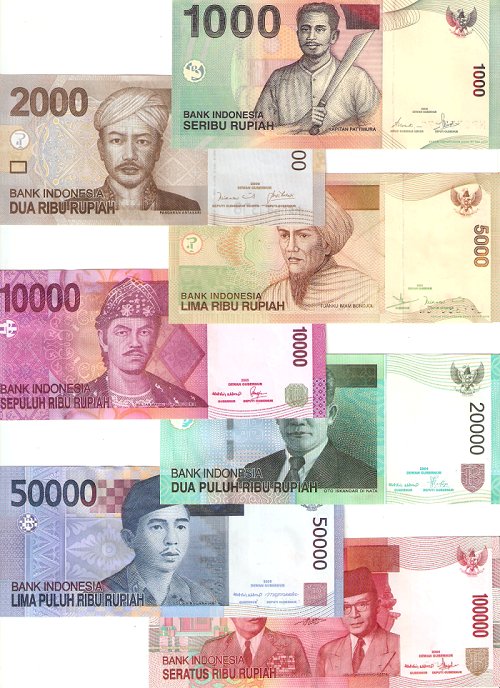
Indonesian money surely isn’t the most practical. Most people carry many notes around in their wallets, because even for the smallest purchase, you’ll need thousands of rupiahs. It gets worse when you have to pay large sums of cash, and all those zeros start to make you dizzy. Also, well-used notes, like the 1,000 rupiah one, can look so much abused that I sometimes hesitate to pay with them. On the other hand, rupiah banknotes are, unlike those of most other countries, quite beautiful and interesting to look at. The Indonesian rupiah truly is money with character. Here are some facts and figures.

Why are rupiahs called rupiahs? The name rupiah comes from the Sanskrit word for wrought silver, rupya. The name was first used to denote a coin introduced by a 16th century ruler in Northern India. The coin obviously was silver based. From there, rupee or rupiah became a common name for the monetary unit in many countries along the Indian ocean, like India, Pakistan, Seychelles and Sri Lanka. And the name also made it to Indonesia.
Money: The Indonesian rupiah, By: Daniel Giovanni
Money: The Indonesian rupiah , By: Daniel Giovanni

What denominations are there? Indonesian rupiah banknotes come in denominations of 1,000, 2,000, 5,000, 10,000, 20,000, 50,000 and 100,000 rupiah. In 2004 and 2005, the latest version of the 10.000 – 100,000 notes were issued and in 2009, the new 2,000 note was issued for the first time. There are also 3 coins, in denominations of 100, 500 and 1,000 rupiah. Originally there were also coins of 25 and 50 rupiah, but they were taken out of circulation, since the value of the material began to exceed the value of the coin itself! And did you know, the rupiah is actually subdivided into 100 sen (cent)? Due to inflation no sen coins or notes are used anymore today.
Indonesian Rupiah notes: colorful & with a lot of zeros!

What’s on the Indonesian Rupiah Notes?

The designs and images have changed a lot over time, but in the newest series every note has a national hero and a landmark or cultural scene on it. With a country so diverse, it must have been hard to choose. In addition, all banknotes are distinctive in color. For example, in the current series the 1,000 rupiah note is blue and green with Captain Pattimura featuring the front side and a picture with a view on Maitara and Tidore islands in North Moluccas on the reverse side. Of course, the red coloured 100,000 rupiah note features Indonesia’s biggest heroes Soekarno and Hatta, with the Indonesian Parlement building in Jakarta on the reverse side.

Here’s a list of denominations and what’s on them:

Indonesian rupiah notes
100000 Rupiah — Soekarno, M. Hatta (The first president and vice president of Republic of Indonesia); Parliament

50000 Rupiah — I Gusti Ngurah Rai (Balinese hero); Beratan Lake

20000 Rupiah y.2004 — Oto Iskandar Di Nata (Independence hero); tea pickers

10000 Rupiah y.2010 — Sultan Mahmud Badaruddin II (Sultan of Palembang); Palembang traditional house

5000 Rupiah y.2001 — Tuanku Imam Bondjol (hero from West Sumatra); woman weaving

2000 Rupiah y.2009 — Pangeran Antasari (Prince of Banjar, South Borneo); Dayak dance

1000 Rupiah y.2000 — Pattimura (National hero from Maluku); fishing boat; volcano

Indonesian rupiah coins

1000 Rupiah (newest) — angklung (music instrument)

500 Rupiah — flower of jasmine (bunga melati)

200 Rupiah — Jalak Bali (Name of bird, Bali origins)

100 Rupiah (white coin) — burung Kakaktua (yellow coin) — Karapan Sapi

50 Rupiah — Kepodang (bird)

Since When Does Indonesia Use the Rupiah?

While the Nederlands-Indische gulden was used in colonial days, the rupiah was introduced right after Indonesia declared its independence. During to the revolutionary war of 1945-1949, a few versions of the rupiah were issued, but it wasn’t until 1953, with Bank Indonesia just established, when the first ‘new Indonesian rupiah’ appeared. Roughly every 10 years new versions have been issued.

Everybody a Millionaire in Indonesia?

Maybe you still remember the first time you got money of an ATM machine in Indonesia and walked away with hundreds of thousands of rupiah in your pocket, or maybe even a few million. It wasn’t always like that. In 1953, Bank Indonesia issued banknotes of 5 rupiah and above. Since then, much has changed. In the spiralling inflation of the ’60s and ‘70s and again during the Asian Financial Crisis of the late nineties, the Indonesian rupiah has devaluated strongly. And that has been the biggest problem for the Indonesian rupiah: it means consumers have to carry large amounts of money.

What about the future of the rupiah? Since banknotes nowadays have at least 3 zeros, Bank Indonesia proposed a redomination of the rupiah by truncating 3 zero digits. So the 100,000 rupiah note would be replaced by a new one of 100. This should simplify transactions, which often run into millions. It would definitely be a lot more convenient, but some people fear it would cause an increase in devaluation of the rupiah. Whatever happens, I sure hope the rupiah will keep its character.

Learn how to pronounce the names of the rupiah bills in the video below:

Arriving & Getting into Jakarta

Arriving & Getting into Jakarta:
By: Emma Kwee

Jakarta is serviced by Soekarno Hatta International airport, located about an hour driving (20 kilometers) from central Jakarta. The airport is often called Cengkareng by Indonesians, after the subdistrict it is located in. Many international airlines from Europe, Asia and Australia make Soekarno-Hatta their turnaround airport, while a number do continue on to Bali and Australia.

Somewhat surprisingly, Sukarno Hatta is one of the best on-time airports in the world (coming second in 2009)! This airport is also the hub of Indonesia’s own Garuda Indonesia as well as home for most of Indonesia’s regular domestic airlines and low-cost carriers (LCC).  Sukarno Hatta consists of 3 terminals, with the newly built low cost terminal being the latest addition.

For most international visitors a visa on arrival is mandatory (25 USD). Make sure you have USD, Euro or Rupiah at hand, otherwise you’ll have to ask permission to visit the ATM that conveniently is located after customs! Also, run if you want to be first in line…

Reaching Jakarta from Soekarno Hatta Airport

From the airport you can reach the city by taxi or by bus. Taxis leave straight from the arrival hall. The time that only Bluebird taxis are reliable is over, but prices do differ between different companies. If a taxi depicts ‘tarif lama’ or ‘tarif bawah’ its fares are said to be cheaper. Also, check whether they use a meter (argo)! Reliable companies are: Taxiku, Express and Cipaganti (that also operates shuttle buses).

The Damri buses leave from terminal 2 and 3. DAMRI shuttle buses connect to numerous destinations in Jakarta and beyond; Gambir (the most appropriate for those going to Jalan Jaksa area), Rawamangun, Blok M, Tanjung Priok, Kampung Rambutan, Pasar Minggu, Lebak Bulus and Kemayoran (Rp 20,000) as well as directly to the neighboring cities of Bekasi, Serang (Rp 30,000), Bogor and Cikarang (Rp 35,000). The bus service from the airport operates until midnight (despite what taxi touts may say to you), is reliable and comfortable. You can get the tickets in the many counters after the airport exit. If arriving by an international flight to the terminal 2, head to the left after going out of the building until you see DAMRI ticket booths and bus stops. In terminal 3, the bus stop is in front of it just behind taxi ranks. Note that DAMRI service to the airport shuts down much earlier – for example, the bus from Gambir operates from 3.30am to 7.30pm.

Cipaganti also operates shuttle buses to Jakarta and beyond. They are stationed near terminal 1A, 1B, 1C, 2D, 2E, 2F. There minivans usually depart every hour and are a comfortable way of getting into the city.

A great option for those traveling on to Bandung is Primajasa. The buses leave hourly and cost some 75.000 Rp. The trip to Bandung takes between 2,5-3,5 hours, depending on traffic.

A wolf in sheep's clothing - Inside Indonesia

A wolf in sheep's clothing - Inside Indonesia - a quarterly magazine on Indonesia and its people, culture, politics, economy and environment

A diversity of corruption - Inside Indonesia

A diversity of corruption - Inside Indonesia - a quarterly magazine on Indonesia and its people, culture, politics, economy and environment

The Asia Foundation and U.S. Department of State Supports Timor ...

The Asia Foundation and U.S. Department of State Supports Timor ...: On May 28, 2012, at the Salao Nobre of Ministry of Foreign Affair of Timor-Leste (MoFA), Secretary General of Ministry of Foreign Affairs of Timor-Leste, Mr.

Stefanie Sun on Fame in China and Her Next Album - Scene Asia - WSJ

Stefanie Sun on Fame in China and Her Next Album - Scene Asia - WSJ

Best Places to Retire Abroad: Bali, Indonesia - WSJ.com

Best Places to Retire Abroad: Bali, Indonesia - WSJ.com

Telecommunications Companies apply for licences. | East Timor Law and Justice Bulletin

Telecommunications Companies apply for licences. | East Timor Law and Justice Bulletin

Human Trafficking and Modern Slavery - Radio Free Asia

Human Trafficking and Modern Slavery

Fundasaun Mahein (FM): PNTL Embroiled Yet Again in Gun-Related Incident | East Timor Law and Justice Bulletin

Fundasaun Mahein (FM): PNTL Embroiled Yet Again in Gun-Related Incident | East Timor Law and Justice Bulletin

Fretilin candidate list for Parliamentary election | East Timor Law and Justice Bulletin

Fretilin candidate list for Parliamentary election | East Timor Law and Justice Bulletin

List of Parliamentary candidates for CNRT | East Timor Law and Justice Bulletin

List of Parliamentary candidates for CNRT | East Timor Law and Justice Bulletin

Lack of Parliamentary quorum; Anti Corruption Law not yet discussed

Lack of Parliamentary quorum; Anti Corruption Law not yet discussed:
The National Parliament in Dili.The Anti Corruption Law proposal should have been discussed already at the National Parliament but continued lack of a quorum prevents it from happening.

“The law came in at a time we have to deal with political campaigns, presidential and now the parliamentary elections. Everyone’s gone to the base, we cannot get a quorum anymore,” said Member of Parliament (MP) Agostu Tara last week (22/05), at the National Parliament, Dili.
The MP claims most other MP’s come and go arbitrarily.

Textbooks in Portuguese only not in Tetum

Textbooks in Portuguese only not in Tetum:
The Secretary General for SPTL, Francisco Fernandes.The Syndicate of Teachers Timor-Leste (SPTL) is raising an eyebrow at the unavailability of textbooks in Tetum, with books available in Portuguese only.
“We keep talking about promoting Timorese culture. Tetum is part of the original culture of Timor but we are developing it,” said the Secretary General for SPTL, Francisco Fernandes, recently from his office in Farol, Dili.

He added even though all teaching books are in Portuguese, teaching in Portuguese is still not being done at 100 per cent.
“Infant students learning in Portuguese, most of them still play with toys and they count in Indonesian 1, 2, 3. They do not speak it [Portuguese] daily, they do not count in Portuguese,” said SPTL SG Fernandes.

INDONESIA: Blasphemy law should be repealed to show Indonesia's commitment to the protection of freedom of expression

INDONESIA: Blasphemy law should be repealed to show Indonesia's commitment to the protection of freedom of expression — Asian Human Rights Commission »
June 7, 2012. Language(s): English only. HUMAN RIGHTS COUNCIL Twentieth session, Agenda Item 3, Interactive Dialogue with the Special Rapporteur on freedom of expression. The Asian Legal Resource Cent...

INDONESIA: President urged to appoint without delay team for dialogue with Papua

INDONESIA: President urged to appoint without delay team for dialogue with Papua — Asian Human Rights Commission »
President Susilo Bambang Yudhoyono is urged to immediately appoint members to a dialogue team in order to intensify dialogue with stakeholders both in the Land of Papua and Jakarta. The formation of ...

NSC AU Lecture Series: Pots and how they are made in Southeast Asia 

NSC AU Lecture Series: Pots and how they are made in Southeast Asia »
Dr. Leedom Lefferts and Louise Allison Cort (Curator, Asian Ceramics, Freer and Sackler Galleries, Smithsonian Institution) conducted an intensive study of the indigenous production of earthenware ......

Resource: Papers on Indigenous Southeast Asian Pottery 

Resource: Papers on Indigenous Southeast Asian Pottery »
Dr. Leedom Lefferts and Dr. Louise Allison Cort have kindly granted the Archaeology Unit permission to disseminate the following papers regarding indigenous Southeast Asian pottery production for n......

Jun 6, 2012

Thai Youth Seek a Fortune Away From the Farm

Thai Youth Seek a Fortune Away From the Farm: Experts worry that Thailand, the world’s leading rice exporter, may have trouble finding people to work in rice paddies, as young people stay longer in school and prefer to work in Bangkok.

Airports and Hotels Look at Tiered Pricing for Internet Access

Airports and Hotels Look at Tiered Pricing for Internet Access: Trying to both meet the customer demand for Wi-Fi and cope with the costs of expanding bandwidth, airports and hotels are adopting tiered pricing models.

More Young Americans Out of High School Are Also Out of Work

More Young Americans Out of High School Are Also Out of Work: A new survey finds that those without a college degree have dismal job prospects and considerable obstacles blocking improvement.

Facebook mulls lowering age restrictions

Facebook mulls lowering age restrictions:
Facebook is considering ways to invite children younger than 13 onto its social network, a controversial move that could bolster the company’s bottom line but also spark concern among regulators over the safety of young Internet users.
Read full article >>


CIA memoirs offer revelations and settle scores among spies

CIA memoirs offer revelations and settle scores among spies:
In between his defense of secret prisons, coercive interrogations of al-Qaeda suspects and the shredding of highly sensitive videotapes, former CIA spymaster Jose A. Rodriguez Jr. makes room in his memoir “Hard Measures” to talk about the competition: other CIA memoirists.
Read full article >>


Socialcam — the app on Facebook that’s so sleazy, it’s insightful

Socialcam — the app on Facebook that’s so sleazy, it’s insightful:
By now you have heard of it, the scourge of civilization, the embarrassment of humanity, the evidence that America is going to hell on a hand-held. Socialcam, the sharing app on Facebook that allows your friends to see what user-generated videos you’ve been watching, zoomed from fewer than 10 million active users in April to more than 40 million in May — though, as Web critics have pointed out, at least some of this rise can be attributed to vaguely sketchy practices and terribly trashy marketing techniques.
Read full article >>


Mubarak examined by doctors after breakdown, Egypt news agency reports

Mubarak examined by doctors after breakdown, Egypt news agency reports:
CAIRO -- A team of doctors was brought overnight to the prison where ousted President Hosni Mubarak reportedly suffered a health-crippling nervous breakdown, Egypt’s state news agency reported Wednesday.
Read full article >>


Jordan clerics protest against government

Jordan clerics protest against government: Imams demonstrate outside royal palace to call for end to security services' interference in Islamic affairs.

Deadly gunfight in Nigeria's northeast

Deadly gunfight in Nigeria's northeast: Police say at least 19 members of armed Islamist group Boko Haram killed during fighting in Kano and Maiduguri cities.

Assad appoints new Syria prime minister

Assad appoints new Syria prime minister: Former agriculture minister and ruling Baath party member Riyad Hijab entrusted with task of forming government.

Knesset rejects bill to legalise settlements

Knesset rejects bill to legalise settlements: Israeli legislators reject attempt to prevent demolition of outpost built on Palestinian land.

Fund launched to back Syrian rebels

Fund launched to back Syrian rebels: Syrian activists say Assad's government gunmen are responsible for second massacre in as many weeks.

Obama Averages 47% Job Approval in May

Obama Averages 47% Job Approval in May: President Obama's job approval rating averaged 47% in May, unchanged from April. Comparing Obama's current rating with previous presidents' ratings in May of their re-election years suggests a close race that could go either way.

Middle East Leads World in Negative Emotions

Middle East Leads World in Negative Emotions: Iraqis are more likely to experience negative emotions on a daily basis than any other population in the world. Palestinians are a distant second.

Views of Obama, Romney More Strongly Negative Than Positive

Views of Obama, Romney More Strongly Negative Than Positive: More Americans continue to hold strongly negative than strongly positive opinions of both Mitt Romney and Barack Obama. Obama continues to elicit much stronger positive reactions from Democrats than Romney does from Republicans.

Reconciliation games

Reconciliation games:
A confusing multitude of different protest groups are out on the streets again, suddenly changing the high stakes game over the future of Thai society yet again. There are several factions of Red Shirts, Yellow Shirts of the People’s Alliance for Democracy (PAD), Dr. Tul’s Multicoloreds, and those associated with the new street protest group named the “Lightening Rod” with its light blue headbands — organised by the Democrat Party and its Blue Sky TV station.
In this article I will try to describe the new situation that began developing during the Pheua Thai government’s efforts to rush a reconciliation bill through parliament. It is not just the opposition Democrat Party, and the PAD that are severely opposed to this bill, but also the Red Shirts and many Pheua Thai MPs close to the Red Shirts. This has led to severe frictions in the Pheua Thai party. Several Red Shirt leaders and Pheua Thai MPs told me that Thaksin has not consulted them over the reconciliation bill. They suggested he was not receptive to their attempts to b cautious and that the efforts were mostly engineered by Pheua Thai party list MP Wattana Muangsuk. One Pheua Thai MP even said to me that he felt being treated by Thaksin as if he were “under his feet”, and that he was extremely disappointed and upset, and that this was not what he was fighting for. Following Thaksin’s speech at Rajaprasong on 19 May 2012, many Red Shirts were very disappointed with Thaksin’s stand.
Already during Thaksin’s stay in Siem Reap during this year’s Songkran several Red Shirt leaders and members of Class 10 have tried to urge Thaksin not to rush the reconciliation bill, and especially not the included amnesty, but to no avail (Wassana Nanuam reported on the Class 10 visit first and this has been confirmed to me by one of the participants). While the first signs of disappointment among many Red Shirts with Thaksin appeared after his speech on the Siem Reap stage on 14 April 2012, this disappointment increased following his more detailed video link outlining his views on the reconciliation process at the 19 May 2012 Rajaprasong rally. After that, many Red Shirts were openly expressing feelings of betrayal.
On 29 May 2012, a breakaway Red Shirt faction decided that they will stay in front of parliament, holding their ground against the PAD protest, announced for 30 May 2012. While reasoning that they wanted to protect the parliament and the government against another possible PAD occupation, another motive mentioned by some of their organisers was that if clashes erupted, it could have been useful to prevent the reconciliation bill from passing, or at least to slow it down. While the Red Shirts would have had difficulties openly protesting the bill, they were about as opposed to it as the PAD but motivated by different reasons — while the PAD accused the government of attempting to whitewash Thaksin, the Red Shirts wanted to prevent any form of amnesty that could result in the end of investigations of the April-May 2010 violence. The UDD has disavowed the breakaway faction, stating that anyone staying at parliament was not a real Red Shirt. Over the night and in the morning there were intense negotiations between the different Red Shirt factions, as well as with the police, resulting in the Red Shirts retreating from parliament, and deciding to just watch developments from afar.
With the situation was momentarily defused, the PAD began gathering at Royal Plaza by midday of 30 May  2012. Their march to parliament was announced for 3 pm. At parliament, on Gate 3 at the Rajawithi/Pichai Road intersection, the “Multicoloreds” assembled — a few hundred protesters with light blue headbands fired up by speeches held from a small mobile stage. Several Democrat Party MPs came out of parliament to visit the protesters. I saw Klong Toey MP Anucha Burapachaisri, Nakhon Si Thammarat MP Thepthai Senpong, and Chumphon MP Chumpol Julsai – who was in 2010 photographed by Matichon carrying an M16 rifle leaving parliament with Suthep Thaugsuban during the Red Shirt invasion into parliament grounds on 7 April 2010. These protesters said that they would merge with the PAD protesters when they arrived at parliament.


At 2.20 pm everything came to a standstill when Princess Soamsawali came to parliament for a ceremony commemorating the death of King Prajadhipok at his statue in front of the parliament building. Soon after the royal motorcade left the PAD protesters arrived at parliament, while at the same time the Multicoloreds, who after a brief scuffle broke through a thin police line, met them there.


Approximately 5000 protesters were now gathered at parliament. I left, as my already ailing camera finally gave up, and went to buy a new camera.
Early morning on 31 May 2012, the first day of the reconciliation bill debate, the news reported that PAD leader Chamlong Srimuang Srimuang threatened an invasion of parliament. When I arrived very few protesters were there. Gate 3 was designated as the entry gate to parliament, and both on Pichai Road and on Rajawithi Road police had erected barricades of concrete slabs and razor wire. Two negotiators from the protesters asked Pol Major General Wichai Sangprapai if he could reconsider opening the roads. He refused the request saying that the day before the protesters failed to keep an agreement not to push through the police lines and that the leaders obviously could not control their protesters as even a bottle was thrown at police officers during the incident.
Police officers were then given orders, to remain calm, and not to use violence against protesters, and only to use their shields to stop protesters from breaking their lines.
While there were constant rumors of an impending invasion into parliament the day on the street was rather uneventful unlike inside parliament — which saw the MPs in near riot situations.

On the street Democrat MPs visited protesters of the Multicolored group at Gate 3, talking with them over the barricades, and also cheering on the PAD over the fence at the main gates.

The PAD played the usual protest games, issuing ultimatums and letters to demand 200 PAD representatives be allowed to watch the proceedings inside parliament, fully knowing that there are only 145 seats available for visitors which were fully occupied anyhow.


Two entries in my notebook were that at 2.05 pm a small fire cracker exploded among the multicolored group, and at 3 pm the multicolored group played the anti-communist right wing song ‘Nac Pandin’ over their loudspeakers. The day ended with a heavy rainstorm, drenching police officers and protesters alike.


Later at night my sources told me to go very early to parliament as the protesters would definitely plan to do something to prevent voting on the reconciliation bill. On 1 June 2012, I arrived before 6 am at parliament. The fence at the parliament main gates was reinforced with razor wire, and more barricades were erected on Pichai Road. Again, police officers were given strict orders to only use shields against protesters, and not to use any violence, and not to allow themselves to be provoked by protesters. While the PAD area at the front gates of parliament was almost empty, two dozen multicolored protesters have gathered at Kan Ruan intersection at Rajawithi Road. Over the loudspeaker they threatened to move their protest to the World Economic Forum, but one of their leaders said to me that they had no intensions to follow through on this threat. At 7.22 am, when their larger mobile stage arrived, the small group of protesters attempted to occupy the intersection, this way blocking the only open entry to parliament. Police easily encircled the small group which unsuccessfully tried to push the police officers away.


The larger mobile stage was then confiscated by police and driven away, leaving only a pickup truck mounted with loudspeakers. In English a speaker on the stage made the announcement that the foreign media should “announce to the world that the police attacked the people”, and that they were protesting against the “fucking unity bill”. Meanwhile several cars with MPs passed through the intersection and went to parliament.
A terrified female uniformed palace official on her way to work was frozen with panic, and carefully led aside by protesters. I asked police officers to take care of her when she just stood next to the protests without moving or answering any questions.
At 8.10 am several hundred PAD protesters arrived from their campsite at Royal Plaza, beefing up the small group of Multicoloreds, and immediately pushed the police away, managing to occupy the intersection and to block the entry route to parliament. The situation immediately calmed down, and no side had any injuries.

About 30 Pheua Thai MPs and 5 Democrat Party MPs were inside parliament by then, the remainder were outside, waiting to be able to get in. A high ranking Pheua Thai MP told me that the government will use a very soft approach with the protesters, and will under no circumstances have clashes between protesters and police. He also said that if the parliament cannot convene they will just postpone the session. Soon after he and several other Pheua Thai Party MPs left parliament, protected by police, through a hole in a fence.

At about 10.00 am the Kan Ruan intersection was still calm. Chen Thaugsuban, Suthep Thaugsuban’s younger brother, walked through the protesters and police let him enter parliament. Straight after, Suthep arrived, was hugged and cheered by protesters and also walked through the police line. The next MP that came was Chuvit Kamolvisit, former massage parlor tycoon, was cheered on by the protesters. Several Democrat MPs trickled in after as well.


I called Gotae, a Red Shirt leader from Pathum Thani, asking him if the Red Shirts planned anything. He said that they will have a stage at the National Memorial at Vibhavadi Rangsit Road, but would  stay away from parliament and only move to the nearby 11th Infantry Regiment in case the military would attempt a coup.
At 13.00 am police began dismantling the barricades at Pichai Road, opening another entry to parliament for MPs to attend the afternoon session, but PAD protesters arrived with a mobile stage from Pichai Road, and immediately rushed the police, pushing the officers away. The police ran and regrouped in a new line maybe 200 meters away from the Gate. PAD protesters stopped, and both sides settled down at the new line.


Soon after, this the reconciliation bill vote was postponed.
At 4.16 pm the Multicoloreds closed their stage at the Kan Ruan intersection. When their loudspeaker went silent several police officers applauded and cheered. I went then to the PAD to take a few photos of their crowd. As soon as I arrived a shocking incident occurred — the first time in the past 6 years that I have seen Asia Times Online correspondent Sean Crispin working in the field during the protests. He swiftly walked through the PAD crowd, sweating like a pig, and even greeted me, passed me, and left me in complete bewilderment and quite speechless as well.


I went home soon, and saw on ASTV how the PAD declared victory, and announced a brief holiday over Visakha Bucha and to gather again on 5 June 2012, to open a permanent stage at Makhawan Bridge from which they would operate from then on, depending on the situation. The Santi Asoke’s Dhamma Army will continue to camp at Royal Plaza.
On Saturday, 2 June 2012, the Red Shirts held a mass gathering at Thunderdome Muang Thong Thani.  The arena was packed, and the area in front as well — quite a flashback to the 11 October 2008 rally there in which the UDD for the first time appeared as “Red Shirts”. Thaksin phoned in, and again, after his phone in on 30 May 2012, to a 111 foundation event, apologised to the Red Shirts for his remarks on his 19 May 2012, speech, repairing some of the damage he did. One Red Shirt leader said to me that the PAD protests had been a blessing in disguise as the appearance of a common enemy helped the reconciliation of several breakaway Red Shirt factions as well.

The real surprise of the day, and a completely new development in the ongoing conflict scenario, took place in front of the Bangkok Metropolitan Administration, where the Democrat Party held a rally with about 2000 protesters with the light blue headbands that appeared first a few days before under the Mulicolored on 30 May 2012. The new protest group is named “Sai Loh Fah” – the lightening rod. The Democrat Party has now made the transition into directly commanding their own street protest group. One of the party’s senior politicians explained to me the reasons for this change in strategy is that all media is closed to them now, that inside parliament they are not allowed to finish their speeches, and that they needed a channel to reach the people. Several Democrat MPs said that they intend to continue and build up this street protest group. Supporting this of course is their allied satellite TV station “Blue Sky TV”.

Most major Democrat Party politicians were present, including former Prime Ministers Abhisit Vejjajiva and Chuan Leekpai, Satit Wongnongtoey, Party Spokesman Chavanont Intarakomalyasut, and former Bangkok Governor Apirak Kosayodhin. Also Deputy Spokeswoman Mallika Boonmeetrakool, who became recently famous for her internet campaigns against perceived offenders against the lese majeste laws, was at the rally.


After Abhisit finished his long speech, the rally ended at about 10 pm with singing of the royal anthem. Footage of the previous days protests at parliament was screened as people left the ground.


These events leave Thailand now in a dramatically changed situation. After the relative calm following the 2011 elections, and the start of the collapse of the Red Shirt movement, first fuelled by gradually increasing infighting, but then accelerated by Thaksin’s speeches at the Siem Reap stage and especially at the Rajaprasong stage on 19 May 2012, and the inability of the PAD and Siam Samakkhi to draw any meaningful crowds, now everything has been heated up and turned around again. It took only a few days. The situation is now again extremely fluid, and absolutely unpredictable. Coup rumours are making the rounds again and this time there might be, according to my own sources, a real possibility of the military stepping in, should there be severe clashes, especially when combined with the chaotic situation in parliament. While the initiator of this new instability quite clearly was the government’s rushing of a highly criticised reconciliation bill, decisions of both the PAD and Democrat Party have contributed to the rapid deterioration as well.
Reconciliation now seems further away than at any time since the 2011 elections.


Thaksin, reform and political crisis

Thaksin, reform and political crisis:
Changes and progress very rarely are gifts from above.
They come out of struggles from below.
Noam Chomsky (2008), What Next? The Elections, the Economy, and the World 
Thaksin’s “phone-in” to the mass gathering at Muang Thong Thani in Nonthaburi on Saturday, 2 June 2012, marked a turning point in the struggle for democracy. It highlighted the need for democratic revolutionary leadership as red shirts are encouraged to regroup around the core leaders of “Truth Today” (Veera/Thida, Nuttawut and Jatuporn).
Readers may recall the unusual violence in parliament last week started by the Democrat Party over the third reading of the Reconciliation Bill. People’s Alliance for Democracy/Yellow Shirts/Multi-Colours took to the streets and obstructed Pheua Thai Party (PTP) Members of Parliament coming into Parliament. The PAD believes that giving the appearance of colour conflict in public could bring about their ulterior motive: a coup and the destruction of PTP. But some consider a coup is already underway through the courts. The PAD was quick to thank the Constitution Court for supporting the current constitution and in resisting changes to it in the interests of protecting the nation and monarchy.
The Reconciliation Bill involves an amnesty which will, among other matters, exonerate Thaksin from the charge which led to his exile. It will also enable the return of Thaksin’s money, which was frozen by the courts (though it has been suggested that much of this has been used by the post-coup regime: hence their concerns over accountability among the Democrat Party/PAD).
Now, given this background and rumours — even indications — of an impending coup, Thaksin stated (my rough translation) in a concerned and urgent manner that:
…the process to overthrow the power of the people has started again. Yesterday the Constitutional Court made a judgement and those who understand the law will know that certain rules [kot-rabiat] come under the law, which in turn cannot be above the constitution. The rules and regulations must be in accordance with the law.  But today we see these rules placed above the law [and used to benefit certain interests]. The Constitutional Court has overstepped its authority in directing Parliament to cease its work [in regard to amending the constitution and reform bills] until further orders. Today the country has no consistent rule of law for citizens to follow because those who are supposed to reinforce the law clearly lack virtue, consistency [in interpreting the law] and basic honesty.  They [the judiciary] continue to use double standard, which is causing deep division which cannot be resolved. This social division will surely get worse.  One would think that having a female PM who does not want to argue with anyone would create the conditions for peace in the country. However, it is not possible when this works against the will of certain powers. If this situation continues I have to ask people whether we should allow them [amaat /courts] to bring down the power invested in elected government. Peoples’ power is the highest power. Let’s monitor closely the situation. The parliament has to consider whether we should accept the power that does not have the right to exert influence on the parliamentary process. Each of us sacrificed blood expecting that we would have reconciliation in Thailand, but seeing the picture happening in Parliament [last week’s violence caused by DP MPs] there was nothing other than an imagined fear of Thaksin! Well, Thaksin is not dead yet, but they are afraid of Thaksin’s ghost!  PTP is trying to raise the credibility and confidence of Thailand among the international community and investors and yet at the same time there is a rumour of a [another] coup. So we cannot trust anything because the rule is not the rule that people respect. Those who are supposed to keep the rules lack virtue and do not keep the rule of law anymore. PTP believes that in hurting one of its politicians [in parliament last week], this is in fact hurting the people as they were elected by the majority of people in the country.
All government projects are seemingly going well, but still certain people came out to create unrest again. We must make the rule of law become firm and followed by everyone, as in government where its public servants are expected to work under strict/proper rules [of conduct and procedure].  DP talk only about 4.6 billion Baht. I urge you to recall the day that Chamlong Srimuang came to invite me to become Minister of Foreign Affairs under Palang Tham Party some 18 years ago. I declared that I had 4.6 Billion Baht assets [way back then]. I was financially well-off before becoming a politician. I did not go and rob anyone. However the younger generation have been taught now to think I became rich after coming into politics. In fact I lost money in politics. This money was taken from me. It is my family’s money that has been taken illegally from me. DP plays a game inside and outside of parliament; is this political party functioning in accordance with the law? 60 years as a political party, why do they play such a dirty game inside parliament? There has never been such an ugly image inside Thailand [the violence and scuffle last week] caused by the oldest political party in Thailand.  As for the likely coup, it is not so easy this time because Prayut is not the same as Anupong. He is smarter and may not do anything that he does not think right. I have read Somsak Jeamteerasakul’s article/s and have to thank him and admit that many things he has written are in fact correct. Much cannot be talked about, but I would like to thank Somsak for his concern and well wishes. Today we have to help bring democracy back to Thailand, even though some of the politicians are just emplaced through electoral networks, but we have to go through this in order to achieve full democracy.
While events turned nasty last week in parliament, agreements were made among red shirt groups to come together and listen to their leaders. The ever-illusive Chupong noted in his media talk (Saturday, 2 June 2012) that his supporters were “ready” and could now see that reconciliation is not working and should join to together with the three core UDD leaders to consider the next steps. He said now he is not just fighting the military, but the amaat’s judiciary.  He noted that the red shirts are entering the revolutionary phase.  Thida also suggested that red shirts start to get prepared (as did Jatuporn in a separate talk). Red shirts with conflict at local level should now put aside their difference and cooperate as one mass movement.
The strategic compact with the amaat (as many have pointed out, not least Thaksin above) has in fact failed. The government tried to make space to govern and bring about democratic changes as smoothly as possible. But the amaat, many red shirts argue, refused to change. Jatuporn has also mentioned that the coup in 2006 occurred because people around Thaksin betrayed him. Right now the military is largely still in the hands of the amaat.  Jatuporn exposed the preparation of a VIP prison room in Regiment 11 in Bangkok ready to detain the elected Prime Minister.
Red shirts everywhere are now being told to “pack their bags; prepare food for a long struggle; fill their motor vehicles/petrol tanks” (Jatuporn). Immediately the coup takes place red shirts have no choice; they consider it a last war for freedom and democracy. Indeed, Democracy Monument will be the chosen gathering site if there is another coup. The amaat really want to maintain their privileges and interests at any cost.  Therefore Jatuporn has said that red shirts must consider this as a last fight. Red shirts are being told to wait to hear from only from its leaders Jatuporn, Thida and Nuttawut. If anything happened to these three persons, then others will come forward to lead.
So now Thaksin realises that he was deceived, after giving elements within the amaat a last chance. The red shirts are now getting back together again, with a new compact consisting of the media/information, education and revolutionary groups. And as Thaksin can now see, Yingluck is in potential danger as the army make plans for her containment. The amaat played a game all along and tried to show the PTP was working with them simply to create division among red shirts (and it worked, even among many intellectuals).
It would seem only a matter of time before the final confrontation.
Jim Taylor is an anthropologist at the University of Adelaide

Kuomintang in northern Thailand

Kuomintang in northern Thailand:

On his Old World Wandering website, Iain Manley has presented a terrific interview with a Kuomintang soldier, Zhan Dening, who settled in northern Thailand. The general story is one that gets told from time-to-time but the details of this particular account are well worth your attention. Zhang concludes by reflecting:
Yes, you could say we’re pretty satisfied. We take care of ourselves. Apart from taxes, the country [Thailand] doesn’t ask anything of us. It’s a different story in Burma. Burma has a complex composition of armies, every ethnic group has its own military force. This ethnic group wants you to pay tax and that one wants you to pay tax too. People there don’t have such a good life. In Thailand, it’s like this: if you look after yourself, that’s fine, you’re left alone.

World IPv6 Launch: Keeping the Internet growing

World IPv6 Launch: Keeping the Internet growing: When the Internet launched operationally in 1983, its creators never dreamed that there might be billions of devices and users trying to get online. Yet now, almost three decades later, that same Internet serves nearly 2.5 billion people and 11 billion devices across the globe. And we're running out of space.


In order to connect to the Internet, each device has to have an IP address—a numerical label which identifies every computer, phone, tablet, ebook reader, etc. IP addresses allow machines to find and communicate with each other online–without them you couldn't check your email, visit websites or watch videos. But like a telephone network that is running out of phone numbers, the current Internet is running out of IP addresses.


The Internet we've relied on so far has space for 2^32 addresses—about 4.3 billion. The new, larger IPv6 expands the limit to 2^128 addresses—more than 340 trillion, trillion, trillion! Enough for essentially unlimited growth for the foreseeable future. Without the rollout of Internet Protocol v6 (IPv6), which formally begins today for participating websites and other organizations on the web, we won’t have the room we need to grow.


In February 2011, the Internet Assigned Numbers Authority (IANA) ran out of addresses to allocate to the Regional Internet Registries. While some of your devices may already share a single address (your home router acts like a switchboard for your home's devices), if IPv6 isn't implemented you'd soon have to share a single address with multiple people or even a whole neighborhood. This tangled, constrained Internet would be unsafe and unsustainable.


Today's World IPv6 Launch, coordinated by the Internet Society, marks the day that participating websites, Internet Service Providers (ISP), and network hardware manufacturers switch on IPv6 permanently in parallel with IPv4. We’re proud to be one of the founding participants; virtually all Google’s services have been available over IPv6 for a while, but IPv6 access was only available to networks participating in the “Google over IPv6” program. From now on, they will be made available to any IPv6 network on the Internet (well, almost any).


Complete transition will take time. Some users may need to upgrade their home routers or possibly download updated operating system software to enable IPv6 in parallel with IPv4. If you're interested in when you'll get IPv6 connectivity (if you don’t have it already), we encourage you to reach out to your ISP and ask.


Today we launch the 21st century Internet: you ain’t seen nothin’ yet.


Posted by Vint Cerf, Chief Internet Evangelist

Older Adults and Internet Use

Older Adults and Internet Use: As of April, 53% of American adults age 65 and older said they used the internet or email. Though these adults are still less likely than all other age groups to use the internet, this represent the first time that half of seniors are going online.