Apr 5, 2010

Rich Benjamin, Nell Irvin Painter, and white culture : The New Yorker

Cover of "Searching for Whitopia: An Impr...Cover via Amazon

Glenn Beck excels at expressing adventurous thoughts in memorable language, but he outdid himself when, one morning last summer, he offered a diagnosis of President Obama. He said, “This President, I think, has exposed himself as a guy, over and over and over again, who has a deep-seated hatred for white people, or the white culture. I don’t know what it is.” (The context was one of the summer’s most entertaining reality shows—the one starring the black Harvard professor and the white police officer who arrested him.) In September, Beck sat for an interview with Katie Couric, and she asked him a deceptively simple question, which had been posed by a Twitter user named adrianinflorida: “what did u mean white culture?” Whatever adventurous thoughts this query inspired, Beck did not seem eager to share them. “Um, I, I don’t know,” he said. Finally, after two minutes of temporizing, he arrived at a nonresponsive response that was both honest and sensible: “What is the white culture? I don’t know how to answer that that’s not a trap, you know what I mean?”

Often, the most appropriate answer to that question is a joke, or a series of jokes. In 2008, a canny young white Canadian named Christian Lander started a blog called “Stuff White People Like,” which soon became a best-selling book bearing the same title; it listed a hundred and fifty of white people’s favorite things, from recycling to the Red Sox. (This magazine made the list, too, at No. 114.) Lander’s tone is faux-anthropological but wide-eyed: “Bike shops are almost entirely staffed and patronized by white people!”; “After learning that a white person is pregnant, it is a good idea to provide a list of recipes for placenta.” His “white people” are wealthy, urban, youngish, and thoroughly blue—they “hate” Republicans, and although Obama hadn’t yet won the Democratic nomination, he placed eighth on the list. (Coffee was No. 1.)

Which means that Lander isn’t really talking about white people, or, at any rate, not most of them. In fact, he sometimes defines “white people” in opposition to “the wrong kind of white people,” because his true target is a small subset of white people, a white cultural élite. Most white people don’t “hate” Republicans—they have voted Republican in every Presidential election since 1968. A few months ago, a different and more demographically precise portrait of white culture arrived, bearing a fulsome blurb (“Revelatory!”) from Lander himself. The author is a black journalist named Rich Benjamin, and his book, “Searching for Whitopia” (Hyperion; $24.99), chronicles the years he spent in overwhelmingly white enclaves across America, from Coeur d’Alene, Idaho, to Forsyth County, Georgia. The people he meets tend to be politically conservative, and although they talk readily about the urban blight they left behind, they talk much less readily about race. Many in Idaho seem to agree with Helen Chenoweth-Hage, the late congresswoman, who responded to a question about the region’s lack of diversity by means of an ingenious euphemism. “The warm-climate community just hasn’t found the colder climate that attractive,” she said. Benjamin hears many disavowals of racism, and he has to drive an hour north of Coeur d’Alene, to a tiny Christian Identity church, in a town called Sandpoint, just to find someone willing to say, “I’m glad I’m white.” Even that statement, delivered from the pulpit, is swiftly followed by a disclaimer: “The Indian, the Mexican, and the black can be proud of what they are, too.”

Benjamin did most of his research toward the end of the Bush era, and perhaps he now wishes he had waited a few years. Obama’s election was a transformative moment for blacks in America, but it has also proved to be a transformative moment for whites. As a whole, white people voted for Senator McCain, and, with the growth of the anti-Obama backlash, especially in the form of Tea Party protests, the whiteness of the Obama opposition has become a political issue. Keith Olbermann, of MSNBC, called the Tea Party movement “a white people’s party,” and asked, in reference to the various marches and rallies, “Where are the black faces?” (The most adroit response came in the form of a YouTube video highlighting the all-white lineup pictured on the MSNBC Web site.) When Jon Stewart introduced a “Daily Show” segment on the Conservative Political Action Conference, he got a laugh from his studio audience by calling it a “festival of whites.” (Stewart’s show ranked thirty-fifth on Lander’s list.)

The organizers of the Tea Party rallies have made a point of inviting African-American conservatives to address the crowds. But there’s no denying that the Tea Party protesters tend to be white. Should we pretend to be surprised? Judging from exit polls, black voters made up about 1.1 per cent of the McCain electorate, which is lower than the historical average, but not by much. (In 1984, when President Reagan was reëlected in a landslide, black voters accounted for only about 1.5 per cent of his total.) American politics has been segregated for decades; the election of a black President only made that segregation more obvious.

But what of it? Why is it that, from Christian Lander to Jon Stewart, a diagnosis of whiteness is often delivered, and received, as a kind of accusation? The answer is that the diagnosis is often accompanied by an implicit or explicit charge of racism. It’s become customary to suppose that a measure of discrimination is built into whiteness itself, a racial category that has often functioned as a purely negative designation: to be white in America is to be not nonwhite, which is why it was possible, in 1961, for a white woman from Kansas living in Hawaii to give birth to a black baby. In a marvellously splenetic essay, “On Being White . . . And Other Lies,” James Baldwin argued that America had, really, “no white community”—only a motley alliance of European immigrants and their descendants, who made a “moral choice” (even if they didn’t realize it) to join a synthetic racial élite. And, in the nineteen-nineties, a cohort of scholars took up Baldwin’s charge, popularizing a field of research that came to be known as whiteness studies. In 1994, the white labor historian David R. Roediger published an incendiary volume, “Towards the Abolition of Whiteness.” Paying special attention to unions and strikes, he traced the unsteady growth of American whiteness, a category that eventually included many previous identities that had once been considered marginal: Irish, Italian, Polish, Jewish. “It is not merely that whiteness is oppressive and false; it is that whiteness is nothing but oppressive and false,” he wrote. “Whiteness describes, from Little Big Horn to Simi Valley, not a culture but precisely the absence of culture. It is the empty and therefore terrifying attempt to build an identity based on what one isn’t and on whom one can hold back.” In his view, fighting racism wasn’t enough; white people who wanted to oppose oppression would have to do battle with whiteness itself. Nearly two decades later, amid a rancorous debate over our first black President, the idea of abolishing whiteness seems no less tantalizing—and no less remote.

In a wide-ranging new book titled “The History of White People” (Norton; $27.95), Nell Irvin Painter, a black historian of America, starts at the beginning, or near it. Her narrative opens in ancient Greece, with Hippocrates, who published his ethnography of the known world around 400 B.C. In assaying the tribes of Europe, he praised the “ferocity” of the mountain-dwellers, but he was less impressed by tribes who live where there is “a larger proportion of hot than of cold winds”—the warm-climate community, a few millennia ahead of schedule. “They are rather of a dark than of a light complexion,” he wrote, adding that “courage and laborious enterprise are not naturally in them.” In time, “ancients” like Hippocrates were seen as archetypes of racial purity and excellence. Painter quotes the eighteenth-century Swiss physiognomist Johann Kaspar Lavater, who delivered a plaintive verdict: “The Grecian race then was more beautiful than we are; they were better than us—and the present generation is vilely degraded!”

Like many of his contemporaries, Lavater was a devout craniologist, and it was through craniology that whiteness was given scientific validation. In 1793, a German anthropologist named Johann Friedrich Blumenbach received a skull from a colleague which he considered particularly pleasing; it had belonged to a woman from Georgia, in the Caucasus region, and Blumenbach declared that it was typical of the “Caucasian” race, a super-category that came to include most of the peoples of Europe. As Painter explains, Blumenbach was making an argument from beauty, and his belief in Caucasian beauty had a notable pedigree: decades earlier, Kant had noted that “Circassian and Georgian maidens have always been considered extremely pretty by all Europeans who travel through their lands”; the fact that these “maidens” were enslaved by the Ottomans was part of the appeal. The Caucasian race begins with an evocation of bondage, and the skull of a young Georgian woman helped seal the connection between whiteness and weakness. It is a delicate race, always on the verge of being overrun or adulterated, dethroned or debunked. The supposed perfection of whiteness makes it vulnerable: every flaw and quirk, every tangled bloodline and degraded specimen, is seen as an existential threat, poised to undermine the whole project.

In eighteenth-century America, whiteness came to connote the opposite of slavery. Whiteness in America was primarily Anglo-Saxon—Thomas Jefferson argued for American independence by adducing the example of “our Saxon ancestors”—but not exclusively so, and the presence of immigrants from elsewhere in Europe eventually nudged American race theorists toward a more miscellaneous idea of whiteness. In 1856, Ralph Waldo Emerson published “English Traits,” which includes a strange and suggestive chapter called “Race.” In it, he portrays the essence of whiteness as an elusive spirit. For a time, Norway had it, and Painter notes Emerson’s “affection” for the bloodthirsty old Norse sagas: “A pair of kings, after dinner, will divert themselves by thrusting each his sword through the other’s body, as did Yngve and Alf.” But even these brutes were, in their own way, as delicate as Circassian waifs. Somehow, the glorious moment passed—a few too many “piratical expeditions,” he suspects—and “the power of the race migrated and left Norway permanently exhausted.” Around the same time, in his journal, Emerson was experimenting with a more ambitious theory. “The Atlantic is a sieve through which only or chiefly the liberal adventurous sensitive America-loving part of each city, clan, family, are brought,” he wrote. “It is the light complexion, the blue eyes of Europe that come: the black eyes, the black drop, the Europe of Europe is left.” This is a powerful notion: America as a magical siphon, extracting whiteness from Europe.

Emerson is a high point in “The History of White People.” As the theorists and theories pile up, Painter starts to seem, like nineteenth-century Norway, a bit exhausted. She isn’t helped by the format she has chosen, which divides a long and circuitous story into a textbook-like series of three-page biographical sketches, and she often sounds bored by the now obscure race men she profiles: William Z. Ripley’s 1899 magnum opus, “The Races of Europe,” is “nonsense” that “could not survive a careful reading”; early twentieth-century Anglo-Saxonist theories are “blather.” One needn’t disagree with her judgments to wonder about her strategy: the tone and the format conspire to make these architects of whiteness hard to distinguish, and harder still to care about.

An odd thing about “The History of White People” is that there’s not more history in it: Painter underplays the social and political developments that were far more influential than the grand theories of whiteness. She mentions America’s one-drop rule only in passing. (The rule held—and, for the most part, still holds—that any person of mixed black and white ancestry is black, no matter the mixture.) And readers will have to search the footnotes to learn about the 1790 Naturalization Act, which made citizenship possible for any “free white person” of “good character” who had lived in America for at least two years. Long before it had any sort of coherent cultural or historical identity, whiteness in America was a broad, loosely defined political category, which is precisely why so many scholars knocked themselves out trying to fill in the details.

Painter aims for the conceptual heart of the race, but Roediger, the eminent abolitionist of whiteness, has always been more interested in its margins and boundaries. In 2008, just in time for the dawning Obama age, he compressed his decades of scholarship into a pithy little book, “How Race Survived U.S. History,” which has just been published in paperback (Verso; $19.95). He is alert to the shifting legal status of whiteness, and he underscores the 1691 Virginia law that banned “negroes, mulattos, and Indians” from “intermarrying with English, or other white women.” (Again, one of the defining qualities of whiteness is that it needs protection.) He also tells the story of Charles W. Janson, a British businessman who came to America in 1793 and, sometime during his thirteen-year visit, offended a white domestic worker by asking to speak with her master. “I have no master,” she said, adding, “I’d have you to know, man, that I am no sarvant; none but negers are sarvants.” Janson was shocked by “the arrogance of domestics in this land of republican liberty and equality”—shocked, that is, by a country where even the maids had something to be proud of, and someone to be prouder than.

The end of the Civil War was a perilous moment for whiteness. Roediger writes that, in America, “scientific racism”—the sort of grand theorizing that Painter chronicles—emerged “in the context of the pro-slavery argument and as a response to abolitionism.” Whiteness survived emancipation by becoming more muscular and more self-referential: where once whiteness offered a specific legal benefit—it meant that you were unenslavable, a non-“sarvant”—now whiteness had to be its own reward. Roediger writes that some poor white laborers in the South started wearing brimless wool hats, to distinguish themselves from ex-slaves, who customarily wore straw hats. (According to one contested etymology, the sunburn such laborers suffered gave rise to the term “redneck,” which conflates race and class.) And he tracks the insurgent whiteness of the Ku Klux Klan, founded after the end of the war and revived in 1915, the year of D. W. Griffith’s blockbuster “The Birth of a Nation,” which portrayed Klansmen as heroic defenders of white virtue. (The pivotal scene involves a white woman on a cliff, who tells her black pursuer, “Stay away or I’ll jump!” He doesn’t; she does.) “The Birth of a Nation” included intertitles with brief history lessons from President Woodrow Wilson, and Roediger quotes the most famous card, which marks the transition from war to Reconstruction: “The white men were roused by a mere instinct of self-preservation . . . until at last there had sprung into existence a great Ku Klux Klan, a veritable empire of the South, to protect the Southern country.”

That astonishing sentence comes from Wilson’s “History of the American People,” but it’s not really a sentence at all: the ellipsis marks the removal of nearly seven hundred words. In Wilson’s original, the apologia for the Klan is meant to echo the eighteenth-century argument for American independence:


The white men of the South were aroused by the mere instinct of self-preservation to rid themselves, by fair means or foul, of the intolerable burden of governments sustained by the votes of ignorant negroes and conducted in the interest of adventurers: governments whose incredible debts were incurred that thieves might be enriched, whose increasing loans and taxes went to no public use but into the pockets of party managers and corrupt contractors.

The film depicts a clash between whites and blacks (one of the main villains is an ambitious mulatto politician), but, in this passage, “ignorant negroes” are a secondary concern, a mere symptom of a greater problem. In Wilson’s telling, Klan violence serves to defend white rights against “adventurers” from the North—that is, against other white people.

In the twentieth century, the struggle to define and defend whiteness was often presented this way, as an intra-racial struggle—white people against “the wrong kind of white people.” The race theorist Lothrop Stoddard warned against “racial impoverishment,” and enumerated the “alien stocks” that were taking over Rhode Island: “Poles, Polish and Russian Jews, South Italians, and French-Canadians.” Because of the legal tradition begun by the 1790 Naturalization Act, courts were often asked to judge the whiteness of immigrants from all over the world— Afghans and Armenians, Persians and Portuguese—and judges appealed to common sense, or to the anthropological entity known as the Caucasian race. But who counts as Caucasian? Madison Grant, in “The Passing of the Great Race,” a supremely pessimistic work of race theory first published in 1916, admitted defeat: “The term ‘Caucasian race’ has ceased to have any meaning, except where it is used, in the United States, to contrast white populations with Negroes or Indians or in the Old World with Mongols.” Grant was right that the putatively scientific term “Caucasian” was becoming interchangeable with its colloquial counterpart, “white”; both referred to a category that was growing simultaneously more inclusive (of Europeans) and more exclusive (of “Negroes” and “Mongols” and others).

But the borders of whiteness were never quite defined, let alone sealed. In an immigration report from 1911, a government commission declared that an “Arabian” was by definition Caucasian, a judgment that some of today’s politicians might want to appeal. The boundaries of whiteness have often reflected the imperatives of U.S. foreign policy. And there remains something particularly fraught about the whiteness of Italian-Americans, which has been contested for centuries. Roediger notes that “ ‘Guineas,’ an old marker for African Americans originally signaling their origins on the West African slaving coast, came to be applied widely and pejoratively to Italian Americans.” Now, of course, “guinea” has given way to “guido,” an anti-Italian-American slur that has been co-opted by its targets. The instructive MTV reality show “Jersey Shore” followed a group of self-described “guidos” and “guidettes” living in a beach house in New Jersey. In this tribe, the bond between skin color and identity had been decisively severed (with help from a nearby tanning salon), and it was discovered that not all the stars were of pure Italian heritage. One of them, known as Jwoww, posted a clarification on her Twitter page: “I’ve said a billion times I’m a spanish/irish!! Its a life style not an ethnicity or race the term ‘guidette’!!”

In current debates about whiteness, no identity is more destabilizing than “Hispanic.” The 2010 census explains that “Hispanic origins are not races,” and yet in America the terms “Hispanic” and “Latino” indicate a population that is often viewed as a racial minority. (When Anglos in America think of the Latino “race,” they are often thinking of the identity known in much of Central and South America as mestizo, which refers to mixed-race descendants of Europeans and various indigenous groups.) In “Searching for Whitopia,” Rich Benjamin is surprised to find himself drawn into conversations with white residents about illegal immigration, especially from Mexico. “For the first time in my life, I am treated like an innocent bystander to the ‘scourge’ of race and poverty,” he writes. “Latinos now take the heat.”

In 1963, when George Wallace was inaugurated as the governor of Alabama, he told the crowd that he was standing in the “heart of the great Anglo-Saxon Southland,” and he issued his famous rallying cry: “Segregation now, segregation tomorrow, segregation forever.” But when Wallace campaigned against the Civil Rights Act of 1964 he stated his case more circumspectly, saying, “This civil-rights bill will wind up putting a homeowner in jail, because he doesn’t sell his home to someone that some bureaucrat thinks he ought to sell it to.” Wallace professed to be defending the common “homeowner,” presumably white, against the faceless “bureaucrat,” also presumably white. It was possible for Wallace to portray himself as a defender of the white race without mentioning race at all.

This was not a new strategy. Throughout history, the power of whiteness has often been linked to its invisibility: white supremacy lurked in seemingly race-neutral language, unmentioned and therefore incontestable. (Think of the Constitution, which tacitly condoned slavery—“importation” of “persons”—without mentioning race.) The success of the civil-rights movement had the paradoxical effect of strengthening this pernicious tradition by making white pride taboo; white politicians had to rely on increasingly subtle forms of coded speech. Roediger is impressed and disturbed by President Reagan’s appeal to working-class white voters, which stemmed, he says, from a “sure command of divisive code words such as ‘state’s rights,’ ‘welfare moms,’ ‘quotas,’ and ‘reverse racism.’ ”

The problem with a fixation on “code words” is that you can start to see them everywhere. At one point, Roediger analyzes the politics of America in the nineteen-seventies through the prism of “such racial ‘code words’ as crime, busing, welfare, and taxes.” Taxes! Is there any hotly debated political topic that couldn’t be considered, in some context, a code word? (Glenn Beck recently argued that “social justice” and “economic justice” are “Marxist code words”; it would be hard to prove that they aren’t or never have been.) And is there any way for a white politician to criticize a black President in front of a disproportionately white audience and be certain that he or she isn’t, however inadvertently, appealing to a sense of racial solidarity?

These are the questions that liberals have been asking of the Tea Party movement, a decentralized libertarian-influenced conservative movement that has cast its opposition to President Obama as an opposition to runaway government spending, runaway public debt, runaway taxation. (The movement’s unofficial motto turns “tea” into an acronym: Taxed Enough Already.) There have been race-related controversies. A white activist in Houston was photographed holding a sign that said, “Congress = Slave Owner. Taxpayer = Niggar”; he was swiftly disavowed by the Houston Tea Party Society (even though, strictly, he was calling himself a “niggar”). At the National Tea Party Convention in Nashville, the former congressman Tom Tancredo voiced his regret that “we do not have a civics literacy test before people can vote in this country,” which reminded some commentators of the schemes that disenfranchised black voters during Reconstruction. (Tancredo declined to apologize, saying that he wanted only to combat “civic ignorance.”) And two African-American congressmen say that they heard someone shout a racial slur during the recent Capitol Hill rally against the health-care bill.

More often, though, the Tea Party movement has been relatively disciplined in its focus on spending and taxing. Conceivably, arguments about health-care reform have been advanced in bad faith, in the hope of stoking white racial resentment. But the other possibility is more unsettling: maybe health-care reform is merely one more topic on which Americans’ opinions correlate, however loosely, with race. Certainly it’s hard to assess the protests without also assessing the politics. Those aggrieved (mainly) white folks look a lot different if you think they’re speaking out against fiscal malpractice.

Because explicit formulations of white-identity politics are taboo, we have no non-pejorative way to talk about the disproportionate whiteness of the Tea Parties. (We don’t even have a good way to measure it. Keith Olbermann included “Hispanics” on the list of people he didn’t see represented in Tea Party crowds, but, really, how could he tell?) Supporters of the Tea Parties can’t decide whether they should refuse this identity, by highlighting black speakers and attendees, or defend it, by suggesting, as Beck did, that anti-white racism is a serious worry. In fact, Beck’s slippery concern with racism—outrage over false charges of anti-black racism, combined with outrage over anti-white racism—seems central to a certain kind of white-identity politics. This professedly anti-racist argument is about as close as anyone comes to articulating a mainstream political agenda that is explicitly pro-white.

In the Warner Bros. movie “The Blind Side,” Quinton Aaron plays Michael Oher, a black football prodigy who is adopted by Leigh Anne Tuohy, a white materfamilias, played by Sandra Bullock. Early on, Michael explains why his new surroundings feel so strange. “I look, and I see white everywhere,” he says. “White walls, white floors, and lots of white people.” They—the white people—are the film’s true subject; Michael remains a sweet but silent cipher. (The real Michael Oher is now a lineman for the Baltimore Ravens, and before the movie’s release he told the Baltimore Sun that he was “not in a hurry to see it.”) The Tuohys’ whiteness is expressed as a series of red-state signifiers: they are Republican and Christian and they live in Tennessee; Leigh Anne’s husband is played by the country star Tim McGraw. There is even a reference to anti-white racism: when the cute young son, known as S.J., complains that a “Chinese” kid was picked, instead of him, to play the Indian chief in the school play, he wonders whether “multicultural bias” might have been at work.

At times, the movie seems to be building toward the familiar moment when the whites atone for the past by confronting their unexamined racism, but that moment never arrives. Instead, a climactic scene has Leigh Anne facing off against a black thug from Michael’s old neighborhood. He insults her with a racial slur (the “s” word—“snowflake”), and threatens her family; she responds by threatening him right back. “You so much as cross into downtown, you will be sorry,” she says, adding that she knows the district attorney and belongs to the National Rifle Association. This kind of threat, a Southern white woman telling a black man to stay in his own neighborhood, has a long and dismal history, but Bullock delivers it with verve, and without a trace of self-consciousness. (No doubt the scene helped her win her Academy Award.) Leigh Anne is refreshing, because there’s no trace of anxiety in her white identity—for her, it’s neither something to live down nor something to live up to.

Is white identity shifting? Painter thinks so. She argues that “being white these days is not what it used to be,” partly because a number of nonwhites have joined the cultural and (more important) economic élite. But she concludes pessimistically, reminding readers that “poverty in a dark skin endures as the opposite of whiteness.” It might be more accurate to say that “poverty in a dark skin” is one of the opposites of whiteness, because, as Roediger’s book demonstrates, the white-identity project has often been conceived in populist terms, as a defense of scruffy local values against the wealthy alien élite. This form of white-identity politics, far from being undermined by the election of President Obama, was strengthened by it. Apparently, a black President born to a white mother can represent the opposite of whiteness, too.

A tension between élitism and anti-élitism is central to white identity, and always has been. The old race theorists couldn’t decide whether the spirit of whiteness was best reflected in the noble refinement of royalty or in the rude vitality of laborers and soldiers. Often, white identity has reflected both traditions at once, as with Emerson’s beloved Scandinavian kings, who conducted themselves like drunken brigands. The “white people” in Lander’s book are rich snobs who view themselves as rebels, resisting the culture of corporate greed in vague solidarity with the world’s poor. The “whitopians” in Benjamin’s book consider themselves “folksy” salt-of-the-earth types, no matter how much money they have accumulated. And “The Blind Side” is a perfect distillation of white identity as anti-élitist élitism: Leigh Anne’s husband owns nearly a hundred fast-food franchises; he’s white-collar, in a blue-collar kind of way.

Roediger and Painter are right to remind us that whiteness was built over centuries on a foundation of deceit and confusion and disguised political imperatives. But neither seems fully to grasp the ways in which this artificial category has, over the years, come haltingly to life. Yes, whiteness is a social construct, and not (as race scientists used to think) a biological essence—but then so, too, is every collective identity. It’s getting easier to talk about “white culture,” maybe even white politics, without knee-jerk sarcasm or, for that matter, knee-jerk sympathy. And it’s getting easier to imagine an American whiteness that is less exceptional, less dominant, less imperial, and more conspicuous, an ethnicity more like the others. In the Obama era—the Tea Party era—whiteness is easier to see than ever before, which means it’s less readily taken for granted. If invisibility is power, then whiteness is a little less powerful than it used to be.

Demographers predict that, sometime before the middle of this century, non-Hispanic white people will cease to be a majority in America. This doesn’t mean that there will be a white “minority”—whites will continue to be the country’s most populous racial group for the foreseeable future. It doesn’t mean that white is the new black—the two races have never been symmetrical, and never will be. And it doesn’t mean that whiteness is innocent of history—you can’t tell the story of whiteness (or, for that matter, blackness) without talking about racism. But, if the old race theory was brutally reductive, there is something reductive, too, about the idea that whiteness, for all its paradoxes, isn’t real. The history of human culture is the history of forgeries that become genuine, categories that people make and cannot simply unmake. So we should probably stop thinking of whiteness as an error, and start thinking of it, instead, as a work in progress. Historians have sometimes framed the treacherous history of whiteness as the slow death of an idea. Perhaps it’s time we start viewing it, instead, as the slow birth of a people.


Read more: http://www.newyorker.com/arts/critics/books/2010/04/12/100412crbo_books_sanneh?currentPage=all#ixzz0kGO2JXDj

Reblog this post [with Zemanta]

For Moscow's Ethnic Minorities, A Fresh Sense Of Fear - Radio Free Europe / Radio Liberty

Moscow's Muslim community is concerned about an increase in racist attacks.

April 01, 2010
By Brian Whitmore
In the aftermath of this week's twin suicide bombings in Moscow, Uzlipat Gebekova is very careful about what she wears in public.

A resident of Makhachkala, the capital of the North Caucasus republic of Daghestan, Gebekova is living in Moscow temporarily while she studies jewelry-making. And she doesn't want anybody associating her with the two female suicide bombers who wore long black skirts to cover the explosive belts they detonated on the Moscow Metro, killing 39 Monday-morning commuters.

"The situation is very dangerous for us," Gebekova says. "Wearing a head scarf is a risk. I think even wearing a skirt would be dangerous. It's best just to wear trousers. To come here [to Moscow] now -- whether for business, education, or medical treatment -- is dangerous."

Life in Moscow is never easy for ethnic minorities, particularly people from the Caucasus. They are routinely subjected to discrimination, harassment, attacks, and humiliating document checks by police. But their situation gets even worse when terrorism strikes, returning the public focus to Russia's long-simmering conflict in the North Caucasus, and heightening resentment between ethnic Slavs and other city residents.

The Moscow-based Sova Center, which monitors racially motivated attacks, has recorded assaults on five members of ethnic minorities in three separate incidents since the March 29 attacks. Among those attacked were three females, including a 17-year-old Armenian girl and two Muslim women who were wearing head scarves.
For them, it doesn't matter where in the Caucasus somebody is from.
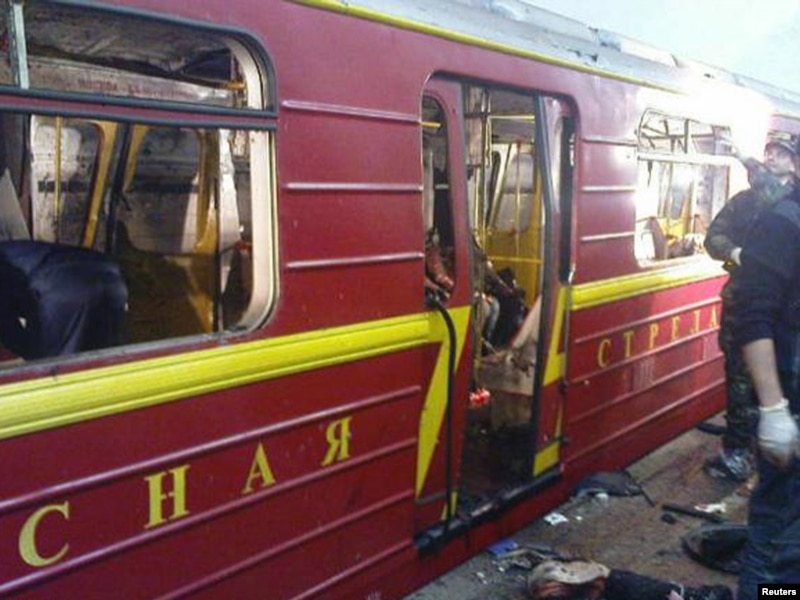

The Sova Center's deputy director, Galina Kozhevnikova, says the number of actual attacks is undoubtedly much higher, since minorities are often afraid to report such attacks and police are reluctant to investigate them.

"We know that many people who don't have a Slavic appearance have consciously avoided going out in public in the days following the attack. They are afraid of attacks," Kozhevnikova says.

Stress, Fear, And Grief

Chechen rebel leader Doku Umarov has claimed responsibility for the March 29 suicide bombings in a video posted on the Internet and said attacks on Russia would continue.

And with Moscow bracing for possible follow-up attacks, some politicians are making pointed statements that it is time for the government to take the gloves off and deal harshly with those responsible for plotting and carrying out terrorist attacks.

In remarks reported by the website gzt.ru, State Duma Deputy Aleksandr Gurov claimed that concerns over political correctness were preventing the authorities from dealing with terrorism effectively. "How much can we play with this so-called tolerance?" he said.

But tolerance is the last thing ethnic minorities are experiencing, according to Abdullah Duduyev, editor of the Chechen-language magazine "Dosh."

Duduyev says he and other Chechens in Moscow are "saddened by what happened," adding that those who perished in the blasts were "innocent people." He adds that "now it is the Chechens who will suffer, as they always do" in the aftermath of a terrorist attack.

"Attitudes toward us have gotten worse," Duduyev says. "When two Muslim women were beaten in the metro, not a single person in the crowded wagon stuck up for them. This shows the mood of society. Stress, fear, and grief are visible on people's faces. It is impossible to hide the aggression people feel toward outsiders."
The twin suicide bombings killed 39 people


Central Asians living in the Russian capital are also fearful. "The atmosphere for our compatriots in Moscow is depressing. People are afraid and are going out less. We canceled a meeting two days ago due to security concerns," says Abdullo Davlatov, a leading member of Moscow's Tajik migrant community. "Police are checking documents more, but we have not yet had any complaints about attacks by nationalists or skinheads."

Outhouses And Sewers


Aleksandr Verkhovsky, director of the Sova Center, says the rhetoric used by the authorities has contributed to the climate of fear among minorities. This includes recent remarks by Prime Minister Vladimir Putin, who pledged on March 30 to "drag" terrorists "from the depths of the sewer." The comments were an echo of his notorious pledge in 1999 to "wipe out" terrorists while they were sitting "in the outhouse."

Verkhovsky says that instead of such provocative phrases, Putin should be using language that unites society.

"So this time the prime minister isn't going to wipe out terrorists in the outhouse. Instead he is going to get them in the sewer," Verkhovsky says. "Of course you need to go after the terrorists, but this over-the-top rhetoric is destructive. It encourages negative emotions. This is the prime minister speaking, not some common citizen talking in the kitchen."

Initially, Russian officials said they were focusing on the North Caucasus, where Moscow has been battling separatists for nearly two decades, to find those involved with the recent attacks. But Nikolai Patrushev, secretary of the National Security Council, suggested that Georgian involvement in the attacks "could not be excluded."

Russia and Georgia fought a bitter five-day war in August 2008 and relations between the two neighbors remain tense. The Georgian government -- which immediately condemned the attacks, offered condolences to the victims, and said it was prepared to assist in any investigation -- denied Patrushev's claim.

Johny Karatskhelia, president of Lazare, a Moscow-based Georgian community organization, says Patrushev's remark shows that all people from the Caucasus living in Moscow are under suspicion -- and therefore in danger.

"For them, it doesn't matter where in the Caucasus somebody is from. They don't make a distinction between a Chechen, an Ingush, a Georgian, or an Abkhaz," Karatskhelia says. "All Georgians and all people from the Caucasus are afraid of what will happen next."

RFE/RL's North Caucasus, Russian, Tajik, Georgian, and Echo of the Caucasus services contributed to this report
Reblog this post [with Zemanta]

Grouping All Asians Together Could Be Bad For Health - NAM

29th Asian Pacific American Heritage FestivalImage by Asian/Pacific American Heritage Festival via Flickr

New America Media, News Report, Paul Kleyman, Apr 05, 2010

Asian Americans as a group are half as likely as non-Hispanic whites to die from heart disease. But Native Hawaiians are 40 percent more apt to suffer from heart disease than whites. That’s just one example of a health threat that gets lost when all Asians are statistically blended into the category “Asian Americans, Native Hawaiians and Pacific Islanders (AA/NHPI).”

The May 2010 issue of the American Journal of Public Health is entirely devoted to health concerns for AA/NHPI populations and is being hailed as a milestone for showing that bundling statistics for all Asians projects, according to a University of Toronto study, an “inaccurate and misleading” picture, which “fails to identify particularly vulnerable groups.”

“We’re constantly being lumped together as the ‘model minority’ that has fewer health problems than other groups,” explained Marguerite J. Ro, deputy director of the Asian & Pacific Islander American Health Forum (APIAHF) in San Francisco.

Although many group differences seem obvious, the common practice of statistical blending in health studies tends to wash out critical differences that would give public health experts information they need to target research and community programs effectively.

For example, Ro said, aggregating so many groups masks Pacific Islander health disparities. “That makes them a minority within an already invisible minority,” she stated.

Among other sharp differences examined in the journal between “Asian” groups are that older Filipinos in the United States stand a far greater chance of being disabled than Japanese Americans, Vietnamese seniors are far more likely than Koreans and “Asians” in general to incur Alzheimer’s disease and other cognitive problems, and Hmong in California experience rates of liver and cervical cancer triple or quadruple those of other AA/NHPI groups.

One study by Scarlett Lin Gomez and colleagues at the Cancer Prevention Institute of California (CPIC) notes that past breast cancer research failed to consider differences in Asian ethnicity or immigrant status. Because group-specific data within Asian groups is unavailable, they wrote, “health disparities experienced within Asian communities in the U.S. have been largely overlooked.”

According to Gomez and her coauthors, Asian American women are the only ethnic group for which cancer is the leading cause of death, outweighing heart disease. Breast cancer is the second leading cause of cancer death in these women. Yet the lack of group-specific data has obscured especially vulnerable populations that health care professionals should target for screening and treatment. For instance, while Japanese-American women born in the United States have a lower incidence of breast cancer than non-Hispanic white women, Filipinas had poorer five-year survival rates and greater development of late stages of the cancer that were comparable to African American women. The study notes that "explanations for the ethnic differences in breast cancer survival in Asians have not been carefully studied."

Gomez’s study determined that Asian-born women in the United States, especially those from Vietnam, China and the Philippines, are at higher risk of dying of developing breast cancer than U.S.-born Asian Americans, with Vietnamese women being the most vulnerable. These findings contradict the popular perception that the burden of breast cancer is universally low among Asian women, Gomez said.

In fact, a University of Toronto study found that there was more variation in disability rates among elderly AA/NHPI groups than between the white and the aggregated Asian group.

For example, the prevalence of Alzheimer’s disease and other cognitive problems was very slight between whites and all Asians. But Vietnamese people 55 and older had significantly higher levels of cognitive difficulties and more than twice the prevalence rate of Koreans.

Unpacking the statistics pertaining to different groups subsumed into the Asian label could also mean more ethnic specific outreach. A report from CPIC revealed the public-health power of ethnic-specific media outreach. Better community education through targeted brochures and use of ethnic media dramatically increased life-saving tests for colorectal cancer (CRC) among Vietnamese Americans ages 50-74.

CPIC’s Bang H. Nguyen and his team focused on older Vietnamese Americans and worked with Vietnamese print, radio and television media in Santa Clara County to develop articles and place ads featuring Vietnamese media personalities, cancer survivors, health community members and health providers. They produced a professional bilingual booklet titled Kham Ruot Gia De Song Tho (For Long Life, Test Colon). They also staffed a bilingual telephone hotline and held programs to educate health providers.

During the two-year project and follow-up survey, the Institute’s researchers found that the California effort boosted CRC screenings by 40 percent more than in the large Vietnamese community of the Houston, Texas area, where there was no cancer-screening effort.

Nguyen concluded that outreach to Vietnamese Americans and other racial and ethnic, poor or immigrant communities “could be applied to other forms of cancer, cardiovascular disease, tobacco, diabetes and obesity control.”

One of the Toronto researchers, Sarah Brennenstuhl, advised in an interview that when AA/NHPI seniors and their family members see a doctor or other health care professional, they should make sure “the person is not making silly assumptions. They shouldn’t assume there’s no need to screen for certain conditions. People should discuss this variability among Asians with their health care professionals.”
Reblog this post [with Zemanta]

The Associated Press: Web chats point to al-Qaida's Indonesian links

Yahoo! MessengerImage via Wikipedia

JAKARTA, Indonesia — It plays out like any ordinary chat between friends on Yahoo Messenger, but the subject matter is chilling: "thekiller" is looking to mesh his Indonesian militant network more deeply with al-Qaida in its Pakistani heartland.

"Come to Pak," he is told by "SAIF-a", the Pakistani at the other end. "The seniors say, send one of your boys here to represent your group."

But beware, "SAIF-a" warns. With the U.S. stepping up its rocket attacks, "The brothers are very worried, in Waziristan all missiles hit very accurately. It means someone inside is involved."

The exchange appears in transcripts of Internet chat sessions recovered from the computer of Muhammad Jibriel, identified in the documents as the man suspected of using the screen name "thekiller". Jibriel, a 26-year-old Indonesian and well-known propagandist for al-Qaida, is currently on trial, accused of helping fund last year's twin suicide bombings at luxury hotels in his country's capital, Jakarta. He claims the transcripts are fabricated.

The 40 pages of conversations are in a police dossier that provides a rare glimpse into the inner workings of Jemaah Islamiyah, Southeast Asia's main extremist group, suggesting it and allied networks in the region have more international links than was previously assumed.

Since the chats took place, from mid to late 2008, a sustained crackdown on Southeast Asian groups has continued, resulting in the arrest of Jibriel and the execution of the man identified in the police dossier as one of his most prominent conversationalists.

But the chats refer to other people engaged in contact with international extremists, and experts believe such ties likely continue.

"The transcripts are a wake-up call," said Sidney Jones, a leading international expert on Southeast Asian terror groups. "They show that Indonesian links to Pakistani and Middle Eastern terror groups are real and dangerous, even if limited to a few individuals."

The 800-page police dossier was given to lawyers and judges involved in Jibriel's juryless trial but is not part of the indictment. It was obtained by The Associated Press from someone close to Indonesian law enforcement who requested anonymity because the disclosure is sensitive.

Indonesian police declined to discuss the chat sessions, or say whether any Indonesian militants had left for Pakistan since the conversations took place.

osamaImage by Mathieu Struck via Flickr

The participants talk about sending money and recruits to al-Qaida. They discuss in detail the progress of a credit card fraud involving several Western banks to fund terror activities. They refer to allied militant cells or contacts in Cairo, Saudi Arabia and Iraq.

The man identified as Jibriel reminisces fondly about time spent in "Kash" (Kashmir), where he says he was taught to fire sniper rifles and shoulder-held rockets. He mentions a trip he made in late 2007 to the Pakistani region of Waziristan where he met with al-Qaida and Taliban leaders, including someone called Abu Bilal al Turki, who he says was "still looking young."

The chats are in a mix of Indonesian, English, Urdu and Arabic. Some of what is said seems to be in code. Slang, shorthand and "smiley face" emoticons stud the text.

The communications take an extraordinary turn as they are joined by "istisyhad," identified in the police dossier as Imam Samudra, a mastermind of the 2002 Bali nightclub bombing. At the time of the chats he was on death row, yet he was communicating from his cell on a smuggled laptop.

The police dossier says Jibriel used several aliases to talk to Samudra, even seeking advice on his turbulent relationship with a militant sympathizer he wants to marry. At one point he asks Samudra "to pray that she and I stay strong and become a great jihad partnership."

In another chat he offers to help Samudra keep in touch with al-Qaida from death row. "If you want to send an e-mail to AQ directly there, I can arrange that," he writes. Samudra was executed by firing squad in 2009.

The prosecution is leaning heavily on an e-mail hacked by the FBI at the Indonesians' request in which Jibriel allegedly asks his brother in Saudi Arabia for money to finance what he claims will be the biggest attack since 9/11, and talks about giving the funds to the organizer. The reference is to the twin hotel attacks, in which seven people died.

Jibriel has claimed the e-mail is fabricated, and says the same of the chats.

"The police have made this up," he said, speaking to the AP through the bars of a cell before a recent court hearing. "I know about technology and I know how easy it is to create something on a computer."

Occasionally a mordant sense of humor creeps into the chatter. "Thekiller" talks with someone offering to forge an ID for him. What name would he like — "that of an unbeliever or a Muslim"?

"Abu Musab al-Zarqawi," the late founder of al-Qaida in Iraq, he jokingly replies. "There is no way that will arouse suspicions."

In one conversation with Samudra, "irhaab _007", another name allegedly used by Jibriel, dwells on sending recruits to Waziristan, apparently to work with al-Qaida's media wing.

"I have still got my 'pass' to Pakistan, his name is Muhammad Yunus," he writes. "But the big AQ (al-Qaida) guys here do not agree that everyone should leave. We have to look at our guys and choose, based on their abilities because people there don't want any hassle.

"At the very least they have to be prepared to stay a long time, 2 or 3 years," he writes. Both men also talk about being asked to send sums of $1,500 to $2,000 to al-Qaida in Pakistan.

Jemaah Islamiyah was formed by Indonesians after they returned home from fighting and training in Afghanistan and Pakistan during the 1980s and 1990s. After 9/11, when al-Qaida began expanding into Southeast Asia, it used those connections to send money and expertise and to recruit volunteers, but was assumed to have largely given up after the crackdown that followed the Bali bombings.

Jibriel's father is an Afghan-trained cleric accused by the U.S. of being a Jemaah Islamiyah leader. In the early 2000s, Jibriel and a small group of other Southeast Asians lived in the Pakistani city of Karachi, and some of them were detained on suspicion of having al-Qaida links.

In Karachi, Jibriel attended a boarding school later linked to Lashkar-e-Taiba, the Pakistani militant group accused of being behind the 2007 Mumbai attacks in which 166 people died. The Australian government, which closely watches Indonesian militant groups, has said the Southeast Asians also attended Lashkar training camps in Pakistani Kashmir when they were living in Karachi.

Returning to Indonesia in 2004, Jibriel made no attempt to hide his profile. He set up a well-funded online network with content praising terrorist attacks around the world, as well al-Qaida and Taliban propaganda videos. He also met several times with an AP reporter over the years.

As he arrived at a recent trial session he was greeted by supporters brandishing their fists and praising God.

To the AP, Jibriel claimed that in Karachi he knew Khalid Sheik Mohammed, the self-professed 9/11 mastermind. Yet he also revealed a love of Hollywood films and a taste for expensive Western restaurants.

Throughout the chats, participants reveal the ever-present fear of infiltrating spies.

"It is difficult to trust anyone. Many of our men are in jail," "thekiller" tells "SAIF-a, adding: "Even the fact a guy has memorized the Quran is no guarantee."

Associated Press Writer Irwan Firdaus contributed to this report from Jakarta.

Reblog this post [with Zemanta]

News Analysis - The West Has Little Room to Respond to Karzai’s Criticism - NYTimes.com

Unstable CliffImage by Rob Watling via Flickr

KABUL, Afghanistan — As President Hamid Karzai made more antagonistic statements over the weekend toward the NATO countries fighting on behalf of his government, the West was taking stock of just how little maneuvering room it has.

There are no good options on the horizon, many analysts say, for reining in Mr. Karzai or for penalizing him, without potentially damaging Western interests. The reluctant conclusion of diplomats and Afghan analysts is that for now, they are stuck with him.

Many fear the relationship is only likely to become worse, as Mr. Karzai draws closer to allies like Iran and China, whose interests are often at odds with those of the West, and sounds sympathetic enough to the Taliban that he could spur their efforts, helping their recruitment and further destabilizing the country.

“The political situation is continuing to deteriorate; Karzai is flailing around,” said a Western diplomat in Kabul with long experience in the region. “At the moment we are propping up an unstable political structure, and I haven’t seen any remotely plausible plan for building consensus.”

The tensions between the West and Mr. Karzai flared up publicly last Thursday, when Mr. Karzai accused the West and the United Nations of perpetrating fraud in the August presidential election and described the Western military coalition as coming close to being seen as invaders who would give the insurgency legitimacy as “a national resistance.”

Despite a conciliatory phone call to Secretary of State Hillary Rodham Clinton on Friday, his comments over the weekend only expanded the discord.

Hamid Karzai - World Economic Forum Turkey 2008Image by World Economic Forum via Flickr

On Saturday, Mr. Karzai met with about 60 members of Parliament, mostly his supporters, and berated them for having rejected his proposed new election law. Among other things, the proposal would have given him the power to appoint all the members of the Electoral Complaints Commission, who are currently appointed by the United Nations, the Afghan Supreme Court and the Afghanistan Independent Human Rights Commission. The Electoral Complaints Commission, which reviews allegations of voting fraud and irregularities, documented the fraud that deprived Mr. Karzai of an outright victory in the presidential election.

At the meeting, Mr. Karzai stepped up his anti-Western statements, according to a Parliament member who attended but spoke on condition of anonymity.

“If you and the international community pressure me more, I swear that I am going to join the Taliban,” Mr. Karzai said, according to the Parliament member.

A spokesman for Mr. Karzai, Waheed Omar, could not be reached for comment on Sunday.

In a speech in Kandahar on Sunday, Mr. Karzai promised local tribal elders that coalition military operations planned for the area this summer would not proceed without their approval.

“I know you are worried about this operation,” he said, adding: “There will be no operation until you are happy.”

Given his tone in the last few days, it was unclear whether he was literally extending the elders veto power over the offensive, or merely trying to quell their fears and bring them on board.

Interviews with diplomats, Afghan analysts and ordinary Afghans suggest that the United States and other Western countries have three options: threaten to withdraw troops or actually withdraw them; use diplomacy, which so far has had little result; and find ways to expand citizen participation in the government, which now has hardly any elected positions at the provincial and district levels.

Threatening to withdraw, which Stephen Biddle, a senior fellow at the Council on Foreign Relations, called the “nuclear deterrent” option, would put the United States and other Western countries in the position of potentially having to make good on the promise, risking their strategic interest in a stable Afghanistan. Few experts think the country would remain peaceful without a significant foreign force here. Moreover, withdrawal could open the way for the country to again become a terrorist haven.

Some Western critics of Mr. Karzai believe that the West has no choice but to threaten to leave.

“There is no point in having troops in a mission that cannot be accomplished,” said Peter W. Galbraith, former United Nations deputy special representative for Afghanistan, who was dismissed after a dispute with his superiors over how to handle widespread electoral fraud and what senior U.N. officials later said was his advocacy of Mr. Karzai's removal. “The mission might be important, but if it can’t be achieved, there is no point in sending these troops into battle. Part of the problem is that counterinsurgency requires a credible local partner.”

Diplomacy has so far failed to achieve substantial changes, although some analysts, like Mr. Biddle, who opposes the so-called nuclear option, believe that the West should demand concessions before spending any more money on development projects like digging wells and building schools.

“We do millions of things in Afghanistan, and any of those things can become a source of leverage,” he said. “Far too much of what we do in Afghanistan we just do without asking for anything explicit in return.”

That approach can backfire, some argue, hurting those the West most wants to help.

Greater power sharing, while promising, faces structural obstacles. Under the Constitution, provincial governors, local judges, district governors and most other offices are appointive rather than elective. In some areas, Afghan and American programs have begun to involve communities in local budgeting, but progress is slow and it would probably take several years to expand it to higher levels of government.

“There are no better angels about to descend on Afghanistan,” said Alex Thier, a senior Afghan analyst at the United States Institute of Peace. “Unless some drastic action is taken, Mr. Karzai is the president of Afghanistan, and he was just elected for another five years.”

That prospect leaves some Afghans uneasy. In interviews with more than a dozen people around the country, there was apprehension and dismay over Mr. Karzai’s clash with the international community, and the specter of renewed chaos it could lead to.

“Karzai delivered this speech based on his own difficulties with the foreigners,” said Gulab Mangal, a tribal leader in the Musa Khel area of Khost Province.

“When the international community criticized his brother, he started to raise these problems,” he said, referring to Ahmed Wali Karzai, a prominent figure in southern Afghanistan. “It shows the relation between Karzai and the international community is deteriorating day by day, and that should not be allowed to happen.”

Mehram Ali, a man from Wardak Province who was shopping in Kabul over the weekend, voiced a similar qualm. “We need the international community to keep supporting us and our government,” he said.

“In this recent situation we do need foreign soldiers to help us in bringing peace and stability for our country, and if the foreigners leave us, then the people of Afghanistan will face adversity from every direction, and Afghanistan will return to what it was like 10 years ago when we had the Taliban government.”

Reporting was contributed by Richard A. Oppel Jr., Abdul Waheed Wafa and Sharifullah Sahak from Kabul, and Taimoor Shah from Kandahar.

Reblog this post [with Zemanta]

Masha Lipman - How Russia nourishes radical Islam - washingtonpost.com

This map shows the 1974 geographic location of...Image via Wikipedia

By Masha Lipman
Monday, April 5, 2010; A11

MOSCOW

After the bombings in this city's subway system last week, U.S. Secretary of State Hillary Clinton noted that we all "face the same enemy." No one -- whether in Moscow, London, Madrid or New York -- can be fully secure against acts of terrorism. In Russia, however, the problem of terrorism is arguably more difficult than in Europe or the United States. We have radical Islam right inside our borders, in the North Caucasus. There is no getting away from it: People who live in this territory are Russian citizens; its provinces are financed by the Russian federal budget. It is as though Afghanistan, with its insurgent activity, were a U.S. state within the borders of the Lower 48.

But while the challenge of terrorism cries for long-term, consistent strategy, Russia's system of heavy-handed and unaccountable governance precludes strategic thinking.

In the early 1990s, after the collapse of the Soviet Union, Boris Yeltsin's government responded to armed secessionists in Chechnya by waging a full-scale war. Russia's armed forces were undertrained and undersupplied; horrific atrocities ensued on both sides. The 1996 peace agreement was evidence of Russia's humiliating weakness: A former superpower failed to subdue its own tiny region.

Official portrait of Vladimir PutinImage via Wikipedia

"Peace" in Chechnya entailed frequent kidnappings for ransom, hostage-taking and terrorist attacks. In 1999, a Chechen force invaded the neighboring province of Dagestan, about the same time explosions of apartment buildings in three Russian cities famously took the lives of roughly 300 people.

When Vladimir Putin became president in 2000, his solution was a new war. With it came more atrocities, deeper brutalization and, in Russia at large, growing xenophobia against "those from the Caucasus." This time federal forces defeated the Chechen fighters, but terrorist attacks continued through 2004. The most horrific of these was the seizure of Beslan school where more than 330 hostages, over half of them children, were killed that September.

By the mid-2000s, secession was no longer the issue in Chechnya, but a new problem was building: Militant Islam was on the rise all over the North Caucasus. In the early '90s Islam had still been weak in this traditionally Muslim territory; adults had secular Soviet educations, and the attraction of Russian culture was still strong. But the new generation growing up in the Chechnya devastated by the Russian army, and in neighboring provinces such as Dagestan and Ingushetia, were increasingly influenced by Islamic culture and Islam, not infrequently its radical strains. Clandestine extremist groups called for jihad across the territory of Russia. Training centers for suicide bombers reportedly operate in the North Caucasus.

The Kremlin shifted tactics a few years ago, installing pro-Moscow leaders in these Muslim provinces and reducing the federal government's mission to allocating funds and occasional anti-terrorist operations. It turned a blind eye to subversive attacks, explosions, and assassinations of area police and local administrators, which have become routine in Ingushetia and Dagestan. The central government also ignored the brutal practices local leaders used against Islamic radicals and other criminal or extremist groups. As long as violence was contained within the North Caucasus, the thinking went, the bulk of Russia remained relatively safe. But last week's attacks underscore just how flawed and shortsighted this policy is.

Today, the rise of radical Islam in the North Caucasus is inevitable, especially with such forces active in many parts of the world. Russia's only strategic option is a long-term and multi-pronged government commitment to the problem. It is critical that the Russian government and the nation treat the people of the North Caucasus as their fellow countrymen -- no easy task given that today they are seen as a suspect culture or simply unwanted intruders. Other urgent needs are to improve security in Russia at large as well as to increase the efficiency of anti-terrorism practices. But these missions will be next to impossible in a country where the violent behavior of police officers makes them a threat to the people, rather than a force from which citizens can draw protection.

Strains of official rhetoric echo the language of 1999: After the infamous blasts of Moscow apartment buildings, Putin pledged to wipe out terrorists in outhouses. Now he vows "to drag them out of the sewer and into broad daylight." But large-scale use of force is not an option. As happened in the '90s, it is bound to start another vicious circle of punitive measures and extremists' efforts to exact revenge.

Reasonable calls have also been heard. President Dmitry Medvedev spoke last week about the need to create in the North Caucasus "the right kind of modern environment for education, for doing business, for overcoming cronyism . . . and, of course, for confronting corruption." But corruption plagues more than the North Caucasus; it's the texture of the Russian system of governance, which is built on political monopoly and unaccountability. Unless Russia makes systemic reforms, good intentions will not translate into stronger policies.

Masha Lipman, editor of the Carnegie Moscow Center's Pro et Contra journal, writes a monthly column for The Post.

Reblog this post [with Zemanta]

Aggregators help media professionals keep on top of digital content trends | Media | The Guardian

Image representing Alltop as depicted in Crunc...Image via CrunchBase

by Kevin Anderson

The internet is not like trying to drink from a firehose but rather like trying to drink from Niagara Falls. For any media professional trying to remain up to speed on digital content trends, it is often overwhelming. I've had to develop a lot of methods and constantly change the tools I use to manage this torrent of information. I've mentioned Popurls before as an easy one-stop shop to follow internet buzz, and once registered you can personalise the site to show your favourite digital content sites first.

You can log into Popurls using your user name and password from several other services such as Google or Yahoo. You can create your own Popurls sharing page and automatically post items you share to Facebook, Twitter or Friendfeed or mini-blogging sites Tumblr or Posterous.

However, if you don't want to take the time to personalise Popurls, there are a number of aggregators that pull together a great sample of digital trends. Sites such as Original Signal are good if you want a single page to have a quick glance at sites covering web 2.0 developments, such as TechCrunch, GigaOm, Mashable and ReadWriteWeb. There is a North American bias to a lot of the content because most of the aggregators operate from there, but it's a good start for a filtered view of the web based on the interests of a digital media professional.

Image representing TechCrunch as depicted in C...Image via CrunchBase

These sites cover the world of web 2.0 with great depth, but if your interests are even more specific, you may want to check out the aggregator Alltop. It takes Popurls to the next level, not just featuring buzz and top-level topics but aggregated pages from sites and blogs covering a wide range of subjects. For instance, you can quickly find blogs and sites covering such specialist topics as web analytics, virtual worlds, rich internet applications or mobile. You can even filter Alltop based on location.

The newest addition to these media news aggregators is also the newest addition to the popular TechMeme family, MediaGazer. TechMeme uses an algorithm and human editors to filter tech stories that are generating conversation. MediaGazer takes the TechMeme model and focuses on media coverage, and it has a very good transatlantic spread, at least in terms of English-language media reporting.

Aggregators are just one way to manage information but, with a little tweaking, they can help the flood of information seem more manageable and relevant.

Reblog this post [with Zemanta]

10 Simple Google Search Tricks - NYTimes.com

Google Search Coupon: 1 FREE Google SearchImage by Bramus! via Flickr

I’m always amazed that more people don’t know the little tricks you can use to get more out of a simple Google search. Here are 10 of my favorites.

  1. Use the “site:” operator to limit searches to a particular site. I use this one all the time, and it’s particularly handy because many site’s built-in search tools don’t return the results you’re looking for (and some sites don’t even have a search feature). If I’m looking for WWD posts about GTD, for example, I could try this search: GTD site:webworkerdaily.com.
  2. Use Google as a spelling aid. As Rob Hacker — the WWD reader I profiled last week — pointed out, entering a word into Google is a quick way to see if you have the right spelling. If it’s incorrect, Google will suggest the correct spelling instead. Additionally, if you want to get a definition of a word, you can use the “define:” operator to return definitions from various dictionaries (for example, define: parasympathetic).
  3. Use Google as a calculator. Google has a built-in calculator — try entering a calculation like 110 * (654/8 + 3). Yes, your computer also has a calculator, but if you spend most of your day inside a browser, typing your calculation into the browser’s search box is quicker than firing up your calculator app.
  4. Find out what time it is anywhere in the world. This one’s really handy if you want to make sure that you’re not phoning someone in the middle of the night. Just search for “time” and then the name of the city. For example, try: time San Francisco
  5. Get quick currency conversions. Google can also do currency conversion, for example: 100 pounds in dollars. It only has the more mainstream currencies, though — if you’re trying to see how many Peruvian nuevos soles your dollars might buy, you’ll be out of luck.
  6. How to Try the New Google SearchImage by shannonpatrick17 via Flickr

    Use the OR operator. This can be useful if you’re looking at researching a topic but you’re not sure which keywords will return the information you need. It can be particularly handy in conjunction with the “site:” operator. For example, you could try this search: GTD or “getting things done” site:webworkerdaily.com
  7. Exclude specific terms with the – operator. You can narrow your searches using this operator. For example, if you’re looking for information about American Idol but don’t want anything about Simon Cowell, you could try: “american idol” -cowell
  8. Search for specific document types. Google can search the web for specific types of files using the “filetype:” operator. If you’re looking for PowerPoint files about GTD, for example, you could try: GTD filetype:ppt
  9. Search within numerical ranges using the .. operator. Say, for example, you want to look for information about Olympic events that took place in the 1950’s, you could use this search: Olympics 1950..1960
  10. Area code lookup. Need to know where a phone number is located? Google will let you know where it is, and show you a map of the area, too. For example: 415

What are your favorite Google search tricks?

Reblog this post [with Zemanta]

At Snopes, a Quest to Debunk Misinformation Online - NYTimes.com

Snopes logoImage via Wikipedia

It is one of the paradoxes of the Internet.

Along with the freest access to knowledge the world has ever seen comes a staggering amount of untruth, from imagined threats on health care to too-easy-to-be-true ways to earn money by forwarding an e-mail message to 10 friends. “A cesspool,” Google’s chief executive, Eric E. Schmidt, once called it.

David and Barbara Mikkelson are among those trying to clean the cesspool. The unassuming California couple run Snopes, one of the most popular fact-checking destinations on the Web.

For well over a decade they have acted as arbiters in the Age of Misinformation by answering the central question posed by every chain letter — is this true? — complete with links to further research.

The popularity of Snopes — it attracts seven million to eight million unique visitors in an average month — puts the couple in a unique position to evaluate digital society’s attitudes toward accuracy.

After 14 years, they seem to have concluded that people are rather cavalier about the facts.

In a given week, Snopes tries to set the record straight on everything from political smears to old wives’ tales. No, Kenya did not erect a sign welcoming people to the “birthplace of Barack Obama.” No, Wal-Mart did not authorize illegal immigration raids at its stores. No, the Olive Garden restaurant chain did not hand out $500 gift cards to online fans.

Drive an Urban LegendImage by Mike Licht, NotionsCapital.com via Flickr

The Mikkelsons talk matter-of-factly about why these stories spread the way they do.

“Rumors are a great source of comfort for people,” Mrs. Mikkelson said.

Snopes is one of a small handful of sites in the fact-checking business. Brooks Jackson, the director of one of the others, the politically oriented FactCheck.org, believes news organizations should be doing more of it.

“The ‘news’ that is not fit to print gets through to people anyway these days, through 24-hour cable gasbags, partisan talk radio hosts and chain e-mails, blogs and Web sites such as WorldNetDaily or Daily Kos,” he said in an e-mail message. “What readers need now, we find, are honest referees who can help ordinary readers sort out fact from fiction.”

Even the White House now cites fact-checking sites: it has circulated links and explanations by PolitiFact.com, a project of The St. Petersburg Times that won a Pulitzer Prize last year for national reporting.

The Mikkelsons did not set out to fact-check the Web’s political smears and screeds. The site was started in 1996 as an online encyclopedia of myths and urban legends, building off the couple’s hobby. They had met years earlier on a discussion board about urban legends.

Mr. Mikkelson was a dogged researcher of folklore. When he needed to mail letters requesting information, he would use the letterhead of the San Fernando Valley Folklore Society, an official-sounding organization he dreamed up. They would investigate the origins of classic tall tales, like the legend of the killer with a prosthetic hook who stalked Lovers’ Lane, for a small but devoted online audience.

After the Sept. 11 terrorist attacks, users overwhelmed the Mikkelsons with forwarded e-mail claims and editorials about the culprits and the failures of the government to halt the plot, and the couple reluctantly accepted a larger role. They still maintain a thorough list of what they call “Rumors of War.”

Less than a year later, Snopes became the family’s full-time job. Advertisements sold by a third-party network cover the $3,000-a-month bandwidth bills, with enough left over for the Mikkelsons to make a living — “despite rumors that we’re paid by, depending on your choice, the Democratic National Committee or the Republican National Committee,” Mr. Mikkelson said.

Dilbert Quotes Contest . Urban legend?Image by FunnyBiz via Flickr

Much of the site’s resources are spent on investigating political claims, even though the Mikkelsons say politics is the last subject they want to write about. (Barbara cannot even vote in American elections; she is a Canadian citizen.) Claims relating to President Obama are now the top searches on the site but “even when there were Republicans in the White House, the mail was still overwhelmingly anti-liberal,” Mr. Mikkelson said.

In late August, Mr. Mikkelson studied an e-mail chain letter titled “The Last of the Kennedy Dynasty” purporting to explain why the late Senator Edward M. Kennedy was unfit for acclaim. Some of its 10 bullet points were true (yes, Mr. Kennedy was cited for reckless driving while in college), but others were misleading assumptions (no, his accomplishments were not “scant”).

Mrs. Mikkelson rolled her eyes at her husband’s plans to fact-check the chain letter. “That’s ephemera,” she said.

He agreed, but the Kennedy report wound up being the Web site’s most-searched subject the next weekend.

The Mikkelsons employ two others full time to manage the enormous volume of e-mail to the site. Increasingly, curious readers are sending videos and photos as well as e-mail, requiring even more investigation. They publish on average one new article each day.

The enduring articles are the ones about everyday fears: computer viruses, scams, missing children. Some e-mail chain letters, like the one offering users $245 for forwarding the message, never fade away.

“People keep falling for the same kind of things over and over again,” Mr. Mikkelson said. Some readers always seem to think, for instance, that the government is trying to poison them: Mrs. Mikkelson said rumors about AIDS have been recycled into rumors about swine flu vaccines.

For the Mikkelsons, the site affirms what cultural critics have bemoaned for years: the rejection of nuance and facts that run contrary to one’s point of view.

“Especially in politics, most everything has infinite shades of gray to it, but people just want things to be true or false,” Mr. Mikkelson said. “In the larger sense, it’s people wanting confirmation of their world view.”

The couple say they receive grateful messages from teachers regularly, and an award from a media literacy association sits atop the TV set in Mr. Mikkelson’s home office.

It is not just the naïveté of Web users that worries the “Snopesters,” a name for the Web site’s fans and volunteers. It is also what Mr. Mikkelson calls “a trend toward the opposite approach, hyper-skepticism.”

“People get an e-mail or a photograph and they spot one little thing that doesn’t look right, and they declare the whole thing fake,” he said. “That’s just as bad as being gullible in a lot of senses.”

But even though Snopes pays the bills for the couple now, through advertising revenue, they doubt they are having much of an impact.

“It’s not like, ‘Well, we have to get out there and defend the truth,’ ” Mrs. Mikkelson added. “When you’re looking at truth versus gossip, truth doesn’t stand a chance.”

Reblog this post [with Zemanta]